








TRON Industry Weekly Report: Tariff Hammer Triggers Crypto Black Swan, Detailed Explanation of Web3's Next-Generation AI Smart Ecosystem Maiga AI
 This week, the market was severely impacted by macro policies and trade risks, leading to a significant correction in crypto assets. However, innovative financing within the industry remains active, particularly with the tokenization of intellectual property (RWA) and the AI agent ecosystem becoming new focal points.
I. Outlook
1. Macroeconomic Summary and Future Predictions
Last week, U.S. stocks faced overall pressure, particularly on Friday when the U.S. announced the re-imposition of tariffs on certain Chinese imports, triggering panic selling in the market. All three major indices saw significant declines, with the Dow Jones dropping over 2% and the Nasdaq plunging more than 3%, led by the technology and manufacturing sectors. Investors are concerned that the resurgence of trade tensions will weaken corporate profits and increase imported inflation, thereby disrupting the Federal Reserve's easing process. Overall, the market has entered a phase of "policy uncertainty + rising trade risks," putting short-term pressure on risk assets as funds shift towards the bond market and safe-haven assets like gold.
2. Market Changes and Warnings in the Crypto Industry
Last week, following the U.S. announcement of new tariffs on Chinese high-tech products, the sharp decline in U.S. stocks on Friday spread risk-averse sentiment, leading to a rapid withdrawal of funds from high-risk assets, with altcoins experiencing widespread declines.
This round of correction was primarily triggered by the deterioration of macro sentiment and tightening liquidity expectations. The new tariff policy was viewed by the market as a risk of renewed inflation, causing investors to worry that the Federal Reserve might slow down its rate cuts, which quickly compressed the "liquidity premium" in the crypto market. Meanwhile, the liquidation of leveraged positions exacerbated the decline. The short-term risk lies in the possibility of further technical selling if Bitcoin falls below the $100,000 threshold. In the medium term, as long as the rate-cutting cycle is not reversed and the dollar remains weak, the correction may serve as a buildup for subsequent rebounds, but caution is still needed regarding the potential for increased volatility and a second bottoming risk.
3. Industry and Sector Hotspots
Raising $15 million, Aria, a decentralized protocol focused on making intellectual property investable, liquid, and shareable, co-invested by Polychain, is a protocol built on Story (a Layer 1 blockchain); with total funding exceeding $19 million, Tangany, a regulated Swiss fintech company based in Munich, dedicated to compliant, secure, and scalable institutional-grade digital asset custody, has five well-known institutions leading the investment.
II. Market Hotspot Sectors and Potential Projects of the Week
1. Overview of Potential Projects
1.1. Analysis of the $15 million funding raised by Aria, a decentralized protocol focused on making intellectual property investable, liquid, and shareable, co-invested by Polychain
++Introduction++
Aria is a protocol built on Story (a Layer 1 blockchain). It allows anyone to invest and earn royalty income from iconic IP (intellectual property), opportunities that were previously accessible only to a few large investors.
Aria empowers users to invest in intellectual property and liquefy it—achieved through fragmentation and tradability. Users do not need to spend millions to purchase the entire asset but can buy a portion of it as an investment, thus owning rights to the potential future earnings of that asset. Investors can choose to hold and stake to continuously receive royalties or resell them on decentralized markets.
Additionally, Aria also provides creators with greater autonomy. When needed, Aria will tokenize the IP and grant programmable features, automating the authorization, signing, and payment processes through on-chain smart contracts, allowing creators to flexibly control the authorization and re-creation of their assets.
++Architecture Overview++
++How does Aria work?++
1. IPRWA Token
- IPRWA = Intellectual Property Real World Assets.
- The IPRWA token is an ERC-20 token on the Story blockchain, backed by real IP asset rights acquired by the Aria protocol.
- Token holders can earn royalty income related to the IP work.
- Aria makes high-quality intellectual property, previously accessible only to large institutions and industry insiders, investable, tradable, and shareable.
2. Lifecycle: Three-Step Process
Step 1: Fundraising
- Through the Vaults mechanism, users participate in fundraising with USDC to help Aria acquire target intellectual property.
- Successful fundraising → Users receive IPRWA tokens in proportion to their contributions;
- Failed fundraising → Users can receive a full refund.
Step 2: Staking
- Users can stake the IPRWA tokens they receive to share in the royalty income generated by the underlying IP assets.
Step 3: Royalty Collection
- After staking, IPRWA is converted to stIPRWA (staked version token).
- As IP royalty income (collected off-chain for repurchasing IPRWA) is injected into the staking pool, the value of stIPRWA will gradually appreciate relative to IPRWA.
- Users have two ways to realize their earnings:
- Unstake in the Aria WebApp → Destroy stIPRWA and receive IPRWA at the current exchange rate;
2. Trade directly on DEX → Exchange stIPRWA for IPRWA, which can then be staked again or converted to other assets.
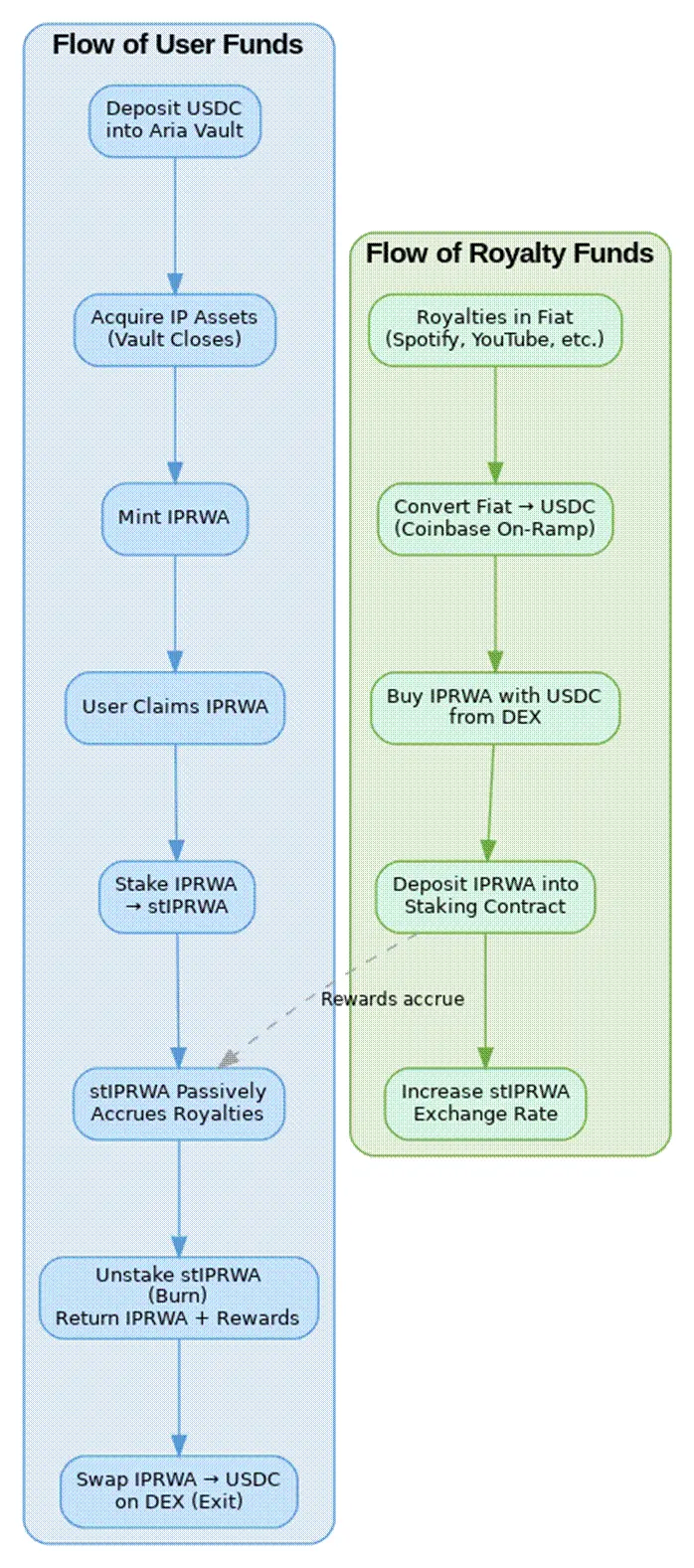
++Flow of User Funds++
++ ++
++
Initial Stage: USDC → IPRWA
- Users deposit USDC into Aria's vaults.
- These funds are used to acquire real intellectual property assets.
- When the vault completes the acquisition of assets, the protocol will mint IPRWA tokens.
- Users can claim the corresponding IPRWA in the wallet where they initially deposited USDC.
Staking Stage: IPRWA → stIPRWA
- To earn royalty income, users stake IPRWA into Aria's staking contract.
- The contract returns stIPRWA (staked version token).
- IPRWA is held in the contract, and stIPRWA will automatically accumulate royalty rewards over time.
Unstaking Stage: stIPRWA → IPRWA
- When users need to withdraw earnings, they can unstake stIPRWA.
- This operation will destroy stIPRWA and return IPRWA at the current exchange rate.
- The current exchange rate reflects the user's original stake and accumulated royalty rewards.
Exit Stage: IPRWA → USDC
- Users can take IPRWA to a decentralized exchange (DEX) and exchange it for USDC.
- Aria will periodically use royalty income to repurchase IPRWA, helping to maintain market liquidity and ensure users can exit smoothly.
++Tron++ ++Commentary++
Aria's advantages lie in its innovative approach to tokenizing intellectual property (IP), allowing users to participate in IP investment and royalty distribution with a low barrier to entry through the IPRWA model, achieving asset fragmentation, liquidity, and tradability. It not only provides investors with new revenue channels but also offers creators a programmable authorization and profit-sharing mechanism on-chain, combining financial innovation with creator empowerment.
Potential disadvantages stem from the model's reliance on real-world royalty income conversion mechanisms (such as centralized fiat channels and platform partnerships), which pose compliance and execution risks in the on-chain and off-chain connections; additionally, the volatility of IP asset values, insufficient market liquidity, and user education costs may also impact its large-scale adoption.
1.2. Interpretation of the total funding exceeding $19 million, led by five well-known institutions, for Tangany, an institutional-grade digital asset custody platform focused on compliance, security, and scalability
++Introduction++
Tangany is a Swiss fintech company based in Munich, regulated by BaFin (German Federal Financial Supervisory Authority), providing a secure, API-first digital asset custody platform for institutional clients such as banks, brokers, fintech companies, and large corporations.
Tangany's infrastructure adopts a white-labeled Wallet-as-a-Service (WaaS) model, combined with HSM (Hardware Security Module) and MPC (Multi-Party Computation) technology to provide advanced security guarantees. Meanwhile, its platform features compliance functionalities such as KYC, encrypted accounting, and staking services, and fully supports tokenized assets, NFTs, and smart contract custody.
++Overview of Tangany Custody API++
Request Validation
- All API endpoints adhere to strict parameter specifications.
- Requests containing undefined properties (query/body) will result in request format errors.
Asynchronous Operations
- Long-running operations (such as sending on-chain transactions) are executed asynchronously, decoupling request triggering from processing logic.
- Even if the initial request returns a 200 status code, it may ultimately fail.
- It is recommended to check the request status via GET /requests/{request}.
Request Status Types:
- Pending (Pending)
- Running (Running)
- Completed (Completed, may be successful or failed)
- Failed (Failed, processing terminated)
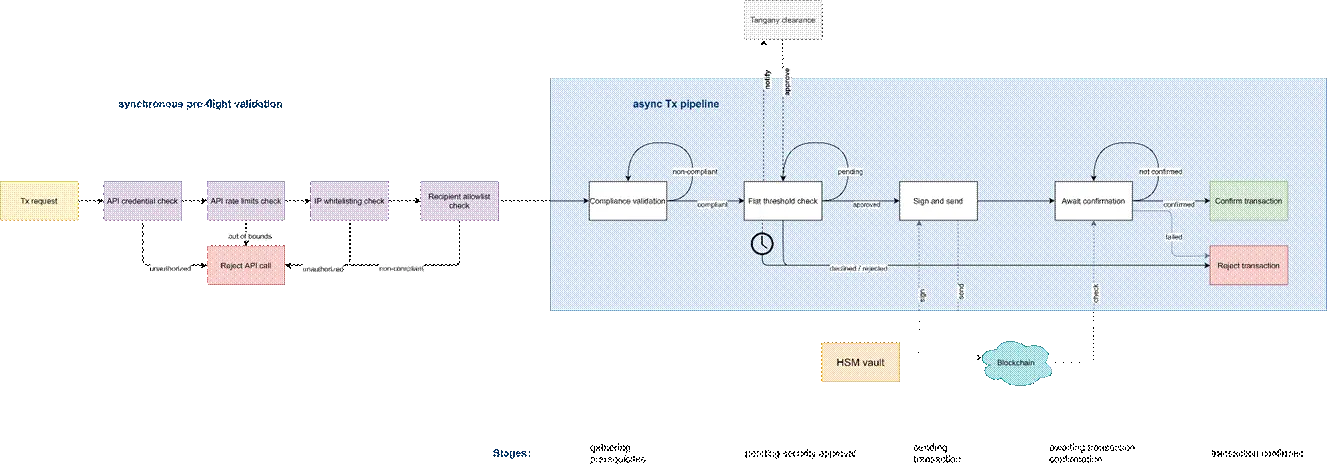
Transaction Lifecycle:
- Pre-flight Validation
- Compliance Validation
- Fiat Threshold Validation
- Signing and Sending
- Waiting for Transaction Completion
Statuses & Retryability
- Pending or Running → API returns 202, including Retry-After, indicating how many seconds to wait before polling again.
- Completed → Background execution is complete, no further updates:
- Success → Returns 200
- Failure → Returns 4xx/5xx (e.g., contract execution failure).
- Failed → Request processing ends abnormally (e.g., RPC connection issues).
Idempotency
- All asynchronous endpoints support idempotency via the tangany-request-id header.
- Requests with the same ID will only execute once; excess requests will be rejected.
- If the ID has already been used, the API returns 409 Conflict.
- Client-generated IDs can be used to recover lost API responses (e.g., due to timeouts/disconnections).
Wallets
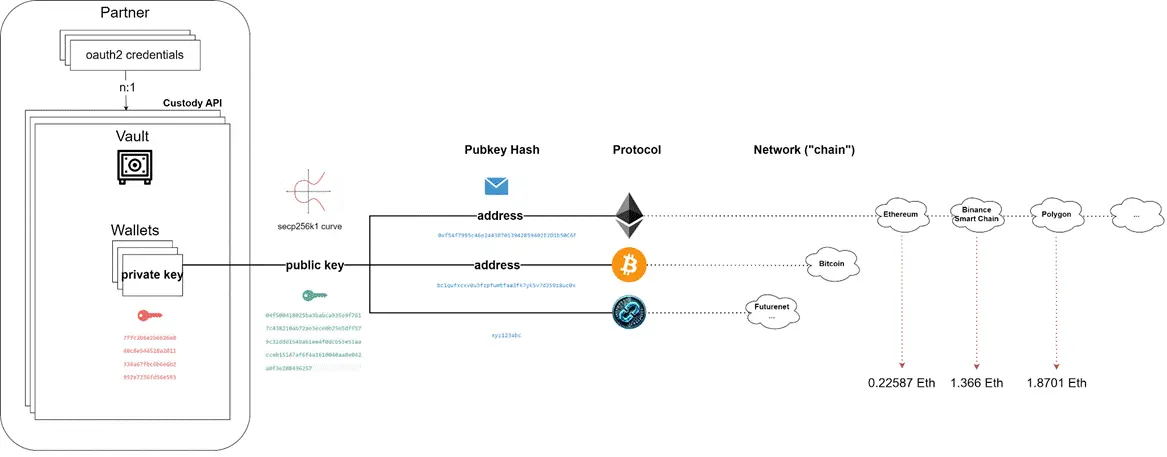
- Wallets are used to manage blockchain assets, containing private keys and representing blockchain account addresses.
- Can be used for:
- Reading data (e.g., querying balances, calling contracts)
- Writing data (e.g., sending transactions, executing smart contracts)
- Each user/blockchain can be assigned one wallet (no mandatory limit).
- Additional data can be attached to wallets through additionalAttributes.
++Tangany Private Key and Transaction Mechanism++
Private Keys
- Private keys are the most sensitive credentials in blockchain, used to authorize transactions and write to the blockchain.
- Once lost, they cannot be recovered, and assets corresponding to that address will be unable to be transferred, usually meaning a loss of funds.
- Due to complexity, private keys are difficult to remember, often stored insecurely, leading to leaks and unauthorized transactions.
●Tangany's solution:
○ Generates and manages private keys within FIPS 140 certified HSM (Hardware Security Module) through Wallet-as-a-Service.
○ Private keys are not readable, not exportable, and cannot be directly accessed by Tangany, clients, or users.
○ Private keys are generated and replicated in a geographically redundant, time-synchronized Security World, ensuring tamper-proof and securely encrypted transmission.
○ All key operations (including replication) are logged for auditing.
Transactions
- Transactions are operations that "write to the blockchain," such as transfers or executing smart contracts.
- Fees: Transactions require payment of the blockchain's native token as Gas.
- Tangany provides a Gas Tank feature: a central wallet pre-funds Gas, allowing user wallets to complete transactions without needing to hold ETH in advance.
- Gas fees are automatically estimated and can be adjusted based on transaction speed (supporting EIP-1559 type transactions and traditional type transactions).
- Transaction Hashes: A hash is generated after submitting a transaction, but it is only considered valid once confirmed by a block and assigned a block number.
Gas Tank Mechanism
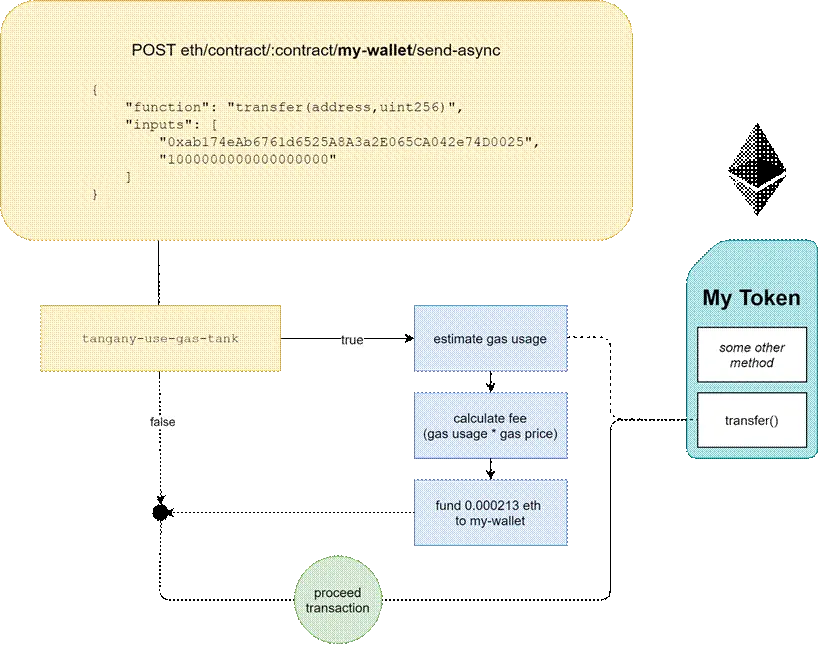
- Enabled by setting the API request header tangany-use-gas-tank=true.
- The API will automatically estimate the Gas required for the transaction and pre-fund it from Tangany's Ether pool.
- After transaction execution:
- Typically consumes all pre-funded Gas;
- If not all is consumed, the remaining portion will be returned to the user wallet.
- Suitable for deterministic smart contract calls (non-deterministic contracts may not be compatible).
- Supports all EVM-compatible chains, and requires contacting Tangany customer service for activation.
++Tron++ ++Commentary++
Tangany's advantages lie in its role as a compliant custody service provider regulated by BaFin, using FIPS 140 certified HSM and MPC technology to manage private keys, ensuring the highest level of security and compliance. Additionally, its API-first design and Wallet-as-a-Service model lower the entry barrier for institutional clients, supporting diverse scenarios such as tokenized assets, NFTs, and smart contracts, while optimizing the transaction experience through the Gas Tank feature.
Potential disadvantages include the model's reliance on centralized custody infrastructure, which may pose limitations for highly decentralized applications; furthermore, its primary clientele is institutional clients, with limited penetration in the retail sector, potentially affecting scalability based on market positioning.
2. Detailed Explanation of Key Projects of the Week
2.1. In-depth analysis of the $2 million funding raised by Maiga AI, driven by Amber, Chainlink, and IBC, to power the next generation of AI agents in Web3.0
++Introduction++
Maiga AI is building an AI smart platform that encompasses trading agents, DeFi managers, automation tools, an AI abstraction layer, and a Bonding Curve Launchpad similar to Virtuals, but operating on the BNB Chain.
It is backed by Amber Group, Red Beard Ventures, IBC Group, TBV Ventures, and Chainlink. Technically, it relies on Eliza AI, ChatGPT, io.net, Google Cloud, BNB Chain, and ThirdFi for its power.
MaigaXBT is the first AI agent application of Maiga AI, providing cryptocurrency enthusiasts with AI-driven trading signals and Alpha insights. It is designed for traders, creators, and speculators, combining advanced AI frameworks with real-time data to help users optimize DeFi strategies.
Based on the ElizaOS AI framework and OpenAI ChatGPT 4o model, running on EVM chains (such as BNB, Base, etc.) and Solana, and integrating cutting-edge technologies like Google Cloud (GCP), Maiga.ai aims to be the preferred solution for users exploring the DeFi world.
++Architecture Overview++
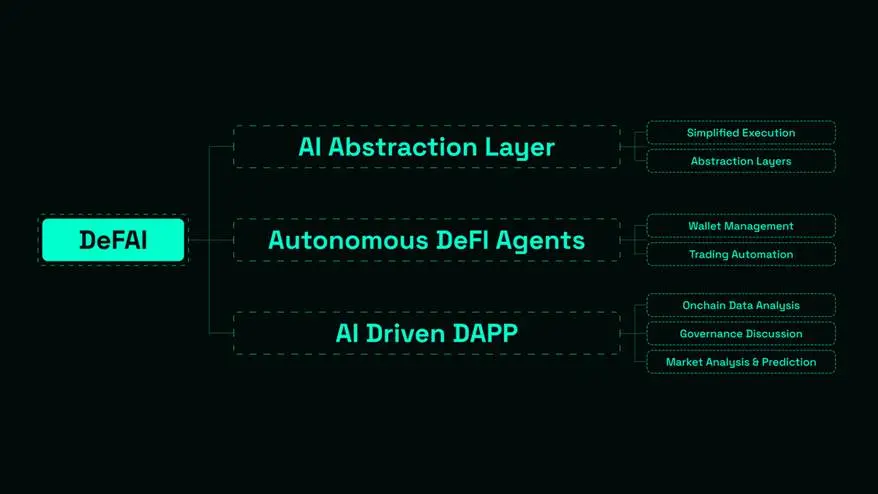
Maiga AI extends the capabilities of artificial intelligence beyond traditional applications (such as machine learning and data analysis). By enabling AI agents to interact directly with DeFi, cryptocurrencies, and finance, Maiga AI opens up various innovative possibilities in the Web3.0 world:
- ●Autonomous Trading: AI agents can automatically monitor and execute trades in financial markets without human intervention. This endows them with real-time decision-making capabilities and the potential for better trading strategies and profit potential.
- ●Simplified Blockchain Interaction: Maiga AI reduces the complexity of DeFi smart contract technology, allowing non-native Web3 users to easily participate. Retail users do not need to master specialized Web3 knowledge to engage with various DeFi applications such as Pendle, LayerZero, 1inch, Uniswap, Aave, Jupiter, and Meteora.
- ●Scalability in DeFi: AI agents can analyze market trends and execute trades to optimize risk/reward ratios, Sharpe and Sortino ratios, trading volumes, liquidity relationships, prevent "rug pull" risks, and track Alpha news and market sentiment, thereby maximizing returns.
++Module Details++
++How does the Maiga AI Agent work?++
++ ++
++
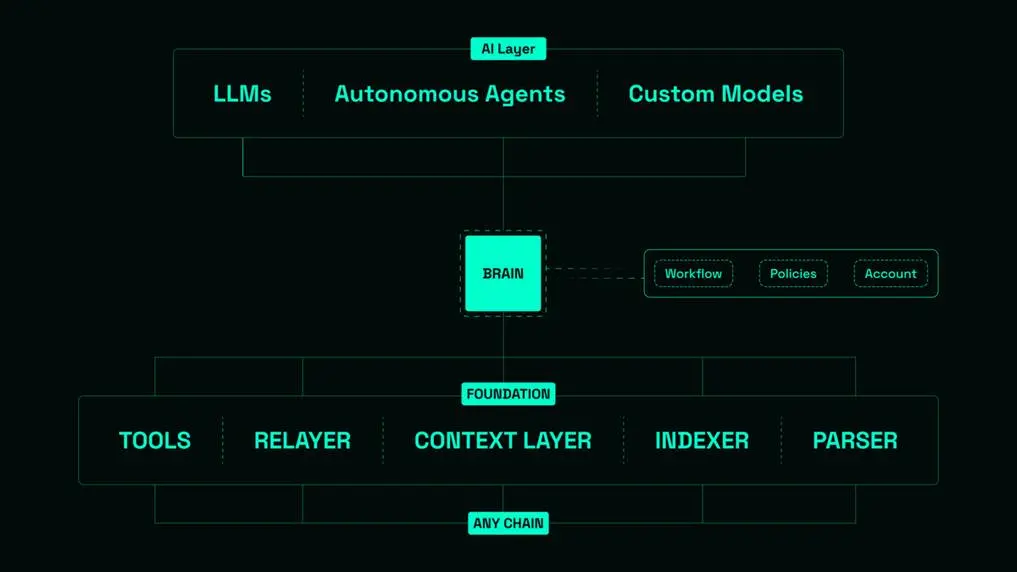
1. Agent Creation
- Use Maiga's native token $MAIGA to create agents, with the token serving as both activation and ownership proof.
- Example: A user spends $MAIGA to create an agent specifically for monitoring and trading DeFi assets.
- Technical Point: The creation process connects the agent to Maiga's shared knowledge base and loads a default function library.
2. Agent Paths
- Provides preset roadmaps to guide agents in efficiently operating within blockchain networks.
- Example: When exchanging tokens across chains, the agent automatically finds bridges, checks liquidity, and completes the transaction.
- Technical Point: Paths are stored in a graph database, with nodes representing blockchain operations (such as smart contracts, DEX). Agents find the optimal execution path through queries, reducing costs and errors.
3. Reinforced Learnings
- Agents continuously optimize decisions and efficiency through past interactions.
- Example: Trading agents can identify market patterns and adjust strategies based on historical performance.
- Technical Point: Memory is divided into short-term (current tasks), long-term (accumulated knowledge), and fixed memory (core experiences), ensuring agents can adaptively evolve.
- Users can provide domain data (such as financial reports, tutorials) for advanced training, allowing agents to specialize in market analysis, sentiment analysis, and other tasks.
4. MPC Wallet Management
- Each agent comes with a wallet that can securely store, trade, and manage on-chain assets.
- Example: Trading agents can autonomously transfer funds into staking protocols while adhering to user-defined conditions.
- Technical Point: Utilizes a Multi-Party Computation (MPC) wallet architecture to avoid private key exposure and enhance security.
- Supports importing dedicated wallets for different DeFi strategy scenarios.
- Benefits: Wallet abstraction allows agents to interact securely across chains, enhancing interoperability.
++MaigaXBT AI Agent Features++
1. Token Analysis / Market Reports
- Real-time charts + on-chain data + trend analysis, providing a comprehensive understanding of any token's market situation.
- Features:
- Track real-time market fluctuations
- Identify key liquidity changes
- Capture signals that the market has yet to react to
- Suitable for: Traders who want not only data but also market context and interpretation.
2. Token Information
- A one-stop token snapshot, eliminating the need to search across multiple platforms.
- Provides information including:
- Market cap, trading volume, circulating supply
- Contract address and audit details
- Holding distribution and whale movements
- Suitable for: Quickly verifying tokens and improving trading decision efficiency.
3. MAIGA IQ / Mindshare
- Tracks social heat and sentiment on crypto Twitter and communities.
- Features:
- Real-time monitoring of token discussion levels
- Discover which tokens are gaining or losing popularity
- Compare sentiment scores across various tokens
- Value: Sometimes, "narratives" move faster than market trends.
4. MAIGA KOL Alpha
- Focuses on genuinely influential opinion leaders (KOLs), tracking their trades and signals.
- Features:
- Identify KOLs that consistently generate Alpha
- Backtest their past recommendation performance data
- Receive alerts on top KOL movements
- Value: Helps users filter out noise and pinpoint real Alpha sources.
++Technical Analysis++
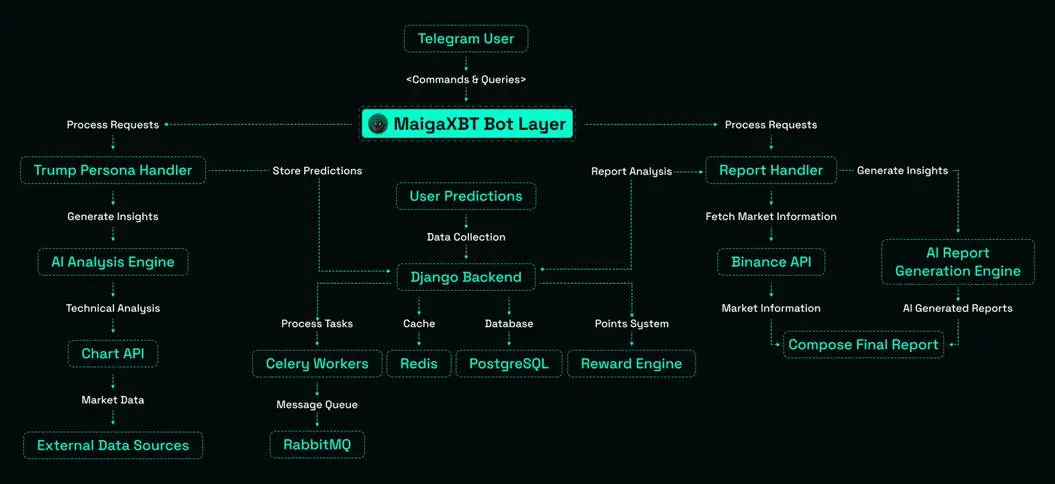
1. Core Knowledge Base
- Stores paths and tool libraries, supporting AI agents in managing wallets, executing trades, and interacting with dApps.
- Example: When executing token exchanges, agents can directly call paths to complete tasks without repeated data retrieval.
2. Blockchain Ecosystem Graph
- A dynamic graph mapping major blockchain entities and smart contracts, assisting AI agents in autonomously navigating across networks.
- Technical Point: Integrates contract metadata, transaction history, and user preferences to aid agents in making better decisions.
3. Private Key Management
- Based on MPC wallet architecture, ensuring private keys are encrypted and securely stored.
- Example: Agents can sign transactions without exposing private keys, ensuring tamper-proof operations.
4. Technical Design Philosophy
- Cross-chain Compatibility: Initially starting on EVM chains, designed to be chain-agnostic, scalable to multi-chain ecosystems.
- High Performance: Supports high-speed transaction execution to cope with volatile markets.
- Usability: Simplifies interaction interfaces, allowing users to complete complex operations with intuitive commands.
- Memory Optimization: Retains transaction logs and learning history for continuous iterative optimization of agent decisions.
5. Consensus & Verification
- Verification Agents: Community-maintained AI agents automatically detect path and signal security.
- Manual Oversight: High-risk paths undergo manual verification for added security.
- Example: New cross-chain paths must pass automatic detection + manual review before entering the shared library.
6. Purpose-built LLMs
- Lightweight large models optimized for blockchain tasks, enhancing efficiency and accuracy.
- Example: Parsing the instruction "If Gas fee is below $2, convert 10% USDT to WETH" and executing it automatically.
- Open-source Philosophy: Datasets and model weights are open to the community, promoting transparency and collaborative innovation.
7. User-friendly Interface
- Non-developers can create and manage AI agents through an intuitive chat-style UI.
- Example: Users can set agents to monitor Web3 news and trigger trades based on keywords.
- Provides a visual dashboard for real-time viewing of agent tasks, memory, and configurations.
8. Developer Integrations
- Seamlessly integrates with frameworks like Eliza OS, HeyAnonAI Automate.
- Offers composable DeFAI datasets, blockchain tools, and API interfaces for custom agent development.
9. Operational Boundaries & User Control
- Bounded Autonomy: Agents execute tasks only within user-defined limits (e.g., DEX trades strictly adhere to slippage and budget constraints).
- Confirmation Mechanisms: Requests user confirmation before key trades, ensuring transparency and security.
- Example: Before staking into a new protocol, agents will prompt risks and rewards, awaiting user approval.
++Tron++ ++Commentary++
Maiga AI's advantages lie in its innovative integration of AI agents with DeFi and crypto finance, providing users and developers with a high-performance and user-friendly platform through its chain-agnostic architecture, MPC wallet security mechanism, composable LLM framework, and SubDAO/Launchpad model. It enables automated trading, cross-chain interaction, market and sentiment analysis, and lowers the entry barrier for non-native users in Web3, demonstrating strong ecological expansion potential.
Potential disadvantages or challenges include the project's high reliance on the development environment of DeFi and AI, both of which face regulatory uncertainties, market volatility risks, and user education costs. Additionally, the autonomy and security boundaries of AI agents need careful balancing, or they may pose security risks or governance complexities. The key to long-term success lies in establishing robust community trust and sustained ecological implementation.
III. Industry Data Analysis
1. Overall Market Performance
1.1. Price Trends of Spot BTC vs ETH
BTC
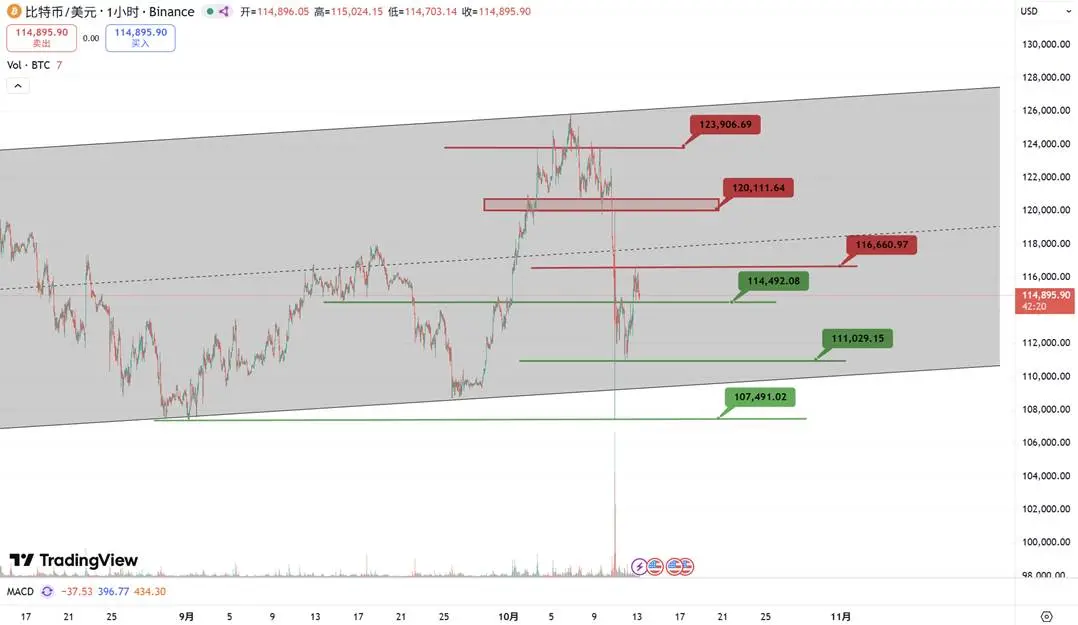
Analysis
Key resistance this week: $116,600, $120,000, $123,900
Key support this week: $114,500, $111,000, $107,500
ETH
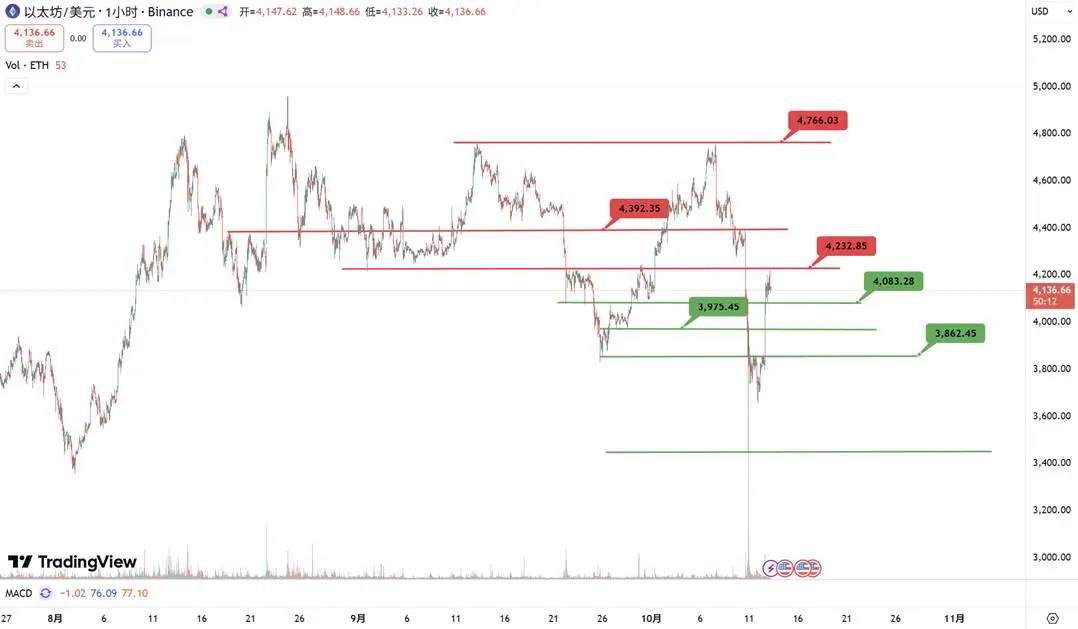
Analysis
Key resistance this week: $4,230, $4,400, $4,760
Key support this week: $4,080, $3,970, $3,860
2. Major Events in the Sector
2.1. RWA Summary
|-----------------|----------------------------------|--------------------------------------------------------------------------------------|--------------------------------------------| | Direction / Sub-category | Main Projects / Entities | Recent Developments / Trends | Impact / Significance | | Infrastructure / Platform / Capital Investment | Mavryk Network | This week disclosed its acquisition of $10 million in funding to advance institutional RWA tokenization. | This signals continued capital betting on RWA infrastructure, aiding middleware/platform capability enhancement | | | Stellar / Centrifuge / Moody's, etc. | In conferences/forums, the judgment was made that "institutions are moving RWA from experimentation to production," with asset scales potentially reaching trillions in the coming years. | Reflects the industry's growing consensus on the long-term potential of RWA | | Government Bonds / Bonds / Tokenized Assets | BlackRock / BUIDL | BUIDL, as a tokenized government bond fund, has been mentioned in multiple RWA reports, holding a significant share in the tokenized government bond/securities asset pool. | Government bonds/bonds are the easiest category to connect with traditional finance and are also entry points for many RWA projects | | Private Credit / DeFi Lending | Maple Finance | Listed as a representative project in the private/RWA credit field in multiple materials. | The private credit direction occupies an important share in the overall scale of RWA | | Policy / Regulation / Regional Restrictions | China / Hong Kong | According to Reuters, Chinese regulatory agencies have informally requested some brokerages to suspend RWA (real asset tokenization) business in Hong Kong. | This action indicates that regulatory boundaries are tightening or being reconsidered, and future tokenized asset businesses in China/Hong Kong may face restrictions | | Competition / Infrastructure Integration | ISDA / Institutional Banks / Banks Issuing Stablecoins | Although not strictly RWA, several mainstream banks are beginning to explore issuing stablecoins pegged to fiat currencies or backed by fiat/assets, intersecting with the RWA ecosystem. For example, over a dozen banks announced a joint exploration of issuing G7 currency-pegged stablecoin projects. | Banks entering the stablecoin/tokenized asset direction may create synergies or squeeze with RWA pathways |
2.2. Summary of EVM & Non-EVM Public Chains
|------------------|------------------|------------------------------------------------------------------------|--------------------------------------------------| | Type | Projects / Technologies | Core Progress | Significance / Risk Points | | EVM Compatible / Expansion | Sei Giga | Released a white paper proposing a multi-proposer architecture + parallel proposals + asynchronous state submissions, achieving > 5 gigagas/sec throughput & < 400 ms finality | If the proposal is implemented, it will significantly enhance the performance boundaries of EVM chains; however, there are many risks in design, implementation, compatibility, and governance | | EVM Acceleration / Hardware Assistance | EVMx (FPGA Acceleration) | Proposed offloading contract execution to FPGA design, testing common opcode execution times reduced by 61%--99% | If commercialized, it could constitute a new path for performance enhancement of EVM chains; however, hardware deployment costs, upgradability, and on-chain verification consistency are challenges | | Architectural Trends / Cross-chain / Asset Flow | Cross-chain Asset Flow & Fund Flow Acceleration | The number of cross-chain assets like BTC held on EVM chains continues to rise; overall fund flows are recovering | Strengthens the position of EVM chains in cross-chain finance, but caution is needed regarding cross-chain bridge contract security and liquidity risks |
2.3. Summary of the Stablecoin Sector
|-------------------|------------------------|--------------------------------------------------------------------------------|--------------------------------------------------------| | Project / Entity | Core Progress | Key Details / Next Steps | Significance / Risk Alerts | | Tether → USAT | Officially launched "U.S. regulated + dollar-pegged" stablecoin | Appointed Bo Hines as USAT CEO; USAT is expected to be issued by Anchorage Digital Bank; designed to comply with U.S. GENIUS Act regulations | This is Tether's compliant entry into the U.S. market; if the regulatory framework loosens or audit or reserve transparency is insufficient, it may trigger compliance or credit risks | | Tether + Rumble | Promoting USAT's user entry | Tether collaborates with Rumble to issue crypto wallets for its 51 million monthly active users to promote USAT | Laying a diffusion path through an existing user platform may accelerate user acquisition and traffic conversion, but user education and compliance disclosure remain challenges | | Coinflow | Completed $25 million Series A funding | Led by Pantera, with participation from Coinbase Ventures, Jump, etc.; plans to expand the stablecoin payment network, improve transaction approval rates, and expand into Asia/Latin America markets | This funding validates the market's optimism about "stablecoins as a payment settlement layer"; however, business expansion faces regulatory compliance, competition with traditional payment systems, and infrastructure stability challenges |
IV. Macroeconomic Data Review and Key Data Release Nodes for Next Week
The government shutdown/budget stalemate has officially begun, with the U.S. federal government entering a shutdown state as of October 1, leading to interruptions or delays in the release of multiple economic data, including the Labor Department's employment report and inflation data. As a result, market expectations for future policy and economic transparency have been impacted.
The market anticipates that the Federal Reserve's easing path may be adjusted due to this impact. Although rate cuts had previously begun, the political risks may constrain policy space in the context of the budget stalemate.
V. Regulatory Policies
United States
- Several large banks are exploring the issuance of stablecoins pegged to G7 currencies.
- Due to the government shutdown, the SEC has suspended several crypto approval processes, including the Solana ETF.
- The draft of the "Responsible Financial Innovation Act" continues to advance, but labor groups have raised objections.
Trend: The regulatory framework is accelerating formation, but political disputes remain numerous, leading to high uncertainty in the short term.
United Kingdom / European Union
- The UK has allowed retail investors to purchase regulated crypto ETN products starting in October.
- The UK's Financial Conduct Authority has strengthened investor suitability testing requirements.
- The EU's MiCA regulatory framework has been fully implemented, requiring crypto service providers to comply uniformly.
Trend: Europe is moving towards a systematic regulatory model, significantly raising compliance thresholds.
India
- The tax department has begun reviewing wallets of users from foreign exchanges, focusing on unreported crypto earnings.
- The Reserve Bank of India reiterated its cautious stance on stablecoins and crypto assets, with no relaxation of regulations for now.
Trend: The prospects for legalizing crypto trading remain unclear, but tax regulation is tightening comprehensively.
Indonesia
- Announced an increase in the crypto trading tax rate starting August 2025, with local exchange taxes rising to 0.21% and overseas platform trading taxes rising to 1%.
- Also increased the value-added tax on crypto mining to 2.2%.
Trend: Guiding funds back to the local market through taxation, with regulation taking on a more economic control color.
Pakistan
- Established the "Virtual Assets Regulatory Authority" (PVARA), responsible for issuing crypto service licenses and regulation.
- The national bank still does not recognize cryptocurrencies as legal payment methods.
Trend: The regulatory infrastructure is taking shape, but policy execution needs further clarification.
 Risk warning Risk warning
Popular articles





