








The "Counter-Trend Stability Technique" of TRON: Survival Insights Amidst a Plunge

 The TRON ecosystem demonstrated exceptional system-level stability during the market crash on "10.11".
On the evening of October 10th, starting at 10 PM, the cryptocurrency market was suddenly hit by a severe shock. Within just seven hours, BTC plummeted from a high of $102,000 to a low of $102,000, while ETH also briefly dropped to $3,400. The market saw a daily liquidation amount reaching $19 billion, with some institutions estimating that the total liquidation across the network could approach $100 billion. The intensity of this market movement not only set a new record for volatility this year but also constituted a system-level stress test for all cryptocurrency projects.
After the crash, analyses of the "causes" flooded the market. From the unreasonable lending systems of centralized exchanges (CEX), failures in trading matching mechanisms, to institutions plotting to short, and a sudden drop in on-chain liquidity. However, these discussions can only explain localized phenomena. For investors, a more critical question than "why did it drop" is which systems remain robust and which assets can still stand firm in extreme market conditions. The answer lies in the data, and in this network-wide crash, the TRON ecosystem undoubtedly stands out as the most remarkable example.
The Resilience of TRX Highlights System Robustness
In the extreme market conditions of October 11th, mainstream assets were hardly spared. Dominant assets like BTC and ETH recorded double-digit declines, and cryptocurrencies ranked in the top twenty generally experienced deep corrections. However, amidst this "sea of blood," TRX's performance was particularly outstanding.
TRX's decline on Binance after a single day of trading was only about 4.85%, with a maximum daily fluctuation of just 12%. In contrast, BTC's maximum fluctuation reached 16.89%, ETH exceeded 21%, and emerging public chain tokens like SOL and AVAX saw declines close to 30%.
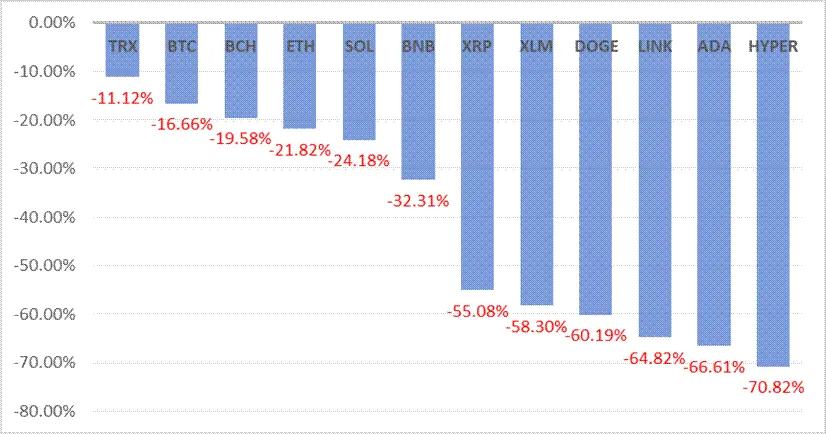
(Maximum decline of assets ranked in the top 20 on Binance on October 11th)
Even the stablecoin system was not spared, with some mainstream stablecoins like USDE and FDUSD experiencing varying degrees of de-pegging. Among them, USDE dropped to as low as $0.65, while USDD remained within the $0.99998 range, with fluctuations almost negligible.
This stability is not coincidental. Historical data shows that as an altcoin, TRX has consistently demonstrated above-average resilience during multiple rounds of market crashes:
- December 4, 2021 crash: BTC down 22%, TRX down 14%;
- November 2022 FTX incident: BTC down 12%, TRX down 5%.
More notably, since January 2023, TRX's price has never fallen below the 200-day moving average, with a cumulative increase of over 7 times. Among mainstream public chain assets, only TRX has maintained this stable range for over thirty months.
Such long-term stable performance cannot be sustained solely by "market protection" or short-term sentiment. With a market cap of approximately $30 billion, TRX's price stability stems from deeper structural support—namely, the operational mechanism, consensus foundation, and robust design of the TRON ecosystem.
It is worth noting that this robustness is closely related to the overall strategic layout of TRON's founder, Justin Sun.
In recent years, he has gradually built a core ecological matrix for TRON through systematic interactions between public chains, stablecoins, CeFi, and DeFi. From the TRX mainnet, USDD stablecoin, to HTX, and then to DeFi platforms like SUN.io and JustLend, Justin Sun's "multi-layer defense system" has withstood the test during this round of market crash:
Whether in liquidity, liquidation mechanisms, or stability anchoring, it has maintained extremely high operational efficiency. This not only allowed TRX to outperform mainstream coins but also enabled the entire TRON ecosystem to maintain high resilience amid the storm.
Deflationary Mechanism and High Staking Rate Build Price Support
The stability of the TRON ecosystem primarily originates from its self-consistent economic system design. Compared to many public chains that rely on short-term inflation issuance or external capital drives, TRON's core mechanism presents an "internal circulation steady-state structure," mainly reflected in two aspects:
Deflationary Mechanism: Burning and High-Frequency Trading Create Continuous Supply Contraction.
In the TRON network, all on-chain operations exceeding pledged resources (energy and bandwidth) require TRX to pay transaction fees, and these TRX will be permanently destroyed by the system. This means that every transaction, contract call, or USDT transfer directly reduces the total supply of TRX.
According to on-chain data, since October 2021, the amount of TRX burned has consistently exceeded the amount minted, entering a long-term deflationary phase. The key driving force behind this trend is the on-chain usage of TRON USDT. Since 2024, the daily transfer volume of TRC20-USDT has stabilized above $20 billion, consistently surpassing ERC20-USDT. This high-frequency usage effectively triggers the burning mechanism continuously, creating a rigid consumption of TRX, which serves as the underlying logic for stable value.
High Staking Rate: Locking Circulation, Stabilizing Supply and Demand Balance.
On the other hand, TRX's staking rate has long maintained between 40%-50%, significantly higher than ETH's approximately 20%-25%. Users staking TRX can earn energy resources and voting rewards, forming a positive cycle of "activity—staking incentives—price stability."
The introduction of Stake 2.0 in 2023 further optimized the mechanism: users can delegate staking resources without unlocking, improving capital utilization and on-chain activity simultaneously, leading to continuous growth in locked positions. This mechanism effectively weakens market selling pressure, providing solid support for TRX's price on the supply side.
In stark contrast, many competing public chains' token economic models have exposed flaws during extreme market conditions: some high-inflation chains exacerbate selling pressure under continuous supply expansion, while some algorithmically stable designs accelerate collapse due to feedback mechanism failures. In comparison, TRON's robustness appears particularly rare.
This also reaffirms the effectiveness of Justin Sun's "long-term steady-state" philosophy, resisting systemic risks through self-consistent mechanisms and ecological interconnections rather than relying on external capital support.
From USDD Anchoring to Compliance Layout
The resilience of TRON is not only reflected at the asset level but also in the integrity and stability of its ecosystem.
As the core stablecoin of the TRON ecosystem, USDD's performance on the day of the October 11th crash was textbook-like—its lowest price was only $0.99998, showing no significant deviation from its usual fluctuations, while various stablecoins like USDE and FDUSD experienced varying degrees of de-pegging. Notably, USDE dropped below $0.70 during high volatility, with a de-pegging extent exceeding 30%, highlighting the fragility of its synthetic asset model. In contrast, USDD achieved stable operation under extreme market conditions, relying on on-chain over-collateralization and multi-layer risk buffer mechanisms.
More broadly, the TRON ecosystem has formed a multi-layer financial network:
- Infrastructure level: The public chain mainnet operates stably, with low transaction fees and high throughput; DeFi and derivatives level: protocols like JustLend, SUN.io, SunPerp, and SunPump form a liquidity closed loop;
- Cross-chain and compliance level: TRC20-USDT has become the most widely circulated version of stablecoins globally; reserve asset level: some institutions have included TRX in their strategic holdings, similar to MicroStrategy's holding of BTC.
Behind this system, Justin Sun's global operational network and risk control thinking play a crucial role. Whether it is USDD maintaining its peg, HTX's stable liquidity, or the absence of chain reactions in ecological tokens, all indicate that its multi-layer structure possesses good self-stabilizing capabilities.
During the October 11th crash, Justin Sun's personal asset portfolio and the ecosystem he leads were not substantially impacted; instead, they quickly rebounded after the market sentiment recovered, becoming a real-world testament to "counter-cyclical stability."
As the scale of the ecosystem expands and on-chain interaction frequency increases, the demand for TRX's staking and burning grows in tandem, forming a closed-loop mechanism of "activity driving deflation—deflation reinforcing scarcity—scarcity feeding back consensus." This structural self-stabilizing ability is the fundamental reason why TRON remained resilient during this crash.
The volatility of the cryptocurrency market is gradually normalizing, and the frequency of extreme conditions is increasing. Each crash serves as a real-world "removal of the false and preserving the true."
It has been proven that only ecosystems that can maintain robustness under pressure tests possess the potential for survival and growth across cycles. With a clear deflationary logic, high-staking consensus, stablecoin anchoring system, and compliance layout, TRON not only demonstrated system-level robustness during this round of crash but also released a strong signal for the future: stability itself is the new competitiveness.
 Risk warning Risk warning



Popular articles





