








China's eSIM industry is reaching a turning point: from policy breakthroughs to ecological reconstruction, the Roam model innovates the "cardless" future

 eSIM China breaks through, Roam defines a new paradigm of connectivity.
China's society has taken the lead in completing the leap from cash to mobile payment, known as "Cashless." Now, a similarly profound revolution called "SIMless" is unfolding in the telecommunications field. With the pre-sale of the iPhone 17 Air in China, which fully supports eSIM, the three major operators have simultaneously launched related services, marking China's official entry into the "cardless connection" era. In this transformation driven by policies, terminals, and operators, the decentralized telecom model represented by Roam is providing a new paradigm for the popularization of eSIM with its unique user participation ecosystem and global coverage capability—it proves that the true value of eSIM lies not only in being "cardless" but also in building an open, interactive, and user-driven connection future.
1. Policy Orientation and Operator Layout: eSIM Development Enters the Fast Lane
By 2025, China's eSIM industry will enter the stage of large-scale deployment driven by both policy and market forces. The release of the Ministry of Industry and Information Technology's "Action Plan for Promoting the Innovative Development of the eSIM Industry (2025-2027)" provides a clear top-level design and implementation path for the industry. Meanwhile, the official pre-sale of the iPhone 17 Air has become an important catalyst for the commercial use of eSIM, accelerating the rollout of services by the three major operators.
China Unicom, as the earliest operator to lay out eSIM, launched the "eSIM Mobile Business" application page in 25 provinces and cities in July 2025. With the pre-sale of the iPhone 17 Air, Unicom has also launched special eSIM services for this model, supporting both "in-store processing" and "door-to-door processing," covering the entire lifecycle management from account opening to closure.
China Mobile has adopted a prudent strategy for eSIM business deployment and recently launched an eSIM appointment processing system. Users need to bring valid identification and devices to the service hall for processing, with the system supporting new network access and number portability. To ensure business security, Mobile has set cautious management rules, including a maximum of two domestic eSIM numbers activated per device and a limit of two new numbers per month.
As for China Telecom, the eSIM mobile business has fully completed technical preparations and system testing. Relevant personnel revealed that the telecom eSIM service was internally trialed on the same day as the iPhone 17 Air pre-sale, and will be fully opened to users as soon as it receives official approval for commercial testing from the Ministry of Industry and Information Technology.
The collaborative advancement of the three major operators marks that China's eSIM industry has moved from the pilot exploration phase to the stage of large-scale commercial use, laying a solid foundation for the comprehensive arrival of the "cardless" communication era.
2. Terminal Pressure and Technical Restructuring: eSIM is More Than Just "Cardless"
Terminal manufacturers have become the strongest external force driving the popularization of eSIM. The iPhone 17 Air, with its ultra-thin design, has completely eliminated the physical SIM card slot, achieving "forced education" of the market. The rapid follow-up by mainstream manufacturers such as Huawei, OPPO, and vivo indicates that eSIM will penetrate from high-end models to all price segments.
eSIM is not simply a replacement for physical cards; it is a SON-8 packaged chip embedded directly into the device's motherboard, enabling remote configuration management through OTA technology, triggering a fundamental transformation in communication architecture:
Hardware Design Liberation: It frees up valuable internal space for terminal devices. For example, the removal of the card slot in the iPhone Air not only helps achieve an ultra-thin body of 5.6 mm but also allows for a larger battery and more complex camera modules. For devices like smartwatches and IoT sensors, eSIM addresses their "space anxiety" and reliability issues.
User Experience Upgrade: It enables "cloud-based card opening and one-click number switching." Users no longer need to rush to get or replace cards; they can switch to local plans online while traveling abroad, and business people can easily manage multiple numbers. For the vast number of IoT terminals, operation and maintenance personnel can achieve remote batch management, significantly reducing costs.
Deep Integration with 5G/IoT: eSIM aligns with the high speed and broad connectivity characteristics of 5G, serving as a key support for the Internet of Everything. In fields like connected vehicles and industrial IoT, the combination of eSIM with AI and edge computing has spawned innovative applications such as automatic cross-border connectivity for smart cars and predictive maintenance for industrial equipment, upgrading it from a "consumer electronics accessory" to a "digital identity foundation for the Internet of Everything."
3. China's Path from a Global Perspective: Opportunities and Challenges Coexist
The global development of eSIM is rapid. The EU's "New Battery Law" requires the gradual elimination of physical card slots in smartphones starting in 2026, and mainstream operators in the U.S. have widely adopted this technology. GSMA predicts that by the end of 2025, the number of global eSIM smartphone connections will reach 1 billion, increasing to 6.9 billion by 2030. Jupiter Research estimates that by 2026, the number of IoT connections using eSIM technology will surge from 22 million in 2023 to 195 million.
In this global wave, the comprehensive opening of the Chinese market holds strategic significance:
First, China boasts the world's largest consumer electronics and IoT application market, providing an ideal soil for the large-scale commercial use of eSIM technology. Data from the Ministry of Industry and Information Technology shows that the number of IoT terminal connections in China has exceeded 2 billion, and annual sales of smart cars have surpassed 3 million, all of which provide rich landing scenarios for eSIM technology.
In terms of the industrial chain, domestic companies have made breakthroughs in key areas. Products from chip manufacturers like Unisoc and Huada Semiconductor have achieved GSMA eSA certification and are being shipped in bulk; platform providers like Dongxin HePing and Siter have built complete management systems; downstream applications are rapidly promoted in fields such as new energy vehicles (BYD, NIO, etc.) and industrial IoT (SANY Heavy Industry, Haier Smart Home).
However, challenges cannot be ignored: there are still gaps in participation in standard-setting and high-end chip design capabilities. Particularly in service models, domestic operators initially mainly adopted "in-store processing," which differs from the mature online activation models overseas in terms of user experience. Balancing security management with user experience has become a pressing issue to address.
4. User Awareness and Market Education: A Key Link in Popularization
Although eSIM technology has advantages in device waterproofing and space-saving, these improvements are not easily perceived by ordinary users. Most users do not frequently change SIM cards, so the experience upgrades brought by eSIM are easily underestimated. Meanwhile, users' habits remain the biggest obstacle—insufficient awareness of eSIM and unfamiliarity with the operational process mean that the inertia of traditional SIM cards remains strong. Although existing eSIM tariffs are generally reasonable, future pricing strategies will directly affect users' willingness to migrate.
If operators merely view eSIM as a "cardless" shift of traditional services without innovating service models, their apps will remain "silent" on users' phones, only opened during recharges. Therefore, the key to promoting eSIM lies in whether it can establish high-frequency, valuable interactions with users, stimulating their willingness to actively use and understand it.
In this regard, the decentralized telecom operator Roam provides a reference case. Roam does not simply view eSIM as a communication product but as an entry point for building a highly interactive, user-oriented digital ecosystem. Its app rewards users with points, digital stickers, and data through gamified operational mechanisms (such as daily WiFi check-ins, watching ads, participating in community activities), and the data obtained is permanently valid. This "participation equals benefit" model transforms users from passive service consumers into co-builders and sharers of the network, effectively addressing the core pain point of "why users need to pay attention" in eSIM promotion.
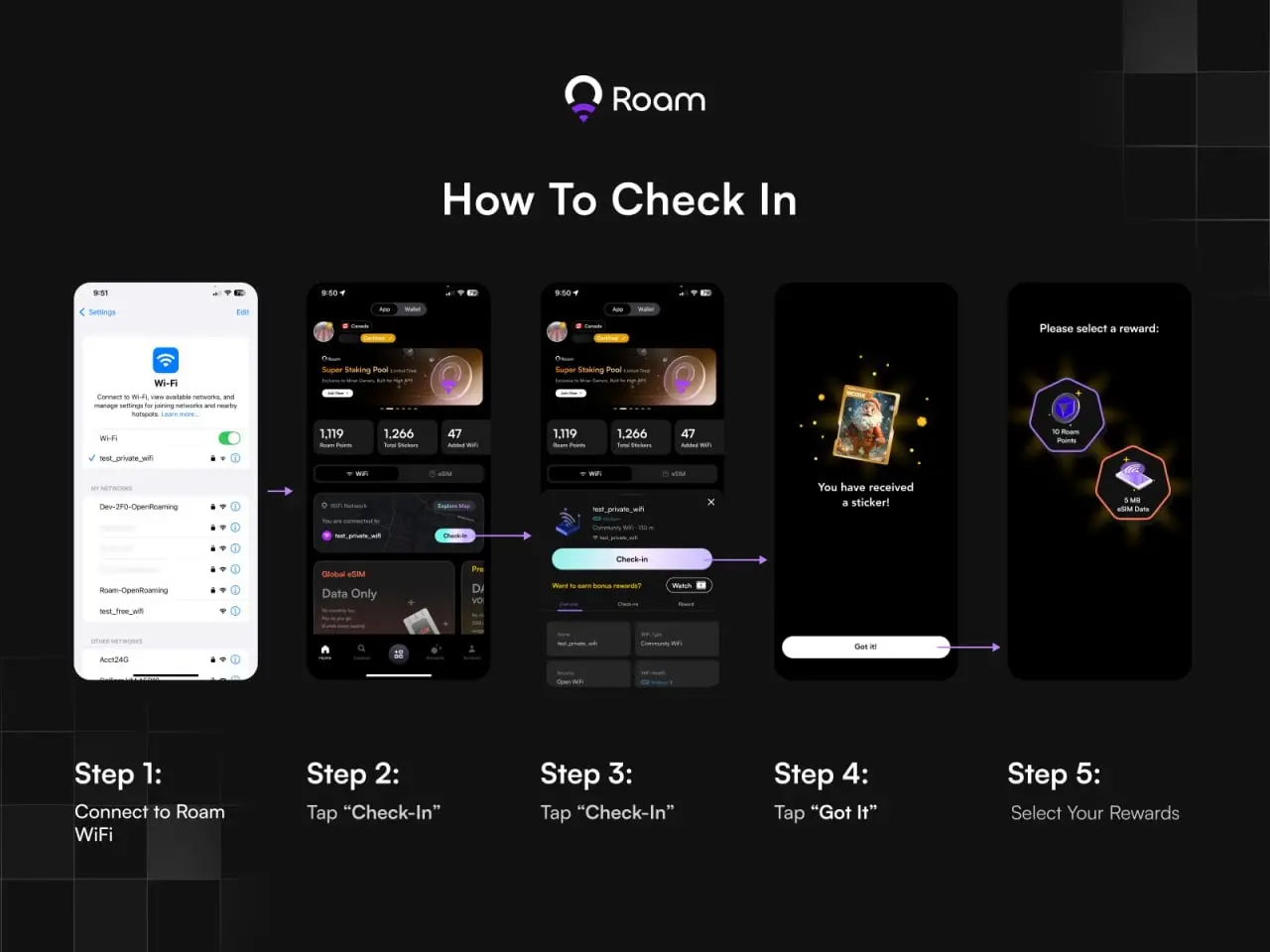
(In the Roam App, users can earn points, digital stickers, and data through daily check-ins, and the data obtained is permanently valid.)
This strategy aligns closely with the successful logic of fitness app Keep. Keep transforms the monotonous fitness experience into a sustainable lifestyle through customized training plans, community check-ins, and achievement systems, fundamentally enhancing users' health levels. Similarly, while attracting user participation and interaction, Roam's core value lies in effectively addressing users' cross-border connectivity pain
 Risk warning Risk warning




Popular articles





