








Vitalik's Speech at the Wanxiang Summit: New Developments in Ethereum and the Future of Applications
 Core Viewpoint

 Cryptography enters the "usable era," and will be widely adopted at low cost in the next 5-10 years.
2025 Shanghai Blockchain International Week and the 11th Global Blockchain Summit
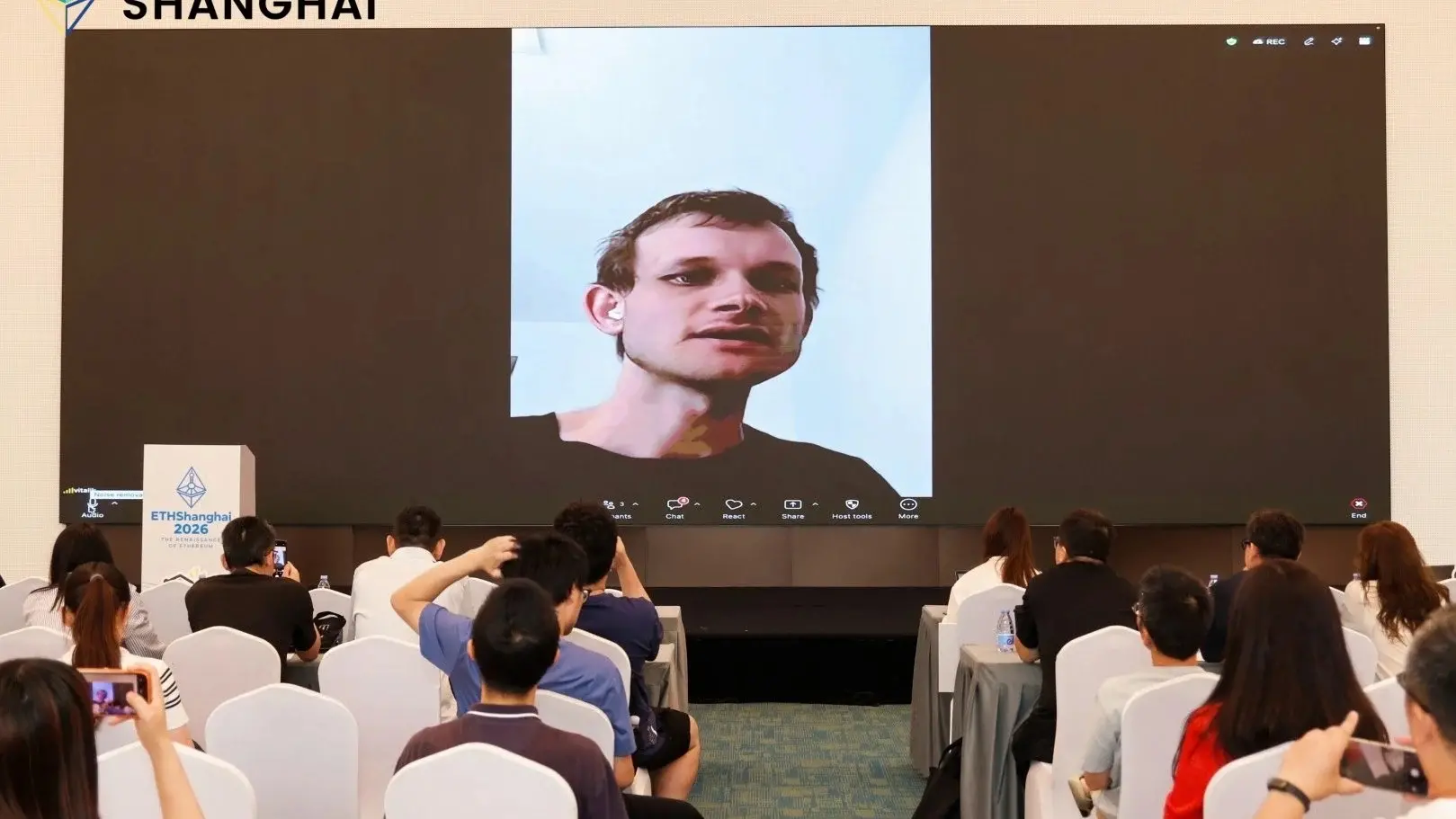
Today, the 2025 Shanghai Blockchain International Week and the 11th Global Blockchain Summit is being held. Ethereum co-founder Vitalik Buterin delivered a speech titled "New Developments in Ethereum and the Future of Applications." Vitalik stated that blockchain and cryptographic technologies have made significant progress over the past decade, and the next five to ten years will usher in a phase of "truly usable, scalable, and low-cost" solutions.
The following is the full text of the speech:
Hello everyone, welcome to this blockchain event. In the past 10 years, the blockchain and cryptography industry has developed a lot. The value proposition of blockchain technology today is significantly greater than it was 10 years ago.
Today, the topic of my speech is to think about blockchain and cryptographic technologies. If blockchain, ZK, FHE, and all other technologies are scalable, developer-friendly, and inexpensive, what can we do with these technologies if they have few drawbacks?
In fact, there are many parts to cryptographic technology. On the left, there are two types, like parts that already exist in the world: the first is signatures, and the second is encryption. Encryption is the difference between APGB and ACBS. You should remember that 20 years ago there was no ACBS; this technology existed. However, 20 years later, all websites, all apps, and all applications are based on encryption.
The first part of ACBS is encryption, and the second part is signatures. Why didn't we have this situation 20 years ago? Why do we have it now? It's because the cost of signatures and encryption is now almost zero. In fact, the technologies of signatures and encryption existed long before 20 years ago; there were some important papers before 1976 and 1978, and later there was RSA, which can be considered the first modern signature and encryption algorithm.
Around the 1980s, specifically starting in 1989, the functionality of digital signatures began to emerge. By around 1992 with PCP, and by 2015, this technology had become rich, ubiquitous, and so cheap and simple that we no longer need to think about the drawbacks of this technology.
In the past decade, I have started to work on some new cryptographic technologies in the field of cryptography, namely zero-knowledge proofs (ZK) and homomorphic encryption (HE).
In one second, you can prove about 2 million hashes, with high technical efficiency and increasing security, providing a particularly good developer experience.
Homomorphic encryption technology has the potential to improve by ten times between 2023 and 2025. We now also have Blocks, which help with L2 security expansion. Currently, there are 6 Blocks, and we plan to have 50 Blocks in the next two to three years.
On L2, this year we have increased from 30 million to 45 million, but we plan to continue to increase it, possibly by 10 times or 100 times. You might think this technology has a very low cost, and the developer UX has become very good. Blockchain has also made similar progress. What is the result? If you are currently thinking about ZK technology, you might wonder why we need ZK. Can we avoid the need for ZK? Many times, the same question applies to blockchain: why do we need blockchain, and can we avoid the need for it? This technology is very new.
Five years from now, I guess many people's attitude towards new blockchain ZK technologies will be: why not add ZK, why not add blockchain? Ethereum has a significant impact in the short term. We now have a plan for the Ethereum website, where you can see many ZK EVMs that can now prove Ethereum L1 in real-time. This was completely impossible two years ago; two years ago, everyone thought it might take five or ten years to achieve this. But now it can be done. Currently, there are about 50 GPUs that can prove almost all Ethereum blocks in real-time, not 30 million, but 45 million. Therefore, when we scale in the long term, we can also create a more scalable and decentralized network. Why? Because we do not need every node to process all transactions in the blockchain; we can also use most nodes to prove with ZK, and verification can be done in a millisecond, which is particularly fast.
ZK also has the advantage of privacy. Therefore, this year we can have a project slogan: we need to think about all aspects of Ethereum privacy, including on-chain transaction privacy, off-chain transaction privacy, and various applications. Now we can do this. Two years ago, we could do a little bit, but now we can do much more than before. Another important issue is the relationship between cryptography, blockchain, and hardware. In the blockchain field, we have a saying: "Not your private key, not your coin." If you do not control the wallet's private key, and if someone else controls your private key, you cannot verify whether your coins are secure. In 2023, we will add another saying: "Not your silicon, not your private key." Because everything done in the blockchain relies on cryptography, which relies on private keys. Algorithms need to run in hardware and be stored in hardware. If you cannot trust your hardware, you cannot trust everything that happens on that hardware.
In fact, many fields have this problem. Blockchain has digital assets and digital identities, but IoT also has this problem. If every device has a computer inside, how can you trust it? Healthcare also has this problem; privacy in the healthcare field is also very important.
We recently started an interesting project. If you play DeFi Coin or DXR in Singapore, you might see a small device that can show you air quality, carbon dioxide levels, and many different indicators. Having such devices helps us better understand what is happening in the air, which is crucial for healthcare. But there are also significant privacy issues. Ten or twenty years from now, the information known in the physical world may be a thousand times more than it is now. How can we protect privacy? How can we ensure security? Therefore, what we are doing now is creating future versions of devices that incorporate cryptographic technology, allowing us to know what we want to know from the data while not exposing the privacy of every individual and every location. ZK is very useful.
First, we know that cryptography is very important, but now we find that cryptography is truly usable. Second, open-source and verified hardware are also important. In fact, the blockchain field shares similar language with many other fields. In all the areas I just mentioned, there has been significant development. How can you participate?
I think there are three answers:
Entrepreneurship: Now you can create or support applications that use ZK, FHE, and blockchain to create ZKID applications.
Development and optimization of underlying cryptographic technologies: The Ethereum Foundation has a Lean team with many collaboration opportunities; everyone can reach out to the Lean team.
You can use current technology-based applications, such as Scroll, Taiko, Lighter, Intmax, Aztec, etc., as well as some ZK voting applications, like zkpassport, which has existed for about two years, and Aragon announced earlier this year that it will use ZK voting, along with some wallets. There are already many ways to participate in these fields.
I think the questions we should consider five or ten years from now are that many technologies, like HTTPS, will use signatures, encryption, and other simple cryptography, but you may not know they have these technologies. These technologies are particularly convenient and can be used directly without considering costs or user issues. If ZK fast blockchain, like L1, L2, and FHE, can achieve this level of efficiency, then everything will be resolved. If this can be realized, what can we do with this technology? The answer is not simple; it requires starting experiments now. Every year we can create more applications, and we will learn a little more each year. I am very happy to participate in the process of technological development with all of you and hope to continue participating together.
 Risk warning Risk warning

Popular articles





