The next leap in AMM perpetual structure: Honeypot Finance's layered risk control and process fairness
 Core Viewpoint

 The golden age of CEX shaped the market size and also shaped the greatest risk of single point of trust.
Author: Honeypot
Lede
Over the past decade, the vast majority of global cryptocurrency trading has remained in the hands of centralized exchanges: user funds are custodied; matching and clearing logic is opaque; the strong liquidation mechanism during volatility is incomprehensible; black swans are always lurking (Mt.Gox, FTX, Bitzlato…). The golden age of CEX has shaped market scale and also the greatest risk of single-point trust.
An increasing number of professional traders and capital have realized: transparency is not optional; it is a fundamental right in finance, and the only way to achieve this is to truly move derivative trading on-chain. Thus, we have seen a batch of excellent on-chain perpetual DEXs - dydx, Hyperliquid, Aster, GMX.
Generally, these on-chain perpetual DEXs can be divided into two mainstream solutions: Orderbook Perp DEX and AMM Perp DEX. Currently, orderbook perp DEXs dominate the market solutions. In our view, both solutions have their pros and cons.
Two paths converge in the future. The on-chain perpetual market is currently in a game of two technical routes:

They represent: "Performance and Precision" vs "Resilience and Sustainability". The ultimate outcome of the future is a market order that combines both, and recently, Honeypot Finance, an integrated omnipotent liquidity hub valued at 35 million and backed by renowned investment institutions like Mask Network, is filling a gap in the market.
What Honeypot aims to do is simple: no flashy derivative designs, just three modules to fill the missing piece of AMM perpetuals—a controllable, predictable market that can execute trades in a storm.
I. The Fundamental Problem of Order Books: Most Vulnerable When Most Needed
The Fragility of Order Books: When You Need Them Most, They Vanish
Most prone to failure at critical moments
The core of order book (LOB) liquidity is not algorithmic guarantees, but the willingness of market makers. When the market is stable—market maker risks are controllable, spreads are extremely narrow, and depth is sufficient—it seems perfect. But once the market enters a high volatility zone:
1️⃣ Willingness Liquidity Collapses
Volatility amplifies → Risk rises non-linearly
Market makers collectively withdraw orders or significantly widen spreads, resulting in: no real orders outside the bandwidth, creating a "Liquidity Void". 📌 Prices do not slide but gap. 📌 Liquidation orders execute in a vacuum. 📌 Trading and risk reference prices are severely distorted.
2️⃣ On-chain Delays and Ordering Rights → "Exploitable Markets"
Market maker orders are exposed to: block delays, MEV front-running, latency arbitrage. The result is that orders are systematically preyed upon: every time targeted → next time quoted shallower, fewer, wider, continuously weakening effective depth, with depth quality experiencing reflexive decline. Effective depth structurally deteriorates.
3️⃣ Inventory Risk Cannot Be Timely Hedged
During severe shocks: external hedging costs soar, execution paths are obstructed, and market maker positions become increasingly skewed. Risk spillover mode: market maker survival → costs are passed on to traders and liquidators, maximizing the impact at liquidation points.
The significance of AMM lies precisely at this moment: 📌 When order books fail, AMM continues to perform, providing continuous quotes + minimum execution guarantees, ensuring the market can operate normally.
II. Why AMM Perpetuals Have Yet to Flourish?
Why AMM Perpetuals Still Lag Behind
AMMs should be "permanently open stalls," theoretically able to withstand volatility, but in reality, there are three structural issues:
1️⃣ LPs and Traders are Zero-Sum Opponents: LPs are the counterparty; once the market trends one-sided, the pool is drained.
2️⃣ Quote Lag → A Feast for Arbitrageurs: AMM prices depend on the asset ratios in the pool. When external markets fluctuate, AMM remains unaware until a trade occurs. Arbitrageurs spot price discrepancies and act immediately, helping AMM "correct prices" while siphoning off LP value.
3️⃣ Capital Layer Confusion: Conservative LPs and yield-chasing LPs are in the same pool, with no clear rules on who bears losses first. The result is that conservative funds are reluctant to stay long, leading to TVL bleeding.
III. The Two Kings: Hyperliquid and GMX
Hyperliquid: The Limits of Speed and the Cost of ADL
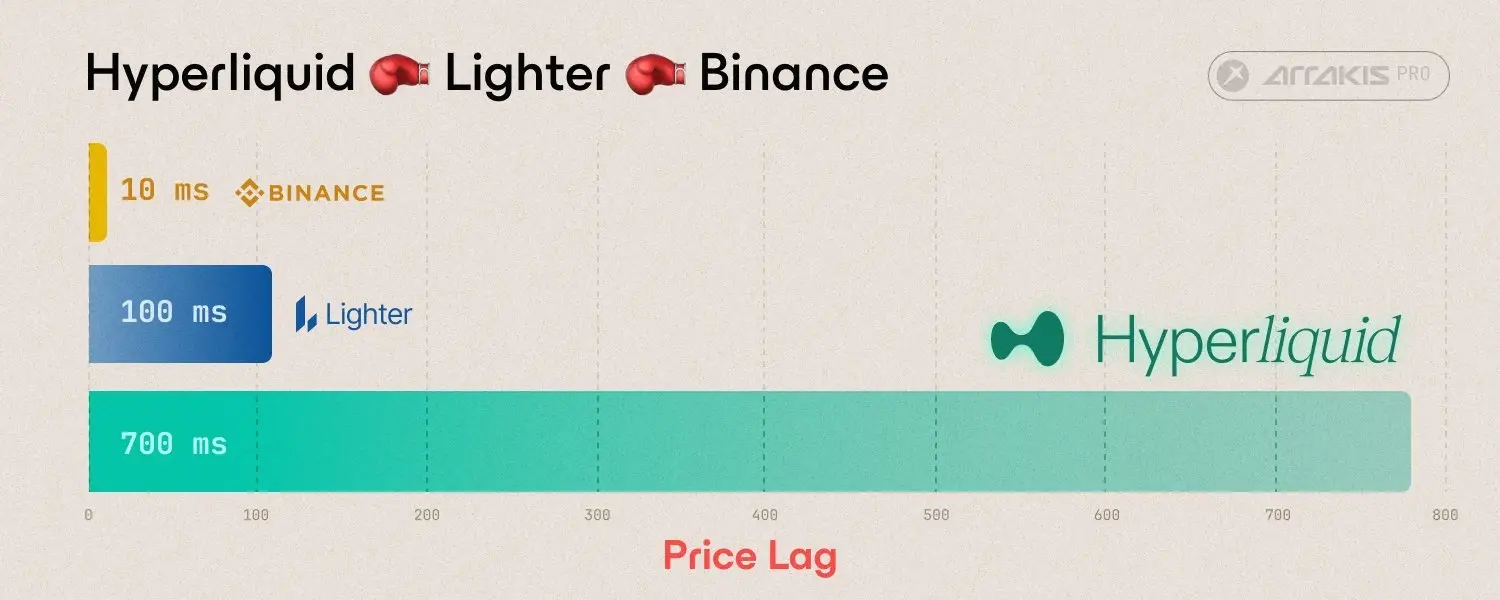
Hyperliquid is currently the benchmark for on-chain order books. It is built on its own Layer 1 "HyperCore," achieving high-frequency matching and low latency. The trading experience is nearly centralized, with ample depth and extreme speed. But speed is not free. Its liquidation mechanism consists of three layers: Market Liquidation: forcibly liquidating losing positions on the order book; Vault Assumption (HLP Intervention): when liquidity is insufficient, the vault takes over positions; ADL (Auto-Deleveraging): when the vault also cannot bear it, the system forces profitable positions to reduce leverage. This makes Hyperliquid nearly impossible to go bankrupt, but the cost is: even if you are a winner, you may be passively liquidated. The recent "1011" incident fully exposed its design flaws, where ensuring system fairness sacrificed individual fairness.
GMX: The Steady Player of AMM Perpetuals
GMX is a pioneer in the AMM perpetual space and currently the king of AMM Perp DEXs. The true era of AMM perpetuals began with GMX. It is not a follower but a trailblazer, the GOAT 🐐 of this track.
GMX V2 brought decisive structural innovations: Isolated GM Pools: the risk of BTC belongs only to BTC, the risk of ETH belongs only to ETH, meme volatility will not drag down the mainstream market → AMM perpetuals bid farewell to the past of "one loss, all losses";
Oracle-Mark pricing mechanism: no longer blindly trusting pool prices, directly aligning with external real markets → Arbitrageurs can no longer plunder LPs for free;
Continuously Online Liquidity: when order books go dark, AMM becomes the "last layer of execution guarantee." GMX has provided AMM perpetuals with value and position, proving it can become a true market infrastructure, not a backup, but the mainstay.
However, GMX's design still faces two structural challenges that we believe need to be addressed:
1️⃣ LPs = market counterparties, trending markets → LPs continuously bleed, TVL shrinks when the market needs it most, and the market cannot rely on "luck" to navigate cycles.
2️⃣ Risks are not layered; conservative funds and high-risk funds bear the same loss priority. Institutions will only ask, "Why must I bear all the risks of market behavior?" → Unable to persuade regulatory funds and large-scale liquidity to enter → AMM perpetuals struggle to truly expand their scale. Next comes the era of structural upgrades, which is where Honeypot Finance stands, and the reason we firmly believe that the next leap in solutions is coming.
IV. Honeypot's Innovation: Structurally Repairing the Fragility of AMM Perpetuals
When designing and breaking through existing AMM models, we focus on three things: risks must be layered; trading and liquidation must be predictable; shocks must be isolated. To this end, we introduce a complete structural upgrade:
1: LPs do not directly face AMM. LPs deposit funds into ERC-4626 vaults of their chosen different risk levels (junior, senior): Senior Vault: fee priority, last to bear losses (institutional/conservative funds). Junior Vault: bears losses first, exchanges for higher yields (crypto-native style).
2: The vault provides liquidity for AMM's "oracle-anchored quote bands" (Senior focuses on near-end bands, Junior focuses on far-end bands).
3: Traders execute trades with vault liquidity; large orders span more bands → slippage and order size are linearly predictable, centered around the oracle-marked price.
4: Funding fees and utilization rates are fine-tuned by the minute, making the crowded side pay more fees, allowing positions to self-rebalance.
5: Market isolation: each trading pair has independent AMM, vault, limits, and liquidation logic, preventing cross-asset chain reactions.
We also simultaneously address the fairness issues present in Hyperliquid's liquidation process. When events like "1011" occur, with high volatility + concentrated liquidations + tight liquidity, Hyperliquid's liquidation design path ensures system safety, but winners are reduced in positions at their most successful, sacrificing individual fairness and profit.
Our liquidation order: Honeypot Liquidation Order (Process Fairness)
1️⃣ Partial reduction → reduce leverage instead of direct liquidation
2️⃣ Small auctions → marketize risk transfer
3️⃣ Junior vault bears losses first → voluntary risk assumption
4️⃣ Insurance pool as a safety net → avoid systemic shocks
5️⃣ ADL executed in small batches → truly a last resort
We first protect the system while also protecting successful individuals. This is a combination of system fairness + process fairness. In Honeypot's system: risk is voluntary, and victory can also be retained. Our design first safeguards the system with structure, then protects successful individuals.
V. Three Systems Horizontal Comparison: Speed, Resilience, Trust

VI: Honeypot Finance Allows Every Market Participant to Perfectly Balance Yield and Risk
In the design of Honeypot Finance, every role truly has its place.
Crypto-native yield players: Junior Vault = volatility as a source of yield, risk is no longer hidden.
Institutions and compliant capital: clear drawdown boundaries, auditable ERC-4626 assets, can participate with peace of mind.
Traders: stable markets → CEX-level experience; volatile markets → predictable slippage and liquidation logic, profits will not be suddenly stripped away.
VII. Conclusion: Speed Represents Performance, Predictability Represents Trust
Hyperliquid → Performance Limits
GMX → Structural Pioneer
Honeypot → A New Baseline of Resilience and Trust
We do not pursue speed; we pursue stability. When the market truly cares not about who has the lowest spread, but rather: when everything is falling, can you still execute trades? On that day, the new baseline of AMM perpetuals will be rewritten in the way of Honeypot.
 Risk warning Risk warning