Space Review | Trump's Pardon of CZ: Strategic Shift Behind the Policy, Market, and Ecological Opportunities of TRON

 The U.S. cryptocurrency strategy has undergone a major change with Trump's pardon of CZ, analyzing the investment logic and ecological opportunities under the new paradigm of the market.
On October 23, 2025, U.S. President Trump signed a presidential pardon for Binance founder Zhao Changpeng (CZ), a decision that has sparked widespread attention in U.S. politics and the cryptocurrency industry. Behind this decision is the "U.S. Crypto Capital" strategy that the Trump administration is vigorously promoting, marking a fundamental shift in the U.S. attitude towards the cryptocurrency industry.
The background of this pardon dates back to 2024, when Binance reached a historic settlement with U.S. regulators, agreeing to pay up to $4.3 billion in fines, while CZ himself faced legal responsibilities for violating the Bank Secrecy Act. In less than a year, the dramatic shift from severe penalties to a presidential pardon highlights the strategic adjustment of U.S. cryptocurrency policy.
On October 28, a deep discussion about the Trump pardon controversy and its potential to shake up the future of the global cryptocurrency market took place in a Twitter Space hosted by SunPump. This Space brought together several industry veterans, aiming to penetrate the surface and explore the political logic behind the pardon, its far-reaching impact on the cryptocurrency market, and the layout strategies for ordinary investors in the new cycle. This was not only a gathering of information but also a valuable collision of ideas for all market participants to clear the fog and seek direction at a critical turning point.

The Logic Behind Trump's Pardon of CZ: Interest Transfer or Grand Strategy?
Regarding Trump's pardon of CZ and the motives behind it, guest Bi News first peeled away the surface fog. He pointed out that although there is concrete project cooperation between Binance and the Trump family business entities, this essentially aligns with the normal mechanism of lobbying by business groups through Political Action Committees (PACs) in the U.S. political ecology. For the cryptocurrency industry, this should be seen as a positive "political feedback," signaling a significant shift in the policy environment.
Guest Tang Eleven echoed Bi News's viewpoint and supplemented it from a financial perspective. He believes that Trump's policy is equivalent to "opening the door" from a top-level design perspective, allowing for "policy easing." This increases the likelihood that the liquidity released by the Federal Reserve will flow into the relatively smaller cryptocurrency market, creating a "rising tide lifts all boats" effect. For ordinary participants, the key is to "get closer to the water source" and engage in early projects that can capture this policy dividend.
Guest 527 offered a broader perspective, revealing the deep considerations behind the U.S. strategy to build a "crypto capital": Subjectively, this is in response to the challenges posed by new energy and multipolar currencies to the dollar's hegemony, constructing a global new settlement network for the dollar by "chain reforming" core assets like U.S. stocks and bonds and promoting stablecoins to consolidate its financial hegemony; objectively, cryptocurrency technology serves as the foundational infrastructure prepared for the impending AI economic wave, with blockchain becoming the key basis for efficient and trustworthy collaboration and payments among AI agents. Based on this grand perspective, he believes that the Trump administration's "pardon" of CZ is by no means a simple exchange of interests, but rather a strategic transformation of the U.S. from exclusion to full embrace of cryptocurrency assets in order to seize the next generation of technological and financial high ground.
After deeply analyzing the strategic intentions behind the pardon, the discussion naturally shifted to its actual impact on the market: Can the resonance of Trump's pardon of CZ, the listing of Hong Kong's first Solana ETF, and the Federal Reserve's interest rate cut expectations truly ignite a new round of cryptocurrency bull market?
Although these three major events have formed a rare synergy, the guests generally held a cautiously optimistic attitude. They believe that, given the current market size is no longer comparable, fully replicating the frenzied bull market of 2019 is unrealistic. A more likely scenario is that this round of resonance will give rise to a new market paradigm with more structural characteristics: centered around mainstream assets and compliant channels, pushing the market towards a more mature and mainstream new development stage. For savvy participants, this will undoubtedly bring a new round of significant opportunities, but the forms of these opportunities will be more diversified, requiring investors to possess stronger track selection and ecological layout capabilities.
Investor Layout Guide: Left Hand Meme Traffic, Right Hand Stablecoin Returns, Tron as the Core Carrier
In the concluding segment of the Space, the discussion returned to the most concerning question for every participant: In the face of Trump's pardon of CZ and the grand narrative of building a "crypto capital," how should ordinary investors layout? The guests engaged in a highly practical discussion from track selection to specific strategies.
Mr. Bai proposed an insightful viewpoint: he suggested moderately allocating Meme coins. He believes that the core value of Meme coins in this cycle lies in their strong user acquisition ability and extremely low promotional resistance. He cited the Meme coins issued by Trump himself as an example, pointing out that they are essentially "fair enough and transparent enough" community assets, without the low-priced chip dumping from VCs, bringing valuable new users and liquidity to the industry. For community leaders and ordinary users, participating in Meme coins with small funds is both an embrace of traffic hotspots and a controllable risk attempt.
He further pointed out that investors can focus on Meme projects backed by strong ecosystems and community consensus. For example, the Meme fair launch platform SunPump within the Tron ecosystem, which combines community enthusiasm and ecological empowerment potential. With the help of SunPump and its automatic token issuance AI assistant SunGenX, users can quickly discover hot projects and participate in market trends, allowing them to deeply engage in an active ecosystem.
At the same time, a more certain main line was repeatedly emphasized by multiple guests—stablecoins. Guest 527 conducted an in-depth analysis, believing that the golden period for retail investors to make money may just be beginning. His core logic is that for the U.S. to realize the vision of a "crypto capital" and promote the on-chain of dollar assets, the most direct way is to cultivate user habits through high-yield incentives and airdrop expectations. Based on this, he suggests that ordinary investors focus on participating in various projects centered around dollar stablecoins, sharing the industry development dividends through active participation in ecological construction.
In this trend, choosing a public chain with strong compliance backing, a complete stablecoin infrastructure, and a thriving DeFi ecosystem is crucial. The Tron ecosystem is an excellent carrier of this trend.
The compliance advantage of Tron lies in the fact that it officially landed on NASDAQ (stock code: TRON) through "Tron Inc." in July 2025, becoming one of the few listed entities based on a blockchain mainnet. This milestone event provides strong compliance backing for the entire Tron ecosystem. The listing is not just a formal change; Tron Inc. has also submitted a plan to the SEC to issue up to $1 billion in mixed securities, clearly stating that the funds will primarily be used to purchase TRX tokens and for corporate operations. This means that in the future, at least $1 billion of compliant capital can legally flow into the Tron on-chain ecosystem through this listed company structure.
The advantages of stablecoins are equally significant. TRONSCAN data shows that the issuance of USDT on the Tron network has exceeded 78.5 billion, making it the absolute main channel for dollar stablecoins to flow on-chain. More importantly, the Tron ecosystem strategically introduced the compliant stablecoin USD1 backed by the Trump family, which not only achieves a deep binding with compliant dollars but also represents a key step in actively embracing the U.S. regulatory framework and strengthening its legitimacy.
At the same time, the DeFi projects within the Tron ecosystem are flourishing. TRONSCAN data shows that the total locked value (TVL) of the Tron ecosystem has exceeded $25.5 billion, with the TVL of the core lending protocol JustLend DAO surpassing $7.3 billion, making it one of the key protocols with strong profitability within the ecosystem. Additionally, the first native perpetual DEX of the Tron ecosystem, "SunPerp," has also performed outstandingly, with trading volume rapidly exceeding $1.8 billion since its launch in September 2025, and the total trading volume has reached $2.98 billion, with registered users surpassing 29,000, showcasing the development potential of this emerging track.
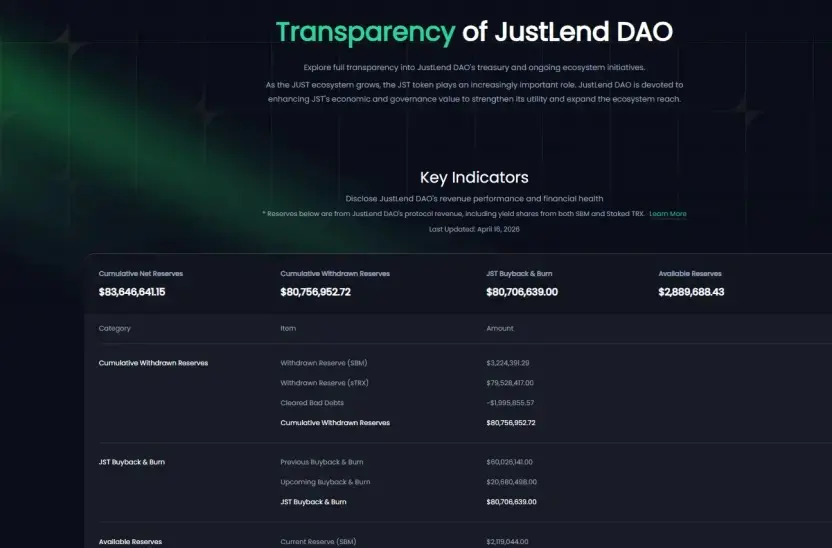
Even more noteworthy is that the large-scale repurchase and destruction plan for the ecological governance token JST has officially launched, injecting strong deflationary momentum into the ecosystem. According to the announcement, JustLend DAO has completed its first repurchase using 17,726,141 USDT from its existing earnings, successfully destroying 559,890,753 JST, accounting for approximately 5.66% of its total supply. This destruction is not only significant in scale but also establishes a sustainable "value flywheel" model, where the net income of the JustLend DAO protocol and the excess returns of the USDD multi-chain ecosystem will be continuously used for repurchasing and destroying JST, providing solid support for the long-term value of the token.
As the guests have insightfully pointed out, the industry is transitioning from chaos to compliance and mainstream, which means that the myth of getting rich quickly will diminish, but sustainable earning opportunities based on logic and ecological participation are emerging on a large scale. For ordinary participants, understanding the capital logic behind the "crypto capital" strategy and choosing ecosystems like Tron, which have a large stablecoin foundation, a thriving DeFi ecosystem, and a clear compliance path, is undoubtedly a rational strategy to seize the dividends of this era.
 Risk warning Risk warning