








Space Review | Focusing on the second half of the DeFi track, how does JST repurchase and burn practice long-termism?
 JST drives the deflationary flywheel with real protocol revenue, creating an independent market trend against the odds.
DeFi was once the core narrative of the crypto market, but as high APY and liquidity bonuses fade, the market is gradually returning to rationality. Today's users are no longer simply buying into stories; they are beginning to think about more fundamental questions: why continue using DeFi in the current environment? What mechanisms can truly transcend industry cycles?
In response to these questions, this issue of Space conducted an in-depth discussion. Guests analyzed the evolution of DeFi from "high APY driven" to "real yield driven," focusing on the transformation of DeFi narratives and value anchors, as well as the JST buyback and burn mechanism within the TRON ecosystem. They explored what kind of DeFi projects can survive market attention being diverted to AI and RWA. Below is a highlight of this issue's dialogue.
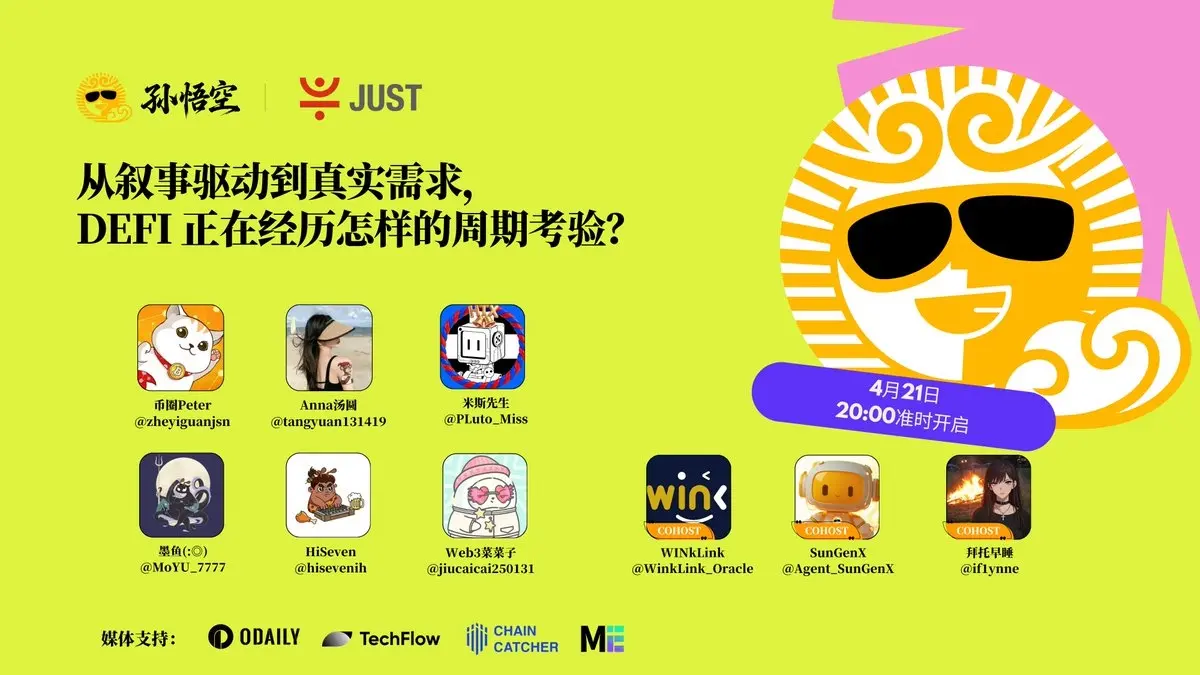
As the tide recedes, the core opportunity of the new DeFi cycle lies in deepening "real demand"
In the context of rapidly shifting narratives in the current crypto market, is DeFi still the main line for the next cycle? Will its position be replaced? In response to this question, multiple guests unanimously agreed that DeFi still occupies an unshakable position in the crypto market, but its narrative style and value anchors have fundamentally changed.
Peter from the crypto circle first broke down the current market structure. He believes that the stratification of market value is becoming increasingly evident. The AI sector carries the immense imagination brought by technological innovation, Memecoins embody the emotional atmosphere of the community, while RWA contains policy expectations and incremental funding stories. These three sectors have a natural advantage in attracting short-term traffic and speculative funds because they "are easier to tell stories about."
However, Peter sharply pointed out that a focus on attention does not equate to a sedimentation of value. Especially when the market enters a phase of volatility and correction, funds will quickly shift from speculation to risk aversion, seeking sectors with "verifiable data." He noted that the essence of DeFi is financial infrastructure, not trend products reliant on narratives or the fulfillment of expectations. As long as there are assets and transaction demands on-chain, the value of DeFi will naturally amplify with the market's recovery; this is its underlying logic for transcending cycles. Mr. Mis also pointed out that without DeFi as the foundational capital pool and financial Lego, emerging sectors cannot support massive capital inflows. Therefore, even when future emotional waves recede, funds will ultimately return to the core area of DeFi.
While affirming DeFi's "cornerstone" status, guests also noted the shift in its role. Unlike the absolute dominance during "DeFi Summer," after experiencing cyclical rotations, DeFi is becoming solidified as a basic infrastructure akin to water and electricity. HiSeven believes that if DeFi wants to truly lead value in the next phase, the market's evaluation criteria will change: in the past, people valued high APY and short-term liquidity incentives for wealth effects. In the next cycle, real users, real protocol income, and long-term sustainable operational mechanisms will be core.
HiSeven added three specific dimensions for future project selection: real protocol income and distribution capability, sustained user retention and repurchase behavior, and sustainable mechanisms that can operate even in cold markets. He asserted that the core opportunity for DeFi in the next phase is no longer to tell newer stories but to expand, deepen, and solidify the real demands that already exist but have not been fully priced.
The new narrative of DeFi's second half: How can JST leverage the buyback and burn mechanism to create an independent market?
Based on the views of various guests, the evolution direction of DeFi in the next phase is already clear: the era of high leverage and inflated APY is coming to an end, and a new phase driven by real demand, anchored by protocol income, and rebuilt trust through data transparency is beginning. In this context, the TRON DeFi ecosystem interprets the substantial transition from "traffic thinking" to "value thinking" through the buyback and burn of JST with real money.
JST is the governance token of the JUST protocol within the TRON ecosystem, and its buyback and burn mechanism is a system arrangement deeply tied to protocol income, approved by community proposals. On October 21, 2025, the community proposal was officially passed, deciding to use the existing income of JustLend DAO, future net income, and over $10 million from the USDD multi-chain ecosystem income entirely for buyback and burn. This fundamentally creates a self-reinforcing closed loop of "the more income → the more buyback → the more burn → the stronger deflation."
Once the mechanism was established, the real test was execution. Looking back at the six months from October 2025 to now, JST has efficiently completed three rounds of large-scale buyback and burn, with a tight rhythm and increasing investment intensity:
The first round (end of October 2025) involved approximately $17.72 million, burning about 559 million JST, accounting for 5.66% of the total supply.
The second round (January 15, 2026) saw a significant increase in the burn amount, with approximately $21 million invested, burning about 525 million JST, accounting for 5.30% of the total supply.
The third round (April 15, 2026) involved approximately $21.3 million, burning about 271 million JST, accounting for 2.74% of the total supply.
In total, over $60 million has been invested, permanently burning about 1.356 billion JST, accounting for 13.7% of the total token supply. Based on the recent market price of JST at around $0.08, the total value of the burned tokens has exceeded $100 million.
The continuous buyback and burn with real money has had the most direct effect on the price trend of JST. Before the buyback and burn plan was initiated, the price of JST hovered around $0.032, and by December 2025, the price quickly rose to about $0.045, with a phase increase of about 40%. By the end of March 2026, the cumulative increase over six months approached 100%, and it continued to rise, breaking above $0.085, with an increase of over 160% compared to before the mechanism was initiated. Even in a market environment where Bitcoin's decline exceeded 37% at one point, JST still exhibited an independent market performance.
The true significance of this mechanism lies in its deep binding of token value to the fundamentals of the protocol. As Web3's Cai Cai Zi stated, all three rounds of JST burns used the protocol's real net income without any external subsidies, marking the formation of a positive flywheel of "real demand sedimenting income, protocol income feeding back to holders," and establishing a long-term verifiable value anchor for the entire sector.
Ultimately, DeFi is bidding farewell to the stage of barbaric growth and returning to the essence of finance. Whether it is the deepening of real demand or deflationary mechanisms supported by actual protocol income like JST, both reflect a substantial shift in market focus towards "sustainability." In future cycles, setting aside inflated expectations, those DeFi projects that can solidly capture value, establish healthy income distribution mechanisms, and speak with transparent data will truly possess the foundational basis for long-term development.
 Risk warning
Popular articles





