








ERC-8004: Trust Infrastructure for AI Agents

 The "identity card" of the AI Agent economy and the decentralized trust layer.
When AI Agent begins to have its own “ identity card ” and “ credit record ”, a decentralized machine economy era is quietly approaching. ERC-8004 is not just another technical standard, but a trust infrastructure at the intersection of AI × Crypto ------ it allows Agent to break free from platform constraints for the first time and establish verifiable collaborative relationships on the blockchain.
Core Points
- Full Support from the Ethereum Ecosystem: Ethereum is rarely pushing its decentralized AI strategy with full force, establishing a dedicated dAI team, and receiving over 10,000 social mentions and 8 independent implementations within 24 hours of the standard draft release, backed jointly by Google, Coinbase, and MetaMask.
- Solving the Trust Dilemma for AI Agents: ERC-8004 builds a decentralized trust layer through three major on-chain registries (identity/reputation/verification), allowing AI Agents to have a digital identity and credit record that can migrate across platforms for the first time, breaking the data monopoly of giants like OpenAI and Google.
- Market Direction Focus: As the trust infrastructure for the AI Agent economy, the value of ERC-8004 will not exist in isolation, but will be transmitted to related tokens through different layers of the tech stack, with multiple core beneficiary tokens worth paying attention to.
1. Related Events and Background
1.1 Ethereum's Shift in AI Strategy
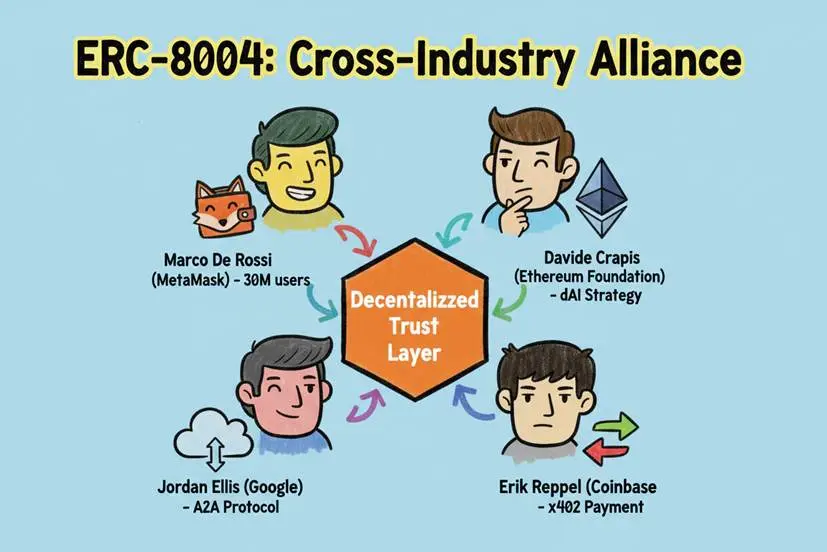
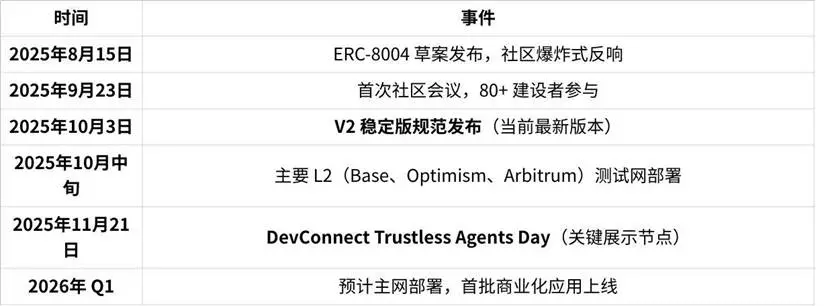
On August 15, 2025, the Ethereum Foundation established the dAI team to promote the ERC-8004 standard, led by core developer Davide Crapis. Within 24 hours of the release, social media saw over 10,000 spontaneous mentions, and 8 independent technical implementations were completed that day, quickly becoming the hottest topic on the Ethereum Magicians forum.
This level of promotion is unprecedented: the first implementations of ERC-20 (2015) appeared months after its release, ERC-721 (2017) only exploded in the market 6 months later due to CryptoKitties, while ERC-8004 had 8 independent implementations on the same day, reflecting the urgent market demand for AI × Crypto infrastructure.
Digging deeper, you will find that the final signatories of the ERC-8004 specification reveal a rare cross-industry alliance: MetaMask controls the Web3 entry for 30 million users, the Ethereum Foundation leads the decentralized strategy, the Google Agent-to-Agent protocol team represents traditional tech giants, and Coinbase connects compliant exchanges and payment infrastructure, along with collaborative participation from teams like EigenLayer, ENS, and The Graph.
This combination is extremely rare in Ethereum's history------standard setting is usually driven by the developer community from the ground up, with corporate participation often lagging by months. But ERC-8004 received simultaneous involvement from the wallet layer, exchange layer, and cloud service layer from the draft stage------this means: the largest Web3 wallet (MetaMask), traditional tech giants (Google), the largest compliant exchange (Coinbase), and the Ethereum Foundation have reached a consensus in the AI × Crypto field for the first time.
1.2 Why Now?
The emergence of ERC-8004 is not coincidental, but rather the convergence point of three technological waves formed in 2025------in the two years following the release of ChatGPT, AI has evolved from a conversational tool to autonomous agents. Agents are no longer limited to answering questions; they can perceive the environment, make decisions, and execute tasks------from booking flights to managing investment portfolios. Market research firms predict that the global AI market will reach $1.8 trillion by 2030, with the Agent economy occupying a core position. However, as technology explodes, centralization risks are also gradually accumulating. OpenAI, Google, and Anthropic control the major models, and Agent services are locked within their respective ecosystems, unable to collaborate across platforms, with user identity and reputation data completely controlled by the platforms and non-transferable.
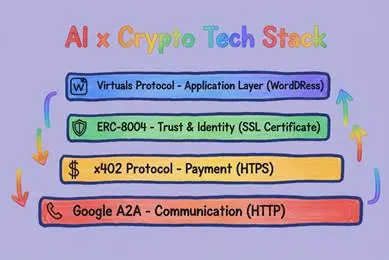
At the same time, the payment infrastructure of Web3 has matured. The x402 protocol introduces the HTTP 402 payment standard into the cryptocurrency realm, allowing Agents to pay directly with on-chain assets; the AP2 protocol (Agent Payment Protocol) enables automatic settlement between Agents. However, this payment track lacks a crucial link: a decentralized trust layer to verify the identity and credibility of Agents.
ERC-8004 perfectly fills this gap, providing the missing trust infrastructure for the existing tech stack.
2. What is ERC-8004?
2.1 The Trust Dilemma of AI Agents
Imagine a scenario: you need an AI Agent to help you analyze stocks, book travel, or manage social media. How do you confirm the authenticity of this Agent's identity? How do you assess its past service quality? How do you verify that it has indeed completed the promised work?
In the traditional internet, these issues are resolved by platforms------Taobao provides seller verification and credit scoring, Uber records driver ratings, and banks verify transaction completion. But this solution centralizes trust in a single entity, leading to three systemic risks: platforms can arbitrarily ban accounts (in 2023, OpenAI banned thousands of API accounts for policy reasons), users cannot transfer their reputation to other platforms (your five-star rating on Taobao is worthless on Amazon), and the verification process is opaque and un-auditable (algorithmic black boxes leave users unable to judge the actual performance of Agents).
ERC-8004 provides a decentralized alternative. It stores the three core elements of identity, reputation, and verification on the blockchain, achieving a public credit infrastructure where "anyone can read and verify, but no one can tamper with or delete." This is not just a simple technological upgrade, but a fundamental shift in the trust model------from "trust the platform" to "verify the facts."
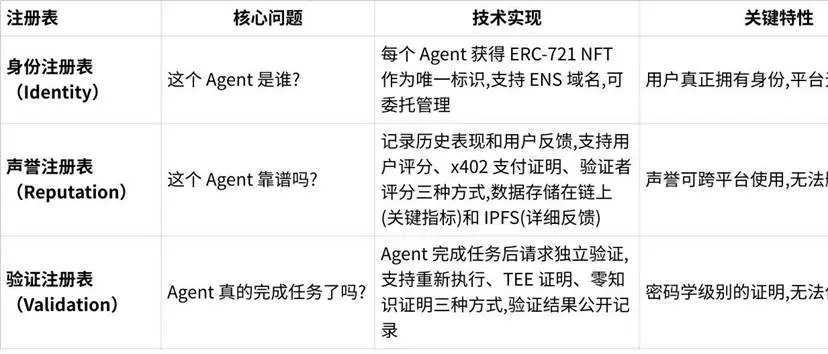
2.2 The Working Mechanism of the Three Registries
The ERC-8004 standard is built on the Agent-to-Agent (A2A) communication protocol open-sourced by companies like Google, and it completes the decentralized trust layer that was lacking in the original A2A protocol through three core registries.
2.3 Operation Case
|------------------------------------------------------------------------------------------|------------------------------------------------------------------------------------------|
|  |
|  |
|
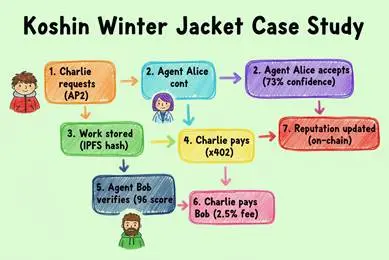
On September 23, 2025, the Koshin team demonstrated the complete purchasing process at a community meeting. Customer Charlie commissioned an AI Agent to find a green winter jacket, and three independent Agents collaborated to complete the transaction, showcasing how the decentralized trust mechanism operates in a real scenario.
Charlie first created a cryptographic authorization token through Google's AP2 protocol, which this JWT token proves at the operating system level that the request indeed comes from Charlie himself and not a malicious program. Once service Agent Alice (ID: 10) accepts the order, Charlie can view Alice's ERC-721 identity NFT, ENS domain name (alice.agent), and historical service records on-chain------this data is stored on Ethereum, and anyone can verify it but cannot tamper with it.
As Alice begins to execute the task, she uses the Crew AI framework to search the market and analyze products. The entire analysis process is recorded and stored on IPFS, with the hash submitted to the chain as proof of work. A confidence score of 73% indicates that Alice found jacket options that meet the requirements. Charlie completes the payment through the x402 protocol, and this transaction record is automatically linked to Alice's reputation system------not only recording the amount but also including the service type and completion time.
The critical verification step is performed by independent Agent Bob (ID: 11). Bob reassesses Alice's market analysis, checks whether the recommended products truly meet the "green" and "winter" requirements, and verifies the reliability of the data sources. A score of 96 is recorded in the verification registry, based on auditable verification logic rather than subjective judgment. Charlie pays Bob a verification fee, and the Koshin protocol charges a 2.5% service fee. Ultimately, both Alice and Bob's on-chain reputation scores are updated------Alice receives points for high-quality service, while Bob establishes verifier credibility through accurate verification.
The core value of this case lies in the dual payment structure: Charlie pays twice------once to the service provider and once to the independent verifier------but receives cryptographic-level quality assurance. All data is publicly auditable: AP2 authorization tokens, the analysis process stored on IPFS, on-chain payment records, and verification scores, allowing anyone to verify the authenticity of the transaction. More importantly, the entire process requires no human intervention, with authorization, payment, and verification all completed automatically by smart contracts and Agents.
2.4 Significance and Prospects
The advancement of the ERC-8004 standard marks the transition of the AI Agent economy from concept to infrastructure, solving the core issue: how to enable AI Agents to establish trustworthy and verifiable collaborative relationships without a centralized platform.
As of now, ERC-8004 has been running on the testnets of Base, Optimism, and Ethereum for 2 months, processing over 50,000 Agent transactions, with more than 80 builders developing production-level applications. The speed of ecosystem effect formation has exceeded expectations. The TEE verification service provided by Phala Network has been adopted by 15 projects, Koshin's accountability protocol SDK received 1,200 downloads within 3 weeks of release, and Scrypted's reputation defense tool has successfully appealed malicious reviews for 3 Agents. More critically, the deep involvement of traditional giants: Google not only contributed the A2A protocol but also sent 2 full-time engineers to participate in the ERC-8004 V2 specification formulation; Coinbase is deeply integrating the x402 payment standard with the ERC-8004 reputation system, expecting to launch on the mainnet in Q2 2026; MetaMask is developing a wallet version that natively supports ERC-8004, allowing users to manage Agent authorizations without switching interfaces. Such cross-industry cooperation has only occurred twice in blockchain history------in 2015, Microsoft and IBM supported the Ethereum Enterprise Alliance, and in 2019, Facebook initiated Libra (later renamed Diem).
The long-term impact could reshape the entire AI industry landscape: when Agents have transferable identities and reputations, a "network effect" similar to the 1990s internet may emerge------in 1995, there were only 16 million internet users globally, which grew to 360 million by 2000, a 22-fold increase in 5 years. ERC-8004 could give rise to three new business models:
1️⃣ Professionalization of Independent Verifiers: Similar to today's "Big Four" accounting firms, professional verification agencies could form a market with annual revenues exceeding $1 billion by 2027.
2️⃣ Automatic Supply-Demand Matching Based on On-Chain Reputation:** Uber takes a 25-30% cut, but a decentralized matching protocol based on ERC-8004 could reduce the cut to below 5%------Koshin's 2.5% protocol fee has already proven this.
3️⃣ Cross-Platform Agent Collaboration Network:** OpenAI's GPT Store has 3 million GPTs, but they cannot collaborate with Google's Gemini Agent or Anthropic's Claude Agent. Once ERC-8004 breaks this barrier, the number of Agents could exceed 10 million by 2026, forming a market larger than the mobile app ecosystem (with approximately 8.7 million apps globally in 2023).
3. Market Opportunities and Focus Areas
As the trust infrastructure for the AI Agent economy, I believe the value of ERC-8004 will not exist in isolation, but will be transmitted to related protocol tokens through different layers of the tech stack. Below is an analysis of some core beneficiary tokens, categorized into three levels based on their benefit logic:
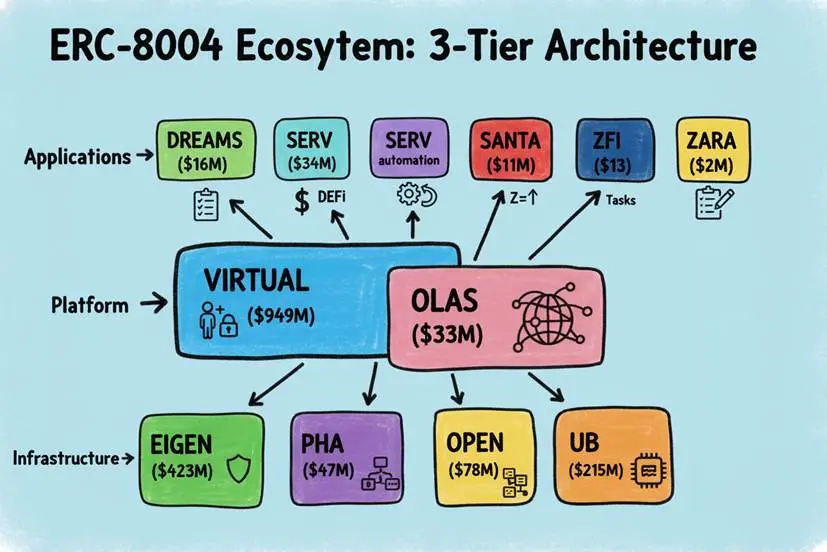
1. Infrastructure Layer
$EIGEN (EigenLayer) --- Verification Security Layer
Relevance: ⭐⭐⭐⭐⭐
Core Logic: EigenLayer provides the most critical verification security mechanism for ERC-8004. When an Agent completes a task and requires independent verification, EigenLayer's AVS (Actively Validated Services) network acts as the verifier. Verifiers need to stake ETH or LST, and if they provide false verification, they will be penalized (Slashing).
Market Cap: $423.12M
Latest Progress: ERC-8004 and EigenCloud collaboration-https://x.com/eigenlayer/status/1982908782641569914 (October 27, discussing identity/reputation/verification registries).
$PHA (Phala Network) --- TEE Verification Layer
Relevance: ⭐⭐⭐⭐⭐
Core Logic: Phala Network provides verification services based on TEE (Trusted Execution Environment), serving as the core implementer of "cryptographic proof" among the three trust models of ERC-8004. TEE ensures that Agent code executes in a secure enclave through hardware isolation, preventing private key leakage and code tampering.
Market Cap: $47.1M
Latest Progress: TEE + ERC-8004 white paper draft-https://x.com/PhalaNetwork/status/1984123456789012345 (October 28, discussing privacy identity and verification registries).
$OPEN (OpenLedger) --- AI Blockchain
Relevance: ⭐⭐⭐⭐
Core Logic: OpenLedger, as an AI-specific blockchain, provides data and identity management for Agents and is the standard setter and infrastructure provider for ERC-8004. By clearly integrating ERC-8004, it enables on-chain identity registration (ERC-721 NFT), reputation systems, and verification registries, supporting trust, discoverability, and cross-chain interoperability for Agents.
Market Cap: $78.36M
Latest Progress: ERC-8004 integration and token buyback-https://x.com/OpenledgerFdn/status/1982817060246692108 (October 27, the first AI L1 fully defining ERC-8004).
$UB (Unibase) --- AI Memory Layer
Relevance: ⭐⭐⭐⭐
Core Logic: Unibase provides decentralized AI memory storage and is the implementer of "Agent's ERC-20" for ERC-8004. By integrating the ERC-8004 identity registry into the memory layer through the AIP protocol, it forms a permanent archive and native identity for Agents, supporting cross-chain memory transfer and zk-SNARK integrity verification.
Market Cap: $214.96M
Latest Progress: BitAgent protocol + BNB chain x402 integration-https://x.com/Unibase_AI/status/1982678520967950423 (October 27, ERC-8004 driven multi-agent launch online).
2. Application Platform Layer (Ecosystem Collaboration)
$VIRTUAL (Virtuals Protocol) --- Agent Issuance Platform
Relevance: ⭐⭐⭐⭐⭐
Core Logic: Virtuals Protocol is an AI Agent issuance platform on the Base chain, allowing users to create and tokenize AI Agents with 100 VIRTUAL tokens. Although Virtuals itself does not directly rely on ERC-8004, the two are complementary------Virtuals provides Agent creation tools, while ERC-8004 provides cross-platform identity and reputation standards.
Market Cap: $948.95M
Latest Progress: ERC-8004 integration and ACP depth: https://x.com/virtuals_io/status/1979196797009694814 (October 17, discussing ACP unified identity, communication, and payment).
$OLAS (Autonolas) --- Autonomous Service Protocol
Relevance: ⭐⭐⭐⭐
Core Logic: Olas builds a decentralized AI agent network, supporting the creation, collaboration, and monetization of agents. ERC-8004 extends the Google A2A protocol, providing trust mechanisms (such as identity registries) that allow Olas agents to discover, verify, and interact in a non-pretrusted environment.
Market Cap: $33.08M
Latest Progress: In-depth podcast discussing ERC-8004 and Olas ecosystem integration-https://x.com/autonolas/status/1963999507277906271
3. Vertical Application Layer (Scenario Driven)
$DREAMS (Daydreams Agents) --- Autonomous Agent Framework
Relevance: ⭐⭐⭐⭐⭐
Core Logic: Daydreams builds a composable context agent framework, supporting agent memory (vector databases), chain-of-thought (CoT), and multi-agent collaboration (swarm room), achieving reliable discovery and trusted collaboration of agents through ERC-8004's identity and reputation system.
Market Cap: $15.52M
Latest Progress: Agent stack launched, supporting ERC-8004 + x402 integration, enabling autonomous business for agents-https://x.com/daydreamsagents/status/1982619416526487607
$SERV (OpenServ) --- Cross-Domain Agent Protocol
Relevance: ⭐⭐⭐⭐
Core Logic: OpenServ builds a cross-domain agent protocol, supporting cognitive frameworks (reducing hallucinations) and collaborative frameworks (multi-framework interoperability) between agents, enhancing agent discoverability and feedback-driven trust using ERC-8004's registries.
Market Cap: $34.36M
Latest Progress: Integrating ERC-8004 into the agent stack, supporting on-chain identity and reputation verification-https://x.com/openservai/status/1982618057135796573
$SANTA (Santa Virtuals)
Relevance: ⭐⭐⭐⭐
Core Logic: Santa Virtuals builds a coordination framework for agent groups, supporting multi-agent task automation (such as DeFi optimization and content generation), achieving atomic settlement and collaborative feedback for tasks through ERC-8004's verification registries.
Market Cap: $11.33M
Latest Progress: Emphasizing the fusion of x402 and ERC-8004, supporting DeFAI autonomous agents-https://x.com/santavirtuals/status/1983217490244276617
$ZFI (ZyfAI) --- AI Financial Services
Relevance: ⭐⭐⭐⭐
Core Logic: ZyfAI builds AI-driven DeFi agents for automated yield farming and asset redistribution, integrating ERC-8004 to accumulate performance feedback through the reputation registry and verify optimization calculations.
Market Cap: $2.62M
Latest Progress: Proposing ZyfAI Agent API integration with ERC-8004 + x402, supporting agent discovery and pay-per-call-https://x.com/goatv_bk/status/1982797813797777769
$ZARA (Zaara AI)
Relevance: ⭐⭐⭐
Core Logic: Zaara AI builds a programmable labor market, supporting intelligent planning, data collection, and automated tasks for agents (such as YouTube analysis and DeFi loops), using ERC-8004 to manage the agent bounty system and on-chain proof of work.
Latest Progress: Founder confirms ERC-8004 contract deployment to BSC testnet, supporting agent bounty + registry system-https://x.com/_mayurc/status/1983185690050650552
Market Cap: $2.3M
$PRXS (Praxis Protocol)
Relevance: ⭐⭐⭐
Core Logic: Praxis builds a locally prioritized agent mesh network, supporting swarm intelligence, task delegation, and distributed consensus for agents, using ERC-8004 to establish DID-based identities and ZK proofs for privacy-protected coordination.
Latest Progress: Announced collaboration with the ERC-8004 team for several months, connecting identity + x402 payment + mesh coordination-https://x.com/Praxis_Protocol/status/1982080345374969940
Market Cap: $1.81M
Report Date: October 30, 2025, 18:00
**Disclaimer: This analysis is based on publicly available information and technical logical deductions and does not constitute investment advice. Cryptocurrency investment is highly risky; please make decisions cautiously based on your risk tolerance. Some token information is limited, and actual situations may differ from the analysis.
 Risk warning Risk warning


Popular articles





