"Introduction to DeFi Study Notes - Stablecoin Chapter"

 Stablecoins have become the target of a new round of competition for the monetary system. Perhaps in the near future, whoever controls stablecoins will hold the global monetary hegemony.
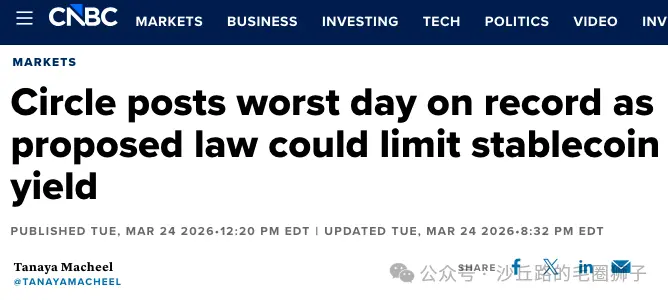
I believe everyone has recently come across the news of Circle's stock price skyrocketing by 620% upon its listing, as well as the "Genius Act" born to digest U.S. debt. Meanwhile, there has been a continuous stream of news in China regarding JD's stablecoin and Hong Kong's stablecoin regulations.
However, some friends still do not understand what stablecoins are. I remember when I was a beginner, I gradually collected information to learn, so I would like to share a study note on getting started with DeFi, starting with an introduction to stablecoins. Any corrections or additions are welcome~
Why Do We Need Stablecoins?
In fact, before 2014, there was no such thing as stablecoins. Users would directly exchange fiat currency to purchase crypto assets, but soon the market exposed some issues: high price volatility, long fiat exchange times, and the proliferation of various worthless tokens, which led banks to refuse to cooperate with exchanges. These problems greatly hindered the development of the crypto market.
From the first principle, the essence of money is actually a commodity that serves as a general equivalent for measuring and exchanging value. In the crypto market, traditional cryptocurrencies experience severe price fluctuations, making it difficult to serve as a general equivalent. Therefore, a digital currency designed to maintain value stability, measure other crypto assets, and act as a medium of exchange—stablecoins—was born.
What Are Stablecoins?
Stablecoins are a type of cryptocurrency that maintains a stable value. They have the advantages of decentralization and ease of transaction associated with cryptocurrencies while avoiding the disadvantages of high volatility that make cryptocurrencies unsuitable for payment pricing.
Stablecoin assets aim to minimize volatility as much as possible and provide users with an effective way to acquire crypto assets. Currently, there are three main types of stablecoins on the market: fiat-collateralized, crypto-collateralized, and algorithmic stablecoins.
The first type is the fiat-collateralized stablecoin, which has the largest market supply and is the most widely used. Examples include $USDT issued by Tether and $USDC issued by Circle. The crypto-collateralized stablecoin is represented by $DAI.
Crypto-collateralized stablecoins are those that use crypto assets (such as ETH) as collateral to issue stablecoins through smart contracts. This type of stablecoin exists entirely on the blockchain and is issued in a decentralized manner, requiring no legal or third-party endorsement.
Due to the high volatility of crypto assets used as collateral, these stablecoins are typically issued using an over-collateralization method.
For example, in Maker DAO, this is executed through a smart contract called CDP (collateralized debt position): to borrow $100 worth of DAI, one must collateralize $150 worth of ETH. When ETH drops in value, the system will auction off the collateralized ETH until the borrowed DAI is repaid.
Crypto-collateralized stablecoins can generally serve as a hedge asset, and these stablecoins often integrate with many DeFi protocols, allowing users to earn higher returns in lending, trading, and liquidity mining to offset the costs of over-collateralization.
The third type is the algorithmic stablecoin, which adjusts market supply and demand through algorithms to keep its price consistently at $1.
Specifically, the price adjustment mechanism of algorithmic stablecoins is essentially a supply-demand model. When the stablecoin price exceeds the target price ($1), the issuance is increased to lower the price; when the stablecoin price falls below the target price, a deflationary mechanism is used to destroy supply, causing the price to rise. This can be done either by directly adjusting the number of tokens in users' wallets through "Rebase" or by designing a dual-token system for exchange adjustments.
The biggest drawback of algorithmic stablecoins is that they may face a death spiral during black swan events in the market. This deflationary mechanism for price drops cannot stabilize the token price in time; it only leads to more selling as prices fall, continuing until market demand stabilizes, represented by $AMPL. Stablecoins have become a new focal point in the competition for the monetary system, and perhaps in the near future, whoever controls stablecoins will hold the hegemonic position of global currency. Interested friends can learn more about this process.
Why Are Stablecoins So Popular?
With the deepening of economic globalization and financial globalization, the connections between countries in trade, capital, and other areas have become increasingly close. Compared to traditional fiat currencies, stablecoins offer advantages such as rapid settlement, global recognition, and higher returns. Additionally, geopolitical crises have frequently occurred over the past half-century, and fiat currencies have strong centralized attributes and political implications, making them likely to be frozen during crises. These reasons have led governments and investors worldwide to pay increasing attention to stablecoins.
The fundamental reason for the recent rise in the popularity of stablecoins is the competition for the global monetary system, or more directly, to digest U.S. debt and maintain the dominance of the dollar. As of May 2025, the U.S. has issued over $36 trillion in debt and has maintained the dollar's hegemonic position through continuous borrowing and money printing.
Anchoring the dollar to stablecoins is akin to the historical anchoring of the dollar to gold and oil. This may be why Trump vigorously promoted the U.S. stablecoin legislation and spoke positively about the crypto space: to create global demand for stablecoins, encouraging issuers to purchase more U.S. debt, thereby maintaining the dollar's hegemonic status.
Stablecoins have indeed become a new focal point in the competition for the monetary system, and perhaps in the near future, whoever controls stablecoins will control the hegemonic position of global currency.
 Risk warning Risk warning