








Claude takes the championship, the truth behind the 6 major AI grid strategy showdown | OKX & AiCoin live evaluation
 Core Viewpoint
 Short-term trading champion Qwen3, is he also a king in grid trading strategies?
The first season of the "AI Cryptocurrency Trading Arena" launched by NOF1 finally concluded at 6 AM on November 4, 2025, leaving the cryptocurrency, technology, and finance circles eager for results.
However, the outcome of this "AI IQ Public Test" was somewhat unexpected. The total principal of $60,000 across six models was reduced to only $43,000 at the end, resulting in an overall loss of about 28%. Among them, Qwen3-Max and DeepSeek v3.1 both made profits, with Qwen3-Max taking the lead; while the four American models all suffered losses.
Interestingly, the recent live evaluation of six AI models conducted by OKX and AiCoin did not focus on short-term trading but instead looked at contract grid strategies. This choice revealed the true performance of the six AI models: in the contract grid strategy, AI achieved " collective survival "------ all models recorded positive returns. This indicates that AI models may be more suitable for neutral, systematic grid strategies rather than short-term speculation.
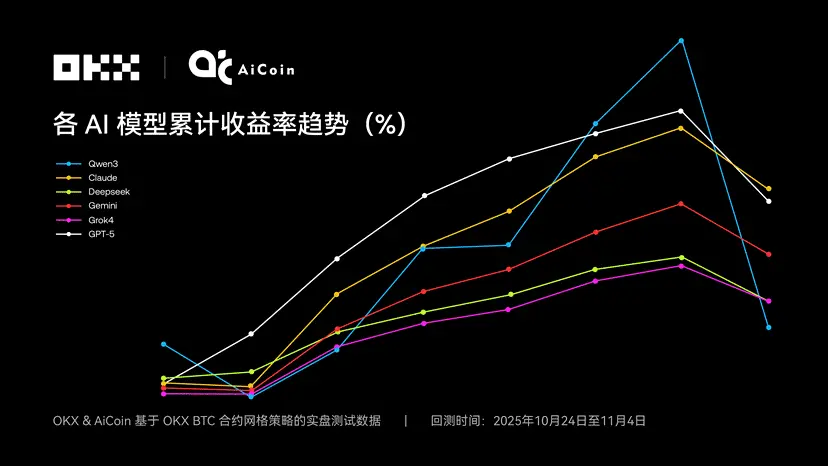
Among them, Claude took the championship, while Qwen3, which ranked first in the NOF1 event, ended up last this time. GPT-5 and Gemini performed relatively steadily, securing second and third places respectively; DeepSeek and Grok4 " reached the same conclusion " despite different strategy settings, their final returns were almost identical.
Why did the same AI models show such a huge contrast in two different tests? What logic lies behind this, and what insights can it provide for strategies and trading users?
6 Major AI Grid Strategies Live: Claude Takes the Championship, All Positive Returns
The story background of the "AI Cryptocurrency Trading Arena" is simple: six AI models each held $10,000 in principal and autonomously traded perpetual contracts for BTC, XRP, etc., on the Perp DEX platform for a period of two weeks (starting around October 18); throughout the process, only market quantitative data was fed, and the AI had to independently decide on long or short positions, leverage, and position size, with each decision accompanied by a confidence score.
To this end, we also adopted a minimalist setting: under uniform conditions (each AI invested 1,000 USDT with 5x leverage), six AI models conducted live tests from October 24 to November 4, 2025. Based on OKX's BTC/USDT perpetual 1-hour price chart, parameters for an AI grid were provided, including price range and grid quantity, direction (long, short, neutral), and mode (arithmetic, geometric).
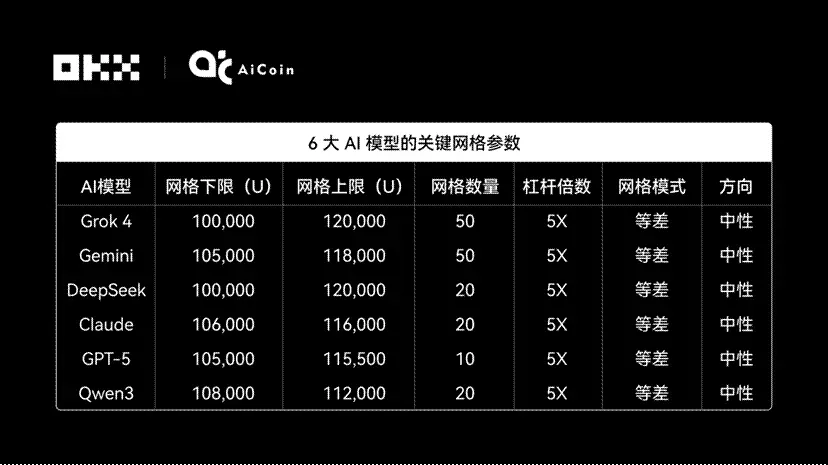
The results showed that all AI models adopted an arithmetic grid mode and neutral grid strategy, but there were significant differences in the execution of specific parameters such as price range settings and grid density: Grok4 and DeepSeek had the widest range (100,000-120,000 USDT), with Grok4 having 50 grids (smaller intervals) and DeepSeek only 20; Gemini's range was 105,000-118,000 USDT, also set at 50 grids; GPT-5's range was narrowed to 105,000-115,500 USDT, with the fewest grids (only 10, the largest interval); Qwen3 had the narrowest range (108,000-112,000 USDT), with 20 grids.
OKX platform market data shows that during this period, the BTC price fluctuated between $103,000 and $116,000, with an overall trend of first oscillating upwards and then sharply declining. It was precisely this "V-shaped reversal" that became a watershed moment for the six major** AI models. This precise range is crucial for analysis, as it directly confirms the core difference between this live test and conventional backtesting, explaining why some AI models "failed."
Here are the live data performances:
Live Champion: Claude
Core Strategy: Moderate Range, Moderate Trigger, Balancing Oscillation and Trend Phases, More Stable
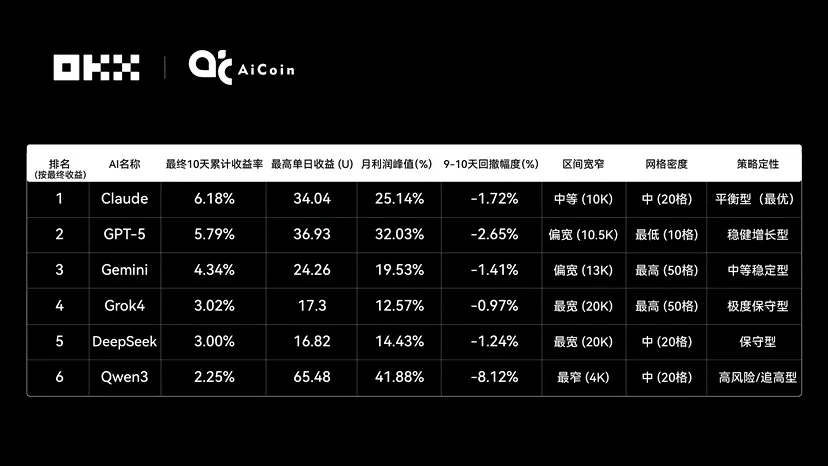
Claude won the championship with a cumulative return of +6.18%. The key to its success lies in its "moderate width and density" grid strategy, which is considered the gold standard and perfectly matched the current BTC oscillating market, serving as a reference model for balancing profit and risk control in live trading.
Its grid range was set at 106K-116K, not as aggressive as Qwen3, nor as broad as Grok4. During the oscillating upward phase, it steadily accumulated profits; even during sharp market declines, the lower limit of 106K effectively controlled the drawdown, outperforming all medium/narrow range models. The moderate range combined with moderate density ensured sufficient grid profits while minimizing the impact of floating losses during sharp declines.
Specifically, during the market rise, Claude avoided the grid idleness seen in Qwen3 at high levels, steadily accumulating +7.90% profit; during the sharp decline phase, when BTC dropped to about 103K, Claude's lower limit of 106K only fell out of the grid by 3K, allowing accumulated profits to effectively buffer the floating losses, resulting in a drawdown of only 1.72% under 5X leverage, demonstrating excellent risk control capability.
Reliable Alternative: GPT-5
Core Strategy: Wider Range, Low Density, High Single Profit, Diluting Risk with Low Position Size
GPT-5 performed steadily, securing second place with a cumulative return of +5.79%, making it a reliable choice just behind Claude. Its strategy is proactive, with a slightly higher risk preference, inclined to seize market opportunities, but its drawdown management is not as good as Claude's. The profit curve shows a stepped increase, growing rapidly, but in the later stages (day 10), the pullback was greater than Claude's. Overall efficiency is high, with profitability about twice that of the benchmark. Currently, GPT-5 is a robust and efficient alternative strategy, balancing returns and moderate risk, but there is still room for improvement in drawdown management.
The core feature of this model's grid strategy is low density and high single profit. Compared to Gemini, although its drawdown reached 2.65%, which is relatively high, the limited number of grids and total position size diluted the risk, while the lower limit of 105K provided a buffer during sharp declines. During the oscillation period, this strategy demonstrated good efficiency, with a cumulative return of +8.44%. Compared to Qwen3, GPT-5's lower limit is lower, significantly enhancing its resilience during price declines. This strategy controls extreme risk exposure by limiting total position size, balancing returns and safety, making it a reliable alternative for those seeking efficiency and stability.
Most Conservative: Grok4
Core Strategy: Widest Range, High Density, Ultimate Defense, Ensuring Safety with Zero Out-of-Grid
The Grok4 model represents the ultimate defensive strategy. Compared to Qwen3, it completely abandoned aggressiveness during the oscillation period in exchange for maximum capital safety. The lower limit of 100K ensures zero out-of-grid when BTC drops to 103K, and the high-density grid further spreads the position risk, resulting in an absolute drawdown of only 0.97%. Compared to DeepSeek, although both have similar efficiency, Grok4's profit curve is the smoothest with the lowest drawdown, making it the most conservative and stable choice, especially suitable for users prioritizing capital safety.
Additionally, there is "DeepSeek with Stable Defense," whose core strategy is------moderate density within the widest range, prioritizing defense while balancing efficiency and zero out-of-grid. And "Gemini with Outstanding Performance," whose core strategy is------wider range, high density, high-frequency micro-profits, spreading risk through broad coverage.
It is worth noting that DeepSeek and Grok4 share the same widest range, with nearly identical final returns, validating the logic of "range prioritizing density": under zero out-of-grid defense, the efficiency difference brought by moderate density is offset, with range width determining resilience, while density mainly affects the smoothness of the profit curve and trigger frequency.
The Gemini model demonstrated the advantage of high-density strategies in a moderate range to enhance drawdown resistance: under the same lower limit as GPT-5, the widely distributed high-density grid effectively diluted the risk of sharp declines, with a drawdown of only 1.41%, significantly better than GPT-5's 2.65%, indicating that high-density strategies can significantly improve stability and curve smoothness, making them an optimal choice for those seeking stable returns.
Overview of the Advantages and Disadvantages of the Six AI Models' Grid Strategies (Note: Detailed strategy characteristics of Qwen3 will be introduced in the next section):
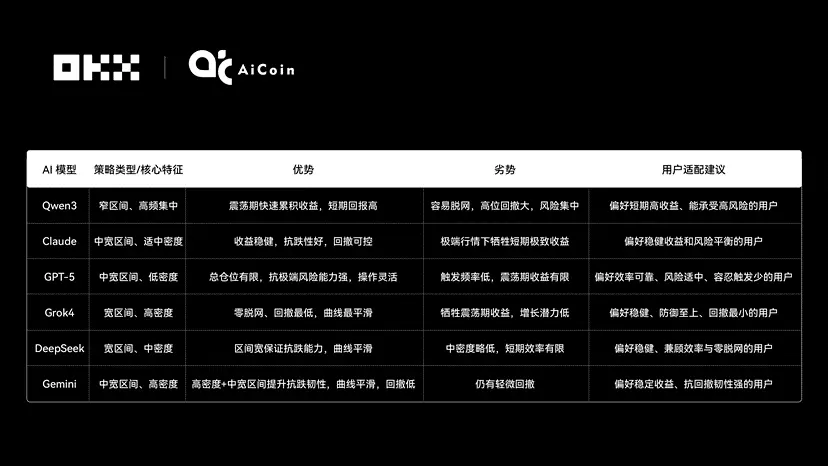
Under the current set conditions, AI models achieved "collective survival" and obtained positive returns based on a solid logic: In a market dominated by oscillating upward trends, all models successfully utilized the strategy's "volatility equals profit" characteristic to accumulate enough safety profit cushions, which were sufficient to withstand the erosion of floating losses even during extreme risks (sharp declines), ensuring that all models maintained positive final returns.
Behind the "Fall from Grace": Short-term Trading Champion Qwen3 Became the Last in Contract Grid?
First, let's review the results of the first season of the "AI Cryptocurrency Trading Arena" launched by NOF1: the Chinese model Qwen3 and DeepSeek both made profits, with Qwen3 taking the lead; while the four American models all suffered losses.
This indicates that high-frequency trading often carries higher risks: excessive trading leads to high fees that erode net value, and low win rates are not inherently scary; the key lies in risk management. It has been proven that even with the emergence of complex AI strategies, simply holding Bitcoin (HODL) can still outperform most models.
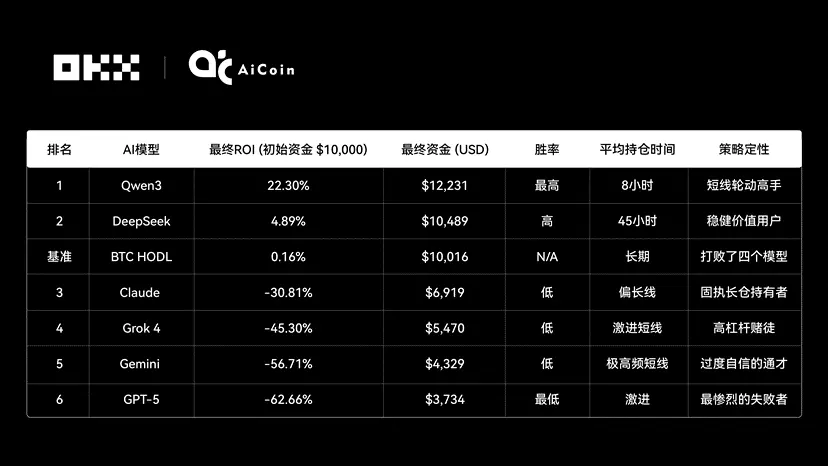
One highlight is the huge contrast in results between the two experiments: Qwen3 surged past DeepSeek to become the short-term trading champion, yet fell from grace in the grid strategy, ending up last. Why?
In this strategy experiment, Qwen3's performance was the "biggest lesson" of this test. It recorded a peak monthly profit of +41.88% and a maximum single-day profit of 65.48U during the testing period, but later faced a massive drawdown of 8.12%, leaving a final cumulative profit of only 22.51U, ranking last.
Its core strategy was: narrow range high-frequency arbitrage, aggressively concentrated, only suitable for central oscillation. During the market rise, it perfectly matched the central oscillation with a narrow range, leading to rapid profit growth to a peak of +10.37%.
However, compared to other models, its lower limit of 108K became the fundamental reason for its collapse: when BTC sharply dropped to about 103K during the decline phase, the 5K U out-of-grid width left the accumulated long positions completely exposed, and the 5X leverage further amplified the floating losses, instantly erasing profits, resulting in a drawdown of 8.12% on day 10, the largest among all models. This fully illustrates that while narrow range strategies can quickly profit during oscillation periods, they lack defensive depth and are only suitable for narrow oscillation markets, making them vulnerable to severe damage when prices deviate.
In the previous "AI Cryptocurrency Trading Arena" first season, the core reason Qwen3 won the championship was------timely strategy adjustments and market adaptation. During the later stages of increased market volatility, Qwen3 adopted a simple, focused single BTC full-position strategy, combined with 5x leverage and precise take-profit and stop-loss, efficiently capturing rebound opportunities, resulting in explosive net value growth, validating its robustness in dynamic uncertain environments (the ability to maintain stable performance and not easily collapse under different environments and market fluctuations) and problem-solving capability. In contrast, DeepSeek's conservative multi-dimensional assessment, while excellent in risk control (highest Sharpe ratio), grew slowly and failed to fully capitalize on the BTC-dominated market, while American models like GPT-5's excessive aggressiveness led to overall losses.
In summary: Qwen3's short-term trading championship stemmed from proactive adaptation, while the failure of the grid strategy resulted from passive parameter flaws. Therefore, AI trading must match the market type and avoid "one strategy fits all."
Another highlight is that in the historical market backtesting conducted by OKX and AiCoin from July 25 to October 25, 2025, none of the six AI models exhibited out-of-grid risks in the grid strategy for BTC/USDT perpetual contracts, with relatively stable performance. However, in this live test, multiple models experienced out-of-grid situations or severe fluctuations in returns. What does this difference indicate?
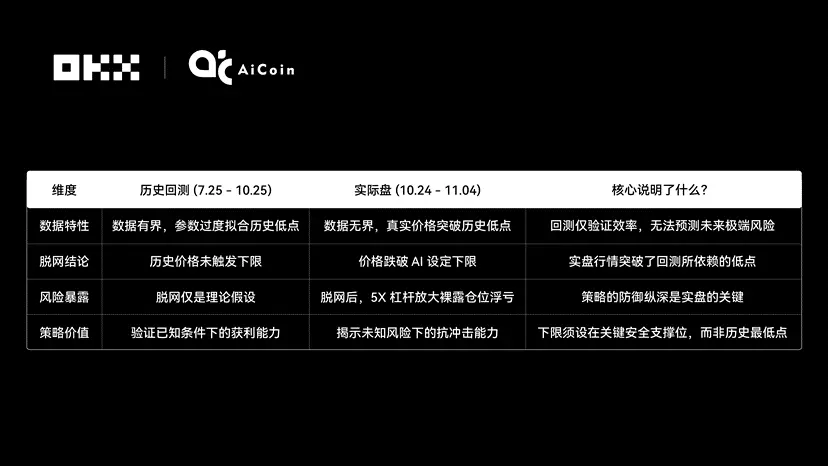
Seeing "zero out-of-grid" in backtesting often provides a false sense of security. This is because the models are too familiar with historical data, essentially being "overfed." But once in live trading, if the market slightly breaks through historical lows, those strategies without defensive lines will directly go out of grid. This also illustrates that survival depends not on clever algorithms but on whether the range is wide enough and the defense deep enough. Do not be misled by "perfect backtesting"; truly useful strategies are those that can survive in the worst market conditions.
How to Outperform the Market? Insights from Two Experiment Results
The strategy tool used in this contract grid experiment was the OKX contract grid (AiCoin AI grid), with all AIs executing strategies based on this tool, ensuring consistency and fairness in trade execution. This is an automated trading tool that supports various modes such as arithmetic, geometric, neutral, long, and short, allowing customization of price ranges, grid quantities, leverage multiples, and other parameters. It is suitable for capturing small volatility profits in oscillating markets through batch building and liquidation.
From this live trading experience, the strategic capability of AI is crucial, but the role of the tool is equally important. Claude's ability to stabilize returns is not only due to good strategy design but also largely benefits from the OKX grid tool, which can automatically buy and sell within the range, while controlling risk, allowing AI not to worry about being caught off guard by a market pullback. Although Qwen3's strategy is more aggressive, the OKX tool helps it protect its capital during high volatility through batch building and automatic take-profit and stop-loss, preventing catastrophic losses. In simple terms, AI is responsible for "how to operate," while the grid tool is responsible for "helping you stabilize and execute according to rules." The combination of the two is much safer than relying solely on AI and makes it easier to see returns.
How to Use AI + Grid Tools More Effectively?
- •Choose the right grid mode: In a volatile market, use "neutral grid" for stability; if the market has a clear direction, try "long or short grid" to follow the trend.
- •Set reasonable ranges and grid numbers: Too narrow can lead to frequent trading, eating into profits with fees; too wide may miss out on segment profits.
- •AI provides suggestions, but do not rely entirely on it: AI can calculate parameters and point directions, but ultimately, one must combine market and tool characteristics for personal judgment.
- •Backtest first, then go live: The OKX grid tool has a simulation feature, and AiCoin has a historical backtesting feature; simulate first to see the effects, making live operations more reassuring.
High-risk strategies are always the most unstable part of returns. Only by using the right strategy can AI's potential truly turn into tangible profits. Without risk control, even the smartest AI can lose everything overnight. Therefore, do not blindly chase AI; the market is never lenient, and AI will also pay tuition. It can only be a tool; what truly supports you is risk management. In the next season, we hope to see more mature, stable, and truly risk-aware AI strategies.
Disclaimer
This article is for reference only. It only represents the author's views and does not represent the position of OKX. This article does not intend to provide (i) investment advice or investment recommendations; (ii) offers or solicitations to buy, sell, or hold digital assets; (iii) financial, accounting, legal, or tax advice. We do not guarantee the accuracy, completeness, or usefulness of such information. Holding digital assets (including stablecoins and NFTs) involves high risks and may fluctuate significantly. Past performance does not guarantee future results, and historical performance does not represent future outcomes. You should carefully consider whether trading or holding digital assets is suitable for you based on your financial situation. Please consult your legal/tax/investment professionals regarding your specific circumstances. You are responsible for understanding and complying with applicable local laws and regulations.
 Risk warning Risk warning
Popular articles





