








Destruction is Uniswap's final trump card
 Core Viewpoint

 Hayden's new proposal may not necessarily save Uniswap.
Waking up, UNI surged nearly 40%, bringing the entire DeFi sector up with it.
The reason for the rise is that Uniswap revealed its final trump card. Uniswap founder Hayden published a new proposal, which revolves around the often-discussed topic of the "fee switch." In fact, this proposal has been raised 7 times over the past two years, and it is no longer a new topic for the Uniswap community.
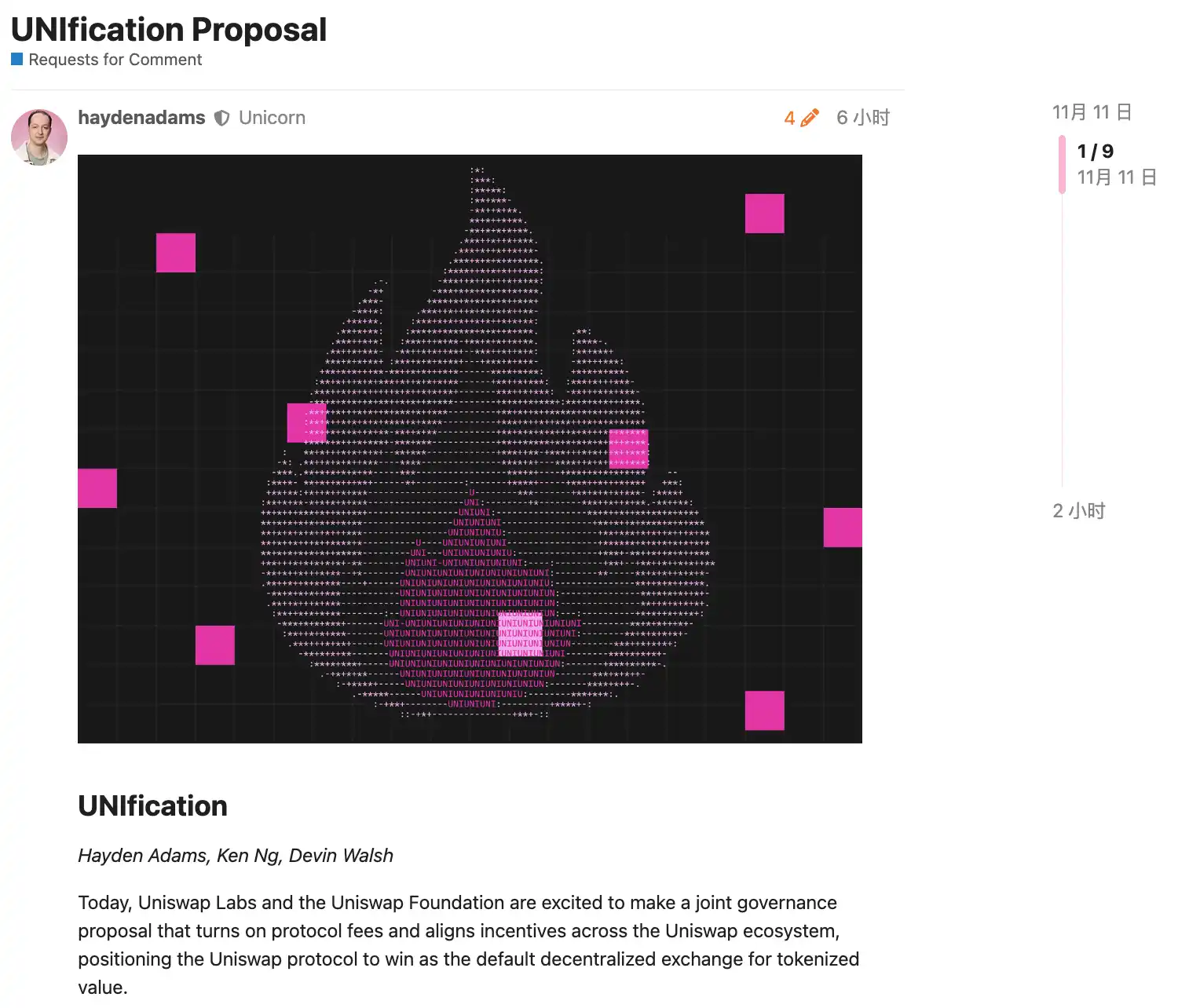
However, this time is different; the proposal was initiated by Hayden himself, and in addition to the fee switch, it also includes a series of measures such as token burning and the merger of Labs and Foundation. Some major holders have already expressed their support, and the probability of the proposal passing in the prediction market is as high as 79%.
2 Years of Failure 7 Times: The Repeated Defeat of the "Fee Switch"
The fee switch is actually a quite common mechanism in the DeFi space. Take Aave as an example; it successfully activated the fee switch in 2025, using a "buy + distribute" model to use protocol revenue for AAVE token buybacks, pushing the token price from $180 to $231, with an annualized increase of 75%.
In addition to Aave, protocols like Ethena, Raydium, Curve, and Usual have also achieved significant success with their fee switches, providing sustainable token economics examples for the entire DeFi industry.
Given that there are so many successful precedents, why has it been so difficult for Uniswap?
a16z Has Relented, But Uniswap's Troubles Are Just Beginning
Here we must mention a key player— a16z.
In Uniswap's history, the quorum has generally been low, usually requiring only around 40 million UNI to meet the voting threshold. However, this venture capital giant previously controlled about 55 million UNI tokens, which had a very direct impact on the voting results.
They have always been opponents of related proposals.
In the two temperature checks in July 2022, they chose to abstain, only expressing some concerns in the forum. But by the third proposal in December 2022, when pools like ETH-USDT and DAI-ETH were preparing to activate on-chain voting for a 1/10 fee rate, a16z cast a clear opposing vote, utilizing 15 million UNI's voting power. This vote ultimately ended with a 45% support rate; although supporters were in the majority, it failed due to insufficient quorum. In the forum, a16z clearly stated: "We ultimately cannot support any proposal that does not consider legal and tax factors." This was their first public opposition.
In subsequent proposals, a16z maintained this stance. In May and June 2023, GFX Labs launched two fee-related proposals in succession. Although the June proposal received 54% support, it ultimately failed again due to insufficient quorum, influenced by a16z's 15 million opposing votes. By the governance upgrade proposal in March 2024, the same script played out again—about 55 million UNI supported, but it failed due to a16z's opposition. The most dramatic instance was from May to August 2024, when the proposers attempted to mitigate legal risks by establishing a Wyoming DUNA entity. The vote, originally scheduled for August 18, was indefinitely postponed due to "new issues from unnamed stakeholders," widely believed to be a16z.
So what exactly is a16z worried about? The core issue lies in legal risks.
They believe that once the fee switch is activated, UNI tokens could be classified as securities. According to the famous Howey test standard in the U.S., if investors have a reasonable expectation of "profits from the efforts of others," then the asset may be deemed a security. The fee switch precisely creates such an expectation—protocols generate income, and token holders share in the profits, which is highly similar to the profit distribution model of traditional securities. a16z partner Miles Jennings bluntly stated in a forum comment: "DAOs without legal entities face personal liability exposure."
In addition to securities law risks, tax issues are equally tricky. Once fees flow into the protocol, the IRS may require the DAO to pay corporate taxes, with preliminary estimates of back taxes potentially reaching $10 million. The problem is that a DAO itself is a decentralized organization without the legal entity and financial structure of a traditional business, making it unclear how to pay taxes and who will bear the costs, which remains an unresolved dilemma. In the absence of clear solutions, hastily activating the fee switch could expose all token holders participating in governance to tax risks.
As of now, UNI remains the largest single token holding in a16z's cryptocurrency portfolio, holding about 64 million UNI, still capable of individually influencing voting results.
But we all know that with Trump's election as president and the SEC's turnover, the crypto industry has ushered in a political spring of stability, and Uniswap's legal risks have decreased, which can also be seen in a16z's gradually softening attitude. Clearly, this is no longer a problem, and the likelihood of this proposal passing has greatly increased.
However, this does not mean that there are no other conflicts; the fee switch mechanism of Uniswap still has some controversial points.
You Can't Have Your Cake and Eat It Too
To understand these new points of contention, we first need to briefly discuss how the fee switch specifically operates.
From a technical implementation perspective, this proposal makes detailed adjustments to the fee structure. In the V2 protocol, the total fee remains at 0.3%, but 0.25% will be allocated to LPs, and 0.05% will belong to the protocol. The V3 protocol is even more flexible, with protocol fees set at one-fourth to one-sixth of LP fees. For example, in a 0.01% liquidity pool, the protocol fee is 0.0025%, equivalent to a 25% share; while in a 0.3% pool, the protocol fee is 0.05%, accounting for about 17%.
Based on this fee structure, Uniswap conservatively estimates it could generate annual revenue of $10 million to $40 million, and in a bull market scenario, based on historical peak trading volumes, this figure could reach $50 million to $120 million. Meanwhile, the proposal also includes an immediate burn of 100 million UNI tokens, equivalent to 16% of the circulating supply, and establishes a continuous burning mechanism.
In other words, through the fee switch, UNI will transform from a "worthless governance token" into a real revenue-generating asset.
This is certainly great news for UNI holders, but the problem lies precisely here. Because the essence of the "fee switch" is the redistribution of profits between LPs and the protocol.
The total amount of fees paid by traders will not change; it is just that part of the profits that originally belonged entirely to LPs will now be allocated to the protocol. The costs are borne by the LPs, and as the protocol's revenue increases, LPs' income will inevitably decrease.
You can't have your cake and eat it too. In the question of "Do we want LPs or protocol revenue?" Uniswap has clearly chosen the latter.
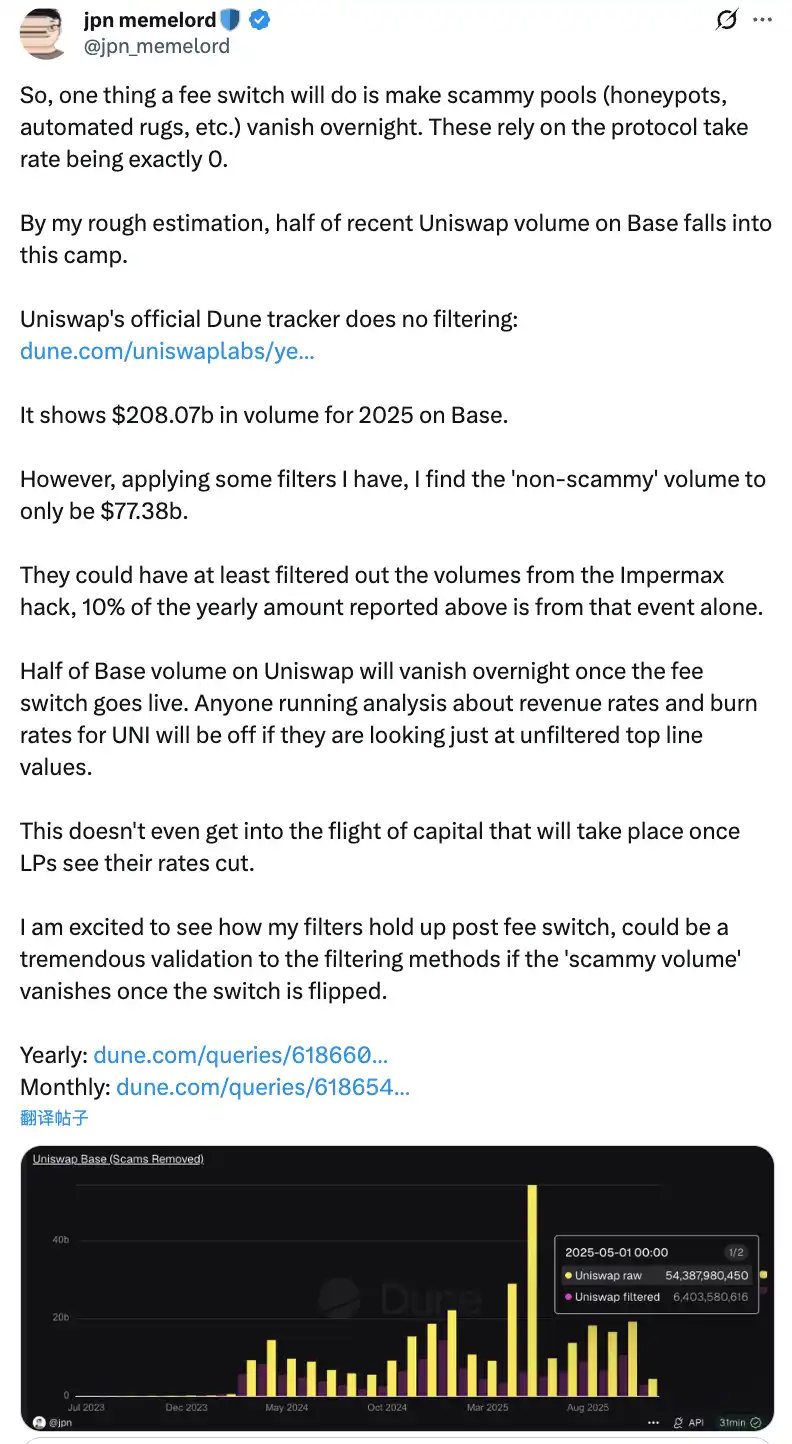
Community discussions suggest that once the "fee switch" is activated, half of Uniswap's trading volume on the Base chain could disappear overnight.
The potential negative impacts of this redistribution should not be underestimated. In the short term, LPs' earnings could be reduced by 10% to 25%, depending on the protocol fee sharing ratio. More seriously, according to model predictions, liquidity could migrate from Uniswap to competing platforms by 4% to 15%.
To mitigate these negative impacts, the proposal also suggests some innovative compensation measures. For example, the PFDA mechanism for MEV internalization can provide additional earnings for LPs, with each $10,000 trade potentially bringing in an extra $0.06 to $0.26. The V4 version's Hooks feature supports dynamic fee adjustments, and aggregator hooks can open up new sources of revenue. Additionally, the proposal adopts a phased implementation strategy, starting with core liquidity pools for pilot testing, monitoring impacts in real-time, and adjusting based on data.
The Dilemma of the Fee Switch
Despite these mitigation measures, whether they can truly alleviate LPs' concerns and allow this proposal to ultimately be implemented will likely require time to verify. After all, even with Hayden personally involved, it may not necessarily save Uniswap from its predicament on this issue.
Because a more direct threat comes from market competition, especially in the face-off with Aerodrome on the Base chain.
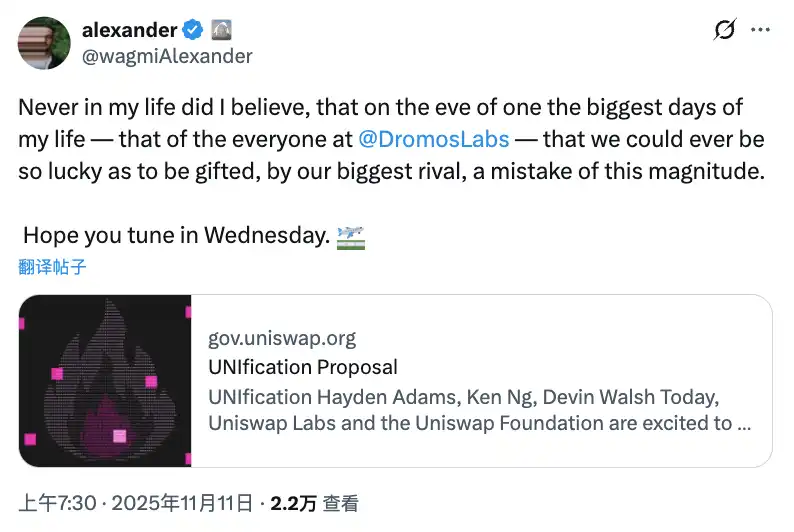
After Uniswap's proposal, Alexander, CEO of Aerodrome's development team Dromos Labs, sarcastically remarked on X: "I never thought that on the eve of the most important day for Dromos Labs, our biggest competitor would make such a significant blunder."
Aerodrome is Crushing Uniswap on the Base Chain
Data shows that in the past 30 days, Aerodrome's trading volume was approximately $20.465 billion, capturing 56% of the market share on the Base chain; while Uniswap's trading volume on Base was about $12-15 billion, with a market share of only 40-44%. Aerodrome not only leads in trading volume by 35-40%, but also surpasses Uniswap in TVL with $473 million compared to Uniswap's $300-400 million.
The root of the gap lies in the significant difference in LP yields. Taking the ETH-USDC pool as an example, Uniswap V3's annualized yield is about 12-15%, solely from trading fees; while Aerodrome, through AERO token incentives, can offer annualized yields of 50-100% or even higher, which is 3-7 times that of Uniswap. In the past 30 days, Aerodrome distributed $12.35 million in AERO incentives, precisely guiding liquidity through the veAERO voting mechanism. In contrast, Uniswap mainly relies on organic fees, occasionally launching targeted incentive programs, but the scale is far less than that of its competitors.
As someone in the community pointed out: "Aerodrome is able to crush Uniswap in trading volume on Base because liquidity providers only care about the return on every dollar of liquidity they put in. Aerodrome wins in this regard." This observation is spot on.
For LPs, they will not stay because of Uniswap's brand influence; they only look at yields. And on emerging L2s like Base, Aerodrome, as a native DEX, has established a strong first-mover advantage with its specially optimized ve(3,3) model and high token incentives.
In this context, if Uniswap activates the fee switch and further reduces LP yields, it could accelerate the migration of liquidity to Aerodrome. Model predictions suggest that the fee switch could lead to a 4-15% loss of liquidity, and in a competitive battlefield like Base, this percentage could be even higher. Once liquidity decreases, trading slippage increases, and trading volume will also decline, creating a negative spiral.
Can the New Proposal Save Uniswap?
From a purely numerical perspective, the fee switch can indeed bring considerable revenue to Uniswap. According to detailed calculations by community member Wajahat Mughal, the situation from just the V2 and V3 versions looks quite promising.

The V2 protocol has generated a total fee of $503 million from the beginning of 2025 to now, with the Ethereum mainnet contributing $320 million, and the trading volume in the last 30 days reaching $50 billion. If calculated based on a 1/6 fee sharing, the protocol fee revenue based on Ethereum mainnet activity is expected to reach $53 million in 2025. The V3 protocol has performed even stronger, with total fees reaching $671 million from the beginning of the year, with the Ethereum mainnet accounting for $381 million, and a trading volume of $71 billion in the last 30 days. Considering the sharing ratios of different fee rate pools—low fee pools charge 1/4 of the protocol fees, while high fee pools charge 1/6—V3 may have already generated $61 million in protocol fees from the beginning of the year to now.
Adding V2 and V3 together, the expected protocol fee revenue from the beginning of the year to now has reached $114 million, and this is still with 6 weeks left in the year. More critically, this figure has not yet tapped into Uniswap's full revenue potential. This calculation does not account for the remaining 20% of V3 pools, fees from all chains outside the Ethereum mainnet (especially Base, which generates fees almost equivalent to the Ethereum mainnet), V4 trading volumes, protocol fee discount auctions, UniswapX, aggregator hooks, and the sorting income from Unichain. If all these are taken into account, the annualized revenue could easily exceed $130 million.
Combined with the plan to immediately burn 100 million UNI tokens (valued at over $800 million at current prices), Uniswap's token economics will undergo a fundamental change. The fully diluted valuation after the burn will drop to $7.4 billion, with a market cap of about $5.3 billion. Based on an annualized revenue of $130 million, Uniswap could buy back and burn about 2.5% of the circulating supply each year.
This means that UNI's price-to-earnings ratio is about 40 times, which may not seem cheap, but considering that there are still many revenue growth mechanisms yet to be fully released, this number has significant room for decline. As someone in the community remarked: "This is the first time the UNI token truly appears to have holding attractiveness."
However, behind these impressive numbers, there are also significant concerns that cannot be ignored. First, the trading volume in 2025 is significantly higher than in previous years, largely due to the bull market. Once the market enters a bear cycle, trading volumes will drop sharply, and protocol fee revenues will shrink accordingly. Using revenue forecasts based on bull market data as a basis for long-term valuation is clearly misleading.
Secondly, the specific operation of the buyback mechanism remains unknown. Will it use an automated buyback system similar to Hyperliquid, or will it be executed in other ways? The frequency of buybacks, price sensitivity, and the impact on the market—these details will directly affect the actual effectiveness of the burn mechanism. If not executed properly, large-scale market buybacks could instead trigger price volatility, putting UNI holders in an awkward position of "robbing Peter to pay Paul."
As platforms like Aerodrome, Curve, Fluid, and Hyperliquid spot are attracting liquidity with high incentives, will Uniswap's approach of cutting LP yields accelerate capital outflow? The data looks good, but if liquidity—the foundation—is lost, even the most attractive revenue forecasts are just castles in the air.
The fee switch can undoubtedly provide value support for UNI. But whether it can truly "save" Uniswap and bring this former DeFi giant back to its peak will likely require both time and market validation.
 Risk warning Risk warning


Popular articles





