








After 43 days of government shutdown, why is the market not buying it?
 Core Viewpoint

 The government's restart is not a "magic cure" for the market; the key is the TGA that drains market liquidity.
Author: Golem, Odaily Planet Daily
The 43-day shutdown of the U.S. federal government has finally ended today.
On November 13, the House of Representatives passed a temporary funding bill with a vote of 222 to 209, and Trump signed the temporary funding bill on the morning of the 13th. This bill will provide funding for food assistance programs that were cut off during the shutdown, retroactively pay wages for hundreds of thousands of federal employees, and restore the normal operation of the air traffic control system. The White House also stated that the labor statistics data for September will be released after the government reopens, but the key economic report for October may not be released at all.
Everything is getting back on track, but the market does not seem to be experiencing a strong rebound due to the government reopening—BTC fell below $101,000 again early this morning, and the overall market is declining. Besides the improvement in the macro environment, the crypto market seems to need more stimulating factors to bring about stronger upward momentum.
Why Did the U.S. Government Shutdown for 43 Days?
Historically, there have been 21 government shutdowns in the U.S. since 1976, but the shutdown that began on October 1, 2025, broke the previous record of the longest shutdown at 35 days.
This record-breaking shutdown stemmed from the failure of Republicans and Democrats to reach an agreement on a new fiscal budget in October. The main disagreement over the budget was related to medical spending, with Democrats demanding an extension of the soon-to-expire tax credits to allow millions of Americans to continue enjoying lower health insurance costs, while Republicans insisted on cutting health and government medical-related expenditures to control the budget size.
Although the House passed a temporary funding bill to avoid a government shutdown, Democrats in the Senate engaged in a prolonged standoff, ultimately leading to the government officially shutting down on October 1. However, even though the temporary funding bill has now been passed, the two parties are still arguing over federal health insurance subsidies, and the Democrats have failed to achieve their goal of extending federal health insurance subsidies.
The core contradiction of this dispute remains unresolved.
Different Performances of U.S. Stocks and Crypto Markets During the Government Shutdown
The U.S. government shutdown not only affected the daily lives of Americans but also impacted the wallets of global investors. The market believed that the government shutdown would bring negative effects to the market.
Firstly, the shutdown caused economic departments like the Department of Labor to be unable to operate normally, and important economic data such as CPI and non-farm payroll reports could not be released on time, leading to "blind flying" in Federal Reserve decision-making, casting a shadow over the market.
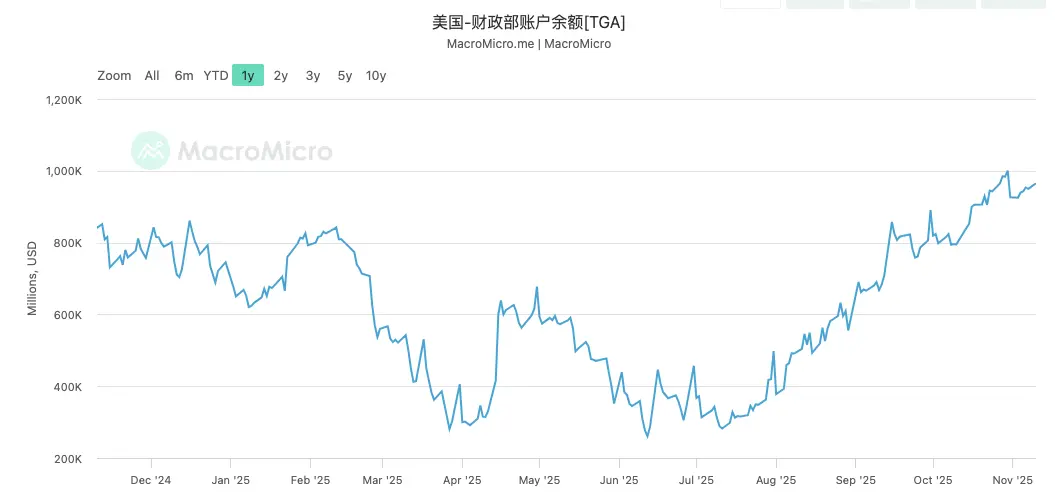
Secondly, the government shutdown also drained market liquidity. The U.S. Treasury General Account (TGA) is responsible for all government expenditures, not only paying U.S. civil servant salaries but also injecting liquidity into the financial market. The government shutdown caused the TGA to only take in funds without any outflows. According to MacroMicro data, during the government shutdown, the TGA accumulated over $1.459 trillion, with a current balance of $965.3 billion.
However, TradingView data shows that during the government shutdown (from October 1 to November 13), the three major U.S. stock indices did not experience significant declines; instead, they rose, with the Dow Jones up 3.5%, the S&P 500 up 3%, and the Nasdaq up 2.9%. Gold rose over 8.5% during the government shutdown and reached a new high of $4,355 on October 22.
The crypto market, on the other hand, "did not disappoint" and took a significant hit. On October 11, the crypto market experienced a "1011" crash, creating a record liquidation of over $19.1 billion in a single day, with Bitcoin even falling below $99,000. Although the market recovered somewhat after the "1011" crash, it remained sluggish overall. During the government shutdown (from October 1 to November 13), BTC saw a cumulative decline of 14%, ETH fell by 20%, SOL dropped by 30%, and BNB decreased by 6.67%.
It is evident that the negative impact of the U.S. government shutdown on the global market was not as significant as imagined. The decline in the crypto market during this period was the result of multiple factors, such as continuous outflows from spot Bitcoin ETFs, the retreat of DAT, weakened expectations for Fed rate cuts, and internal crises within the crypto industry.
The Market May Have Overestimated the Impact of the U.S. Government Reopening
Since the government shutdown is just a minor influencing factor in the fluctuations of the global market, perhaps investors have also overestimated the impact of the government reopening on the market.
U.S. stocks closed on Wednesday, with a high expectation of the Senate voting to pass the funding bill and the government reopening, yet only the Dow rose by 0.78%, the S&P 500 saw a slight increase, while the Nasdaq fell by 0.26%. The crypto market still did not rebound from its downturn, with BTC down 1.04% on the daily chart, and the government reopening cannot be considered a "positive" for the crypto market.
Historically, a blogger @BunnyTalks_ summarized a pattern: during the major government shutdowns in 1995-1996, 2013, and 2018-2019, although the stock market was lukewarm during the shutdown, it tended to rise after the shutdown ended. Whether this pattern will hold true again remains to be seen in tonight's stock market opening.
For the crypto market, there is no established pattern of "must rise after government reopening." Statistics show that since Bitcoin was officially assigned a price by the market, the U.S. government has shut down three times.
- October 1-17, 2013: Due to the controversy over Obama's healthcare, the government shut down for 16 days, and there was no significant change in Bitcoin's price within a month after the government reopened.
- January 20-22, 2018: Due to the controversy over Trump's immigration policy, the government shut down for 2 days, and Bitcoin's price fell below $10,000 within a month after the government reopened.
- December 22, 2018 - January 25, 2019: Due to the controversy over Trump's border wall, the government shut down for 35 days, and there was also no significant change in Bitcoin's price within a month after the government reopened.
In summary, past government shutdowns and reopenings have had little impact on Bitcoin and the crypto market, and we should not have overly high expectations for its ability to boost the market. The significant drop in Bitcoin in early 2018 was mainly due to the aftermath of the "94" incident, which led to a prolonged bear market in the crypto space.
Moreover, the impact of the "1011" crash on the crypto industry is slowly becoming apparent, with liquidity nearing exhaustion, DeFi crises, and structural buying support from ETFs and DAT being withdrawn. These factors are suppressing the upward momentum that the reopening of the U.S. government could bring to Bitcoin.
However, some opinions suggest that the current crypto market is different from the past, especially as Bitcoin has become an "appendage" to the U.S. stock market, so macroeconomic positives will play a crucial role. As the U.S. government resumes normal operations and the TGA begins to inject liquidity into the market, the previously suppressed hundreds of billions of dollars in fiscal spending will also flood into the market, potentially turning the crypto market around.
 Risk warning
 Risk warning



Popular articles





