








Cryptocurrency sixteen years
 Core Viewpoint

 Sixteen Years of Cryptocurrency — Rereading "The Denationalization of Money"
On March 6 this year, Trump signed an executive order announcing the establishment of a "strategic Bitcoin reserve," stating that the U.S. government would not sell its existing approximately 200,000 Bitcoins and would continue to increase its holdings in a "budget-neutral" manner. On July 18, he signed the "Genius Act," establishing regulatory rules for stablecoins pegged to the U.S. dollar. Meanwhile, Hong Kong's "Stablecoin Regulation" officially took effect on August 1, establishing a framework for licensing, reserve supervision, and redemption guarantees.
The cryptocurrency industry, which has been around for 16 years, has quietly grown into a massive industry with a total market value of over $3.5 trillion due to its decentralized nature, long residing in the "Wild West" where state power is hard to reach. The recent surge in regulatory measures marks the industry's entry into the mainstream financial order.
Two ideological threads run through cryptocurrency: one originates from the "cypherpunk movement" of the 1990s, defending privacy and freedom through cryptographic technology. The other comes from the history of economic thought, tracing back to Hayek's 1976 work "The Denationalization of Money." This article revisits this book at this moment, reflecting on the origins of money, the monopoly of minting rights, and the grassroots minting experiments in cyberspace.
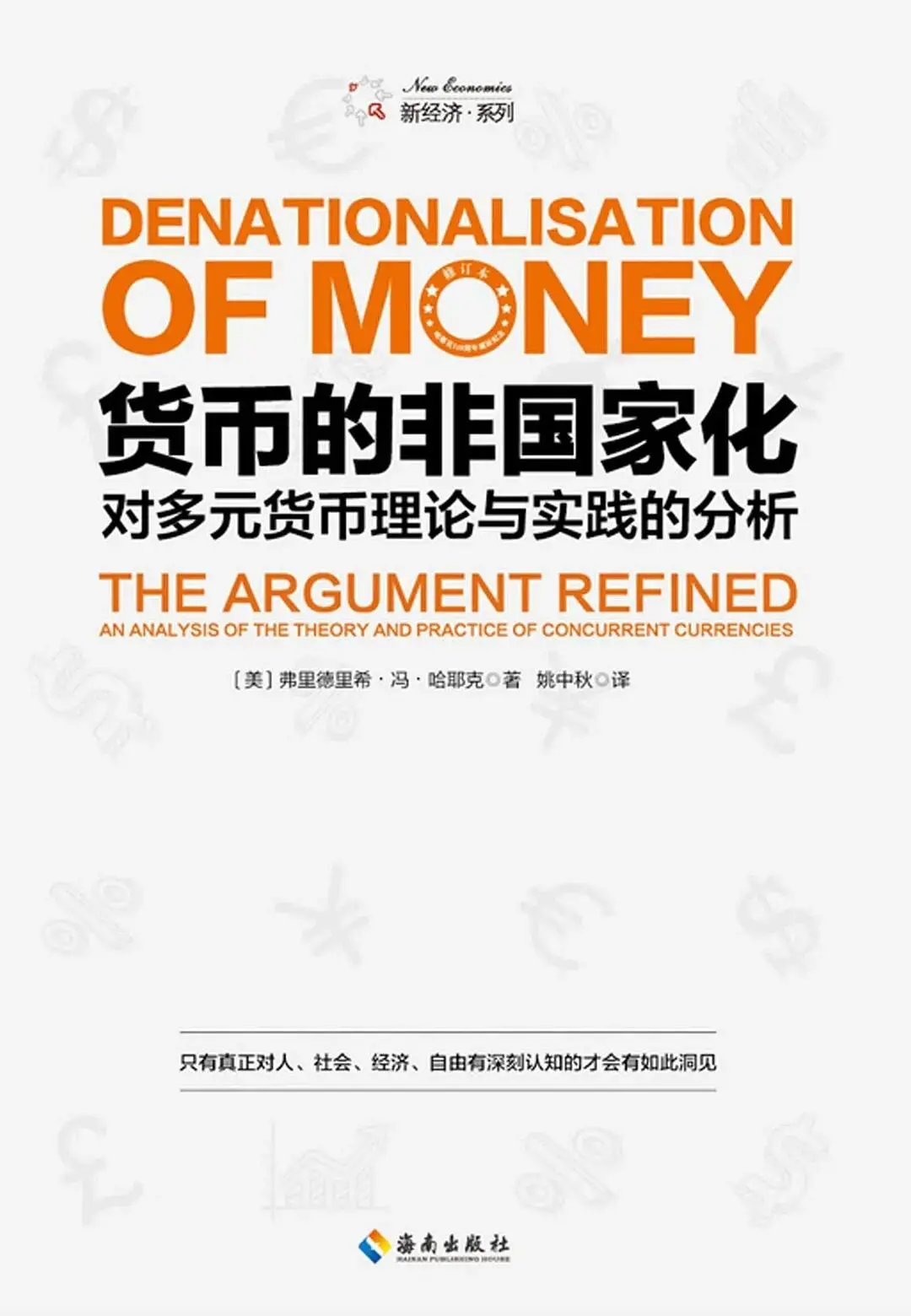
The Denationalization of Money
[Eng] Friedrich von Hayek | Author
Yao Zhongqiu | Translator
Hainan Publishing House May 2019
The Monopoly of Minting Rights
The earliest forms of money were not invented by the state but were tools gradually agreed upon by people through countless exchanges, the fruits of spontaneous order.
Before 4000 BC, people lived in villages of a few hundred, relying on farming, hunting, and gathering for survival, with most people's living radius being only a few dozen kilometers. At this time, the medium of exchange between people could only be considered a primitive form of money, or "natural money," such as livestock, salt, shells, and grains. The common characteristic of these "currencies" is that they have basic functions of trade and value storage but are not easy to carry or divide.
With the spread of metallurgy and the rise of city-states, gold, silver, and copper gradually became used as mediums of exchange due to their durability, divisibility, and portability. This marked the "weight-based currency" phase, where transactions were valued based on weight and purity.
In the 6th century BC, the Kingdom of Lydia, located in western Anatolia (now inland on the western coast of Turkey), was the first to mint metal currency under state authority. This was closely related to its unique geographical and resource conditions: Lydia was connected to the trade networks of Mesopotamia and Persia to the east and the maritime trade routes of Greece and the Aegean Sea to the west, with merchants gathering and frequent exchanges. The Pactolus River within its territory was rich in natural gold-silver alloy (electrum), which was malleable, easy to smelt, and had a color between gold and silver, providing excellent materials for minting.
The royal family minted coins with a lion's head emblem, symbolizing royal power and credit. Their weight and purity were standardized, allowing for direct valuation by the piece and immediate circulation. Compared to the old days when metal blocks needed to be weighed and tested for purity, this unified minted currency indeed improved transaction efficiency and marked money with the imprint of state power.
Starting in the mid-7th century BC, Lydia's state minting practices spread to the city-states of the Aegean and the Persian Empire within about 100 years, becoming a model for other countries to emulate. By the 5th century BC, Greece, Persia, and various Mediterranean countries had successively established a system of unified minting by the state or city-states.
The history of paper money mirrors the trajectory from natural money to metal money: it began in the private sector and was later monopolized by the state. The "jiaozi" from the Northern Song Dynasty in China is the world's earliest paper currency, issued with the joint guarantee of 16 wealthy merchants and later taken over by the government in 1023. The earliest paper money in Europe appeared in Sweden in the mid-17th century, issued by the Stockholm Bank. As circulation expanded and government regulation increased, by the end of the 17th century, Sweden and England successively established central banks, gradually concentrating the power to issue paper money in the hands of the state.
The benefits of state monopoly over minting rights are evident. For private commercial activities, transaction efficiency is enhanced. For the state, it increases a fiscal tool and a source of revenue. The downsides, however, are more subtle. In the era of metal currency, the state could indirectly tax by reducing the precious metal content of the currency. In the era of paper money, the behavior of excessive issuance of currency is even less constrained. In peacetime, excessive issuance is often tolerable, but once war arrives, it is often accompanied by the state printing money frantically, raising military funds while the citizens holding currency lose their wealth. At times of dynastic change or credit collapse, the currency of the previous dynasty often turns into worthless paper.
Many historians have attempted to prove that inflation is necessary for achieving long-term economic growth. Hayek refuted this view with facts. Taking Britain as an example, from the mid-18th century to the early 20th century, during the 200 years of the Industrial Revolution and the gold standard, industrial output and national income grew exponentially, yet the price level remained close to that of the mid-18th century. The same phenomenon occurred in the United States during the industrialization wave from the late 19th century to the early 20th century—rapid economic expansion with falling prices, even dropping below levels seen a century earlier.
Hayek's Monetary Ideal
In 1976, the year Hayek published "The Denationalization of Money," Europe and America were experiencing severe inflation. Tracing its roots leads back to the Bretton Woods system on the eve of World War II.
In 1944, to prevent the competitive devaluations and financial chaos seen during the war, representatives from 44 allied nations convened in Bretton Woods, New Hampshire, USA. The conference established a fixed exchange rate system centered on the U.S. dollar: each country's currency was pegged to the dollar, which was convertible to gold at $35 per ounce. This system effectively maintained exchange rate stability and low inflation for nearly 30 years after the war and was widely regarded as supporting the post-war recovery of Europe and Japan.
Entering the 1960s, the inherent contradictions of the system gradually became apparent. As the issuer of the global reserve currency, the United States had to continuously export dollars to meet global liquidity, but the issuance of dollars far exceeded gold reserves. The Vietnam War and social welfare spending further inflated the fiscal deficit. By 1971, U.S. gold reserves were insufficient to support the overseas dollar supply. In August of that year, Nixon announced the suspension of dollar convertibility into gold, leading to the collapse of the Bretton Woods system. Over the next decade, oil prices soared, prices rose, and U.S. inflation rates once exceeded 13%, while the pound and franc depreciated significantly, yet economic growth stagnated—resulting in a rare phenomenon of stagflation, unprecedented in the post-war Western economic history.
Three economists' voices are crucial regarding the birth and demise of the Bretton Woods system: Keynes, Friedman, and Hayek.
Keynes's core argument is that the market cannot achieve full employment on its own; the government must intervene through fiscal and monetary policies to regulate total demand and stabilize the economic cycle. He advocated for expanding spending during depressions and tightening during booms to maintain employment and growth. This idea laid the foundation for the post-war Western consensus on "government intervention in the economy," giving rise to the welfare state and the macroeconomic control system of central banks. In 1944, he attended the Bretton Woods Conference as the chief representative of the British delegation, and his ideas on fixed exchange rates and international coordination profoundly influenced the post-war financial order.
Friedman, on the other hand, argued that government intervention in monetary policy should be limited, proposing a fixed monetary growth rate to replace arbitrary policy stimuli and establishing an independent central bank to stabilize prices and expectations by controlling the money supply. After the stagflation of the 1970s, Keynesianism faltered, and Friedman's monetarism rose, driving the U.S. and the UK to implement tightening policies and raise interest rates, ultimately curbing inflation.
On the spectrum of "government intervention" versus "free market," Hayek stood at the farthest end. He believed Keynesianism was merely a temporary relief that inevitably came at the cost of inflation and stagflation. He also disagreed with Friedman's monetarism, arguing that the government's power to issue currency could not be permanently constrained; once an economic downturn occurred, political forces would inevitably triumph over rules, and the printing press would be activated again. Thus, he proposed a more radical solution: since power cannot be limited, it should be stripped away—abolishing the state's monopoly on currency issuance and allowing money to return to market competition.
In Hayek's vision, any private institution, such as banks, chambers of commerce, large corporations, or even international organizations, could issue their own currency. In this competitive system, if a currency depreciated due to excessive issuance or mismanagement, the market would automatically abandon it, and the issuer would lose credibility and market share. Ultimately, only the most stable and trustworthy currencies would survive. The value of money would no longer depend on political power but would be determined by market trust.
Hayek further proposed the characteristics that an ideal currency might possess: its primary goal should be to maintain stable purchasing power, with value anchored to a basket of representative goods or price indices; issuers should actively adjust the money supply based on market price changes to prevent inflation or deflation; and credibility should be maintained through transparent assets and redemption mechanisms. He also emphasized that the ultimate form of ideal currency should be determined by market evolution rather than preset by theorists.
Between 1979 and 1985, Hayek's vigilance against state intervention and belief in spontaneous market order provided important ideological support for Thatcher and Reagan's market-oriented, deregulation, and anti-inflation policies. However, his advocacy for abolishing the state's minting rights and returning money to market competition was never adopted by any government before his death in 1992. Years later, with the arrival of the technological wave of the internet and cryptocurrencies, a series of minting experiments emerged in cyberspace. These experiments became a distant echo of Hayek's ideas.
Minting Experiments in Cyberspace
Today, the most well-known currency born in cyberspace is undoubtedly Bitcoin. However, before its emergence, the internet world had already undergone several minting experiments, all of which ended in failure.
The most widely used was E-Gold. Founded in 1996 by former U.S. oncologist Douglas Jackson and lawyer Barry Downey, the company attempted to recreate a gold standard order online. E-Gold issued digital currency equivalent to gold, allowing users to settle in "grams" and transfer across borders, while the company stored corresponding gold assets in vaults in London and Dubai. At its peak, it had over 5 million accounts and an annual transaction volume of $2 billion. In 2007, E-Gold was sued by the U.S. Department of Justice for "money laundering, conspiracy, and operating an unlicensed money transfer business," severely hindering its operations and gradually leading to liquidation.
Hayek predicted in his book that the state would prevent the emergence of private currencies because the monopoly on minting rights is its most secret source of revenue. This may be the deeper reason for E-Gold's failure. Its anonymity also indeed facilitated fraud, drug trafficking, and money laundering. The final result was that while the state cracked down on crime, it simultaneously defended its monopoly on minting rights.
This situation changed after the emergence of Bitcoin. E-Gold relied on centralized companies and physical gold reserves, making it susceptible to regulation. Bitcoin has no issuing institution and no seizable vault; even its creator, Satoshi Nakamoto, remains unknown. It replaces trust in institutions with technology, allowing currency issuance to break free from state and corporate control for the first time. However, lacking a physical anchor, its value primarily relies on network consensus, the energy invested by miners, and operational costs, leading to significant price volatility. This high instability further distances it from Hayek's envisioned ideal currency—a currency that can maintain stable purchasing power in free competition.
Subsequently, new experiments followed one after another. People attempted to pursue stability and order in the ungoverned territory of blockchain. The most significant attempts can be roughly divided into two categories.
The first category has internet genes. The most representative is Meta (formerly Facebook), which announced Libra in 2019. This project was ambitious: the Libra Association was formed by over twenty institutions, including Visa, Uber, Temasek, and Coinbase, planning to issue a global digital currency pegged to "a basket of fiat currencies and short-term government bonds," aiming to create a cross-border payment and settlement network. However, before the project could launch, it faced strong backlash from regulators in Europe and America—concerns about its threat to monetary sovereignty, impact on financial stability, and even violations of privacy and antitrust laws. Three years later, Libra was stillborn, and the ideal dissipated.
The second category carries the genes of cryptocurrencies and can be further divided into three types: algorithmic stablecoins, over-collateralized stablecoins, and stablecoins pegged to real assets. Algorithmic stablecoins are attempts to maintain currency value stability through algorithmic mechanisms. The most famous example is Luna, which collapsed in 2022, reaching a market cap peak of $40 billion. After its collapse, it became clear that it resembled a Ponzi scheme disguised as an algorithm. Over-collateralized stablecoins are minted on the blockchain using assets like Bitcoin and Ethereum as collateral, creating digital currencies equivalent to $1. Their collateralization rates are usually over 150%, meaning that to generate $1 of stablecoin, $1.5 to $2 of assets often need to be locked up. The low capital utilization rate has prevented widespread adoption.
What has truly entered the mainstream are stablecoins pegged to U.S. dollar assets. The two most representative companies are Tether and Circle. The former generated over $13 billion in net profit last year with a team of about 150 people, while the latter went public on the New York Stock Exchange in June this year. The core models of both are basically the same: they issue "on-chain dollars" roughly equivalent to the amount of high liquidity assets like cash, U.S. Treasury bonds, and short-term deposits. The difference is that Tether also holds a small amount of non-typical liquid assets like Bitcoin and gold. From Hayek's perspective, these companies are not competitors to the dollar but extensions of the dollar's credit—a kind of shadow dollar.
Thus, we return to the starting point: the denationalization of money has still not been truly realized. In today's financial order, there is no widely used currency that can ensure value stability without relying on state credit. Will such a currency emerge in the future? If Hayek were alive today, he might also want to know the answer to this question.
 Risk warning Risk warning




Popular articles





