








AI bubble and crypto bear market, these are all noise
 Core Viewpoint

 Many things that could originally be approached with long-term thinking and planning have now lost their certainty.
Author: Meng Yan's Thoughts on Blockchain
In the past two weeks, the AI bubble has become the hottest topic in the overseas tech circle. The related debates are intense and have directly led to a 5% overall decline in the total market value of Nasdaq, with leading AI companies like Nvidia, Meta, and Oracle experiencing a 10-30% drop in market value. From the tech world to the financial sector, many celebrities have expressed sharply opposing views, engaging in heated debates. Meanwhile, the Crypto market has also seen continuous declines since October 11, with the entire industry anxiously debating whether the market has entered a bear phase.
I have inevitably been asked by some friends about my views on the AI bubble theory and the Crypto bull-bear market. To be honest, I don't know, and I don't really care. Whether it’s AI or Crypto, there are indeed many uncertainties. Will large model technology lead to AGI? Are AI companies extending depreciation periods to inflate profits? Are a large number of GPUs sitting idle? When will liquidity in the crypto market recover? These issues are certainly important for figures like Trump, Jensen Huang, Musk, and Ultraman, but for ordinary people like me, it’s not necessary to solve these problems to make the right choices. Debates that are crucial for industry giants may just be noise for us. Focusing too much on this noise can blind us to certain opportunities.
In the modern media environment, a few elites control the agenda-setting power, hijacking the public's attention. Ordinary people struggle in real life, often spending a lot of energy worrying about issues that are not directly related to them, while neglecting their own pressing concerns. You have to work very hard to break free from the illusion that you are a capital giant or an industry leader, to always realize that their power and wealth are not ours, and their problems are not ours. Spending attention on debates set by the elites actually leads to losing oneself in their world, making us miss out on real opportunities in our lives.
Most people over forty have their own stories of missing the internet boom. I often think back to those early 2000s and wonder why I and many around me missed the best opportunity to join the internet. In hindsight, as early as 2002 or 2003, the success of the internet was already a pre-announced victory: the rapid growth of internet users, the increasing average online time, and the swift migration of information access and commercial transactions. What clearer signal could there be? What trend could be more certain than the success of the internet? Why didn’t we think to dive in wholeheartedly?
In fact, those of us who fully experienced that period know that most people did not fail to see such signals, but rather hesitated, caught up in wave after wave of debates. Initially, we debated whether the internet had a profitable model, and when Google established an advertising profit model, we debated whether this model had enough room for growth. When e-commerce began, we debated whether payment and return issues would be a permanent deadlock for Chinese e-commerce. As online gaming rose, we debated whether youth addiction to games would ruin the future of the country. With the advent of social media and online payments, we debated when the government would decisively intervene. When Bitcoin was born, we debated whether Satoshi Nakamoto was the CIA or whether Li Xiaolai was just boasting. Throughout, these topics successfully captured our attention, leading us to identify with roles in internet industry associations, youth work committees, bank presidents, and even propaganda and law enforcement departments, remaining indecisive about the obvious certainty of the internet's success while getting lost in a sea of unimportant uncertainties.
Unfortunately, it is said that the historical records of the Chinese internet are being erased at a record-breaking speed. I suspect that even if today’s historians send AI to do archaeology, they wouldn’t imagine that the onlookers back then spent so much energy and opportunity cost debating others' issues. I have seen many records of internet history, which mostly focus on the successful, describing them as visionary, intelligent, resilient, and insightful, but hardly anyone summarizes the lessons of "ordinary people." So while the memories of our generation are still fresh, I want to summarize this lesson: others' problems may not be your problems, others' signals may be your noise, and you should not get caught up in debates that do not belong to you; just observe the facts and grasp the certain, overall trends based on those facts. For ordinary people, this is often enough.
The frenzy over AI on Wall Street and Silicon Valley today is because almost all credit resources in the U.S. are being allocated to AI, and nearly all economic growth comes from AI investments. It is also because there are some concerning signals in the revenue data and financial behavior of the AI industry. Is this a problem? Yes. Whose problem is it? It is Wall Street's and Silicon Valley's problem, possibly also the White House's and the Federal Reserve's problem, and perhaps many Asian funds and family offices' problems, but it is likely not your problem. You are not Jensen Huang, not Ultraman, not the big short Barry, nor Larry Ellison's Chinese brother-in-law; whether AI has a bubble is not something you need to worry about.
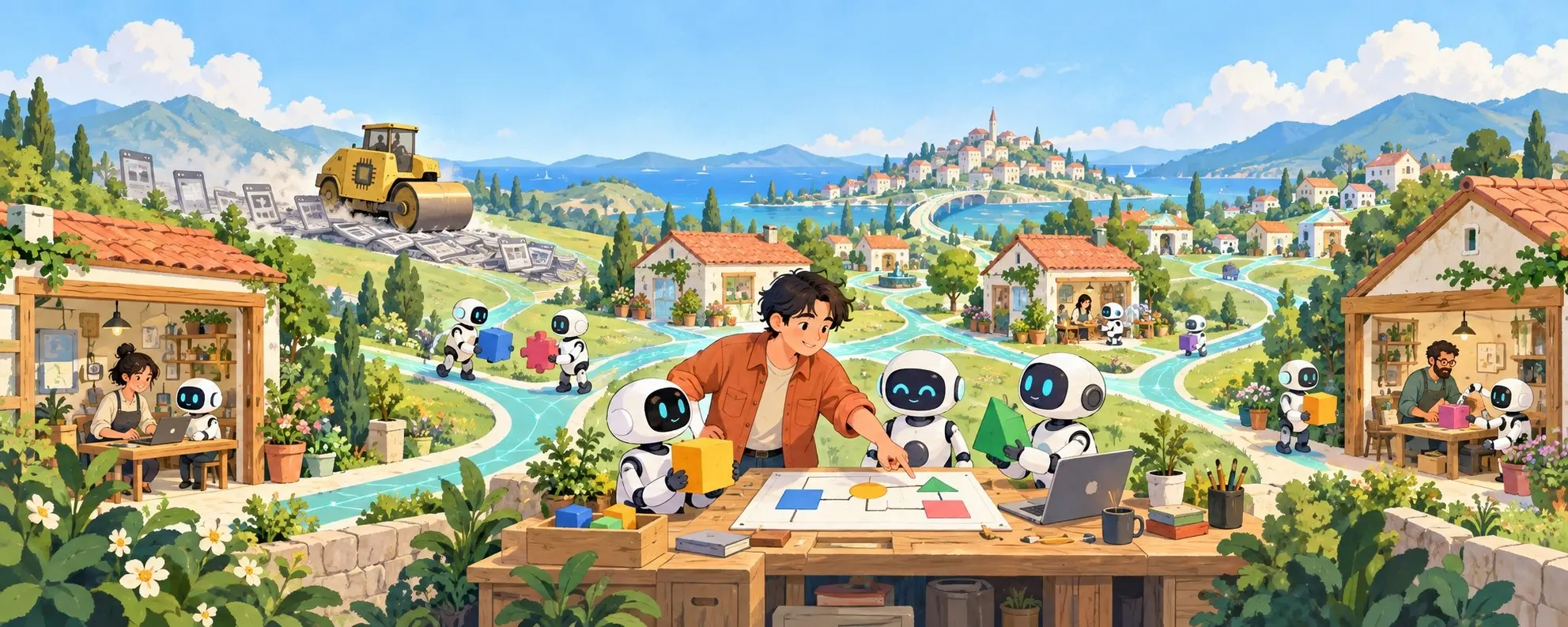
What should you care about? Although we do not know whether large models are the path to AGI, AI's capabilities are already very strong. In fact, the capabilities that AI currently possesses have not yet been fully applied and mobilized, and the bottleneck mainly lies with people. A new group of "AI super users" is emerging, who can skillfully combine various AI tools to dominate their fields, while are you still just treating AI as a search replacement? Recently, many products in various AI sub-sectors have generated considerable actual revenue, and AI giants need to continuously drive user growth and usage to persuade capital to keep supporting them, which will more actively incentivize developers of specific applications. Can you create something in your area of expertise?
In the blockchain field, although the market has become increasingly speculative over the past few years, amidst the noise, blockchain infrastructure has basically resolved the performance bottlenecks in transaction processing, sufficient to support low-latency, high-performance, large-scale on-chain applications. As the largest blockchain application, the scale of stablecoins continues to grow, and the application areas are constantly expanding. More importantly, from Wall Street to Hong Kong, more and more traditional financial assets—stocks, equity, bonds, precious metals, foreign exchange, derivatives—are moving onto the blockchain. This means that the entire finance sector will migrate to blockchain. So what is my real concern? It is not the short-term price fluctuations of Bitcoin, nor when the liquidity in the crypto market will recover after its collapse, nor whether Trump still has enough authority to push for crypto legislation, but rather facing such a clear future scenario: in three to five years, people will be able to use stablecoins to invest in various assets around the world on the blockchain, and use AI as their investment advisor. As long as one has the corresponding knowledge and skills, and is proficient in the relevant tools, ordinary people can grow alongside the fastest companies and industries in the world, with no limitations to hold them back. In this new world, do I have enough knowledge and skills? Can I help more people escape the fate of being slaughtered by chaos and inflation? What opportunities do I have to build valuable products and services?
I will constantly remind myself that these are the real issues I should care about.
I also admit that the world is becoming increasingly chaotic, with many distressing and troubling issues. Many things that could have been approached with long-term thinking and planning have now lost their certainty. Whether we like it or not, we are descending the levels of Maslow's hierarchy of needs, moving from an era of pursuing success and self-actualization to an era where many people are struggling just to survive with dignity. These are probably the facts. Many times we feel that instead of increasing anxiety, it’s better to watch a few short videos for some fun. But after the dopamine rush, we still have to return to face real life. I do not intend to comfort everyone by saying the world will get better. But I also believe that we do not need to guess everything correctly; we just need to do the certain things right and grasp the certain trends. Compared to wasting energy in hesitation and fear, and getting lost in topics set by others, the situation will be somewhat better.
Recommended Reading:
Rewriting the 18-Year Script, U.S. Government Shutdown Ends = Bitcoin Price Will Soar?
$1 Billion Stablecoin Evaporation, What’s the Truth Behind the DeFi Chain Reaction?
MMT Short Squeeze Event Review: A Carefully Designed Money-Making Game
 Risk warning Risk warning


Popular articles





