








Delphi Research Report: Who Issues Stablecoins is Not Important, Mastering Distribution Rights Holds the Future
 Core Viewpoint

 The distribution rights are the real moat.
Original Author | Simon
Original Compiler | Deep Tide TechFlow
1. The Moats of Tether and Circle Are Shrinking: Distribution Capability Outweighs Network Effects
According to the analysis in Delphi's comprehensive report "Apps and Chains, Not Issuers," the dominance of Tether and Circle in the stablecoin market has reached a relative peak, even though the overall supply of stablecoins continues to grow. It is expected that by 2027, the total market capitalization of stablecoins will exceed $1 trillion, but this growth is no longer primarily driven by existing giants as it was in the previous cycle. Instead, an increasing share of the market will flow to ecosystem-native stablecoins and white-label issuance strategies, as blockchains and applications gradually internalize revenue and distribution capabilities.
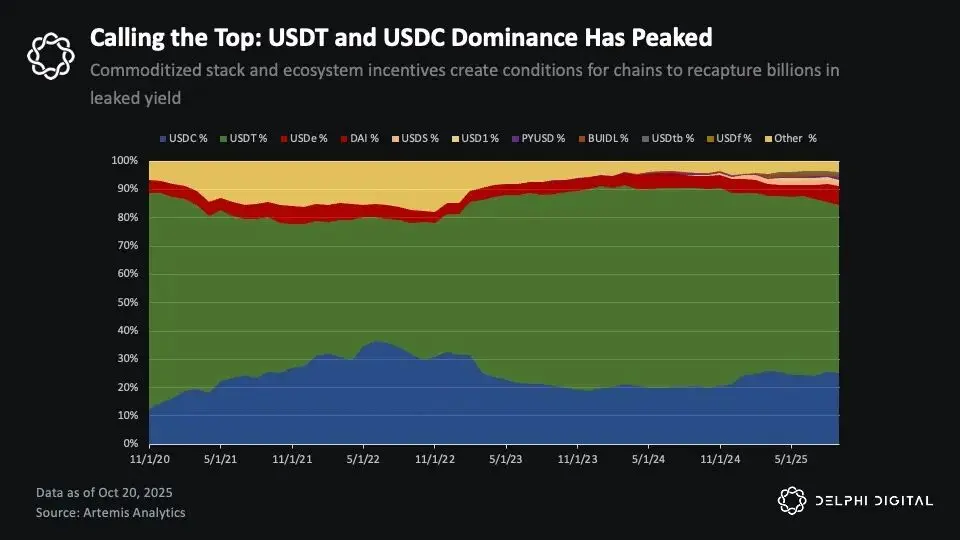
Currently, Tether and Circle account for approximately 85% of the circulating stablecoin supply, totaling around $265 billion.
Background data: Tether's valuation reportedly reaches $500 billion and is seeking to raise $20 billion, with a circulating supply of $185 billion. Circle's valuation is around $35 billion, with a circulating supply of $80 billion.
The network effects that once solidified their dominance are weakening, driven by three major forces:
1. Distribution Capability Takes Precedence Over Network Effects
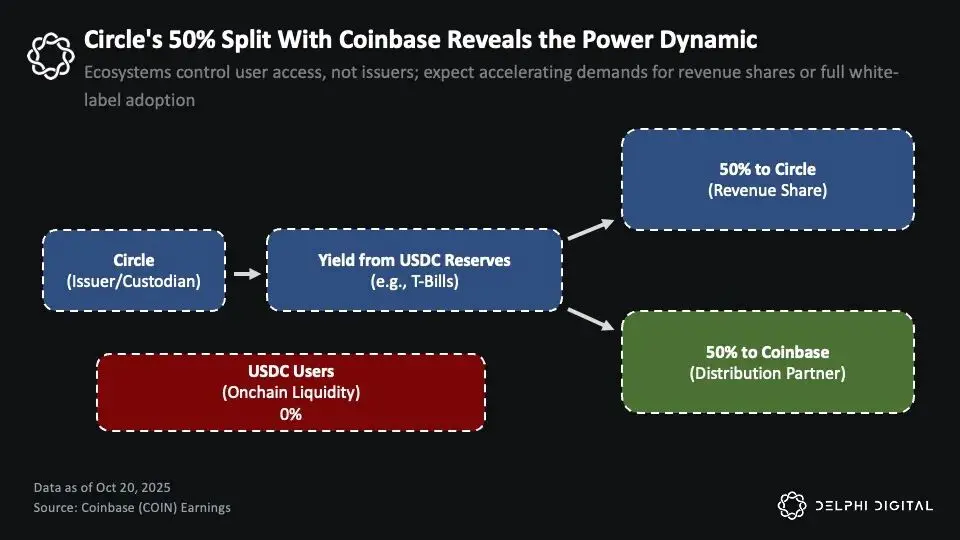
The partnership between Circle and Coinbase clearly illustrates this point. Coinbase receives 50% of the residual income from Circle's USDC reserves and exclusively retains all the income from USDC held on its platform. In 2024, Circle's reserve income is estimated to be around $1.7 billion, of which approximately $908 million is paid to Coinbase. This indicates that distribution partners can capture a significant portion of the stablecoin economy's revenue, leading players with strong distribution capabilities to launch their own stablecoins instead of continuing to create value for issuers.
2. Cross-Chain Infrastructure Makes Stablecoins More Interchangeable
The development of cross-chain technology has made the interchange costs between stablecoins nearly zero. Upgrades to standard bridges on major L2 networks, universal messaging protocols from LayerZero and Chainlink, and the proliferation of smart routing aggregators have made intra-chain and cross-chain stablecoin exchanges efficient and user-friendly. Users can quickly switch stablecoins based on liquidity needs, significantly reducing the importance of which stablecoin is used.
3. Regulatory Clarity Lowers Barriers to Entry
Legislation like the GENIUS Act creates a unified framework for domestic stablecoins in the U.S., reducing the risks for infrastructure providers holding stablecoins. Coupled with an increasing number of white-label issuers lowering fixed costs of issuance, and the attractiveness of treasury yields driving the monetization of floating funds, the stablecoin stack is becoming commoditized and more interchangeable.
This commoditization undermines the structural advantages of existing giants. Any platform with strong distribution capabilities can now internalize the stablecoin economy without having to share revenues with others. Leading players include fintech wallets, centralized exchanges, and an increasing number of DeFi protocols.
DeFi is the most obvious area of this trend, with the most profound impacts.
2. From Outflow to Income: DeFi's Stablecoin Strategy
This shift is already becoming apparent in the on-chain economy. Compared to Circle and Tether, certain chains and applications exhibit stronger product-market fit (PMF), user stickiness, and distribution capabilities. They are adopting white-label stablecoin solutions to leverage existing user bases and capture revenues that historically flowed to the giants. This dynamic change presents a genuine opportunity for on-chain investors who have long overlooked stablecoins.
1. Hyperliquid: The First Major "Defection" Case
In the DeFi space, this trend is first reflected in Hyperliquid. At that time, approximately $5.5 billion of USDC reserves were tied up in its USDH proposal, meaning that $220 million in additional income could flow to Circle and Coinbase each year instead of staying internal.
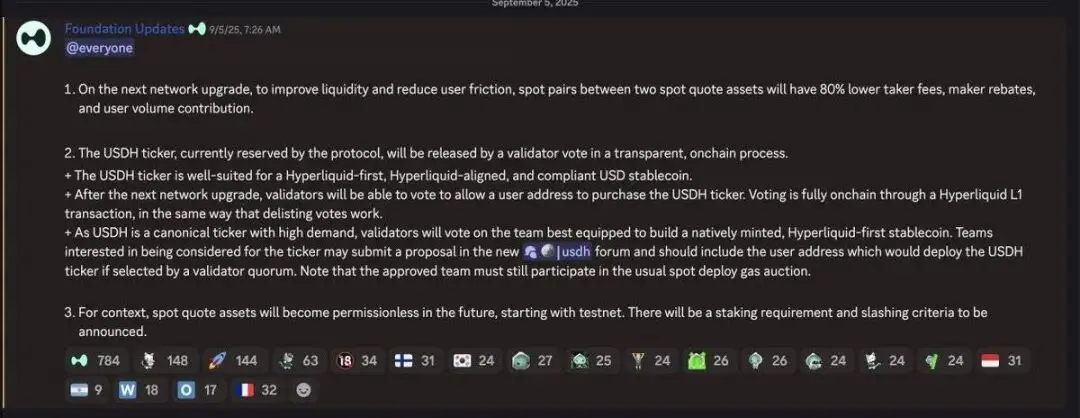
In an upcoming validator vote, Hyperliquid announced plans to launch a native minting stablecoin centered around Hyperliquid. This decision marks a significant shift in the power dynamics of the stablecoin economy.
For Circle, being a major trading pair asset in Hyperliquid's core market has always been a highly profitable position. They directly benefit from Hyperliquid's explosive growth while contributing almost nothing to that growth. For Hyperliquid, this means a significant loss of value to a third party that has made almost no effort, contradicting its "community-first, ecosystem-aligned" philosophy.
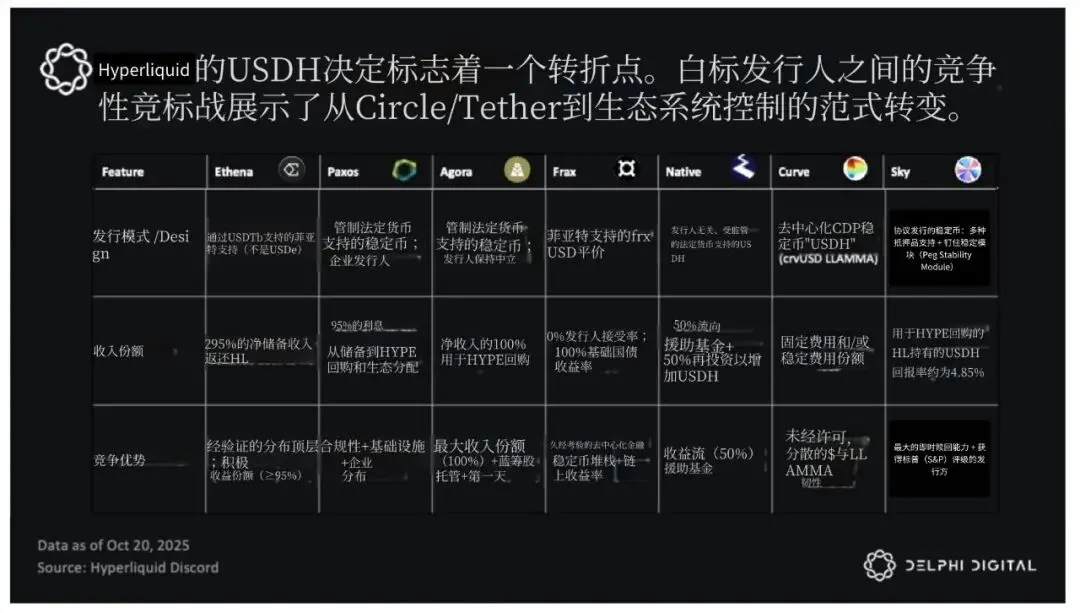
Hyperliquid's USDH selection process attracted bids from nearly all major white-label stablecoin issuers, becoming one of the first large-scale competitive cases in the application-layer stablecoin economy.
In the competitive bidding for USDH distribution, several major white-label stablecoin issuers, including Native Markets, Paxos, Frax, Agora, MakerDAO (Sky), Curve Finance, and Ethena Labs, submitted proposals. This process highlights the immense value of distribution capability in the stablecoin economy.
Ultimately, Native Markets won with a proposal that better aligned with Hyperliquid's ecosystem incentive mechanisms.
Native's model is issuer-neutral and regulated, with its stablecoin supported by off-chain reserves managed by BlackRock, and on-chain infrastructure provided by Superstate. Crucially, 50% of its reserve income will flow directly into Hyperliquid's aid fund, while the remaining 50% will be reinvested to expand USDH's liquidity.
Although USDH will not replace USDC in the short term, this decision reflects a broader trend of power transfer: the moats and leverage effects in DeFi are gradually shifting towards applications and ecosystems with sticky user bases and strong distribution capabilities, rather than traditional issuers like Circle and Tether.
2. The Rise of White-Label Stablecoins: SaaS Model Opens New Chapters
In recent months, this trend has accelerated as more ecosystems adopt white-label stablecoin models. Ethena Labs' "Stablecoin as a Service" solution is at the core of this transformation, with on-chain players like Sui, MegaETH, and Jupiter already integrating or announcing plans to issue their own stablecoins through Ethena's infrastructure.
What sets the Ethena model apart is that its protocol returns revenue directly to holders. For example, USDe's revenue comes from basis trading. Although yields have compressed to around 5.5% as supply exceeds $12.5 billion, this is still higher than the approximately 4% treasury yield and far superior to the zero-yield situation of holding USDT or USDC on-chain.
However, as other issuers enter the market and directly pass on treasury yields, Ethena's comparative advantage is diminishing. Treasury-backed stablecoins provide substantial yields with lower execution risks, making them more attractive in the current environment. But if the future interest rate cut cycle continues, the basis trading spread may widen, enhancing the appeal of Ethena's revenue model once again.
You may wonder how this model aligns with the GENIUS Act, which technically prohibits stablecoin issuers from directly paying yields to holders. However, the reality may not be as strict as it seems. The GENIUS Act does not explicitly prohibit third-party platforms or intermediaries from distributing rewards to stablecoin holders, which can be funded by issuers. This gray area has not been fully clarified, but many believe this loophole still exists.
Regardless of how the regulatory framework evolves, DeFi has always operated in a permissionless manner at the regulatory edge and may continue to do so. The underlying economic reality is more important than legal details.
3. The "Tax" of Stablecoins: The Phenomenon of Mainstream On-Chain Value Outflow
Over $30 billion of USDC and USDT are idling on chains like Solana, BSC, Arbitrum, Avalanche, and Aptos, contributing approximately $1.1 billion in annual revenue to Circle and Tether (assuming a reserve yield of 4%). This figure is about 40% higher than the total transaction fee revenue of these chains. This imbalance highlights that stablecoins have become the largest under-monetized area within L1, L2, and applications.
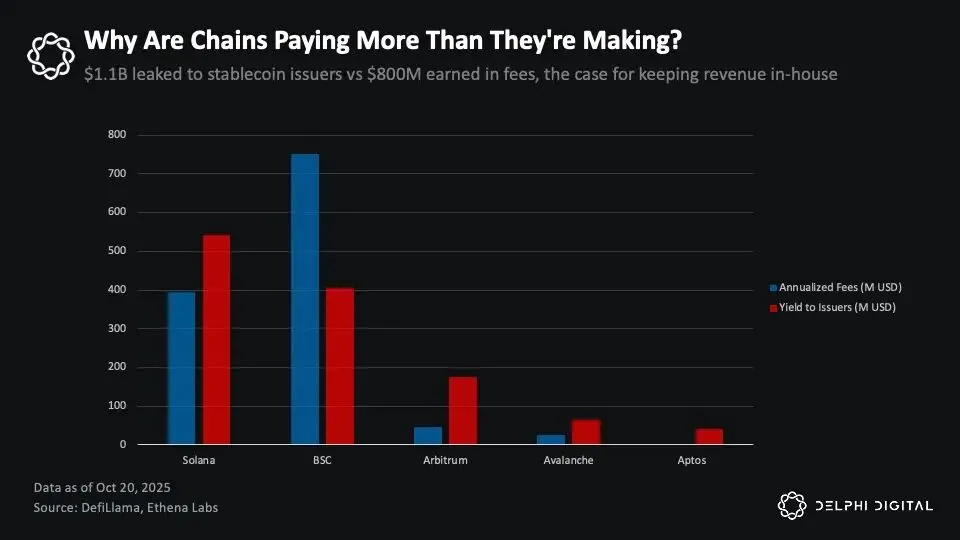
On chains like Solana, BSC, Arbitrum, Avalanche, and Aptos, approximately $1.1 billion in annual revenue flows to Circle and Tether, while the total transaction fee revenue of these ecosystems is only $800 million.
In other words, these ecosystems lose hundreds of millions of dollars annually due to the outflow of stablecoin revenue. If even a small portion of this revenue could be recaptured, it could fundamentally reshape their economic structure, establishing a more stable and counter-cyclical revenue base than relying solely on transaction fees.
Why can't these chains recapture this revenue? The answer is: they absolutely can!
In fact, these chains have multiple avenues to recapture this revenue: negotiating revenue-sharing agreements directly with Circle or Tether, similar to Coinbase's partnership model; emulating Hyperliquid's approach by initiating competitive bids through white-label stablecoin issuers; or collaborating with "Stablecoin as a Service" platforms like Ethena to launch native ecosystem stablecoins.
Each method has its trade-offs: partnering with existing stablecoin giants retains the familiarity, liquidity, and market-tested trust of USDC or USDT; launching a native stablecoin allows for greater control and higher revenue capture rates but requires overcoming challenges in the startup phase, and its infrastructure is relatively less market-validated.
Regardless of the chosen path, the necessary infrastructure already exists, and different chains will adopt different strategies based on their priorities.
4. Reshaping the On-Chain Economy: Stablecoins May Become Revenue Engines
Stablecoins have the potential to become the largest source of revenue for certain chains and applications. Currently, when the economic structure of a blockchain relies solely on transaction fees, its growth is subject to structural limitations. The network's revenue only increases when users pay more fees, and this misalignment not only suppresses user activity but also limits the ability to build sustainable, low-cost ecosystems.
MegaETH's strategy clearly demonstrates the current transformation trend. They launched the white-label stablecoin USDm in partnership with Ethena Labs, with USDm based on USDtb. USDtb is primarily supported by the on-chain short-term treasury product BUIDL launched by BlackRock. By internalizing the revenue from USDm, MegaETH can operate its blockchain sequencer at cost and redirect the revenue to "community-oriented projects."
As the leading decentralized exchange aggregator on Solana, Jupiter is achieving a similar strategic transformation through its stablecoin JupUSD. JupUSD is deeply integrated into its product ecosystem, including collateral for Jupiter Perps (expected to gradually replace the $750 million stablecoins in JLP with JupUSD) and liquidity pools for Jupiter Lend. In this way, the protocol can reinject stablecoin revenue back into its ecosystem instead of paying 100% of the revenue to external issuers. This revenue can be used to reward users, buy back tokens, or fund new incentives, which is clearly more attractive for enhancing ecological value compared to external payments.
The core of this transformation is that revenue that previously passively flowed to stablecoin issuers is now actively reclaimed and retained within the ecosystem by applications and blockchains.
5. Applications vs. Blockchains: Divergence and Reshaping of Valuation
As this trend unfolds, both blockchains and applications have the potential to generate more stable and lasting sources of income than at present. This income will no longer rely on the cyclical fluctuations of "internet capital markets" or be highly dependent on on-chain speculative behavior. This transformation may even help them achieve an economic foundation that aligns with their valuations.
Current valuation frameworks are largely based on measuring value through total on-chain economic activity. In this model, on-chain fees equal the total costs paid by users, while on-chain revenue is that portion of fees allocated to protocols or token holders through mechanisms like burning or treasury inflows. However, this framework has clear flaws: it assumes that as long as economic activity occurs on-chain, value will naturally be captured by the blockchain, whereas actual economic benefits often flow elsewhere.
This model is beginning to change, with applications leading the transformation. For example, two standout applications of this cycle, Pumpfun and Hyperliquid, allocate nearly 100% of their revenue (rather than fees) to repurchasing their native tokens, while their valuation multiples are far lower than mainstream infrastructure layers. These applications generate transparent, real cash flows rather than implied yields.
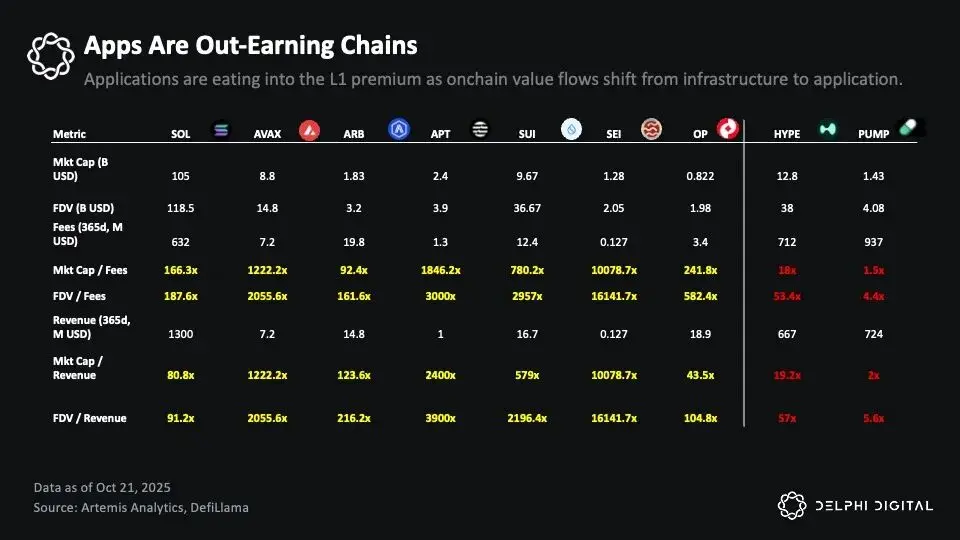
Currently, most mainstream public chains are valued at hundreds or even thousands of times their revenue, while leading applications achieve higher revenues at much lower valuation multiples than public chains.
For instance, in the past year, Solana generated approximately $632 million in fees and $1.3 billion in revenue, with a market capitalization of about $105 billion and a fully diluted valuation (FDV) of $118.5 billion. This means its market cap to fee multiple is about 166 times, and its market cap to revenue multiple is about 80 times, already a relatively conservative valuation level among mainstream L1s. Many other public chains have FDV multiples even reaching thousands of times.
In contrast, Hyperliquid's revenue is $667 million, with an FDV of $38 billion, corresponding to a 57 times FDV multiple or 19 times circulating market cap. Pump.fun achieved $724 million in revenue, with an FDV multiple of only 5.6 times and a market cap multiple of just 2 times. These figures indicate that applications with strong product-market fit and distribution capabilities are achieving substantial revenues at far lower valuation multiples than infrastructure layers.
This phenomenon clearly reveals the power shift the industry is undergoing: the valuations of applications are increasingly based on their actual generated revenues and contributions to the ecosystem, while public chains are still searching for rationalizations for their high valuations. The valuation premium of L1 public chains is gradually being eroded, and the future trend is becoming clearer.
If public chains cannot find ways to internalize more of the value flowing through their ecosystems, these lofty valuations will continue to face the risk of compression. White-label stablecoins may represent the first genuine attempt by public chains to recapture some value, transforming passive "monetary plumbing" into active revenue sources, allowing public chains to redefine their economic models.
6. The Coordination Dilemma of On-Chain Competition: Why Some Public Chains Run Faster?
The transformation of stablecoins around ecosystem alignment is accelerating, but the pace varies significantly among public chains due to their coordination capabilities and urgency of action.
Take Sui as an example; despite its ecosystem being far less mature and developed than Solana's, Sui's actions have been remarkably swift. Sui has partnered with Ethena to launch sUSDe and USDi, both of which are stablecoins supported by BUIDL, similar to those adopted by Jupiter and MegaETH. This is not a grassroots movement initiated from the application layer but a strategic decision at the chain level aimed at seizing the initiative in stablecoin economics before path dependence sets in and changes user behavior. These products are expected to launch in the fourth quarter, and although not yet online, Sui has become the first major public chain to actively implement this strategy.

In contrast, Solana faces a more urgent and painful situation. Currently, there are about $15 billion in stablecoins on Solana, of which over $10 billion is USDC. These USDC generate approximately $500 million in interest income for Circle each year, a significant portion of which flows directly to Coinbase through revenue-sharing agreements.
So, where does Coinbase use this revenue? The answer is to subsidize Base—one of Solana's most direct competitors. Liquidity incentives, developer funding, and ecosystem investments are partially sourced from stablecoins on the Solana chain. In other words, Solana is not only losing revenue but also indirectly funding its biggest competitor.
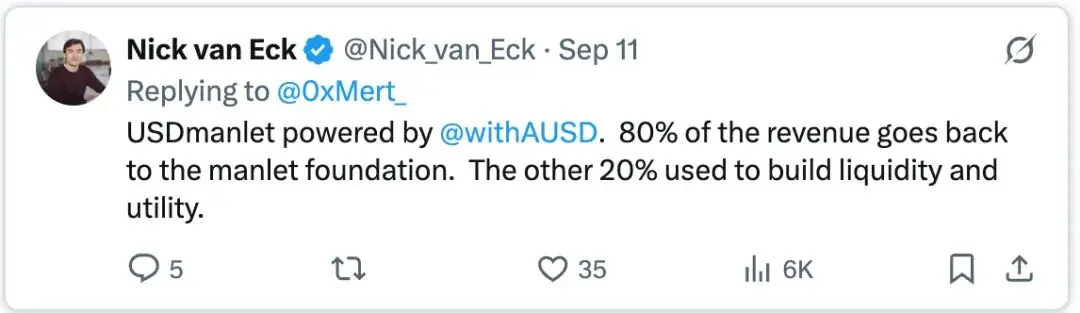
This issue has already sparked widespread concern within the Solana ecosystem. Notable voices like Helius's @0xMert_ have called for Solana to launch ecosystem-aligned stablecoins and proposed frameworks such as using 50% of the revenue for SOL buybacks and burns. The leadership of stablecoin issuer Agora has also suggested similar alignment structures. However, compared to Sui's proactive approach, these proposals have received little response from Solana's leadership.
The logic is straightforward: stablecoins have become a "commodity," especially after regulatory frameworks like the GENIUS Act have provided clearer guidance. As long as stablecoins maintain their peg and liquidity, users do not care whether they hold USDC, JupUSD, or other compliant stablecoins. So why default to a stablecoin that funds a competitor?
Solana's hesitation may partly stem from its desire to maintain "trustworthy neutrality." This is particularly important as the Solana Foundation strives for institutional recognition on par with Bitcoin and Ethereum. Attracting major issuers like BlackRock—whose institutional endorsement can drive massive capital inflows and position traditional finance to view it as a commoditized asset—may require Solana to maintain a certain distance in ecosystem politics. Supporting an ecosystem-aligned stablecoin could be seen as favoring certain ecosystem participants, complicating its path toward this goal.
Moreover, the scale and complexity of Solana's ecosystem make decision-making more challenging. With hundreds of protocols, thousands of developers, and billions of total locked value (TVL), coordinating a transition from USDC is much more difficult than for a younger, less dependent chain like Sui. However, this complexity itself is a reflection of Solana's network maturity and ecosystem depth, not a flaw.
But the problem is that inaction also has a cost, and that cost will continue to grow over time.
The effects of path dependence are intensifying daily. With each new user defaulting to USDC, the switching costs increase further. Every protocol optimizing liquidity around USDC makes it more difficult for other alternatives to launch. Technically, the existing infrastructure could support this transition overnight, but the real challenge lies in coordination.
Currently, within the Solana ecosystem, Jupiter is leading this transformation through JupUSD, explicitly committing to redirecting revenue back to the Solana ecosystem and deeply integrating it into its product stack. The question is whether other major Solana applications will follow suit. Will applications like Pump.fun adopt similar strategies to internalize stablecoin economics? At what point will Solana have to guide from the top down? Or will they choose to let applications within the ecosystem harvest this revenue themselves? While from the chain's perspective, ceding stablecoin economics to applications may not be the ideal outcome, it is undoubtedly better than letting funds leak out or, worse, being used to fund competitors.
From the perspective of the chain or the broader ecosystem, the current key lies in collective action: protocols need to tilt liquidity toward aligned stablecoins, treasuries need to make conscious allocation decisions, developers need to adjust default user experiences (UX), and users need to vote with their capital. The $500 million that Solana currently subsidizes Base with will not disappear due to a foundation mandate. Only when enough participants decide to stop funding competitors will this portion of funds truly remain within the ecosystem.
7. Conclusion: A New Direction for Stablecoin Economics
The next wave of stablecoin economics will no longer be determined by who issues the tokens, but by who controls the distribution rights and who can coordinate actions more swiftly.
Circle and Tether built massive businesses by being the first to issue and establish liquidity. However, as the stablecoin technology stack becomes commoditized, this moat is weakening. Cross-chain infrastructure makes stablecoins interchangeable, regulatory clarity lowers barriers to entry, and white-label services reduce issuance costs. Most importantly, platforms with the strongest distribution capabilities, sticky users, and mature monetization models are beginning to internalize revenues rather than pay them to third parties.
This transformation has quietly begun. Hyperliquid is capturing the $220 million in annual revenue flowing to Circle and Coinbase by switching to USDH. Jupiter is deeply integrating JupUSD into its entire product stack. MegaETH is using stablecoin revenue to operate its sequencer at cost. Sui has deployed ecosystem-aligned stablecoins in partnership with Ethena before path dependence sets in. These are just attempts by early actors, and now every chain losing hundreds of millions annually due to fund leakage has a reference guide for action.
For investors, this change provides a new perspective to evaluate on-chain ecosystems. The question is no longer "How much on-chain activity is there?" but rather "Can they overcome coordination challenges, monetize liquid funds, and capture stablecoin revenues at scale?"
When public chains and applications internalize hundreds of millions in annual revenue and redistribute it to token buybacks, ecosystem incentives, or protocol revenues, participants in the liquid market can directly price and invest in these revenue flows through the native tokens of these platforms. Protocols and applications that can internalize this revenue will have more robust economic models, lower user costs, and tighter alignment of interests with their communities. Those that fail to transform will continue to pay the "stablecoin tax," while their valuations will keep shrinking.
The most interesting investment opportunities are no longer about holding equity in Circle or speculating on high FDV stablecoin issuer tokens, but rather identifying which chains and applications can successfully complete this transformation, turning passive infrastructure into active revenue drivers.
Distribution rights are the true moat. Those who control the flow of funds, rather than merely providing infrastructure, will define the next phase of stablecoin economics.
Original Link ```
 Risk warning Risk warning




Popular articles





