








Why the decline is more severe than the market expected
 Core Viewpoint

 The uncertainty and pressure of the system are intensifying.
Original Title: Why the endgame looks uglier than markets are pricing
Original Author: arndxt
Original Translator: SpecialistXBT
In the past few months, my stance has undergone a substantial shift:
From "extremely bearish to actually bullish" (a crowded pessimistic sentiment that usually paves the way for a short squeeze) to "bearish and genuinely worried that the system is entering a more fragile phase."
This is not triggered by a single event but is based on the following five mutually reinforcing dynamic factors:
The risk of policy missteps is rising. The Federal Reserve is tightening financial conditions due to the uncertainty in economic data and clear signs of economic slowdown.
The AI/mega-cap complex is transitioning from cash-rich to leveraged growth. This shifts the risk from pure equity volatility to more classic credit cycle issues.
Private credit and loan valuations are beginning to diverge. Beneath the surface, model-based pricing pressures have shown early but concerning signs.
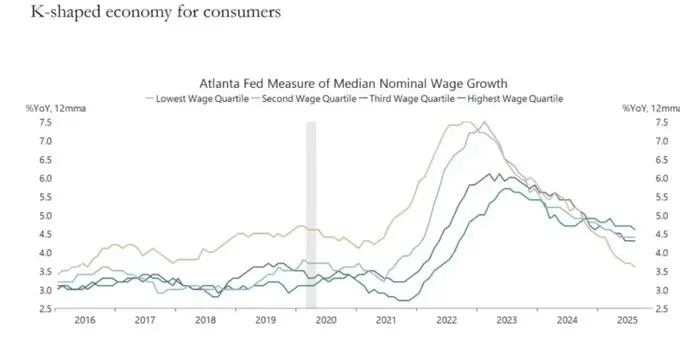
The K-shaped economy is solidifying into a political issue. For an increasing portion of the population, the social contract is no longer credible; this sentiment will ultimately be expressed through policy.
Market concentration has become a systemic and political vulnerability. When about 40% of the weight in an index is actually concentrated in a few tech monopolies sensitive to geopolitical and leverage issues, they are no longer just growth stories but become matters of national security and policy objectives.
The baseline scenario may still be that decision-makers will "do what they always do": inject liquidity back into the system and support asset prices into the next political cycle.
But the road to this outcome looks bumpier than the standard "buy the dip" script assumes, more credit-driven, and politically more unstable.
Macro Stance
For most of this cycle, holding a "bearish but constructive" stance has been rational:
Inflation is high but slowing.
Policy remains generally supportive.
Risk asset valuations are high, but pullbacks typically invite liquidity injections.
Now, several factors have changed:
- Government Shutdown: We have experienced a prolonged government shutdown that has disrupted the release and quality of key macro data.
- Statistical Uncertainty: Senior officials themselves admit that the federal statistical system is compromised, meaning they lack confidence in the statistical series that underpin trillions of dollars in asset allocation.
- Turning Hawkish Amid Weakness: Against this backdrop, the Federal Reserve has chosen to turn more hawkish on both interest rate expectations and its balance sheet, tightening financial conditions despite deteriorating leading indicators.
In other words, the system is exacerbating uncertainty and pressure rather than alleviating it. This is a fundamentally different risk situation.
Policy Tightening in the Fog
The core issue is not just about policy tightening but about where and how the tightening occurs:
- Data Fog: Key data releases (inflation, employment) have been delayed, distorted, or questioned following the shutdown. The Fed's "dashboard" has become unreliable at the most critical moment.
- Interest Rate Expectations: Although leading indicators point to disinflation early next year, the market's implied probability of near-term rate cuts has been adjusted downwards as Fed officials make hawkish statements.
Even if policy rates remain unchanged, the stance of the balance sheet on quantitative tightening and the tendency to push more duration assets into the private sector is essentially hawkish for financial conditions.
Historically, the Fed's mistakes have often been timing errors: tightening too late and easing too late.
We face the risk of repeating this pattern: tightening in the face of slowing growth and data ambiguity rather than preemptively easing to address these situations.
AI and Tech Giants Reduced to "Leveraged Growth" Stories
The second structural shift lies in the nature of tech giants and AI-leading companies:
Over the past decade, the "Mag7" has effectively behaved like equity bonds: dominant franchises, huge free cash flows, significant stock buybacks, and limited net leverage.
In the past 2-3 years, these free cash flows have increasingly been redirected towards AI capital expenditures: data centers, chips, infrastructure.
We are now entering a new phase where new capital expenditures in AI are increasingly financed through debt rather than relying solely on internally generated cash.
This means:
Credit spreads and CDS (credit default swaps) are beginning to behave differently. As leverage increases to finance AI infrastructure, credit spreads for companies like Oracle are widening.
Stock volatility is no longer the only risk. We are now seeing sectors that once felt "bulletproof" beginning to exhibit classic credit cycle dynamics.
Market structure amplifies this. These names occupy an oversized share in major indices; their transition from "cash cows" to "leveraged growth" alters the risk profile of the entire index.
This does not automatically mean an AI "bubble" will burst. If the returns are real and sustainable, leveraging for capital expenditures can also be justified.
But it does mean that the margin for error has become smaller, especially in a higher interest rate and tighter policy environment.
Signs of Fractures in Credit and Private Markets
Beneath the surface of the public markets, private credit is showing early signs of pressure:
The same loan is being valued significantly differently by different managers (for example, one estimates 70 cents, while another estimates about 90 cents).
This divergence is a typical precursor to broader disputes between model-based pricing and market value pricing.
This pattern resembles:
2007 - Rising bad assets, widening spreads, while stock indices remain relatively calm.
2008 - Markets viewed as cash equivalents (like auction rate securities) suddenly freeze.
Additionally:
The Fed's reserves are beginning to peak and decline.
There is increasing recognition within the Fed that some form of balance sheet expansion may be needed to prevent issues in the financial pipeline.
None of these guarantee a crisis will occur. But they align with a system that is quietly tightening credit while policy remains framed as "data-dependent" rather than preemptively responsive.
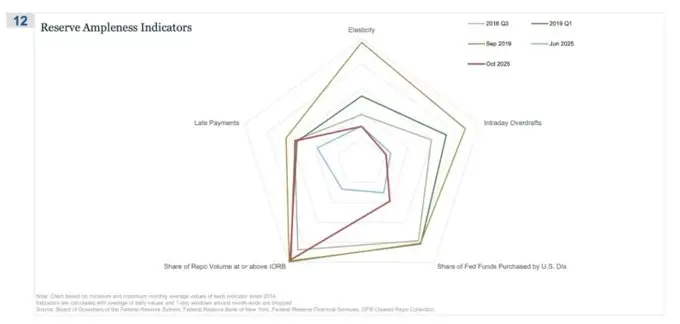
The repo market is where the "not abundant" story first becomes evident.
On this radar chart, "repo volume reaching or exceeding the IORB share" is the clearest indicator that we are quietly exiting a truly ample reserve regime.
In Q3 2018 and early 2019, this indicator was relatively controlled: ample reserves meant that most secured financing transaction rates comfortably stayed below the IORB lower bound.
By September 2019, just before the repo crisis erupted, this line sharply expanded, with an increasing number of repo transactions occurring at or above the IORB—this is a typical symptom of collateral and reserve scarcity.
Now look at June 2025 compared to October 2025:
The light blue line (June) remains safely within, but the red line for October 2025 extends outward, approaching the 2019 shape, indicating that an increasing number of repo transactions are touching the policy lower bound.
In other words, as reserves are no longer abundant, dealers and banks are pushing up overnight financing prices.
Combined with other indicators (more intraday overdrafts, higher discount window usage, and increased late payments), you get a clear signal.
The K-shaped Economy is Evolving into a Political Variable
What we have long referred to as the "K-shaped" economic divergence, in my view, has now become a political variable:
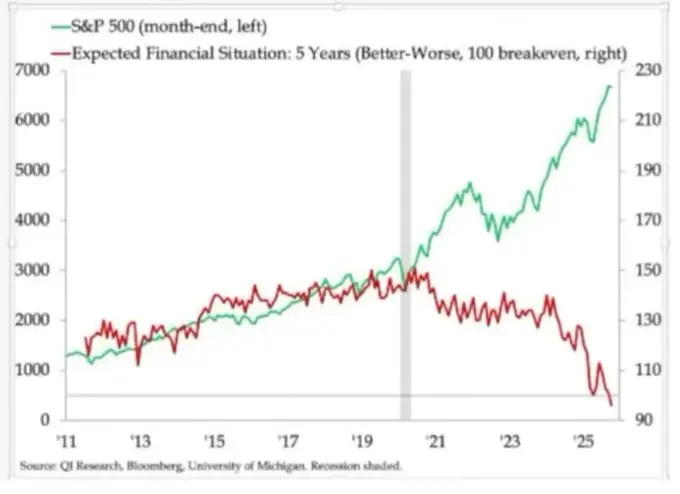
Household income expectations are polarized. Long-term financial outlooks (like 5-year expectations) show a staggering gap: some groups expect stability or improvement; others anticipate a sharp deterioration.
Real-world pressure indicators are flashing:
The default rate among subprime borrowers is rising.
The age of homebuyers is being pushed back, with the median age of first-time buyers nearing retirement age.
Youth unemployment indicators are gradually rising across multiple markets.
For an increasingly large segment of the population, the system is not just "unequal"; it is failing:
They have no assets, limited wage growth, and almost no realistic path to participate in asset inflation.
The recognized social contract—"work hard, progress, accumulate wealth and security"—is collapsing.
In this environment, political behavior will change:
Voters are no longer choosing the "best managers" of the current system.
They are increasingly willing to support disruptive or extreme candidates from the left or right because, for them, the downside space is limited: "It can't get worse than this."
Future policies regarding taxation, redistribution, regulation, and monetary support will be formulated in this context. This is not neutral for the markets.
High Market Concentration Becomes a Systemic and Political Risk
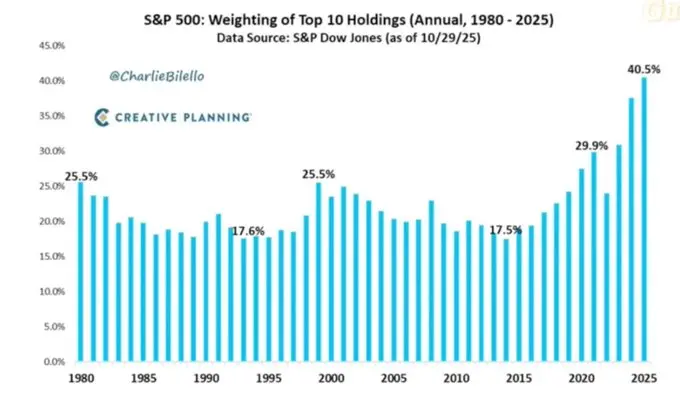
Market capitalization is highly concentrated in a few companies. However, less attention is paid to its systemic and political implications:
The top 10 companies now account for about 40% of major U.S. stock indices.
These companies:
- - Are core holdings in pension funds, 401(k)s, and retail investor portfolios.
- - Are increasingly leveraged to AI, have exposure to the Chinese market, and are sensitive to interest rate paths.
- - Are effectively monopolies in multiple digital domains.
This creates three intertwined risks:
Systemic market risk. Shocks to these companies—whether from earnings, regulation, or geopolitics (like Taiwan, Chinese demand)—will quickly transmit throughout the household wealth complex.
National security risk. When so much national wealth and productivity is concentrated in a few companies that are dependent on external factors, they become strategic vulnerabilities.
Political risk. In a K-shaped, populist environment, these companies are the most visible focal points of resentment: higher taxes, windfall taxes, and restrictions on buybacks. They will face antitrust-driven breakups and stringent AI and data regulation.
In other words, these companies are not just engines of growth; they are also potential policy targets, and the probability of becoming targets is rising.
The Failure of Bitcoin, Gold, and the "Perfect Hedge" Narrative (Temporarily)
In a world filled with risks of policy missteps, credit pressures, and political instability, one might expect Bitcoin to thrive as a macro hedge tool. However, gold has behaved like a traditional crisis hedge: steadily strengthening, with low volatility, and increasing correlation in portfolios.
Bitcoin's trading performance resembles that of a high Beta risk asset:
- - Highly correlated with liquidity cycles.
- - Sensitive to leverage and structured products.
- - Long-time holders (OGs) are selling in this environment.
The initial narrative of decentralization/money revolution remains conceptually appealing, but in practice:
- - Today's dominant capital flows are financialized: yield strategies, derivatives, and volatility shorting behaviors.
- - Bitcoin's empirical behavior is closer to tech stock Beta rather than a neutral, robust hedge tool.
- - I still believe there is a reasonable path for 2026 to become a major turning point for Bitcoin (next policy cycle, next wave of stimulus, and further erosion of trust in traditional assets).
But investors should recognize that at this stage, Bitcoin has not provided the hedging attributes many hope for; it is part of the same liquidity complex we are concerned about.
Scenario Framework Leading to 2026
A useful framework for constructing the current environment is: this is a managed bubble deleveraging aimed at creating space for the next round of stimulus.
The sequence may be as follows:
Mid-2024 to Mid-2025: Controlled tightening and pressure.
- - Government shutdown and political dysfunction causing cyclical drag.
- - The Fed leans hawkish in rhetoric and balance sheet, tightening financial conditions.
- - Credit spreads moderately widen; speculative sectors (AI, long-duration tech stocks, some private credit) absorb initial shocks.
Late 2025 to 2026: Reintegrating into the political cycle.
- - As inflation expectations decline and markets pull back, decision-makers regain "space" for easing.
- - We see rate cuts and fiscal measures calibrated to support growth and electoral goals.
- - Given the lag, inflation consequences will manifest after key political milestones.
Post-2026: Systemic repricing.
- - Depending on the scale and form of the next round of stimulus, we will face a new cycle of asset inflation, accompanied by higher political and regulatory intervention, or more abruptly confront issues of debt sustainability, concentration, and the social contract.
This framework is not deterministic, but it aligns with current incentives:
- - Politicians prioritize re-election over long-term equilibrium.
- - The simplest toolbox remains liquidity and transfer payments rather than structural reforms.
- - To use that toolbox again, they first need to squeeze out some of today's bubbles.
Conclusion
All signals point to the same conclusion: the system is entering a more fragile phase with lower tolerance for error.
In fact, historical patterns suggest that decision-makers will ultimately respond with a significant influx of liquidity.
But entering the next phase requires first experiencing:
- - Tighter financial conditions
- - Rising credit sensitivity
- - Political turmoil
- - Increasingly nonlinear policy responses
 Risk warning Risk warning



Popular articles





