








A Brief Discussion on the Challenges of Ethereum | Bill It Up Memo

 The dilemma of Ethereum's "feudalization" and the advantages of Solana's "entrepreneurial charge" comparison.
First of all, it should be noted that both I and our organization hold ETH and SOL, so it's not because we hold SOL that we like to nitpick ETH. The issues with ETH have been long-standing and will not be overlooked by the market just because of previous hype.
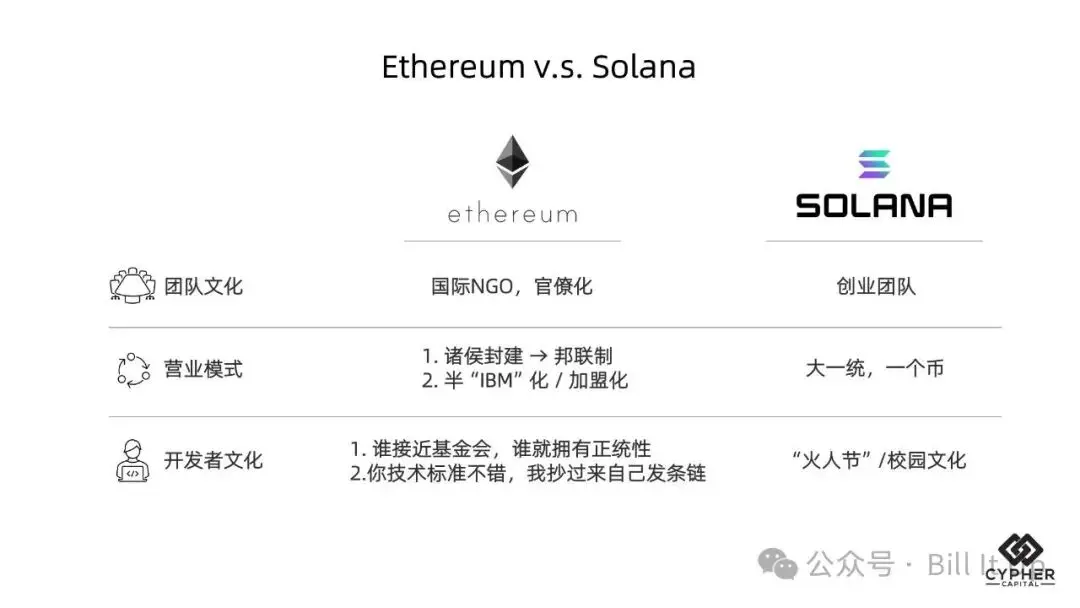
Ethereum is like an international NGO with a feudal system—bureaucratic, decentralized, and focused on procedural justice. Vitalik Buterin is like the Son of Heaven, having lost centralized power too early, allowing L2 to become feudal lords, with very limited financial contributions from local lords to the central authority. It even resembles the Commonwealth of Independent States after the dissolution of the Soviet Union, or the Commonwealth of Nations after the disintegration of the British Empire, and even that relationship is somewhat tenuous.
Additionally, will ETH become like IBM? Microsoft, Amazon, and Nvidia are all worth trillions, while IBM is still lying there: it is a well-branded entity, exporting technology and empowering others, but in the end, its business is not the entire market's take rate (the tax model is the strongest business, such as Amazon taking a cut from merchant transactions, and Google taking a cut from global merchants' advertising expenditures), but rather it has become an organization that does tech licensing (and ETH's licensing is free, anyone can use EVM).
Another age-old issue is that in the developer culture, those who are close to the foundation and can flaunt their relationship with it possess "orthodoxy" and can enjoy more attention from investors and the community. This centripetal culture of sycophancy is contrary to Ethereum's original intention.
Moreover, I have heard some major Wall Street institutions mention in private conversations that Wall Street players come to ETH, partly because it is the oldest, most reliable, and branded first public chain; on the other hand, surprisingly, many of them want to launch permissioned chains, and ETH's technology in this regard has been validated over many years. This mindset also treats ETH like IBM; it seems that Wall Street institutions share similar thoughts with Chinese financial institutions.
In contrast, Solana represents a typical startup team culture—centralized, efficient, and strong in execution. The business model is a unified whole, with one coin supporting the entire system. The developer culture resembles a "Burning Man" festival: young, passionate, and strong in experimental spirit, closer to campus hacker culture. From the perspective of team and culture, I still feel that Solana resembles a multinational tech startup team more.
Regardless, in the end, everyone is working together to put global assets on the blockchain; competition is a good thing for all of us.
 Risk warning Risk warning




Popular articles





