








Wall Street is counting on Bitcoin's high volatility to pay year-end bonuses
 Core Viewpoint

 ETFs have not "tamed" Bitcoin; volatility is the most attractive indicator of the asset.
This article is from: Jeff Park, Bitwise Advisor
Compiled by: Moni, Odaily Planet Daily
In just six weeks, Bitcoin's market value evaporated by $500 billion, with ETF fund outflows, Coinbase discounts, structural sell-offs, and poorly positioned long positions being liquidated, all without any obvious catalysts to stimulate a market rebound. Moreover, ongoing concerns such as whale sell-offs, heavily loss-making market makers, lack of defensive liquidity supply, and existential threats from quantum crises continue to hinder Bitcoin's potential for a rapid recovery. However, throughout this decline, one question has persistently troubled the community: What has happened to Bitcoin's volatility?
In fact, the volatility mechanism of Bitcoin has quietly undergone a transformation.
Over the past two years, it has been widely believed that ETFs have "tamed" Bitcoin, suppressing its volatility and transforming this asset, which was once highly sensitive to macroeconomic factors, into a trading tool constrained by institutional oversight and volatility suppression mechanisms. However, if we focus on the past 60 days, we find that this is not the case; the market seems to have returned to its previous state of volatility.
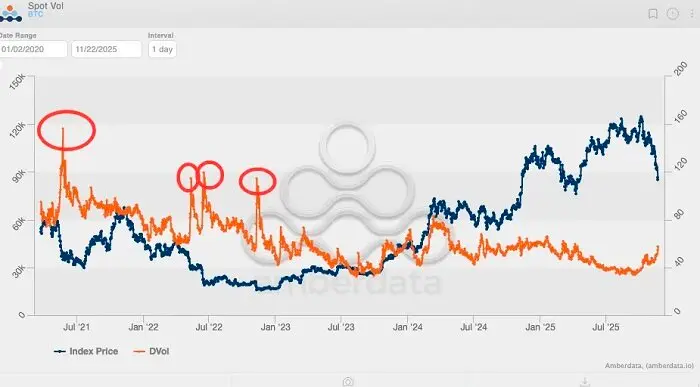
Looking back at the implied volatility of Bitcoin over the past five years, we can trace the peaks of this indicator:
The first peak (and the highest) occurred in May 2021, when Bitcoin mining faced setbacks, causing implied volatility to soar to 156%;
The second peak appeared in May 2022, triggered by the collapse of Luna/UST, reaching 114%;
The third peak occurred between June and July 2022, when 3AC was liquidated;
The fourth peak was in November 2022, during the FTX collapse.
Since then, Bitcoin's volatility has never exceeded 80%. The closest it came to 80% was in March 2024, when the spot Bitcoin ETF experienced three months of continuous fund inflows.
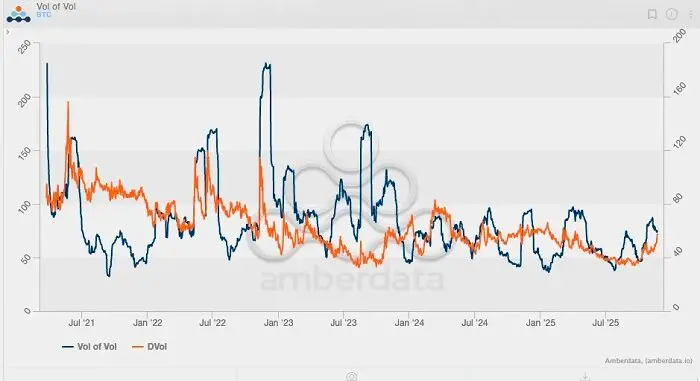
If we observe the Bitcoin volatility index (vol-of-vol index), a clearer pattern emerges (this index is essentially the second derivative of volatility, reflecting the rate of change of volatility itself). Historical data shows that the highest value of the Bitcoin volatility index occurred during the FTX collapse, when it soared to about 230. However, since the ETF received regulatory approval for listing in early 2024, the Bitcoin volatility index has never surpassed 100, and implied volatility has continued to decline, unrelated to the spot price trend. In other words, Bitcoin seems to no longer exhibit the characteristic high volatility behavior seen in the market structure before the ETF launch.
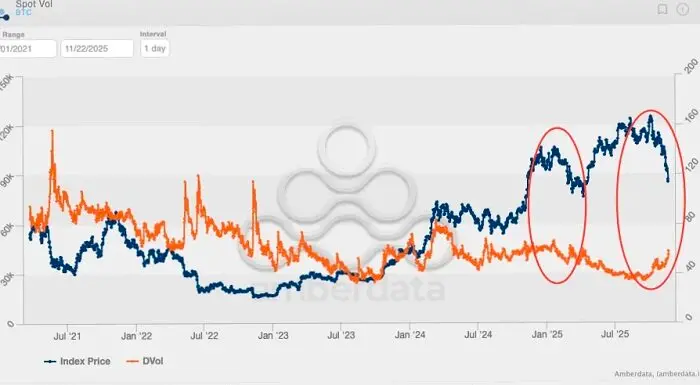
However, the situation has changed in the past 60 days, with Bitcoin's volatility experiencing its first rise since 2025.
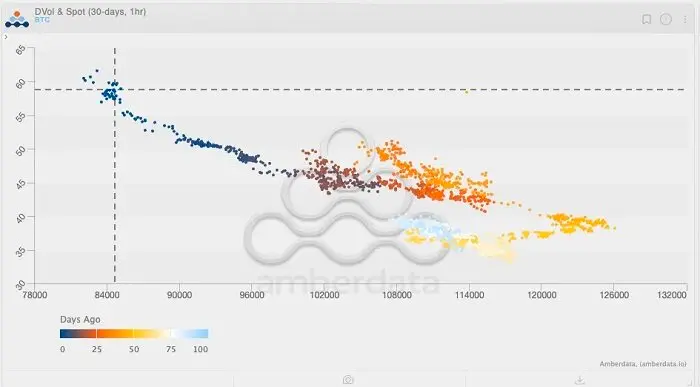
Looking at the chart above, note the color gradient (light blue to dark blue represents "days ago"). Tracking recent trends, you will notice a brief window where the spot Bitcoin volatility index climbed to around 125, while implied volatility was also rising. At that time, Bitcoin's volatility indicators seemed to suggest a potential market breakout, as previously, volatility was positively correlated with spot prices. However, contrary to expectations, everyone now knows that the market did not rise as anticipated but instead reversed and fell.
Interestingly, even as the spot price declined, implied volatility (IV) continued to rise. Since the advent of the ETF era, it has been rare for Bitcoin's price to fall while implied volatility continues to rise. It can be said that we may be witnessing another significant "turning point" in Bitcoin's volatility pattern, where implied volatility returns to the state it was in before the ETF appeared.
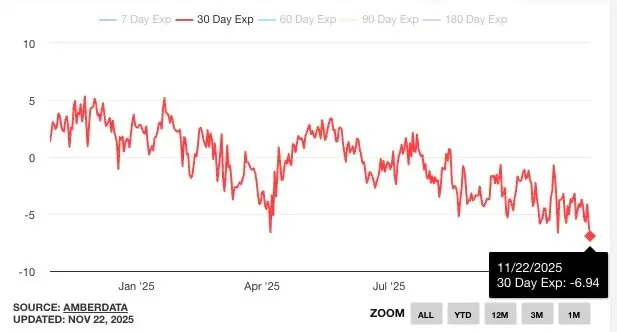
To better understand this trend, we use a skew chart for further analysis. During significant market downturns, the skew of put options typically rises sharply—this can be seen in the three major events mentioned earlier, where the skew reached -25%.
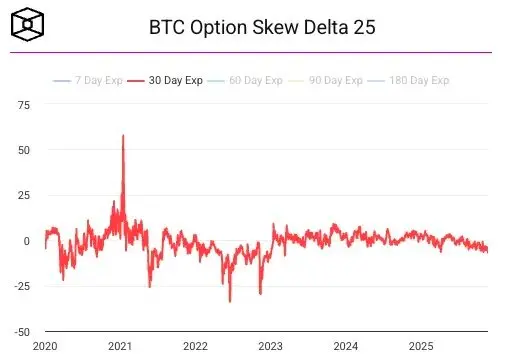
However, the most noteworthy data point is not the skew during market declines but rather in January 2021, when the skew of call options peaked above +50%. At that time, Bitcoin experienced the last true mega-gamma squeeze in recent years: the price surged from $20,000 to $40,000, breaking the historical high of 2017 and triggering an influx of trend followers, CTAs, and momentum funds. Actual volatility exploded, forcing traders to buy spot/futures to hedge against the gamma risk of short positions, which in turn pushed prices higher—this was also when Deribit saw record retail fund inflows as traders discovered the power of out-of-the-money call options.
Analysis shows that monitoring changes in options positions is crucial. Ultimately, it is the options positions—not just spot trading—that create the decisive moves that drive Bitcoin prices to new highs.
With the "turning point" in Bitcoin's volatility trend re-emerging, it suggests that prices may again be driven by options. If this shift continues, the next wave of Bitcoin's price increase will not only come from ETF fund inflows but also from a volatile market (with more investors entering to seek profits from volatility), as the market finally recognizes Bitcoin's true potential.
As of November 22, 2025, the top five nominal amounts of open contracts on the Deribit platform are as follows:
A $85,000 put option expiring on December 26, 2025, with an open contract size of $1 billion;
A $140,000 call option expiring on December 26, 2025, with an open contract size of $950 million;
A $200,000 call option expiring on December 26, 2025, with an open contract size of $720 million;
An $80,000 put option expiring on November 28, 2025, with an open contract size of $660 million;
A $125,000 call option expiring on December 26, 2025, with an open contract size of $620 million.
Additionally, as of November 26, the top ten options positions of BlackRock IBIT are as follows:
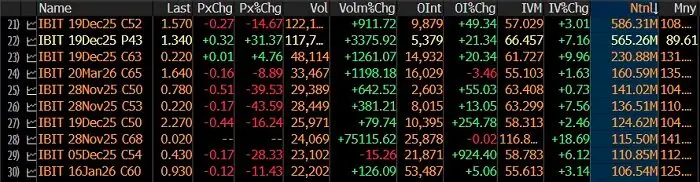
This indicates that the demand for options configuration before the end of the year (calculated by nominal value) is greater than the demand for options configuration (calculated by nominal value), and the strike price range of options is more skewed towards out-of-the-money options.
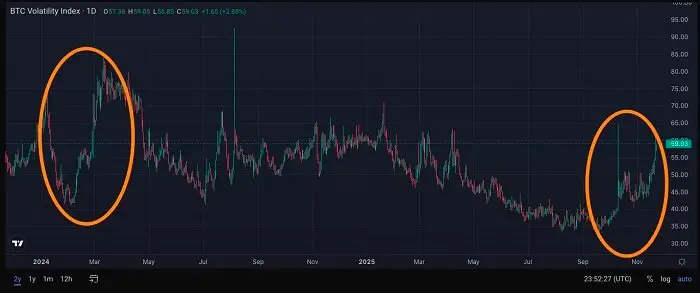
If we further observe the implied volatility chart of Bitcoin over the past two years, we find that the sustained demand for volatility in the past two months closely resembles the similar trend on the chart during February to March 2024. Many should remember that this was the period of explosive growth driven by Bitcoin ETF fund flows. In other words, Wall Street needs Bitcoin to maintain high volatility to attract more investors, as Wall Street is a trend-driven industry that likes to maximize profits before year-end bonuses are distributed.
Volatility is like a self-propelling profit-driven machine.
Of course, it is still too early to assert whether volatility has formed a breakout trend and whether ETF fund flows will follow, meaning that spot prices may continue to decline. However, if spot prices continue to fall from their current position while implied volatility (IV) rises during this period, it would strongly indicate that prices may experience a significant rebound, especially in an environment where traders still prefer to buy "sticky options." But if the sell-off continues and volatility stagnates or even declines, the path out of the downturn will be greatly narrowed, particularly in light of the recent structural sell-off triggering a series of negative external effects. In this case, the market is less about finding a rebound point and more about gradually forming a potential bearish trend.
The coming weeks will be interesting.
Recommended reading:
Rewriting the 2018 script, will the end of the US government shutdown lead to a Bitcoin price surge?
$1 billion stablecoin evaporation, what’s the truth behind the DeFi chain explosion?
MMT short squeeze event review: a carefully designed money-making game
 Risk warning Risk warning




Popular articles





