








Etherscan's sudden charging unexpectedly exposes the data dependency contradiction in the Ethereum ecosystem
 Core Viewpoint

 Etherscan's cessation of free API services on multiple chains has sparked industry debate, reflecting the deep-seated contradictions between the commercialization and decentralization of blockchain data infrastructure.
Original Title: "Etherscan cancels several free APIs, raising some questions we never thought of"
Original Author: Eric, Foresight News
On November 23, Lefteris Karapetsas, the founder of the open-source portfolio tracker rotki, tweeted his frustration about Etherscan. He stated that Etherscan suddenly announced during Devcon that it would no longer provide free APIs for the Avalache C-Chain, Base, BNB Chain, and OP Mainnet block explorers.
While he understands that providing free services can be quite stressful, he questioned whether they could have given a bit more notice or at least not chosen such a major event when everyone is away to make this "sudden attack," leaving no time for a response.
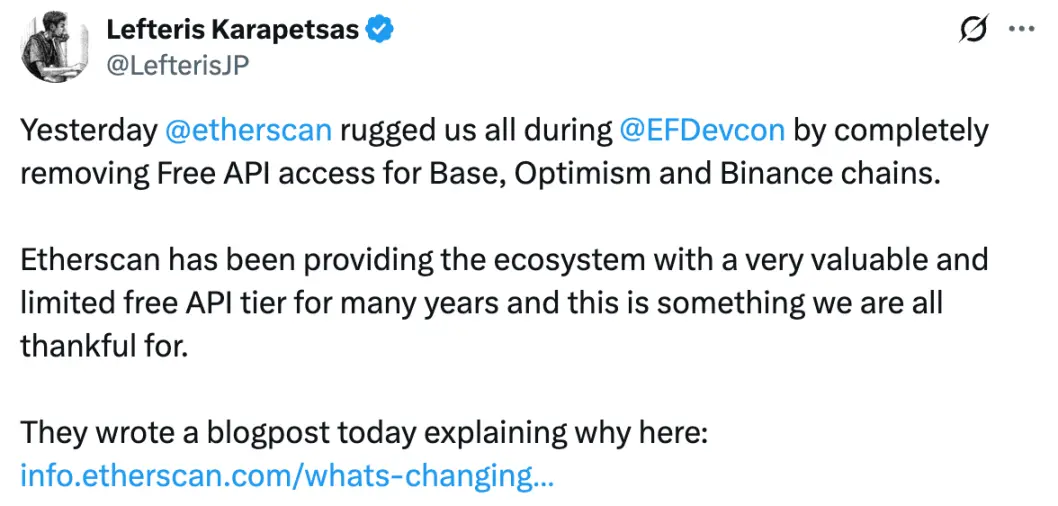
According to Etherscan's announcement, as the performance of chains gradually improves, the amount of data has also increased significantly, which has raised costs considerably. In this situation, they can no longer afford to provide all APIs for free and have reluctantly turned some originally free APIs into paid versions.
It is clear that the inability to continue offering free APIs for specific chains is likely due to a lack of sufficient funding or resource support.
In the end, this guy was still a bit puzzled, wondering if Base, OP Mainnet, and BNB Chain really couldn't afford to support such important services, aside from Avalache?
However, opposing voices quickly followed, with Jack, the founder of Routescan and operator of the Avalanche block explorer Snowtrace, being the first to respond. Jack provided some data that might only be known within the industry:
· Etherscan charges the chains it supports about $1.5 million to $2 million per year, although some only cost around $300,000 and provide very basic data;
· For those chains that have already paid, Etherscan only offers 5 RPS (requests per second) of free API, and if more is needed, the monthly subscription fee can go up to $899;
· Last month, the number of unique visitors to Etherscan's various chain explorers were: OP Mainnet, 102,000; BNB Chain, 2.5 million; Base, 1 million; HyperEVM, 30,000; Avalanche, 16,000. Etherscan itself had 4 million.
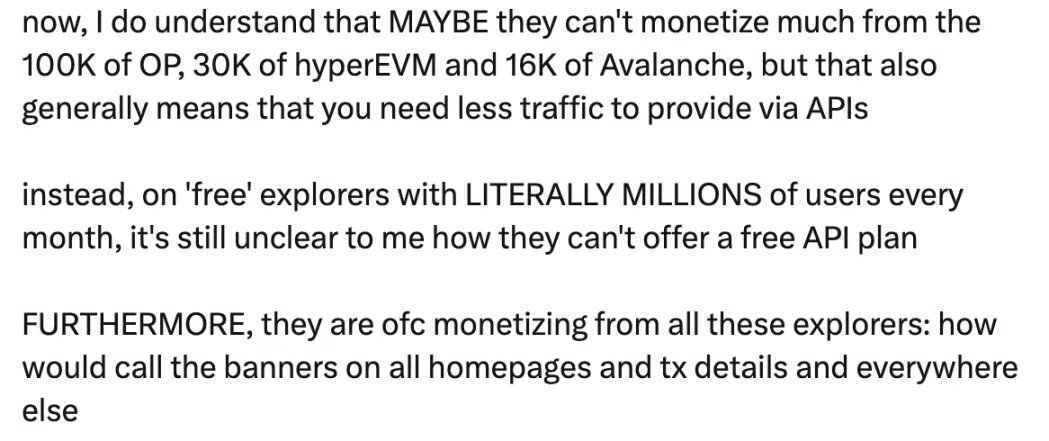
The CEO's implication is that charging for a small number of APIs is indeed due to financial strain, not because they are unhappy with the money they make. Some chains have not paid, and they have already been generous by providing free services for a while, so everyone should stop complaining and move on.
There isn't much more to discuss about this issue; some people feel that Etherscan is greedy, while others believe that commercial behavior is justifiable. However, some other discussions that emerged from this event are quite interesting.
First, this incident made the author aware of the existence of the VERA ecosystem alliance, which promotes convenient, unified, and open access to EVM smart contract source code, as well as the Open Labels Initiative, which promotes the standardization of EVM address labeling frameworks and data models. The goals of these two organizations are essentially aligned: to support the accessibility of blockchain data, especially verification.
The Open Labels Initiative retweeted Lefteris Karapetsas's complaint tweet and stated that they have been working to prevent such situations from centralized data providers on chains that are overly relied upon over the past year, and they believe that such important infrastructure should not be monopolized but rather co-built.
Sourcefify.eth, a platform for verifying Ethereum contract code, the Ethereum data visualization platform growthepie, the open-source block explorer Blockscout, and the aforementioned Routescan are all contributing to the readability and accessibility of Ethereum data.
According to Reserve Protocol DeFi engineer Akshat Mittal, Etherscan has not participated in these efforts. Is it for commercial interests? No one knows, but even if it is, it is not unjustifiable. The Ethereum ecosystem will always have some who uphold open-source culture and reject excessive commercialization; this is not about good or bad, but rather the diversity of the ecosystem. Profit-oriented organizations can ensure service quality, and open-source products will also have their place.
In addition, 0xFrancis, the founder of zCloak Network, who has recently been lavish in praising IC, once again made a comparison between IC and Ethereum.
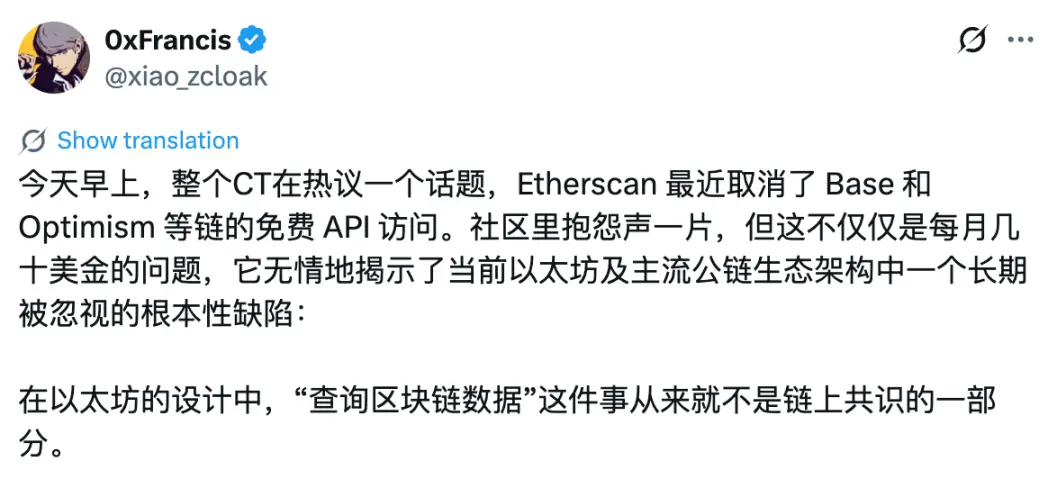
0xFrancis stated that Ethereum does not consider "querying block data" as part of its consensus, and developing DApps must rely on third-party RPC services. If the RPC nodes collectively go offline, although the chain will continue to operate, it will become "unreadable."
On a deeper level, if centralized RPC nodes or websites like Etherscan provide false data, it can easily mislead people. IC treats querying itself as part of the protocol; when someone initiates a query request, it is executed uniformly through the ICP node network and returns cryptographically verified data, ensuring data accuracy.
0xFrancis's points are not without merit, and this can also serve as a typical example of IC being overly advanced. The debate surrounding Etherscan's fees is similarly a classic discussion about centralization versus decentralization. However, is it possible that Ethereum's imperfections and the need for commercial components have actually driven the prosperity of its ecosystem?
 Risk warning
 Risk warning

Popular articles





