








The Bitcoin Mining Lifeline: How Do Miners Survive After a 35% Drop in Profits?
 Core Viewpoint

 The decline in Bitcoin prices, along with rising difficulty and costs, has pushed many miners close to the breakeven point, forcing them to rely on holding coins and external financing to sustain operations.
Original Title: The Miners's Mirage
Original Author: Prathik Desai, Token Dispatch
Original Compilation: Chopper, Foresight News
The financial logic of Bitcoin miners is quite simple: they rely on fixed protocol income for survival while facing fluctuating real-world expenses. When the market is volatile, they are the first group to feel the pressure on their balance sheets. Miners' income comes from selling the Bitcoin they mine, while their operating costs are primarily the electricity needed to run the heavy computers for mining.
This week, I tracked some key data on Bitcoin miners: the rewards paid to miners by the network, the costs incurred to earn this income, the remaining profit after cash expenses, and the final net profit after accounting.
With the current Bitcoin price below $90,000, miners are in a difficult position. Over the past two months, the 7-day average income for miners has dropped by 35% from $60 million to $40 million.
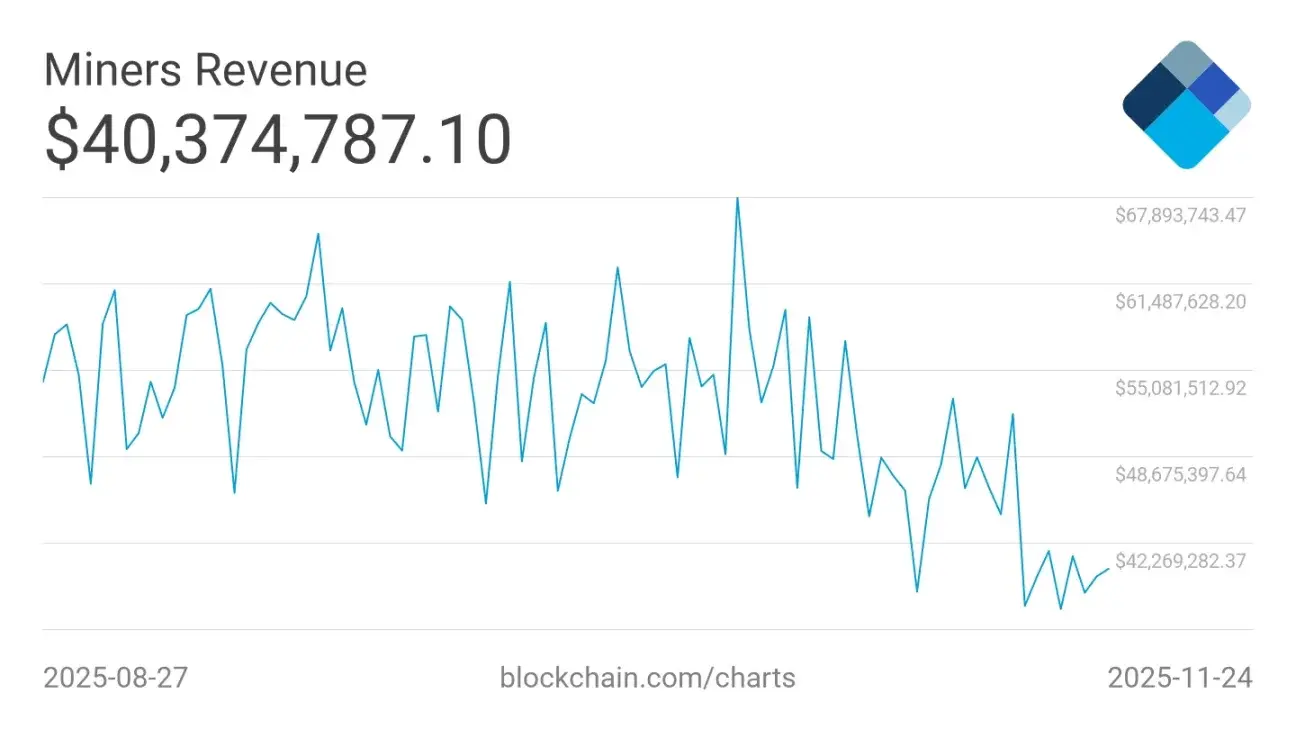
Let me break down the key logic in detail.
The income mechanism for Bitcoin is fixed and encoded in the protocol. The mining reward for each block is 3.125 Bitcoins, with an average block time of 10 minutes, resulting in about 144 blocks produced daily, equivalent to approximately 450 Bitcoins mined per day across the network. Over 30 days, global Bitcoin miners accumulate 13,500 Bitcoins, which, at the current price of about $88,000, amounts to a total value of approximately $1.2 billion. However, if this income is distributed across a record 1,078 EH/s (exahashes) of hash power, the final income per TH/s (terahash) of hash power is only 3.6 cents, which is the entire economic foundation supporting the security operation of this $17 trillion network. (Note: 1 EH/s = 10^18 H/S; 1 TH/S = 10^12 H/S)
On the cost side, electricity is the most critical variable, with its level depending on the mining location and the efficiency of the mining machines.
If using modern S21-level mining machines (with a power consumption of 17 joules per terahash) and able to access cheap electricity, miners can still achieve cash profitability. However, if the mining machines are primarily outdated equipment or if they have to pay high electricity costs, then each hash calculation will increase costs. At the current hash price (affected by network difficulty, Bitcoin price, block subsidies, and transaction fees), an S19 miner using electricity at $0.06 per kilowatt-hour can barely break even. Once network difficulty rises, Bitcoin prices drop slightly, or electricity costs surge, their economic benefits will further deteriorate.
Let me analyze some specific data.
In December 2024, CoinShares estimated that publicly listed mining companies would have a cash cost of about $55,950 to mine one Bitcoin in the third quarter of 2024. Now, Cambridge University's estimate has raised this cost to about $58,500. There are differences in actual mining costs among different miners: the largest publicly listed Bitcoin mining company, Marathon Digital (stock code MARA), has an average energy cost of $39,235 to mine each Bitcoin in the third quarter of 2025; the second largest listed mining company, Riot Platforms (stock code RIOT), has a cost of $46,324. Although the Bitcoin price has dropped 30% from its peak to $86,000, these mining companies are still profitable. However, this is not the whole truth.
Miners also need to consider non-cash expenses, including depreciation, impairment, and stock option compensation, which together make mining a capital-intensive industry. Once these costs are accounted for, the total cost of mining one Bitcoin can easily exceed $100,000.
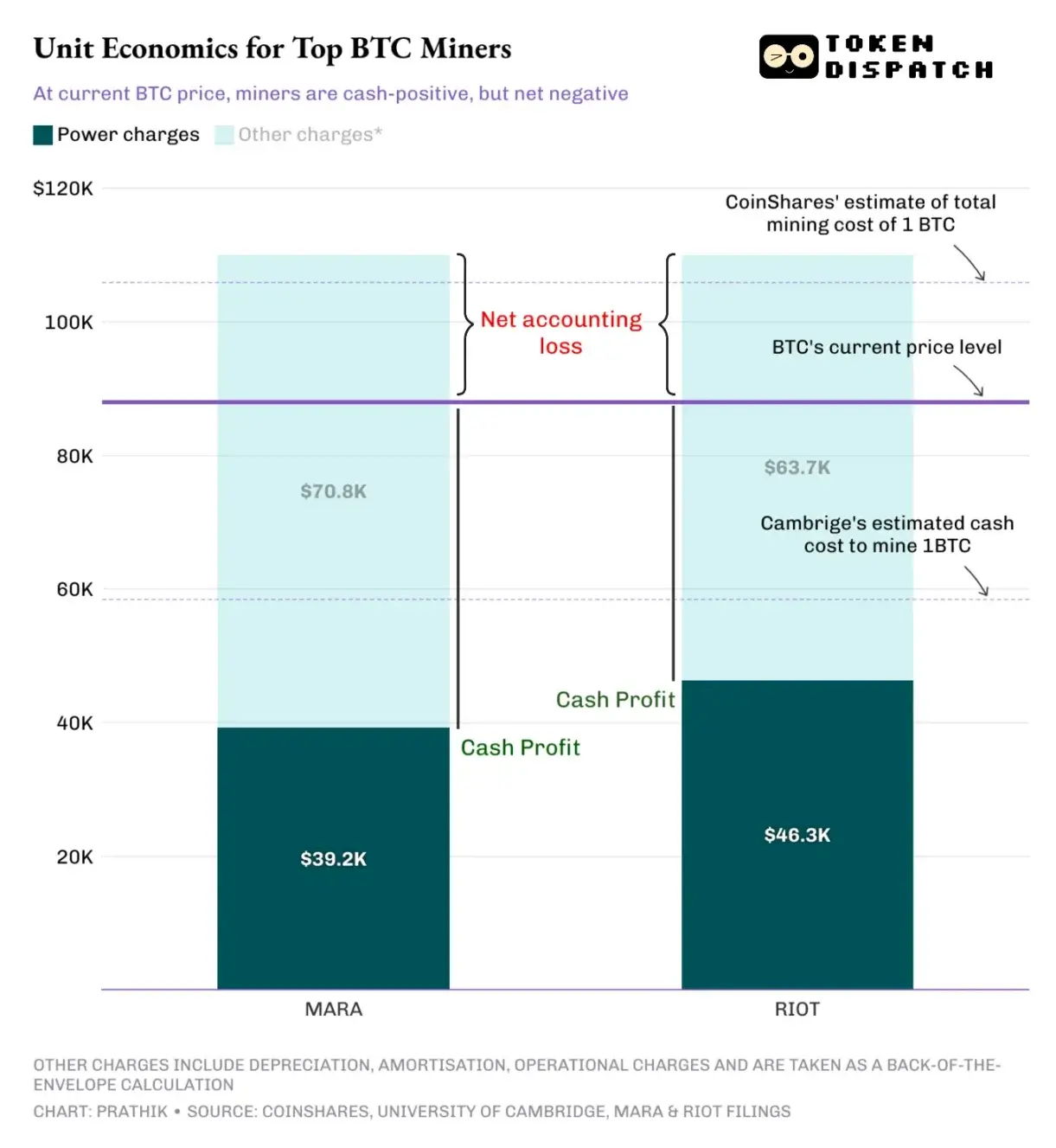
Mining costs of top mining companies Marathon and Riot
MARA uses both its own mining machines and third-party hosted equipment for mining. MARA has to pay for electricity, depreciation, and hosting fees. Rough calculations show that its total mining cost per Bitcoin exceeds $110,000. Even the total mining cost estimated by CoinShares in December 2024 is about $106,000.
On the surface, the Bitcoin mining industry appears robust. Cash profit margins are substantial, with the potential for accounting profits, and the operational scale is large enough to raise funds at will. However, a deeper analysis reveals why more and more miners choose to hold the Bitcoin they mine, or even increase their Bitcoin holdings from the market, rather than sell immediately.
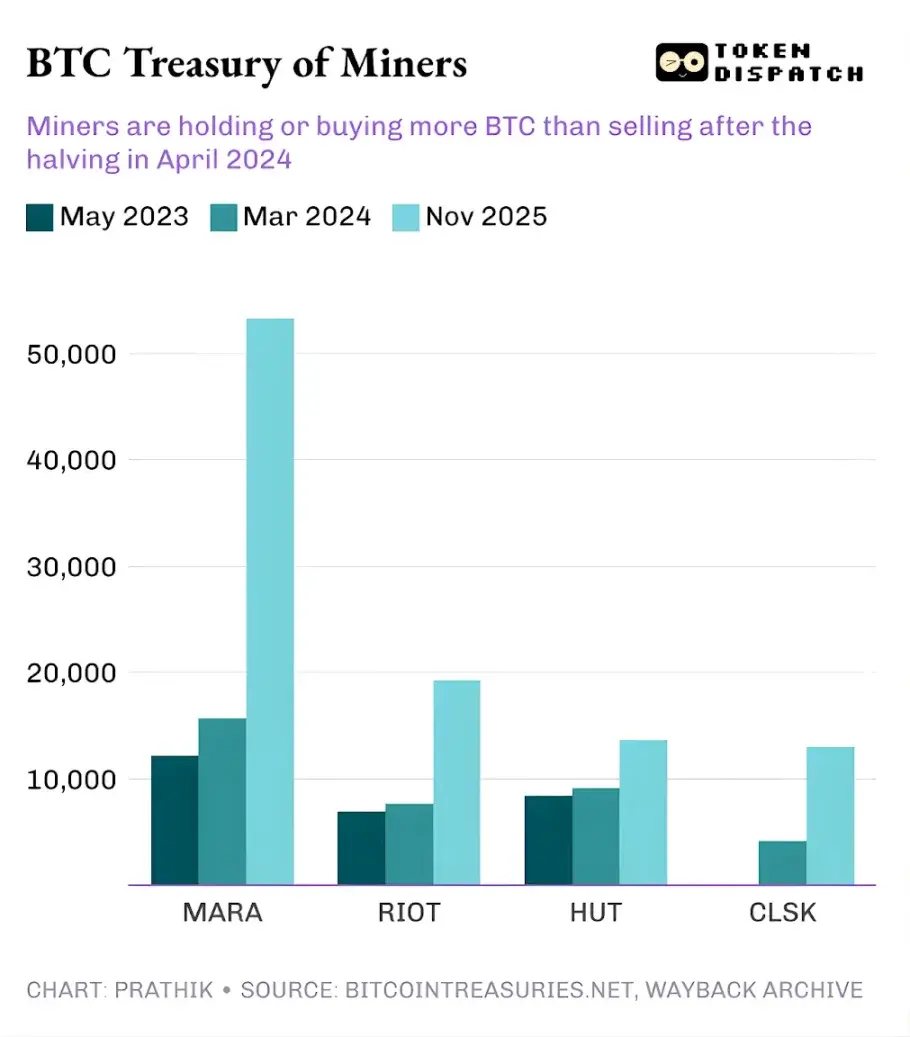
Bitcoin reserves of leading mining companies
Strong mining companies like MARA can cover their costs because they have auxiliary businesses and can access capital markets. However, many other mining companies could fall into losses if network difficulty rises again.
Overall, there are two coexisting breakeven scenarios in the mining industry:
The first scenario involves large industrial-scale mining companies that have efficient mining machines, cheap electricity, and light capital asset balance sheets. For them, the daily cash flow only turns negative when the Bitcoin price drops from $86,000 to $50,000. Currently, they have a cash profit of over $40,000 for each Bitcoin mined, but whether they can achieve accounting profitability at the current price level varies by company.
The second scenario involves the remaining group of miners, who will find it difficult to maintain breakeven once depreciation, impairment, and stock option expenses are accounted for.
Even conservatively estimating the comprehensive cost of each Bitcoin to be between $90,000 and $110,000 means that many miners have already fallen below the economic breakeven point. They can continue mining because cash costs have not been breached, but accounting costs have exceeded the limit. This may prompt more miners to choose to hold Bitcoin rather than sell it now.
As long as cash flow remains positive, miners will continue to mine. At the price level of $88,000, the entire system appears stable, but this premise relies on miners not selling Bitcoin. If the Bitcoin price falls further or miners are forced to liquidate their holdings, they will approach the breakeven line.
Therefore, although price crashes will continue to affect retail and trading groups, it is currently unlikely to harm miners. However, if miners' financing channels become more restricted, the situation may worsen, leading to a breakdown of the growth flywheel, forcing miners to increase their investment in auxiliary businesses to maintain operations.
Recommended Reading:
Rewriting the 18-Year Script, U.S. Government Shutdown Ends = Bitcoin Price Will Soar?
$1 Billion Stablecoin Evaporation, What’s the Truth Behind the DeFi Chain Reaction?
MMT Short Squeeze Event Review: A Carefully Designed Money-Making Game
 Risk warning
 Risk warning




Popular articles





