








Is the prediction market the next ByteDance? How to layout? Dissecting the hundred billion market value model
 Core Viewpoint

 Exploring the high valuation of the prediction market, from event derivatives to world prediction OS, benchmarking ByteDance's trillion-level potential.
Currently, Polymarket and Kalshi have valuations of $15 billion and $12 billion respectively, with Kalshi's annual revenue expected to be $60 million, reaching a 200x PS.
Why are VCs giving such high multiples? This article attempts to provide some answers.
I have been following prediction markets for over a year and am also curious about this question. I have done some research to try to answer this question, as well as to understand what stage these two companies are currently in, how much room for growth they have, and to compare them with ByteDance:
At first, VCs did not see the value of "news apps" and basically passed on "ByteDance"; ultimately, ByteDance became the story of a "recommendation engine," using the powerful tool of "recommendation" to almost redo all internet businesses, reaching a valuation of $500 billion.
Could Polymarket and Kalshi potentially use their "prediction" capability to replicate this in other industries? What are the possible ways to participate and position themselves?
Additionally, I recommend reading this article first https://x.com/starzq/status/1993486485170143499?s=20
【Table of Contents】
Five Final Forms and Corresponding Valuations
Where do Polymarket / Kalshi stand in A/B/C/D/E?
Polymarket vs ByteDance: A Comparison of Financing and Valuation, which stage is it roughly equivalent to in ByteDance's timeline?
Easter Egg: Ways to Position
Disclaimer: All discussions in this article are not investment advice, but merely a record of valuation thoughts. Additionally, this article was completed by me and ChatGPT together.
1. Five Final Forms and Corresponding Valuations
In my view, the ultimate forms of prediction markets can be roughly divided into five levels:
A: Event Derivatives Exchange
B: Parametric Insurance Infrastructure
C: Decision & Governance "Truth Layer"
D: AI Probability Data & World Prediction OS
E: Prediction-native Social Media
The higher the level, the more abstract the narrative and the greater the imagination for valuation.
Let's break it down layer by layer.
1.1 Form A: Event Derivatives Exchange
Keywords: YES/NO contracts, Fed, CPI, elections
Valuation Imagination: Tens of billions to $20 billion
The story at this level is the easiest to understand:
Transform questions like "Will there be a rate hike?", "Will CPI exceed 3%?", "Who will win the election?" into tradable standardized contracts;
Each event corresponds to a pair of YES / NO shares, which settle to either $1 or zero;
Price = Probability, 0.32 ≈ 32%.
From this level, the prediction market is essentially a "new asset class branch of CME / Binance":
Users / Hedge Funds / Market Makers: Use event contracts to hedge macro risks (Fed, inflation, unemployment rate), or purely for speculation;
Exchanges: Make money from transaction fees, clearing fees, and matching fees.
A very rough valuation logic:
Assume achieving an annual trading volume of $100-300 billion;
Fee rate (including implicit income) of 0.1-0.2%;
Annual revenue = $100-600 million;
A valuation of 10-15x PS for a "high-growth exchange / financial infrastructure" is relatively easy for the market to accept;
→ Corresponding valuation upper limit = $10-90 billion.
If you are a bit more optimistic and believe it can achieve:
Annual trading volume of over $500 billion
Annual revenue of $500-1 billion;
Then purely at level A, it can support a ceiling of $5-20 billion, already on par with mainstream crypto exchanges and some mid-sized CBOE / CME business lines.
1.2 Form B: Parametric Insurance Infrastructure
Keywords: Natural disasters / Floods / Agriculture / Business Interruption
Valuation Imagination: An additional layer of $5-20 billion on top of A
Layer B pushes "speculation / hedging" a step further, directly targeting the traditional insurance industry. The logic of parametric insurance is:
- You are not insuring for "loss amount," but for an "observable trigger": Typhoon wind speed > 80 mph (this case shared earlier is very vivid), rainfall > a certain threshold, index drop > X%
- Once the condition is triggered, it automatically pays out; otherwise, you get nothing.
The YES / NO contracts in prediction markets are essentially a "parametric trigger," just expressed differently. If a platform successfully operates at level B:
- Upstream: Connect with insurance companies / reinsurance companies / corporate risk management departments;
- Downstream: Use event contracts to abstract various natural disaster / climate / business interruption risks;
- What it collects is not the full premium, but infrastructure / clearing / data usage fees;
It will transform into a "routing layer for global parametric risk + reinsurance matching platform," rather than just a "betting platform." How to think about valuation?
- Global P&C / Cat / Specialty insurance premiums are at the trillion-dollar level;
- A small portion of that (say 1-3%) can be abstracted into parametric forms;
- A portion of that can be priced and matched through platforms like Polymarket / Kalshi.
This layer brings the platform an additional potential revenue of several hundred million dollars:
- Conservative: an additional $100-300 million in infra fees per year;
- Aggressive: achieving $500-1 billion.
Adding the portion from the A layer event trading, the combined ceiling of A+B could reach $10-30 billion.
1.3 Form C: Decision & Governance "Truth Layer"
Keywords: Truth price, policy sandbox, corporate prediction market
Valuation Imagination: An additional "Bloomberg / MSCI-style" premium, in the $30-80 billion range
If the prices in prediction markets prove to be closer to the true probabilities over the long term than:
Polls
Media
Expert interviews
Then it can easily become a "probability dashboard" in various decision-making processes:
Government: Before implementing a policy, check how the implied probabilities of related events change;
Corporations: Internally budget, create employee prediction markets, and gather the "collective wisdom" within the organization;
Investment institutions: Directly integrate event prices into strategies (e.g., the probability of excessive rate hikes / no hikes).
At level C, the platform is selling not just "contracts," but:
Probability data APIs;
Decision & governance tools;
Various "event indices," "risk factors," and associated index licensing.
This is somewhat like: Bloomberg + MSCI + a bit of Palantir.
If A+B can already contribute $500-1 billion in annual revenue, then level C could potentially:
Contribute several hundred million to over a billion dollars in data / tools / index licensing revenue;
Form a comprehensive "event & probability infrastructure" with $1-2 billion in annual revenue.
Using the logic of "high-stickiness data infrastructure + financial infrastructure" to give a 15-25x PS, the valuation would naturally slide into the $30-50+ billion range.
This should also be the core reason why ICE, the parent company of the NYSE, will make a $2 billion strategic investment in Polymarket
1.4 Form D: AI Probability Data & World Prediction OS
Keywords: World model training, feedback datasets
Valuation Imagination: Pushing towards the "hundred billion" tier is the key layer
Layer D is the most abstract but also the easiest to discuss seriously in recent years:
The prediction market = a set of "world probability datasets with monetary gains and losses, timestamps, and result feedback."
For AI, this is fundamentally different from ordinary text:
Text: Can only learn "how humans speak" and "emotions";
Prediction markets: Can learn "how people assign probabilities to events under different information sets"; each sample has a "post-event truth" for comparison; naturally suitable for world model calibration and reinforcement learning.
If a platform truly succeeds at level D:
Open prediction task APIs for AI models;
Provide an environment for agents with "continuous betting / being wrong / being rewarded";
Evaluate and rank the predictive abilities of humans and AI using a unified metric;
Then its role in the AI ecosystem would be close to:
"A probabilistic version of data OpenAI + Kaggle + financial sandbox."
At this point, A/B/C would bring "steady cash flow," while D would bring:
The "high valuation, high premium" layer story ------
It is also the key to pulling the entire story from several hundred billion to a trillion.
1.5 Form E: Prediction-native Social Media
Keywords: Opinions + Positions + Timeline
Valuation Imagination: Adding a layer of "Byte-style Attention Premium" to the entire story
The final layer is the most imaginative: a new type of social media.
Traditional social media revolves around:
- People: Who you follow;
- Content: What you scroll through;
- Interaction: Likes / Comments / Shares.
In the prediction-native social media form, an additional dimension is added:
"How much are you betting on this matter?"
The same "topic card" can simultaneously carry:
- Events: For example, "Can Trump win?" "Will NVDA double next year?";
- Prices: Current implied probabilities from Polymarket / Kalshi;
- Opinions: Long analyses, short comments, memes;
- Positions: Who stands on which side, and how their past prediction records look.
User behavior paths will also change from:
Seeing a topic → Liking / Watching
To:
Seeing a topic → Checking odds → Checking KOL positions → Placing a small bet.
The biggest variable here, and what excites me the most, is that the entire content distribution system will be reconstructed, shifting from the past "traffic model" to a "trading model":
- In the traffic model, rewarding "popularity" rather than "truth" often leads to a proliferation of those who tell small stories, while those with genuine insights struggle to gain visibility;
- In the trading model, since "betting on the truth" can bring rewards for predictive success, it will attract both capital and traffic, building a new flywheel: traffic may not necessarily lead to trades, but good trades will definitely bring traffic.
Content with trading will become a new content increment, and there is even a chance to build a new type of native social media.
At the same time, the "monetization methods" of prediction platforms will expand from A--D's:
- Trading fees
- Insurance fees
- Data service fees
To:
- Advertising / Brand budgets;
- Content subscriptions / Tips;
- Tools / Reports / Services aimed at high-net-worth individuals;
- Various "commercialization entrances around prediction topics" (sponsored markets, co-branded events, offline conferences, etc.).
If:
- A+B+C+D pushes the platform's revenue to $1-2 billion/year;
- E contributes several hundred million to over a billion dollars in advertising / subscriptions / services;
Then the entire story has the opportunity to reach $2-3 billion/year in revenue.
In the context of the overlap of "Finance + Data + Social + AI," a valuation of $50-100 billion is no longer a completely arbitrary number, but a "optimistic scenario" that can be seriously discussed.
Because of this:
When at least three layers of A--E are formed, and the other two have clear paths, achieving a "trillion-dollar valuation" is feasible.
2. Where do Polymarket / Kalshi stand in A/B/C/D/E?
With these five layers, we can more calmly locate:
Where do Polymarket / Kalshi currently stand in A--E?
2.1 Kalshi: A is the most solid, C/E are just emerging shadows, B/D are still almost blank
A: Event Derivatives Exchange (✓✓✓)
Complete CFTC license, positioned as a "regulated event futures exchange";
Contract design is highly financialized: CPI, non-farm payrolls, unemployment rate, unemployment claims, etc.; political events like elections and congressional control; now also includes sports and entertainment topics.
Connected with multiple brokerages (Robinhood, Webull, etc.), integrating event contracts into traditional trading interfaces.
This line can be said to have already formed a clear prototype: a hybrid of a small CME + CBOE.
B: Parametric Insurance (× / Not yet formed)
Currently, there is no evidence of Kalshi directly binding event contracts with "insurance / reinsurance" structures;
It seems more like moving the "hedging originally done by insurance companies with derivatives" onto its own platform, but not actually redoing the insurance products themselves.
C: Decision & Data Layer (✓ / Emerging Stage)
Macro traders and media are already using Kalshi prices as an "enhanced version of polls";
However, it is still quite far from "governments and corporations integrating it into decision-making processes" and "forming standardized APIs and indices."
D: AI World OS (× / Completely a story)
At least currently, there are no publicly available product lines specifically for AI models to create world prediction data / training environments;
This layer is entirely a story, remaining more in the realm of investment research imagination.
E: Prediction-native Social Media (✓- / Product shows signs, but may not be fully priced in)
Kalshi's own front-end UI is much better than traditional brokerages in integrating "topic cards + probabilities + news";
However, it has not yet built a complete content and social ecosystem like X or TikTok, leaning more towards tools rather than media.
Conclusion: Kalshi = A is the most solid, C/E have some embryonic forms, B/D are basically blank. The current valuation of $12 billion essentially reflects a price of "a prototype of a new asset class CME + some data stories."
2.2 Polymarket: A is strong, C/E are highly anticipated, B/D are still in the story zone
A: Event Derivatives Exchange (✓✓✓)
Uses a hybrid structure of on-chain settlement + off-chain CLOB order book, with depth and trading experience already very close to mature crypto exchanges;
In the political, sports, and macro sectors, Polymarket's activity level is among the strongest in the entire prediction market space;
During the 2024 election cycle, a single sector has already accumulated several billion dollars in trading volume, making it a leading application in the crypto space.
B: Parametric Insurance (× / Not yet operational)
The currently visible markets are still primarily focused on politics / sports / macro;
There has been no evidence of systematic weather insurance, climate insurance, or supply chain interruption insurance being abstracted into "insurance / reinsurance" business;
This part still largely remains on the "can be done in the future" PPT page.
C: Decision & Data Layer (✓✓ / The clearest path among options)
Here, Polymarket has done two very key things in the past 12 months:
Collaborated with X (Twitter) to become one of the official sources of prediction data;
Reached a strategic investment + data distribution agreement with ICE, the parent company of the NYSE: ICE is investing up to $2 billion, giving an estimated pre-investment valuation of about $8 billion; at the same time, it is agreed that ICE will distribute Polymarket's event data to global institutional clients.
These two steps essentially capture:
Web2 traffic entry (X);
TradFi paid data entry (ICE).
If the collaboration can continue to advance, Polymarket's story at level C will become:
"Providing global event probability data and metrics infrastructure for individuals and institutions."
D: AI World OS (× / Concept exists, but products are not yet available)
Both officials and media have been discussing "the value of prediction markets for AI training world models";
However, there has not yet been a similar "prediction API / Benchmark platform for LLM / Agents."
This area remains more of "the page that appears in pitches with AI," and there is still distance to true commercialization.
E: Prediction-native Social Media (✓ / Possibly a unique card for Polymarket compared to Kalshi)
In terms of product form, Polymarket is closer to a "prediction version of Reddit + TradingView": each market has a long comment section, icons, price trends; the community atmosphere is more Crypto Native, mixing memes, analysis, and betting;
If the collaboration with X really deepens in the future (for example, directly embedding odds into Tweet cards), it would create a completely different path at level E ------ "building a social timeline around predictions."
Conclusion: Polymarket = A has already been established, C/E have very concrete touchpoints, B/D are still highly abstract options. At a valuation of $15 billion, it essentially means that the market has already assumed it is "the one most likely to occupy A+C+E in this round of crypto prediction markets."
3. Polymarket vs ByteDance: A Comparison of Financing and Valuation, which stage is it roughly equivalent to in ByteDance's timeline?
Another interesting thing is that a few days ago, I shared an interview that I believe has the deepest understanding of [prediction markets], featuring Jeff Yass, the founder of SIG, the largest options market maker in the U.S. and currently a major market maker for Kalshi.
SIG is more familiar to Asian users for its $5 million investment in ByteDance in 2012, which has now yielded over a billion dollars, a true grand slam.
Friends familiar with ByteDance should know that initially, VCs did not see the value of "news apps" and basically passed; ultimately, ByteDance became the story of a "recommendation engine," using the tool of "recommendation" to almost redo all internet businesses, reaching a valuation of $500 billion.
(There are also many early employees of ByteDance on Twitter, who probably didn't expect their previous options to be worth so much money ten years ago, haha)
Is it possible for Polymarket and Kalshi to use their "prediction" capability to start from social media and replicate this in other industries?
I think an interesting angle is, if Polymarket really has the opportunity to become a "prediction version of ByteDance" in the future, at what stage is it roughly equivalent to ByteDance's timeline?
3.1 ByteDance: The Curve from $500 Million to $500 Billion
According to public information, ByteDance's valuation has gone through roughly this process:
2014 Series C: Raised $100 million; valuation around $500 million, at that time Toutiao had just proven the effectiveness of its content recommendation model;
2016 Series D: Raised $1 billion; valuation around $11 billion;
2017 Series E: General Atlantic led a $2 billion round; valuation around $22 billion;
2018 SoftBank $300 million E+ round: Valuation directly raised to $75 billion, becoming one of the world's most expensive unicorns at that time;
Around 2020: A new round of financing + share buyback, valuation around $180 billion;
2024-2025: Employee buybacks and over-the-counter trading, mainstream valuation range around $300-500 billion.
It can be simply summarized as:
$500 million: Toutiao just started;
$11-22 billion: The information flow advertising model was validated, Douyin began to explode;
$75-180 billion: TikTok + Douyin dual engines began to define a new generation of "Attention OS";
$300-500 billion: A global super platform + multi-business matrix.
3.2 Polymarket: Accelerating from Tens of Millions to "Hundreds of Billions"
Now looking at Polymarket:
2020-2022: Several rounds of seed + Series A, raising several million to tens of millions, with a valuation in the tens of millions to $100 million range;
2024: Reports mention a round of financing exceeding $1 billion valuation ("unicorn" starting point);
June 2025: Founders Fund and others enter, market rumors suggest a valuation in the $1-1.2 billion range;
October 2025: ICE takes a stake: up to $2 billion investment, giving an estimated pre-investment valuation of about $8 billion, with some media reporting post-investment at $9 billion.
Some secondary trading and rumors: Many sources claim Polymarket is negotiating its next round of financing at a "valuation of $15 billion."
Looking at the numbers alone: Polymarket's current valuation range of $8-15 billion is in the same order of magnitude as ByteDance's valuation during 2016-2017 (around $11-22 billion).
3.3 However, from the "Business Maturity" Perspective, Polymarket is Still Far from ByteDance in 2016-2017
The key difference lies here:
ByteDance in 2016-2017: Toutiao was already a leader in China's information flow advertising, with very solid cash flow from advertising; Douyin was just taking off, and the short video S-curve was just beginning; the valuation included both "steady cash flow" and "Douyin options."
Polymarket in 2025: Product: Proved strong demand for event prediction, with explosive growth during the election cycle, and the X/ICE collaboration opened two important entry points; Revenue: Still primarily in the "subsidizing liquidity, market-making rewards + initial fee experiments" stage, with much GMV not yet converted into stable, high-quality revenue; Regulation: Just passed DOJ/CFTC review, returning to the U.S. through the acquisition of a licensed exchange, which has only happened in the last 12 months.
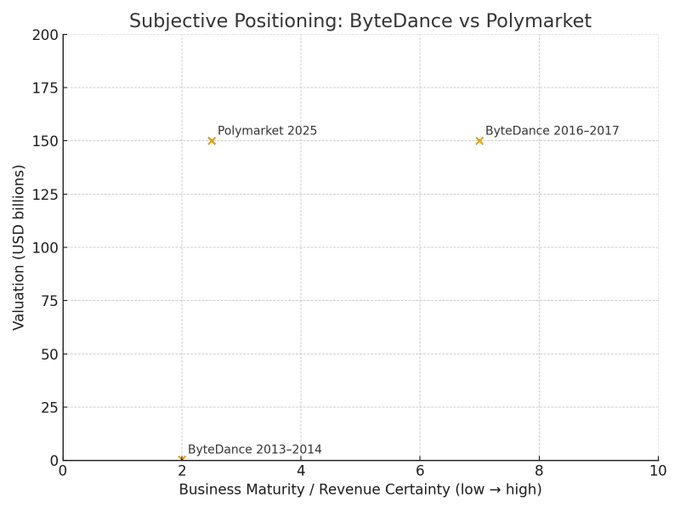
If we were to plot this on a two-dimensional coordinate system (purely subjective):
X-axis = Business Maturity / Revenue Certainty;
Y-axis = Valuation Scale;
It would roughly look like this:
ByteDance 2013-2014: Business just emerging, valuation $500 million;
ByteDance 2016-2017: Business and cash flow highly certain, valuation $11-22 billion;
Polymarket 2025: Business certainty ≈ ByteDance 2013-2014, but valuation has already jumped to the 2016-2017 level.
The market is already pricing Polymarket from the perspective of "A layer almost assumed successful + C/E layer has clear paths." At the same time, it has pre-paid a portion of "option fees" for B (insurance) and D (AI).
4. Easter Egg: Ways to Position
TL:DR Four types of positioning
Interact with prediction markets in the market, especially those not yet TGE, such as @Polymarket, @opinionlabsxyz, @42space (@Kalshi is only open to U.S. users)
Yap: Polymarket will also reward content creators, please quickly bind your X account on the official website.
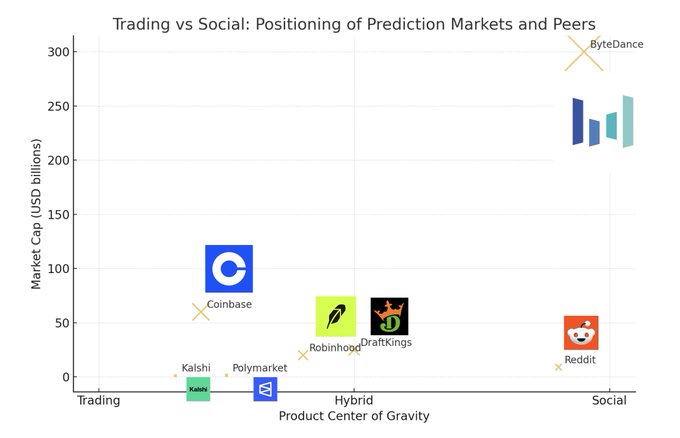
Primary Investment: Many people may not know that the Pre-IPO platform Jarsy has listed Polymarket and Kalshi's Pre-IPO equity, valued at $17.8 billion and $13.8 billion respectively, not cheap. Friends who are particularly optimistic can research it. At the end of the article, we attach our previous interview with the Jarsy Founder. Additionally, consider positioning in xAI; if prediction markets can become new social media, I think the giants most likely to benefit are X, Robinhood, Coinbase, Reddit, and Meta (Facebook), essentially finding new business increments. X is now part of xAI, which is a company Musk values highly, currently valued at $171B, available for purchase on @PreStocks. Jarsy also has xAI, but due to different platform mechanisms, the valuation is higher.
Secondary Investment: Following the logic above, prediction markets could become a new type of social media, likely becoming an important increment for Robinhood, Coinbase, Reddit, and Meta, especially for Robinhood and Coinbase, both currently valued at hundreds of billions. Both Robinhood and Coinbase have already collaborated with Kalshi; for Reddit and Meta, due to their more diversified businesses, I think it would be better to wait for signs of entering the prediction market before making decisions.
Finally, I will conclude with a tweet from the Founder of 1confirmation, who believes that in the current crypto space filled with negative EV, prediction markets will bring positive EV within ten years. https://x.com/NTmoney/status/1993473872914751758?s=20
On one side is trading, on the other side is social, with more and more players entering the field, continue to pay attention to this track.
Once again, to declare: All discussions in this article are for informational purposes only and are not investment advice, DYOR
Original link
 Risk warning Risk warning



Popular articles





