The HTTPS Moment for Ethereum Privacy: From Defensive Tools to Default Infrastructure
 Core Viewpoint

 Summarize the "Holistic Reconstruction of the Privacy Paradigm" from dozens of speeches and discussions at the Devconnect ARG 2025 "Ethereum Privacy Stack" event.
Ethereum Privacy Stack Event Summary
The Ethereum Privacy Stack event is jointly organized by the Privacy & Scaling Explorations (PSE) team, Web3Privacy Now, and core members of the Ethereum Foundation (EF). It is one of the highest-profile vertical events during Devconnect ARG 2025. The event brings together Vitalik Buterin, the founder of Tor, EF core researchers, founders of privacy protocols (such as Railgun, 0xbow, Aztec, etc.), and leading legal experts. Its core purpose is to re-map the Ethereum privacy ecosystem at a turning point where regulatory pressure is increasing and technology is maturing, bridging technological silos and setting the tone for the privacy roadmap for the next 3-5 years.

The Ethereum Privacy Stack held during Devconnect Buenos Aires 2025 is the most significant privacy-themed gathering in the Ethereum ecosystem this year.
The most notable consensus of this event is the establishment of the concept of "Holistic Privacy": privacy is no longer just a stack of on-chain tools like zero-knowledge proofs (ZK) or mixers, but a complete closed loop that spans the network transport layer (Tor), RPC reading layer, data storage layer, and user interaction front end.
As emphasized by Vitalik Buterin and Tor project founder Roger Dingledine, if the underlying network leaks IP addresses, anonymity at the application layer is meaningless. The community has reached a consensus that Ethereum must follow the "barrel theory," patching the weakest links in metadata leakage to truly become a censorship-resistant "world ledger."
Trend Insight: The Final Battle Towards "Default Privacy" and User Experience
Participants generally believe that Web3 privacy is experiencing a critical moment similar to the transition from HTTP to HTTPS in Web2. Privacy technology should no longer be the exclusive domain of "geeks" or "hackers," nor should it carry the moral burden of "hiding crime." By comparing Railgun, Kohaku wallet, and historical experiences from Web2, speakers pointed out that the next key step is to "stigmatize non-privacy behavior," making publicly transparent transfers seen as an abnormal behavior akin to being naked on the internet.
By 2026, the Ethereum community aims to reduce the cost of private transfers to an acceptable range (e.g., only twice that of ordinary transfers) and achieve a one-click, seamless experience, thereby not only serving retail users but also opening doors for traditional financial institutions that cannot enter due to a lack of commercial confidentiality protection.
Core Controversy: Compliance Spectrum and the "Civil War" Concerns of L1
Despite the gradual clarity of the technical roadmap, ideological tensions still exist. The biggest point of contention lies in the struggle between "compliant privacy" and "permissionless privacy." One side, represented by Privacy Pools, advocates for actively isolating illegal funds through "disassociative proofs" in exchange for regulatory tolerance and institutional adoption; the other side insists on pure crypto-punk spirit, believing that any form of compliance compromise will ultimately lead to censorship.
Additionally, PSE's Andy Guzman warned of a potential "civil war": whether privacy features should be integrated into the Ethereum core protocol layer (L1). Writing it into L1 can bring unified liquidity and default protection, but it may also introduce significant regulatory risks and protocol complexity. This decision will determine the political attributes of Ethereum's future.
Infrastructure Awakening: Hardware and the Last Line of Defense Against Censorship
In addition to discussions at the software level, this event rarely delved into the physical and network layers. From "running your own node" to "de-trusting trusted execution environments (TEE)," the community realizes that if hardware is implanted with backdoors, all upper-layer encryption will fail. Censorship resistance is redefined as public infrastructure akin to "fire exits," which may seem to lack market demand in peacetime, but is the only hope for survival in times of crisis. Whether building decentralized VPNs (like Nym, HOPR) or utilizing ZK-TLS for "guerrilla interoperability," efforts are being made to create a robust system even amidst extreme geopolitical conflicts.

Legal and Cultural Self-Rescue
In light of the experiences of Tornado Cash developers, the event was permeated with a sense of urgent "self-rescue." Legal experts and developers unanimously called for the establishment of robust legal defense funds and policy lobbying groups. Everyone realizes that protecting privacy is not just about writing code; it is a war for narrative control: developers' images must be transformed from "potential accomplices of terrorists" to "defenders of freedom in the digital age." If the industry cannot unite to protect open-source contributors, technological progress will stagnate as no one dares to write code.
Below is a detailed summary of the 16 speeches and panels from this event.
1. Onionizing Ethereum
Speakers: Vitalik Buterin (Ethereum Foundation), Roger Dingledine (Tor Project)
This dialogue marks a significant conceptual shift in Ethereum's privacy vision. Vitalik pointed out that the Ethereum Foundation is promoting a plan to deeply integrate Tor and Onion Services into the entire Ethereum tech stack. This represents a shift in mindset: from focusing solely on privacy at the transaction level (like ZK proofs) to a more comprehensive view of "holistic privacy." This holistic view encompasses writing privacy (transaction sending) and reading privacy (RPC data reading), aiming to prevent users from leaking IP addresses and access patterns when broadcasting transactions or reading on-chain data.

Roger Dingledine shared the current status of the Tor network as the underlying infrastructure for Bitcoin, noting that approximately three-quarters of Bitcoin nodes connect via onion addresses. He emphasized that achieving credential anonymity at the application layer is insufficient; if the underlying network transport layer leaks IP addresses, privacy protection at the application layer becomes meaningless. Ethereum's goal is to introduce mixnets and onion routing not only at the smart contract level but also at the P2P network layer to defend against denial-of-service attacks (DoS) targeting validators (Proposers) and enhance censorship resistance.
Vitalik further elaborated on the two meanings of "censorship": application layer transaction censorship and network layer access censorship. He emphasized that Ethereum's goal is to become a globally accessible ledger, allowing users and validators to access the network through Tor's Pluggable Transports (like Snowflake) even when facing national firewalls. This technology can disguise traffic as ordinary WebRTC video call traffic, thus bypassing blocks. This is not only about privacy but also about Ethereum's resilience and geographical decentralization as a "world ledger."
In future prospects, the two discussed the possibility of Ethereum validators (Stakers) simultaneously running Tor relay nodes. Since traffic for specific onion services does not require exit nodes (Exit Relay), this means validators can easily run non-exit relays, contributing bandwidth without legal risks. If this initiative can be realized, it will significantly enhance Ethereum's underlying censorship resistance and privacy protection levels in the coming years, achieving a dual enhancement of user experience and network resilience.
2. Ethereum is for DefiPunk
Speaker: Hsiao-Wei Wang (Ethereum Foundation)
Hsiao-Wei's speech centered around the Ethereum Foundation's (EF) latest financial policy, introducing the concept of "DefiPunk," aiming to reinject the spirit of Cypherpunk into the DeFi ecosystem. She pointed out that DeFi should not only be about pursuing yields but also embody characteristics of censorship resistance, open-source, and privacy protection. EF has decided that its funding allocation should not only consider financial returns but also reflect Ethereum's core values, supporting projects that promote the long-term healthy development of Ethereum rather than merely chasing high APY or adopting centralized shortcuts.
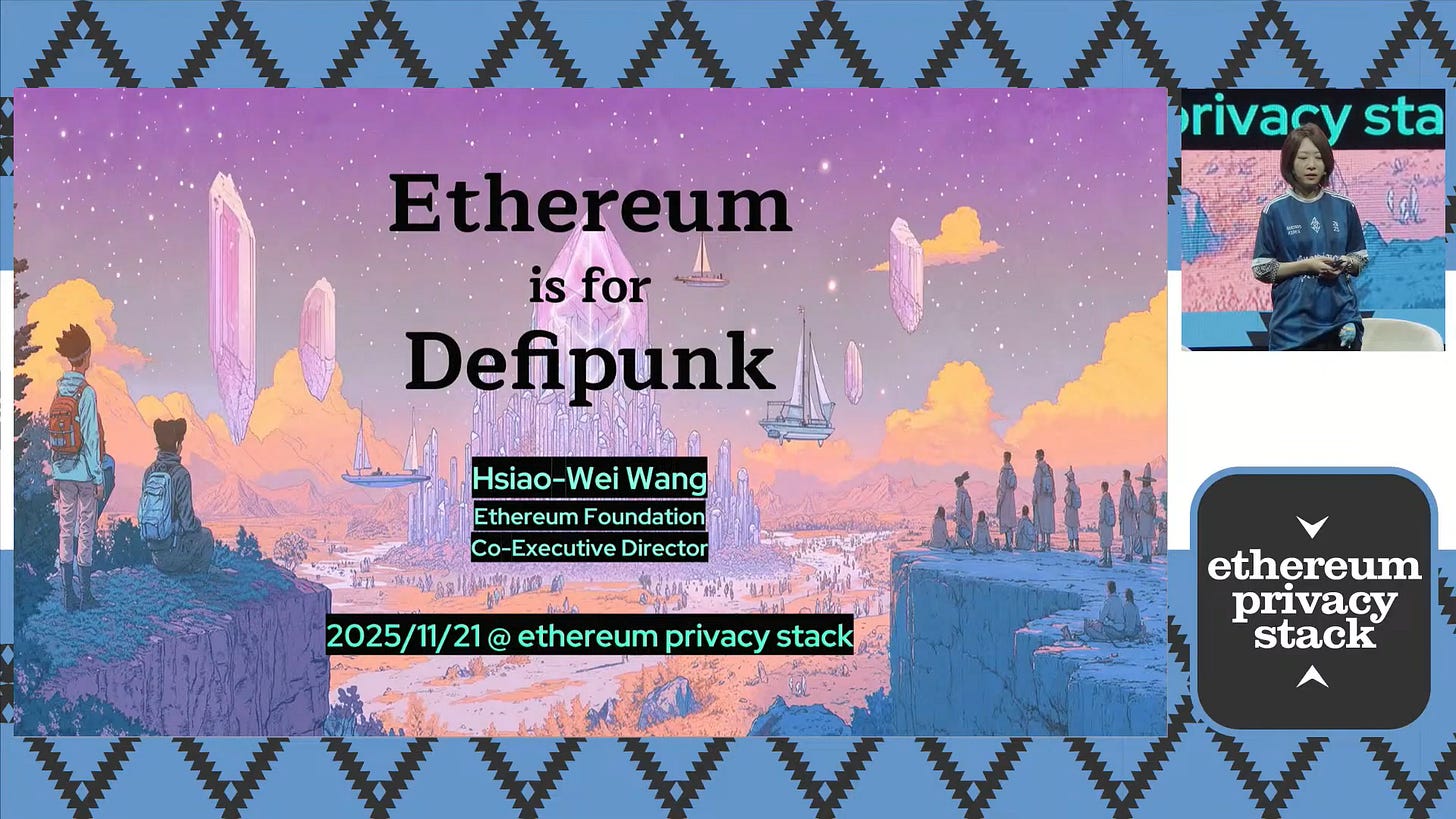
To guide this strategy, she elaborated on the six core attributes of DefiPunk: Security, Open Source, Financial Self-sufficiency, Trust-minimized, Crypto Tools, and Privacy. Particularly regarding open-source, EF tends to support projects that adopt Free/Libre and Open Source Software (FLOSS) licenses to encourage true transparency and collaboration rather than commercial source protection.
In specific standards, DefiPunk emphasizes that protocols must be permissionless, allowing users from any region to access; users must have complete control over their assets, rather than relying on third-party custody. Additionally, she particularly emphasized that privacy should not be a luxury in DeFi but a first-class citizen. EF encourages projects to circumvent the censorship risks that centralized front ends may bring through distributed front ends, independent UIs, or even command-line tools.
Finally, Hsiao-Wei called on the community and developers to jointly practice these values. EF's role is not only as a fund provider but also as a supporter of this philosophy. She encouraged users to think like a true "DefiPunk" when choosing DeFi protocols: check the codebase, pay attention to whether the governance process is transparent, and check for immutable smart contracts. This speech challenges the current state of the DeFi industry, demanding a return to the original intention of decentralized finance: to provide uncensorable financial services for the oppressed and those unable to access banking services.
3. Privacy-Aware Mechanisms for Public Goods Funding
Guests: Camila Rioja (Plexos), Thomas Humphreys (EF), Tanisha Katara, Beth McCarthy, José Ignacio Trajtenberg
This panel discussion focused on how to balance transparency and privacy in public goods funding. The panelists first shared real-world application cases, such as the aid distribution project in collaboration with UNICEF by Xcapit, and Brazil's attempts to manage community currency using blockchain technology. In these scenarios involving humanitarian aid and vulnerable groups, privacy is not only about data protection but also a critical factor concerning the safety of beneficiaries.
The core tension of the discussion lies in the trade-off between "transparency" and "privacy." For the distribution outcomes of funds, transparency is necessary to ensure that funds are directed correctly and have an impact; however, at the participation level, especially in voting and identity verification, privacy is crucial. If voting is entirely public, it can lead to bribery markets and social pressure, distorting governance outcomes. By introducing zero-knowledge proof (ZK) primitives, voting eligibility and results can be verified without disclosing specific ballots, thus achieving anti-collusion governance.
The guests also explored how technical tools can adapt to the needs of different jurisdictions. For example, in some countries, collecting specific data may be legal, while in others (like Germany), the same data collection may violate GDPR. Therefore, building a global public goods funding tool should not attempt to meet all compliance requirements but should construct flexible, privacy-first infrastructure that allows local communities to adapt based on their needs.
Finally, the discussion looked forward to future technological directions, including privacy-preserving prediction markets and self-sustaining public goods funding mechanisms. The guests unanimously agreed that technology should not only address efficiency issues but also return to a "human-centered" design philosophy. Through ZK identity proofs and privacy voting tools, user data can be protected while preventing Sybil attacks, thereby establishing a fairer and safer community governance system.
4. Who pays for privacy? The real cost of building aligned apps
Speaker: Lefteris Karapetsas (Rotki)
Lefteris opened with a sharp observation about the current industry state: "If the product is free, then you are the product."
He pointed out that current internet applications generally exchange free services for a data tax, where users' data is collected and sold. To break this situation, he proposed the concept of "Aligned Apps," which genuinely serve user interests, respect data sovereignty, prioritize local needs, and are non-tracking software. However, building such applications faces enormous engineering challenges and cost pressures.
Using his own development of Rotki (a locally prioritized asset tracking tool) as an example, he detailed the hidden costs of developing privacy applications. Unlike SaaS products, local applications cannot easily perform A/B testing or collect error logs; developers must package binaries for multiple operating systems, handle local database migrations, and pay expensive code signing certificate fees. This means lower development efficiency and an inability to monetize user data, making the business model more challenging.
Lefteris strongly advised developers not to rely on donations or grants for survival, as this is a dead end. He argued that privacy applications must have a clear business model and charge users directly. This is not only to sustain development but also to educate users: privacy has explicit costs. Through a freemium model, enterprise support, or specific paid features (like advanced data analytics), developers can achieve predictable recurring revenue.
At the end of his speech, he called for a new covenant relationship between users and developers. Users should realize that paying is not just for the current software functionality but also to support a future that is non-surveillance and non-malicious. He encouraged developers to price confidently, not to undervalue their labor, and to maintain financial transparency to gain community trust. Building "Aligned Apps" itself is a punk act, a rebellion against the monopolies of cloud computing and data surveillance.
5. Ethereum Privacy Ecosystem mapping
Guests: Mykola Siusko, Antonio Seveso, cyp, Alavi, Kassandra.eth
This panel attempted to clarify the complex and fragmented Ethereum privacy ecosystem. The guests unanimously agreed that the core of the ecosystem is not just listing all privacy protocols but understanding the relationships between them. The current privacy ecosystem is mainly divided into several verticals: on-chain privacy (like stealth addresses, privacy pools), network layer privacy (like mixnets), and the most critical connection layer—user experience (UX). UX is seen as the bridge connecting these decentralized technological components, determining whether privacy technology can truly be adopted by the public.
The discussion mentioned the subtle relationship between "compliance" and "privacy." The guests reflected on the limitations of building privacy tools solely for regulatory defense. They believe that privacy should not merely be defined as a defensive technology (to prevent surveillance) but should be viewed as a collaborative community effort, a tool that can unlock new capabilities for users and communities. Overemphasizing the "defensive" narrative may instead limit the imagination of products.
Regarding regulation and compliance, the guests expressed strong views: building a globally compliant product that meets all jurisdictional requirements is unrealistic and even naive. Rather than attempting to embed compliance within the protocol layer (which often means leaving backdoors), it is better to build universal privacy infrastructure and empower users with the right to selectively disclose information at the application layer (like View Keys). This protects users from comprehensive surveillance while retaining the ability to prove compliance when necessary.
Finally, the guests emphasized the importance of breaking the technological "echo chamber," calling for closer ties with privacy organizations outside the crypto space (like Tor, EFF, Signal). The future ecosystem map should not just be a stack of technological components but should include legal aid, hackathons, education, and advocacy organizations. Normalizing, socializing, and even making privacy fun is key to the next step in the ecosystem's development.
6. Ethereum Institutional Privacy now
Guests: Oskar Thorin, Zach Obront, Amzah Moelah, Eugenio Reggianini, Francois
Oskar Thorin first introduced the EF's Institutional Privacy Task Force (IPTF) and its mission: to help traditional financial institutions migrate to Ethereum while meeting their privacy needs. The current trend is that institutions are no longer refusing to go on-chain due to regulation but are unable to do so due to a lack of privacy. Even if only 1% of traditional financial funds enter Ethereum, the impact on the privacy ecosystem would be enormous.
In the panel session, guests from ABN Amro (Dutch Bank) and Etherealize shared the real pain points of institutions. Institutions do not want to use the global liquidity of public chains, but they cannot accept that trading strategies, positions, or customer data are fully public on-chain. Unlike retail users, institutions need not only privacy but also "control": clarity on who can see what data and when. This control needs to be detailed down to specific business flows, such as bond issuance, lending settlement, or secondary market trading, each with different transparency requirements.
Francois from Polygon Miden introduced how they address this issue through a hybrid account model (Account + UTXO): users can maintain privacy locally and only prove the validity of transactions to the public network when necessary. The discussion also touched on the application of zero-knowledge proofs (ZK) in compliance reporting, using ZK technology to prove institutional solvency or compliance to regulators without disclosing underlying data.
The guests unanimously agreed that the future direction is not to establish isolated private chains but to build a privacy layer on the Ethereum public chain. By decoupling identity verification (KYC/KYB), strategy execution, and compliance reporting, institutions can enjoy the security and liquidity of Ethereum while maintaining their commercial secrets. The maturity of this architecture will be a key turning point for large-scale institutional adoption of Ethereum around 2026.
7. Privacy Without Terrorists
Speaker: Ameen Suleimani (0xbow)
Ameen's speech opened with a parable about the pollution of Patagonia's lakes, vividly metaphorizing the dilemma of Tornado Cash: when a few people ("terrorists"/hackers) pollute public resources (privacy pools), everyone (ordinary users) suffers the consequences. He reviewed the history of Tornado Cash, pointing out that developers should not be held responsible for users' illegal actions, but he also posed a sharp question: ordinary users using mixers are essentially providing privacy cover for hackers. Therefore, the community has a responsibility to build a new system that protects legitimate users' privacy while not empowering criminals.
This is the core idea of Privacy Pools. Unlike Tornado Cash, Privacy Pools allow users to publicly "disassociate" themselves from illegal funds (like those from North Korean hackers) through zero-knowledge proofs. When withdrawing, users can prove that their funds come from a legitimate deposit pool without disclosing the specific source of the deposits. This meets regulatory anti-money laundering requirements while preserving users' on-chain privacy.
Ameen detailed the governance mechanism of 0xbow. The system introduces KYT (Know Your Transaction) checks, requiring deposits to be approved. If 0xbow discovers that a deposit source is illegal, it can remove it from the compliant pool but cannot freeze users' funds. He particularly emphasized the "Rage Quit" mechanism: even if a user's deposit is later marked as non-compliant, or if 0xbow decides to cease operations, the smart contract still guarantees that users can withdraw their principal at any time. This achieves a "non-custodial but permissioned" privacy model.
Finally, Ameen previewed the roadmap for Privacy Pools V2, set to be released at EthCC (Paris). V2 will support shielded transfers, allowing peer-to-peer payments within the pool without needing to withdraw to a new address as in V1. V2 essentially trades some fungibility for recoverability, aiming to build privacy infrastructure for "good people" and prevent developers from going to jail for writing code.
8. Is censorship resilience truly necessary?
Speaker: Mashbean (Matters.lab)
Mashbean posed a disturbing question: if censorship resistance is so important, why is it difficult for products centered around it to survive? He combined the five-year operational experience of Matters.news (a decentralized content publishing platform) to reveal the misalignment between "market demand" and "survival demand." While marginalized groups (dissidents, journalists) have a strong moral need for censorship resistance, this market is small and lacks purchasing power. Most ordinary users care more about content quality than whether the platform is censorship-resistant.
He delved into the "Honeypot Paradox": building censorship-resistant platforms naturally attracts the most sensitive content, thereby centralizing risk. This not only invites blockades from authoritarian governments but also leads to a flood of spam and scam content attacks. Ironically, to combat spam, platforms must introduce some form of moderation, which creates tension with the original intention of censorship resistance. In fact, a large number of spam attacks have triggered automatic fraud detection systems in democratic countries, leading to platforms being mistakenly banned, creating a new form of "cross-border joint censorship."
In the face of these dilemmas, Mashbean proposed some counterintuitive solutions. First, do not build a single large platform; instead, create modular components (storage, identity, payment) that allow small communities to reuse this infrastructure, avoiding the establishment of obvious attack targets. Second, developers must "eat their own dog food," meaning they must adopt high levels of OpSec (operational security) and privacy payments themselves, as developers are also a high-risk group.
The conclusion is that censorship-resistant technology should not be viewed as an ordinary commercial product but as public infrastructure akin to "fire exits" or "seat belts." You wouldn't ask how large the market size (TAM) of fire exits is, but they are lifesaving in a fire. Therefore, the financing model for such projects needs to change, mixing public funds, charitable donations, and community ownership, with success metrics not based on revenue but on how many people can still speak and survive under pressure.
9. Guerilla Interoperability
Speaker: Andreas Tsamados (Fileverse)
Andreas's speech was highly combative, comparing the current Web2 internet to a city filled with "Hostile Architecture," where giants control users through walled gardens, DRM, and data lock-in. To combat this "Enshittification," he proposed the concept of "Guerilla Interoperability." This is a user-driven tactical resistance that forcibly achieves interoperability using technical means without the permission of dominant platforms, reclaiming data sovereignty.
He detailed the technological arsenal to achieve this goal, particularly ZK-TLS (zero-knowledge transport layer security). This technology allows users to generate encrypted proofs of their interactions with Web2 websites (like banks, social media), thereby bringing Web2 data into the Web3 world without permission. This means developers can build applications attached to existing monopolistic platforms, siphoning off and surpassing them without waiting for the platforms' APIs to open.
Andreas advocates for a culture of "revolutionary optimism," rejecting the fatalism of the current internet situation. He showcased tools developed by Fileverse, such as ddocs.new and dsheets.new, which are decentralized alternatives to Google Workspace. They are not only end-to-end encrypted but also support inviting collaborators through ENS, with data stored on IPFS.
The core recommendation of the speech is: do not wait for the giants to have a change of heart, but use programmable accounts, decentralized storage, and ZK technology to forcibly build alternatives. This "digital repair rights" movement requires developers to utilize existing closed-system infrastructure to provide users with better privacy and sovereignty options until the giants are forced to accept this new normal.
10. Building infrastructural resilience
Guests: Sebastian Burgel, ml_sudo, Pol Lanski, Kyle Den Hartog
This panel focused on the physical and hardware layers. The guests pointed out that if our underlying hardware is untrustworthy, then the privacy of upper-layer software is built on sand. Current chips (like Intel SGX) often sacrifice security for performance and are vulnerable to side-channel attacks. ml_sudo introduced the Trustless TEE (Trusted Execution Environment) initiative, aiming to build completely open-source hardware chips, with transparent and verifiable designs from blueprints to manufacturing processes, to adapt to the increasingly fragmented geopolitical threat model.
Pol Lanski (Dappnode) emphasized the importance of self-hosting. He believes that while the current user experience is not good enough, our goal should still be "everyone runs their own node." This is not only for decentralization but also a form of civil disobedience, a "vote with your feet" method. When laws (like Chat Control) attempt to monitor all communications, running one's own relay nodes and servers is the most effective way to make the law unenforceable.
Sebastian (HOPR) made an interesting point: "Nerds protect networks." While we hope ordinary users can participate, it is actually that small group of geeks willing to tinker with hardware and run nodes that forms the frontline of network defense. Therefore, the ecosystem should respect and empower this geek culture while also striving to lower hardware barriers so that more people can participate.
The discussion ultimately returned to the "why" question. In this era of rampant AI forgery and network connectivity, only through trustless hardware and infrastructure can we retain "humanity" in the digital world—ensuring that you are interacting with real people and that your data is not being stolen. The resilience of this infrastructure is our last line of defense against digital authoritarianism.
11. Kohaku wallet on Ethereum
Speaker: Nicolas Consigny (EF)
Nicolas announced a new project led by the Ethereum Foundation—Kohaku. This is a collection of primitives focused on privacy and security, including an SDK and a reference implementation of a browser extension wallet (based on Ambire fork). The goal of Kohaku is not to become another competing wallet but to provide high-quality open-source components for other wallet developers to use, enhancing the overall privacy standards of the ecosystem.
The core highlight of Kohaku is that it greatly simplifies the usage threshold of privacy protocols. It integrates privacy protocols like Railgun and Privacy Pools, allowing users to switch with one click in the wallet interface and directly send assets to privacy pools without complex setups. Additionally, Kohaku introduces a connection system of "one account per dApp," preventing users from mistakenly associating the same address with multiple applications, thereby reducing metadata leakage.
In terms of hardware security, Kohaku has achieved several significant breakthroughs. The team collaborated with ZKnox to enable signing ZK transactions of Railgun directly on hardware wallets, meeting the needs of advanced users for "cold storage + privacy." At the same time, they demonstrated a universal hardware application layer, allowing the same privacy signing logic to run on Keystone, Keycard, and even low-cost DIY hardware.
Nicolas's presentation showcased EF's pragmatic attitude towards privacy: not seeking to change the world overnight but building secure and user-friendly SDKs (like the OpenLV connection suite) to allow existing wallets to easily integrate Tor network support and privacy transaction features. Kohaku plans to launch a public testnet during EthCC in April next year, marking a new phase of standardization and modularization for Ethereum application layer privacy.
12. Private voting in DAOs
Guests: Joshua Davila, Lasha Antadze, Anthony Leuts, Jordi Pinyana, John Guilding
This discussion delved into the necessity of privacy voting in DAOs and real-world governance. Anthony (Aragon) bluntly pointed out that the lack of privacy leads to false governance: under the pressure of transparent voting, 99% of proposals receive 99% approval because no one wants to be the "party pooper" or face retaliation. Privacy voting is not only to protect voters but also to capture genuine public opinion, breaking this toxic "false consensus."
Representatives from Rarimo and Vocdoni shared their experiences implementing privacy voting in high-risk environments (under oppressive regimes). In these scenarios, participating in voting can lead to imprisonment, making identity privacy a matter of life and death. Technically, the current challenge is how to combine real-world identities (like passports, biometrics) with on-chain privacy, preventing Sybil attacks (one person, multiple votes) while ensuring ballots are untraceable.
John (MACI) focused on the importance of anti-collusion. Privacy voting must not only be anonymous but also "impossible to prove who you voted for" to prevent bribery. If voters can generate proof of "I voted for A" for buyers, bribery markets will form. MACI (Minimum Anti-Collusion Infrastructure) is dedicated to solving this issue. He mentioned that the recent Gitcoin privacy round was a successful experiment, proving that relevant technologies (like quadratic voting combined with ZK identity) are close to production readiness.
The guests unanimously agreed that 2026 will be a key year for the maturity of privacy voting protocols and their integration into mainstream DAO tools (like Snapshot, Tally). Although the technology is basically ready, the biggest obstacle lies in the mindset: the crypto community is accustomed to "transparency equals justice," even viewing bribery as a normal DeFi mechanism. Changing this narrative and making people realize that privacy is the cornerstone of democracy is the upcoming political task.
13. From Tornado Cash to future developers protection
Guests: Marina Markezic, Fatemeh Fannisadeh, Ayanfeoluwa Olajide, Joan Arús
This panel was filled with urgency and calls to action. Joan Arús shared the background of the establishment of the Sentinel Alliance: an alliance formed by victims of spyware (like Pegasus). He recounted the experiences of the Aragon and Vocdoni teams being monitored by government spyware for developing anti-censorship voting technology. This indicates that the threat has escalated from "prosecuting past crimes" to "preemptive surveillance," targeting the potential uses of open-source code.
Lawyers analyzed the escalation of legal risks in detail. Current anti-terrorism laws are defined extremely broadly, and any attempt to "disrupt political or economic structures" could be defined as terrorism. This means that developers creating decentralized finance or privacy tools could unknowingly be labeled as terrorists. Fatemeh warned that we cannot rely solely on bureaucratic procedures to seek justice; we must establish proactive defense mechanisms.
Marina (EUCI) brought a glimmer of hope. She shared the latest progress on the EU's GDPR revisions, noting that after lobbying, regulators are beginning to recognize the uniqueness of blockchain and may acknowledge privacy-enhancing technologies as a means to achieve GDPR compliance rather than an obstacle in the amendments. This proves that policy advocacy is effective.
Finally, the panel issued a strong call: The crypto industry has billions of dollars in capital and must stop using funds merely for gatherings but should invest in legal defense funds and policy lobbying. If a legal framework to protect developers is not established, and if we do not unite against the trend of criminalizing open-source development, the next person to go to jail could be any developer present. This is not just a compliance issue but a survival battle for freedom.
14. Protocol-level privacy: Lessons from web2
Speaker: Polymutex (Walletbeat)
Polymutex provided a valuable reference framework for the popularization of Web3 privacy by reviewing the history of the transition from HTTP to HTTPS in Web2. He pointed out that the early internet was as devoid of privacy as the current blockchain, for surprisingly similar reasons: immature encryption technology, regulatory uncertainty (encryption was once seen as military hardware), and high performance overhead (handshake delays).
He summarized the four key stages of HTTPS popularization: 1. Making privacy possible (standard setting, like SSL/TLS); 2. Making privacy legal (winning encryption rights through litigation); 3. Making privacy cheap (hardware-accelerated instruction sets); 4. Making privacy the default and the norm. Among these, the emergence of Let's Encrypt was a turning point, making obtaining certificates extremely simple and free. The final stage was when browsers began marking HTTP sites as "insecure," thus stigmatizing non-privacy behavior.
Mapping this framework to Web3, we are currently doing well in the "possible" stage (privacy protocol standards); the "cheap" stage is being advanced through ZK hardware acceleration and precompiled contracts; however, we still face significant challenges in the "legal" stage (the Tornado Cash case) and the "simple" stage (wallet integration). In particular, Web3 currently lacks an "Oh Shit Moment" like the Snowden incident to thoroughly awaken public awareness of privacy.
Polymutex's final conclusion is that we need tools (like WalletBeat) to monitor the privacy behavior of wallets (like RPC leaks) and promote privacy as the default setting. More importantly, the community needs to stigmatize non-privacy behavior—just as browsers currently warn that HTTP is insecure, future wallets should warn users, "This is a public transaction; your finances will be monitored." Only by treating the lack of privacy protection as an anomaly can privacy truly become widespread.
15. Privacy on Ethereum now: key challenges
Speakers: Alan Scott, Max Hampshire
Alan and Max explored the real pain points of building privacy protocols on the front lines in a light-hearted dialogue. The primary challenge is the narrative issue. Currently, using privacy tools (like Railgun) is often directly associated with illegal activities: "Why are you hiding? Are you afraid of the police?" This stigmatization leads ordinary users to shy away. They emphasized that the narrative must shift from "hiding crime" to "protecting everyday financial security" (just like not wanting everyone to see your Visa bill).
Technical integration friction is another significant barrier. Alan mentioned that Railgun's SDK has hundreds of thousands of lines of code, and integrating such a massive entity into mainstream DeFi protocols like Aave is not only technically challenging but also risky. This is why DeFi protocols prefer to have the privacy layer adapt to them rather than the other way around. Additionally, existing wallets (like those forked from Rabby) are often filled with various trackers (Analytics), which contradicts the goals of privacy protocols.
Regarding network layer privacy, Max pointed out that this is a cat-and-mouse game. De-anonymization technologies (like traffic analysis) and anonymization technologies (like Mixnets) are constantly evolving. Relying solely on application layer privacy is insufficient; if ISPs or RPC nodes can see your IP and access patterns, on-chain privacy is significantly undermined. Therefore, network layer facilities like Nym need to be closely integrated with application layer protocols.
Finally, the two discussed how to expand the anonymity set. If privacy tools are only used by whales, their privacy effectiveness is limited. The goal must be to enable ordinary users to use privacy features unconsciously (Plug and Play), even if just to prevent being front-run or to protect alpha. Only when "good people" and ordinary transactions are numerous enough can privacy networks truly provide protection.
16. Ethereum Privacy Roadmap
Speaker: Andy Guzman (PSE)
Andy Guzman provided a macro summary and outlook for the day's events. He proposed a simplified classification model for the privacy tech stack by PSE: Private Reads, Private Writes, and Private Porting. He pointed out through the barrel theory (Law of the Minimum) that the strength of privacy systems depends on their weakest link. If we achieve perfect ZK privacy on-chain but leak IP at the RPC layer, the entire system still fails.
In terms of roadmap predictions, Andy boldly predicted: By November 2026 (the next Devcon), the issue of private transfers on Ethereum will be completely resolved. He noted that over 35 teams are currently exploring about 13 different technical paths (from stealth addresses to privacy pools), and the richness of this ecosystem ensures that a superior solution will eventually emerge. Future solutions will feature low costs (only twice that of ordinary transfers), low latency, and a one-click experience.
He also raised a potential point of contention: Should privacy be retained at the application layer or sunk into the core protocol layer (L1)? This may spark a "civil war" in the future. Writing privacy into L1 can bring better liquidity unification and default privacy, but it may also introduce regulatory risks and protocol complexity. He called for the community to engage in open discussions on this.
Finally, regarding compliance, Andy presented a spectrum from "permissionless privacy (Cypherpunk)" to "compliant privacy (Practical)." He believes that while pure crypto-punk spirit is worth pursuing, to enable institutional and governmental adoption, we also need responsible solutions like Privacy Pools. The future of Ethereum's privacy should not be singular but rather a diverse ecosystem that accommodates different needs. PSE will continue to work to fill technical gaps and ensure Ethereum becomes a truly privacy-first network.
 Risk warning Risk warning