








YZi Labs accuses 10X Capital of "breach of trust" and mismanagement. Has the battle of "rights protection" and "power seizure" officially begun?
 Core Viewpoint

 In the context of the lack of a unified regulatory framework, there are ambiguities in the power boundaries of asset managers, the mechanisms for protecting shareholder rights, and the standards for information disclosure.
Written by: Glendon, Techub News
As the enthusiasm for the DAT market wanes, the predicament faced by BNB Treasury Company seems more severe compared to other cryptocurrency treasury companies.
Last night, YZi Labs issued a formal notice and correction request to 10X Capital Asset Management LLC, the asset manager of BNB Treasury Company CEA Industries (NASDAQ: BNC). As a significant shareholder of CEA Industries, YZi Labs accused 10X Capital of two main issues: first, poor asset management of CEA Industries and a lack of necessary transparency; second, an intention to violate the strategic service agreement previously signed with YZi Labs.
10X Capital is an alternative asset management company based in the United States, managing approximately $10 billion in assets, with business covering venture capital, private credit, blockchain/Web3, and more. Its core team consists of financial professionals with backgrounds in Wall Street and Silicon Valley, positioning itself as a "new generation investment bank" focused on institutional-level investments in digital assets and digital infrastructure.
The core dispute between the two parties centers on 10X Capital's threat to force BNC to abandon its original BNB asset management strategy in favor of investing in other cryptocurrencies like Solana. This approach severely deviates from the strategic direction articulated by 10X Capital during the private equity financing (PIPE) in July. In light of this, YZi Labs demands that 10X Capital confirm in writing by December 5 that it will strictly adhere to the BNB asset management strategy promised to PIPE investors and that it has not improperly disposed of BNB assets.
From the sensational "romance" months ago to the current "breakup" tension, why have 10X Capital and YZi Labs drifted apart, and how has their dispute evolved step by step to this point?
The "Honeymoon Period" in the DAT Wave
This summer, the digital asset treasury (DAT) wave surged. On June 24, Nasdaq-listed crypto mining chip manufacturer Nano Labs announced it would issue $500 million in convertible notes to build a BNB strategic reserve, opening the door to the BNB treasury field. On July 16, Nasdaq-listed biotechnology company Windtree Therapeutics (NASDAQ: WINT) followed suit, announcing a $200 million securities financing specifically for building a BNB treasury. A week later, Windtree Therapeutics further strengthened its BNB cryptocurrency funding strategy by signing a financing agreement worth up to $520 million. The strategic shifts of these two U.S. listed companies, combined with BNB briefly becoming the fourth largest cryptocurrency by market capitalization, attracted considerable institutional attention, prompting several DAT companies centered around BNB to accelerate their initiatives and layouts.
Meanwhile, Binance was selecting suitable candidates to become the "orthodox army" of the BNB treasury. After careful screening, Binance ultimately focused on CEA Industries (formerly NASDAQ: VAPE), which primarily sold e-cigarettes and had a market capitalization of less than $8 million.
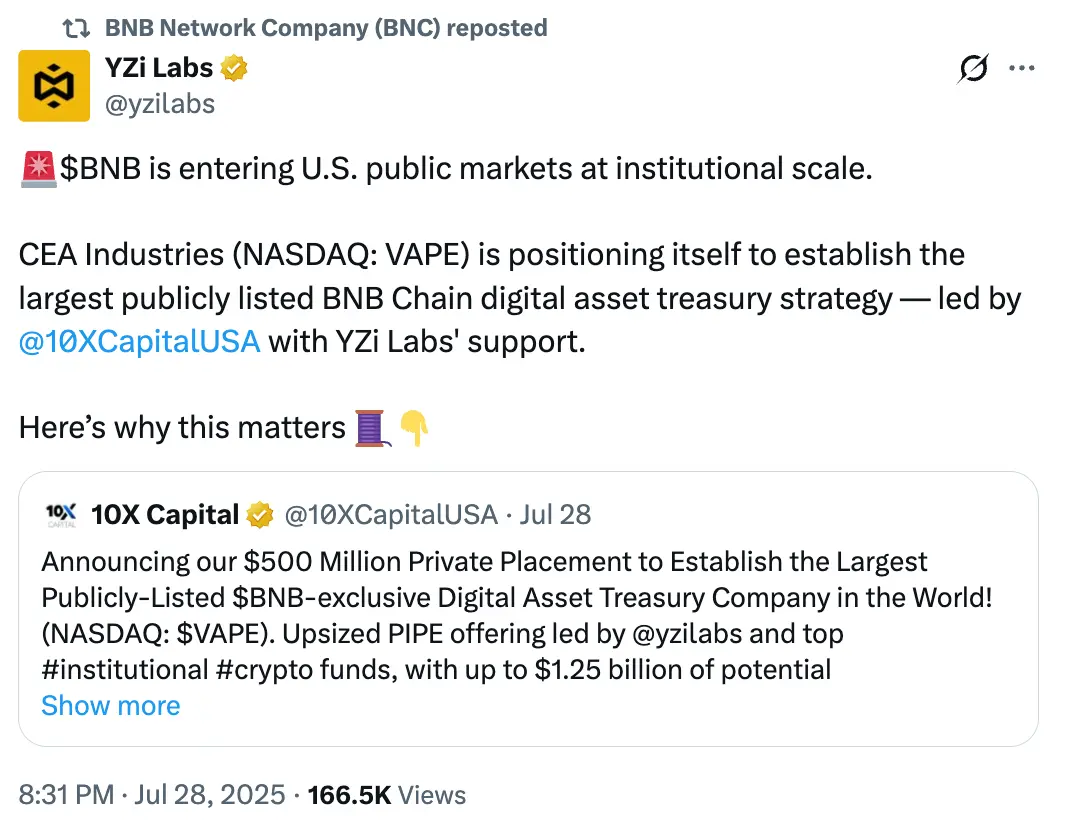
On July 28, a significant private financing led by 10X Capital and YZi Labs was successfully completed. CEA Industries raised $500 million through this financing to establish a BNB treasury. The issuance included common stock PIPE, with total proceeds reaching $500 million, comprising $400 million in cash and $100 million in cryptocurrency, and it could potentially gain up to $750 million in additional cash through the issued warrants (assuming 100% of the warrants are exercised). This financing lineup was strong, with many well-known institutions such as Pantera Capital, Arche Capital, GSR, Borderless, Arrington Capital, Blockchain.com, Hypersphere Capital, and Kenetic participating alongside YZi Labs.
In terms of roles, 10X Capital was responsible for asset management, while YZi Labs, as a significant shareholder, participated by providing ecological resource support. The two parties signed a strategic service agreement, clearly stating that they would build a digital asset treasury centered around BNB, transforming CEA Industries from an e-cigarette seller into a publicly listed company in the crypto field, and creating the world's largest publicly listed BNB treasury company.
At that time, the DAT market was in a prosperous golden period, and the overall crypto market was also showing a strong upward trend, with BNB's rise being particularly noteworthy. Following the PIPE financing announcement, CEA Industries' stock price surged from $8.88 before the announcement to $57.59, an increase of nearly 550%. In the following period, YZi Labs, 10X Capital, and CEA Industries worked together, enjoying a brief "honeymoon period."
On August 6, CEA Industries officially completed a $500 million private placement led by YZi Labs. At the same time, it changed its stock code on the Nasdaq from "VAPE" to "BNC" and planned to operate its new BNB funding strategy under the name "BNB Network Company." As of October 21, publicly available data showed that CEA Industries held 500,000 BNB, with a total investment of $435 million, making it the largest BNB treasury company in terms of capital size in the market.
During these two months, the price of BNB also soared, reaching new highs, until it broke through $1300. In this regard, David Namdar, who was once a senior executive at 10X Capital and is now the CEO of CEA Industries, praised BNB as "the most overlooked blue-chip in the market." He stated that BNB's breakthrough of $1300 was not an "accidental result or rare peak," but rather demonstrated the network's credibility, scale, and practicality, reflecting that its long-underestimated fundamentals had finally broken through.
However, the market is unpredictable. After the "10.11" flash crash, although BNB climbed to $1375 in mid-October, the overall situation in the crypto market took a sharp downturn, entering a downward channel, and BNB's price subsequently fell. At the same time, liquidity contraction led to a significant decline in institutional investors' risk appetite, further exacerbating the "tide retreat" phenomenon in the DAT market. Perhaps influenced by this, CEA Industries' pace of increasing holdings noticeably slowed. According to the company's publicly available holding data, from the end of October to now, the company has only increased its holdings by about 15,000 BNB in the past month, with a total holding of approximately 515,000 BNB. Moreover, its holding's floating profit has shrunk significantly from nearly 50% to about 7% currently.
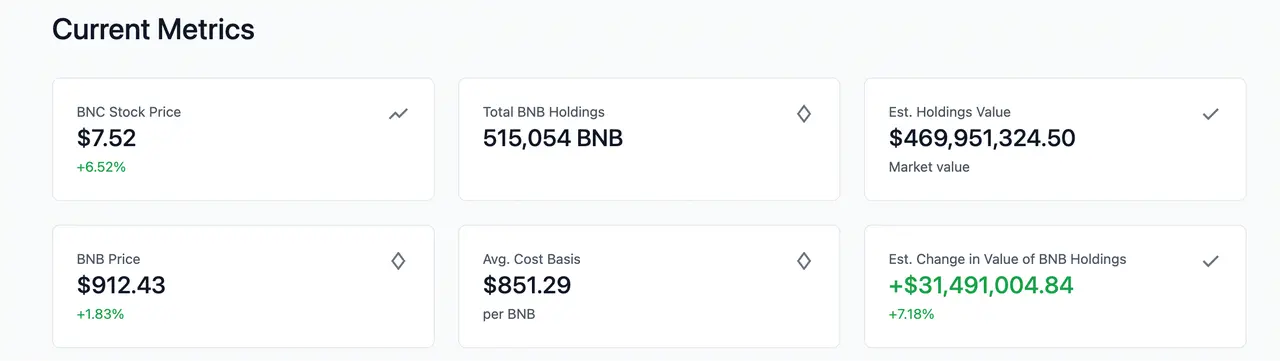
It is evident that CEA Industries' development trajectory and actual performance after completing the financing did not align with YZi Labs' expected blueprint. Thus, while YZi Labs was "defending its rights," it also conceived the idea of "seizing control."
10X Capital's Governance Failure, YZi Labs Seeks Control
In fact, before YZi Labs publicly accused 10X Capital of "breach of trust" and poor governance yesterday, it had already submitted a preliminary consent statement to the U.S. Securities and Exchange Commission (SEC) on November 27, clearly aiming to seek written consent from shareholders to expand the board of directors of CEA Industries and elect additional directors.
YZi Labs stated that its initial investment in CEA Industries was based on the latter's solid fundamentals and BNB-centered digital asset management strategy. Despite BNC's main asset BNB price rising significantly, BNC's actual performance has been contrary to the expected investment logic, resulting in continuous damage to shareholder value. At the same time, YZi Labs also pointed out that BNC had serious delays in submitting key documents to the SEC, lacking updates for investors on its digital asset reserves and net asset value (NAV), leading to confusion among investors regarding the company's identity, information dissemination, and strategic direction.
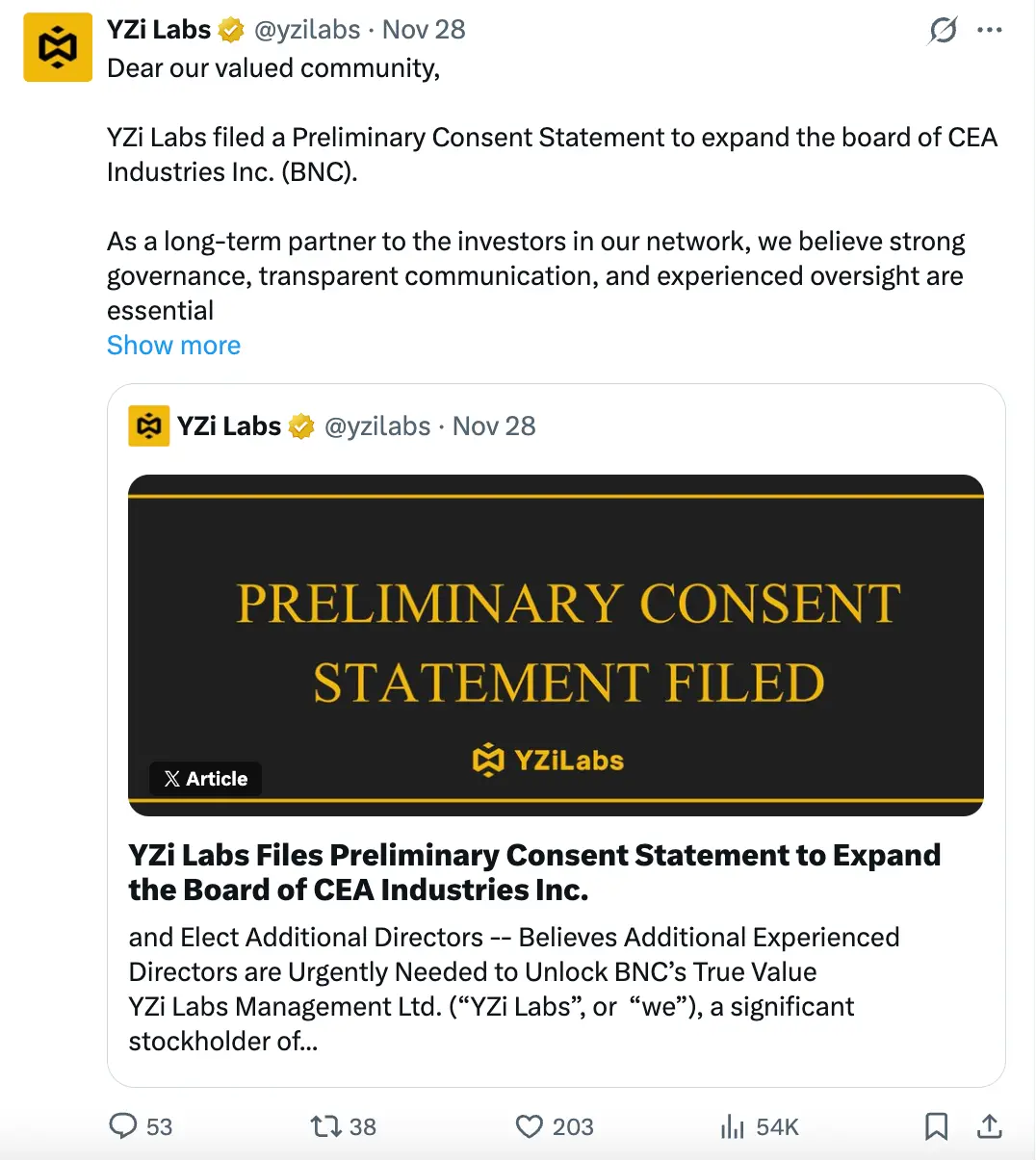
Ella Zhang, the head of YZi Labs, pointedly noted that BNC's poor performance is the result of multiple factors, with ineffective strategic execution, insufficient investor communication, and lack of effective oversight being direct causes. She emphasized, "We are selecting experienced and capable directors to address the company's poor stock performance and operational deficiencies, and to help unlock the value that should belong to shareholders."
Based on this statement, if the majority of BNC's shareholders agree to the above proposal, YZi Labs will effectively gain control of the world's largest BNB treasury company.
It is noteworthy that at this time, YZi Labs' statement submitted to the SEC did not directly mention 10X Capital and its breach of fiduciary duty. However, just a few days later, news emerged in the market that 10X Capital was attempting to force BNC to abandon its BNB asset management strategy in favor of investing in cryptocurrencies like Solana, sparking industry discussions. Whether YZi Labs' public statement triggered 10X Capital's strategic adjustment or if the latter had already harbored intentions to shift towards competitors remains unknown.
Thus, in yesterday's announcement, YZi Labs no longer held back, directly targeting 10X Capital and stating that it exhibited systemic misconduct.
YZi Labs first reiterated that 10X Capital had caused several serious issues, including failing to disclose key data about BNC's assets in a timely manner, preventing shareholders from assessing investment risks, which in turn led to a significant depreciation of investment value. Secondly, YZi Labs accused BNC CEO David Namdar and 10X Capital founder and BNC board member Hans Thomas of seriously violating their fiduciary duties, specifically by failing to fulfill the BNB ecosystem investment commitments outlined in the strategic agreement and refusing to amend unreasonable terms in the AMA (Asset Management Agreement) between BNC and 10X.
Overall, these improper actions directly led to a sharp decline in BNC's stock price. As of the time YZi Labs released its announcement, BNC's stock price had dropped by 19% from the $8.88 per share before the PIPE announcement, and by as much as 87% from its peak of $57.59, significantly underperforming its peers.
The report warned that if 10X Capital continues to delay information disclosure and further exacerbates conflicts of interest, leading to a worsening of mismanagement, shareholders will face the risk of continued stock price declines.
Delving into the deeper reasons behind the intensification of conflicts in this accusation, it is essentially the result of the intertwined pressures of market conditions and strategic differences. The mismanagement by 10X Capital and BNC is undoubtedly the primary trigger for this dispute, which is also closely related to the recent market situation. The retreat of the DAT market is self-evident, and now market confidence has been severely damaged, with BNB's price dropping from the October peak of $1375 to the current $910, a decline of over 53%, further reducing institutional investment willingness.
Moreover, 10X Capital's shift may hide multiple motives. On one hand, it could be a "threat" tactic in response to YZi Labs' desire to add directors, to maintain its interests and position; on the other hand, this shift also reveals 10X Capital's lack of confidence in the BNB ecosystem, indicating that it does not genuinely see the latter's long-term development potential, thus attempting to achieve short-term gains by adjusting its investment portfolio (such as reducing BNB holdings), while YZi Labs, as a major shareholder, is more focused on long-term ecological synergy. This clash between short-term interests and long-term strategies becomes particularly sharp amid increasing volatility in the crypto industry.
With the situation developing to this point, YZi Labs' public accusations have thoroughly pushed the conflict to the forefront. If 10X Capital cannot provide a commitment to rectify by December 5, this "defense of rights" and "seizure of power" battle may evolve into a milestone event in crypto custody governance. How this matter will develop remains to be seen. However, we can speculate on what might happen if YZi Labs completely takes control of BNC.
We must clarify that the current BNB DAT market is facing a severe situation of depleted capital inflows, with some major BNB treasury companies being very cautious in increasing their BNB holdings, with almost no actions to increase holdings. For example, Nano Labs has not publicly released any information about increasing its holdings since mid-August when it disclosed holding over 128,000 BNB; Windtree Therapeutics faced delisting from Nasdaq due to regulatory issues and saw its market value plummet, and similarly has no recent news of increasing holdings; BNB treasury company BNB Plus (stock code: BNBX) disclosed its BNB holdings reached 15,524.68 BNB in mid-November, but its size is relatively small compared to the market.
In this challenging market backdrop, YZi Labs is very likely to leverage its strong strength and influence, utilizing the advantages of Binance and the BNB ecosystem, to re-push capital inflows and form a new ecological system of "Binance ecosystem + treasury company." At the same time, it can quickly integrate rich resources such as BNB staking and Launchpad ecological projects, attracting institutional funds through a "treasury + ecosystem" linkage model. Additionally, YZi Labs' insistence on making BNC's holding data public to enhance market transparency can also help rebuild institutional trust in the BNB treasury.
However, it is worth mentioning that the market sentiment repair cycle needs to be considered. At this stage, the cautious attitude of institutions due to the retreat of the DAT market may take several quarters to reverse. Meanwhile, the "deep-pocketed" YZi Labs can convey confidence in long-term holding to the market through continuous actual increase actions, gradually rebuilding market trust. But the premise of this process is that 10X Capital must face its violations of agreements and fiduciary duties and improve BNC's operational mechanisms.
Finally, how this largest BNB treasury company's "seizure of power" battle will develop remains to be observed by the industry. Regardless of the outcome, it is expected to bring a better development result for the previously lukewarm BNC. At the same time, this incident also exposes some issues in the crypto custody field: in the absence of a unified regulatory framework, the power boundaries of asset managers, shareholder rights protection mechanisms, and information disclosure standards all have ambiguous areas. If 10X Capital's violations are not effectively constrained, it may trigger a chain reaction, leading other institutional investors to follow suit, further undermining market trust in crypto treasury companies. From this perspective, the outcome of this game will not only determine the victory or defeat of the two companies but also serve as a crucial test of the governance mechanisms in the crypto custody field.
 Risk warning Risk warning




Popular articles





