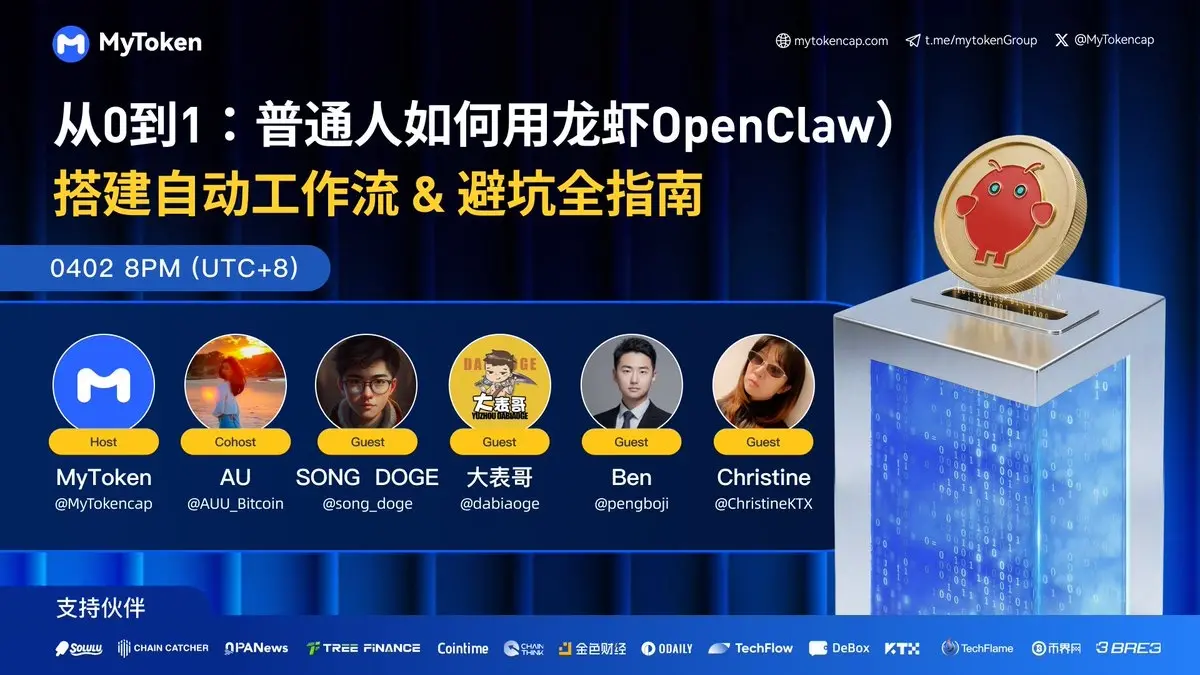
In the era of institutional dominance, how can retail investors break the deadlock - MyToken AMA highlights review

 On December 5th, MyToken held an AMA to discuss how retail investors can leverage tools, optimize asset allocation, and seize opportunities in emerging sectors under an institution-led crypto market.
On December 5th, the well-known blockchain data platform MyToken held an online AMA themed "The Era of Institutional Dominance: Challenges and Opportunities for Retail Investors." The event invited prominent KOL Lao Zhang (@zhangbj), seasoned investor Yangzi Olivia (@knowyourself518), CMO of KTX exchange Christine (@ChristineKTX), and a content researcher from Ju.com (@Jucom_intern) to discuss the strategies and future outlook for ordinary investors amid profound changes in the current market structure.

1. Changes in Market Structure: From Retail Frenzy to Institutional Dominance
At the beginning of the discussion, the guests unanimously agreed that the cryptocurrency market has entered a new phase of deep participation by traditional financial institutions, marked by the approval of Bitcoin spot ETFs.
- Institutionalization and Structuring as Core: Yangzi pointed out that institutions bring massive capital, and their pursuit is no longer the "hundredfold myth," but sustainable and compliant returns. This has directly led to a huge demand in the market for robust underlying assets (such as RWA) and professional strategies. Although market volatility remains, the previous wild fluctuations driven by retail sentiment have been "flattened" by institutional allocation behaviors.
- Retail Investors Forced to Upgrade: Christina from KTX cited data showing that the proportion of retail funds has significantly decreased from about 80% in the last bull market. Faced with the capital and information advantages of institutions, the old model of retail investors "chasing meme coins and betting on contracts" is becoming unsustainable. Christina, representing an exchange that emphasizes user experience and transparency, revealed that KTX is actively developing products that can assist retail investors, such as smart trading strategy tools based on multiple indices, aimed at helping users optimize decisions in a complex market environment. A researcher from Ju.com observed that retail investors are becoming more "professional," increasingly relying on on-chain data tools for decision-making.
- Changes in Trading Behavior: The guests believe that retail investors are shifting from high-frequency trading and speculation on altcoins to focusing on asset allocation. Some funds are allocated to dollar-cost averaging into core assets like Bitcoin, while others are exploring more stable returns through yield aggregators, strategy shops, or professional asset management platforms.
2. Outlook for 2026: Strengthening Trends and Emerging Tracks
Regarding the upcoming year 2026, the guests generally believe that the trend of institutional dominance will continue to strengthen, but new opportunities are also emerging.
1. Continued Strengthening of Trends
Lao Zhang and the researcher from Ju.com both believe that compliant entry points like ETFs make mainstream capital more inclined towards high-quality assets like Bitcoin, and this structure is hard to reverse. The market may present a "layered" structure: at the top are large institutional trades; in the middle, AI-driven tools (such as data analysis agents and strategy platforms) become widespread, helping retail investors narrow the information gap; at the bottom, there will still be new types of assets driven by strong narratives.
2. Key Tracks to Watch:
- RWA (Real World Assets): Several guests mentioned that this is key to connecting traditional finance with the crypto world, such as tokenized government bonds and equities, which can provide stable sources of income.
- AI and Autonomous Agents (AI Agents): With the development of standards like ERC-404 and X402, AI Agents capable of autonomous on-chain interactions and payments may become a new growth point.
- Payment and Financial Infrastructure: As payment channels open up globally, the application of cryptocurrencies in daily consumption (such as QR code payments) will become an important trend, achieving "Web3 earning, spending offline."
- Bitcoin Ecosystem: Lao Zhang suggested that due to long-term needs for network security and miner incentives, the construction of the Bitcoin ecosystem (such as layer two networks and new asset protocols) may face necessary breakthroughs.
- Other Opportunities: Prediction markets, on-chain derivatives mining (such as Hyperliquid), and SocialFi are also considered directions that retail investors can pay attention to and participate in.
3. Retail Strategies: Focus on Stability and Utilize Tools
In the face of the new environment, the guests provided the following practical advice for retail investors:
- Adjust Mindset and Strategy: Adopt a Barbell Strategy—allocate most of the funds to stable assets like Bitcoin, while a small portion is used to explore high-risk, high-potential new narratives. Shift from a "trader" mindset to that of a "fund investor," relying more on professional management.
- Select Platforms Carefully: Security is the primary criterion for choosing trading platforms and asset management products, followed by the professionalism of the products and transparency of the underlying assets. Attention should be paid to those that can provide in-depth market data, clear risk disclosures, and support flexible subscriptions and redemptions. Whether it is a trading platform or asset management product, it is essential to first examine its fund custody, audit status, and asset transparency. Christina elaborated on KTX's security measures from multiple angles.
- Utilize Tools and Leverage Professionals: Retail investors should proactively learn to use data analysis tools (such as the monitoring features provided by MyToken) and AI-assisted products. Additionally, they may consider platforms like CICADA for asset management, entrusting a professional team with strategy management to share in institutional-level return opportunities. They should also remain sensitive to emerging narratives, set aside biases, and conduct timely research.
Conclusion
This AMA clearly reveals that the cryptocurrency market is maturing amid the waves of compliance and institutionalization. For retail investors, the era of going it alone is coming to an end; leveraging professional tools, shifting towards asset allocation, and keenly capturing structural opportunities in emerging tracks will be key to addressing future challenges. As the host summarized, regardless of how the market changes, continuous learning and adaptation will always be the most reliable moat for investors.
(This article is based on the content of the MyToken AMA, and the views of the guests are for reference only and do not constitute investment advice.)
 Risk warning Risk warning