Stepping into the wave of stablecoins for six years, he has seen the embryonic form of the future of payments
 Core Viewpoint

 When stablecoins are referred to as "financial infrastructure," real change has already occurred beneath the surface. Raj Parekh, one of the participants, reflects on this six-year experiment and where it is heading.
Original Title: Stepping into the Stablecoin Wave for Six Years, He Sees the Prototype of Future Payments
Original Author: Sleepy.txt, Dongcha Beating
This year is destined to be recorded in financial history as the "Year of Stablecoins," and the current commotion may just be the tip of the iceberg. Beneath the surface lies a current that has been flowing for six years.
In 2019, when Facebook's stablecoin project Libra detonated like a deep-water bomb, it awakened the traditional financial world, and Raj Parekh was at the eye of the storm at Visa.
As the head of Visa's cryptocurrency division, Raj experienced the psychological shift of this traditional financial giant from watching to participating, a moment of non-consensus.
At that time, the arrogance of traditional finance coexisted with the immaturity of blockchain. Raj's experience at Visa painfully exposed him to the invisible ceiling of the industry; it wasn't that financial institutions didn't want to innovate, but rather that the existing infrastructure simply couldn't support "global payments."
Carrying this pain point, he founded Portal Finance, attempting to build better middleware for crypto payments. However, after serving a large number of clients, he found that no matter how optimized the application layer was, the underlying performance bottleneck remained the ceiling.
Ultimately, the Portal team was acquired by the Monad Foundation, with Raj at the helm of the payment ecosystem. In our view, he is the perfect candidate to review this efficiency experiment, as he understands both the business logic of stablecoin applications and the underlying mechanics of crypto payments.
Recently, we chatted with Raj about the development process of stablecoins in recent years. We need to clarify what drives the current enthusiasm for stablecoins: is it the feasible boundaries set by regulation, the willingness of giants to enter the field, or the more pragmatic calculations of profit and efficiency?
More importantly, a new industry consensus is forming—stablecoins are not just assets in the crypto world; they may become the infrastructure for the next generation of clearing and capital flow.
But the question arises: how long will this enthusiasm last? Which narratives will be debunked, and which will solidify into long-term structures? Raj's perspective is valuable because he is not merely an observer from the shore; he has always been fighting in the water.
In Raj's narrative, he describes the development of stablecoins as the "email moment" of currency, a future where capital flows as cheaply and instantly as sending a message. But he also candidly admits that he hasn't fully figured out what this will give rise to.
Below is Raj's account, organized and published by Dongcha Beating:
Problem-First, Not Technology-First
If I had to pinpoint a starting point for all this, I would say it was 2019.
At that time, I was at Visa, and the atmosphere in the entire financial industry was very subtle. Facebook suddenly launched the Libra stablecoin project. Before that, most traditional financial institutions viewed cryptocurrencies either as geek toys or speculative tools. But Libra was different; it made everyone realize that if they didn't sit at the table, there might not be a place for them in the future.
Visa was one of the first publicly listed partners of the Libra project. Libra was very special at that time; it was an early, large-scale, and very ambitious attempt that brought many different companies together around blockchain and crypto for the first time. Although the final outcome did not materialize as everyone initially expected, it was indeed a very important watershed event that made many traditional institutions take crypto seriously for the first time, rather than viewing it as a marginal experiment.
Of course, this was followed by enormous regulatory pressure, and later Visa, Mastercard, Stripe, and other companies withdrew in October 2019.
However, after Libra happened, not only Visa but also Mastercard and other members of Libra began to systematically formalize their crypto teams. On one hand, this was to better manage partners and relationship networks; on the other hand, it was to truly create products and elevate it to a more comprehensive strategy.
My career started at the intersection of cybersecurity and payments. In the first half of my time at Visa, I was mainly building a security platform to help banks understand and respond to data breaches, exploits, and hacking attacks, with a core focus on risk management. It was during this process that I began to understand blockchain from the perspective of payments and fintech, always viewing it as an open-source payment system. The most shocking aspect was that I had never seen a technology that could allow value to flow globally at such high speed, 24/7.
At the same time, I also clearly saw that Visa's underlying infrastructure still relied on the banking system, on Mainframe, wire transfers, and other relatively old technology stacks. For me, that open-source system that could also "transport value" was very attractive. My intuition at the time was simple: the infrastructure that systems like Visa relied on would likely be gradually rewritten by systems like blockchain.
After the Visa Crypto team was established, we didn't rush to promote technology. This team was one of the smartest and most hands-on builders I had ever seen. They understood both traditional finance and traditional payment systems, and they had a deep respect and understanding of the crypto ecosystem. The crypto world, after all, has a strong "community attribute"; if you want to succeed here, it's hard not to understand and integrate into it.
Ultimately, Visa is a payment network, and we must focus a lot of energy on how to empower our partners, such as payment service providers, banks, fintech companies, and what efficiency issues exist in our cross-border settlement processes.
So our approach was not to push a specific technology onto Visa but rather to first identify the real problems within Visa and then see if blockchain could solve them in certain areas.
If we look at the settlement chain, we see a very intuitive problem: since capital flows are T+1, T+2, why can't we achieve "second-level settlement"? If we can achieve second-level settlement, what can it bring to treasury and finance teams? For example, if banks close at 5 PM, what if the treasury team could initiate settlements at night? Or, for example, if weekends are typically non-settlement days, what if we could settle seven days a week?
This is why Visa later turned to USDC; we decided to use it as a new settlement mechanism within the Visa system, truly integrating it into Visa's existing framework. Many people may not understand why Visa would conduct settlement tests on Ethereum. In 2020 and 2021, this sounded crazy.
For instance, Crypto.com is a major client of Visa. In the traditional settlement process, Crypto.com has to sell their crypto assets daily, convert them to fiat, and then wire transfer to Visa via SWIFT or ACH. This process is very painful; first, there's the time factor—SWIFT is not real-time, and there can be T+2 or even longer delays. To ensure settlement without default, Crypto.com must keep a large amount of collateral in the bank, known as "pre-funding."
This money could have been used to earn returns through business but is instead just sitting in the account to cope with the slow settlement cycle. We thought, since Crypto.com's business is built on USDC, why not settle directly with USDC?
So we reached out to Anchorage Digital, a digital asset bank with a federal license. We initiated the first test transaction on Ethereum. When that USDC transferred from Crypto.com's address to Visa's address at Anchorage and completed final settlement within seconds, it felt incredible.
Infrastructure Gaps
My experience with stablecoin settlements at Visa painfully made me realize one thing: the industry's infrastructure is too immature.
I have always understood payments and capital flows as a "completely abstracted experience." For example, when you go to a coffee shop to buy coffee, the user just swipes their card, completes the transaction, and gets their coffee; the merchant receives the money—it's that simple. Users are unaware of how many steps happen in the background: communicating with your bank, interacting with networks, confirming transactions, completing clearing and settlement… all of this should be thoroughly hidden and invisible to the user.
So I view blockchain in the same way; it is indeed a good settlement technology, but ultimately it should be abstracted through infrastructure and application layer services so that users do not need to understand the complexity of the chain. This is why I decided to leave Visa and start Portal, to create a developer-focused platform that allows any fintech company to integrate stablecoin payments as easily as connecting to an API.
To be honest, I never envisioned that Portal would be acquired. For me, it felt more like a sense of mission; I viewed "building an open-source payment system" as my life's work. I felt that if I could make on-chain transactions easier to use and make open-source systems truly applicable in everyday scenarios, even playing a small role would still be a huge opportunity.
Our clients included traditional remittance giants like WorldRemit, as well as many emerging neobanks. But as our business deepened, we fell into a strange loop.
Some may ask why we chose to build infrastructure instead of applications. After all, many people now complain that "too much infrastructure has been built, but applications are lacking." I think this is actually a cyclical issue. Generally speaking, better infrastructure comes first, which then spurs new applications; as new applications emerge, they in turn spur the next round of new infrastructure. This is the "application-infrastructure" cycle.
At that time, we saw that the infrastructure layer was not mature enough, so I felt it made more sense to start from infrastructure. Our goal was to pursue two parallel lines: on one hand, to collaborate with large applications that already had distribution, ecosystems, and transaction volumes; on the other hand, to enable early-stage companies and developers to easily get started with development.
To pursue performance, Portal supported various chains like Solana, Polygon, and Tron. But after going around in circles, we always returned to the same conclusion: the network effects of the EVM (Ethereum Virtual Machine) ecosystem are too strong; developers are here, and liquidity is here.
This creates a paradox: the EVM ecosystem is the strongest, but it is too slow and too expensive; other chains are fast, but their ecosystems are fragmented. We were thinking that if one day, a system could emerge that is both EVM-compatible and capable of high performance with sub-second confirmations, that would be the ultimate answer for payments. So in July of this year, we accepted the Monad Foundation's acquisition of Portal, and I began to oversee payment operations at Monad.
Many people ask me, isn't there already an oversupply of public chains? Why do we still need new chains? This question itself might be misframed; it's not "why do we still need new chains," but rather "do existing chains really solve the core problems of payments?"
If you ask those who are genuinely engaged in large-scale capital transfers, they will tell you that what they care about most is not how new the chain is or how good the story is, but whether the unit economic model adds up. What is the cost of each transaction? Does the confirmation time meet commercial needs? Is liquidity deep enough between different forex corridors? These are very practical issues.
For example, sub-second finality sounds like a technical metric, but it corresponds to real money. If a payment takes 15 minutes to confirm, it is commercially unusable. But having this alone is not enough; you also need to build a large ecosystem around the payment system, including stablecoin issuers, deposit and withdrawal service providers, market makers, and liquidity providers—each role is indispensable.
I often use a metaphor: we are in the "email moment" of currency. Do you remember the scene when email first appeared? It not only made writing letters faster but also allowed information to be transmitted to the other side of the planet in seconds, fundamentally changing the way humans communicate.
I view stablecoins and blockchain in the same light; this is an unprecedented ability to transport value at internet speed in human civilization. We haven't even fully figured out what it will give rise to; it could mean the reshaping of global supply chain finance or the zeroing out of remittance costs.
But the most critical next step is how this technology can be seamlessly integrated into YouTube, integrated into every daily app on your phone. When users do not feel the presence of blockchain but enjoy the rapid flow of funds at internet speed, that is when we truly begin.
Earning Through Flow: The Evolution of Stablecoin Business Models
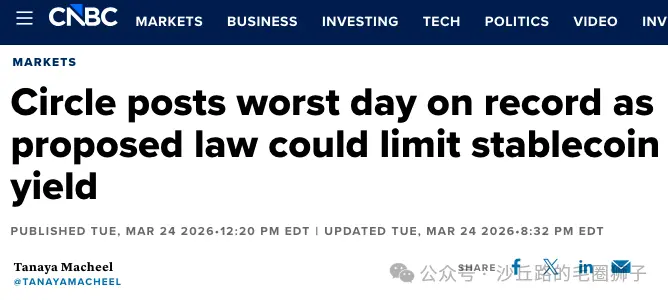
In July of this year, the U.S. signed the GENIUS Act, and the industry landscape is undergoing subtle changes. The moat advantage that Circle once established is beginning to fade, and the core driving force behind this is a fundamental shift in business models.
In the past, early stablecoin issuers like Tether and Circle had very simple and direct business logic: users deposited money, and they took that money to buy U.S. Treasury bonds, with all interest income going to the issuer. This was the game rule of the first phase.
But now, if you observe new projects like Paxos and M0, you will find that the game rules have changed. These new players are starting to directly pass on the interest income generated by underlying assets to users and recipients. This is not just an adjustment in profit distribution; I believe it actually creates a new financial vernacular we have never seen before—a new form of currency supply.
In the traditional financial world, money in the bank only earns interest when deposits are idle. Once you start transferring or making payments, that money typically does not earn interest during the flow.
But stablecoins break this limitation; even when funds are flowing, being paid, or engaged in high-speed trading, the underlying assets continue to generate interest. This opens up a whole new possibility—not just earning interest while idle, but also while in flow.
Of course, we are still in the very early experimental stage of this new model. I have also seen some teams attempting more radical approaches, managing large-scale U.S. Treasury assets behind the scenes and even planning to pass 100% of the interest to users. You might ask, how do they make money? Their logic is to profit from other value-added products and services built around stablecoins, rather than relying on interest spreads.
So, although this is just the beginning, after the GENIUS Act, the trend is already very clear: every major bank and every large fintech company is seriously considering how to join this game. The future business model of stablecoins will not stop at simply depositing money to earn interest.
In addition to stablecoins, new crypto banks have also received significant attention this year. Combining past experiences in payments, I believe there is a core difference between traditional fintech and crypto fintech.
The first generation of fintech companies, like Brazil's Nubank or America's Chime, is essentially built on the local banking infrastructure of their respective markets. They rely on the local banking system at their core. This leads to an inevitable result: their target audience is severely limited, primarily serving local users.
But when you build products based on stablecoins and blockchain, the situation changes completely.
You are actually building products on a global payment track, something we have never seen in financial history. The change this brings is disruptive; you no longer need to be a fintech company in a single country. From day one, you can build a global new bank aimed at multi-country users, even global users.
This is what I see as the biggest unlocking point; in the entire history of fintech, we have rarely seen this level of global inception. This model is giving rise to a new generation of founders, builders, and products that are no longer constrained by geographical barriers. From the first line of code written, the goal is the global market.
The Future of Agent Payments and High-Frequency Finance
If you ask me what excites me most in the next three to five years, it would definitely be the combination of AI Agents (Agentic Payments) and High-Frequency Finance.
A few weeks ago, we held a hackathon in San Francisco focused on the intersection of AI and cryptocurrency. A large number of developers emerged on-site; for example, one project combined the U.S. delivery platform DoorDash with on-chain payments. We are already starting to see this trend where agents are no longer limited by human processing speeds.
In high-throughput systems, agents move funds and complete transactions at speeds that human brains may not be able to comprehend in real-time. This is not just a matter of being faster; it represents a fundamental shift in workflow: we are upgrading from "human efficiency" to "algorithm efficiency," ultimately moving towards "agent efficiency." To support this leap in efficiency from milliseconds to microseconds, the underlying blockchain performance must be robust enough.
At the same time, user account forms are also merging. In the past, your investment account and payment account were separate, but now those boundaries are becoming blurred.
This is actually a natural selection at the product level and is precisely what giants like Coinbase want to achieve. They hope to become your "Everything App," where you can save money, buy crypto, buy stocks, and even participate in prediction markets, all within the same account. This way, they can keep users firmly locked in their ecosystem without relinquishing deposits and behavioral data.
This is also why infrastructure remains very important. Because only by truly abstracting those components of the crypto underlying can we integrate DeFi transactions, payments, and earning yields into a unified experience, where users hardly feel the complexity behind it.
Some of my colleagues have a strong background in high-frequency trading, accustomed to making large-scale trades in systems with extremely low latency on CME or stock trading platforms. But what excites me is not continuing to trade, but rather migrating this rigorous engineering capability and algorithm-driven decision-making mechanism into the everyday financial workflows of the real world.
Imagine a financial manager handling multinational funds, needing to manage large amounts of capital spread across different banks and involving various forex pairs. In the past, this required a lot of manual coordination, but in the future, if there are LLMs combined with high-performance public chains, the system can automatically conduct large-scale algorithmic trading and fund scheduling behind the scenes, allowing the entire capital management operation to earn more returns.
Abstracting the capabilities of "high-frequency trading" and migrating them into more diverse real-world workflows. This is no longer the exclusive domain of Wall Street; it is about allowing algorithms to optimize every penny of a business at extremely high speeds and scales. This is the new category that is truly worth looking forward to in the future.
 Risk warning
 Risk warning