








The stall moment of Paradigm: When "research-driven" encounters the test of reality
 Core Viewpoint
 If the past Paradigm represented the "engineer era" of the cryptocurrency industry, then what it will face next may be a more pragmatic and market results-oriented phase. The success or failure of this adjustment will also determine whether it can continue to play the role of a definer rather than a bystander in the next cycle.
Author: Gu Yu, ChainCatcher
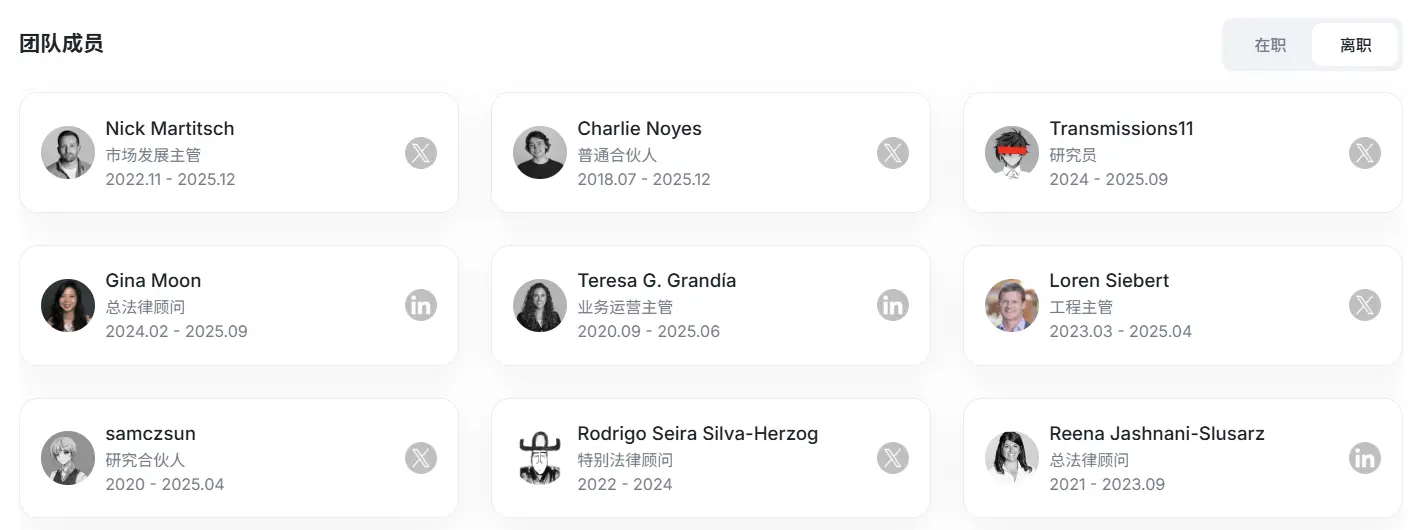
For a long time, Paradigm has been an iconic venture capital institution in the crypto industry, representing the top investment style and aesthetics in the field. Research-driven crypto VCs have been highly praised. However, affected by the cyclical nature of the industry, Paradigm has not been spared during the current period of general VC sluggishness, one manifestation of which is an unprecedented wave of executive departures, with at least 7 employees leaving since April this year, including several partners.
In December, Paradigm's first employee and general partner Charlie Noyes, along with Paradigm's head of market development Nick Martitsch, announced their departures.
In September, Paradigm's general counsel Gina Moon and researcher Transmissions11 left.
In June, Paradigm's chief operating officer Teresa G. Grandía departed.
In April, Paradigm's engineering lead Loren Siebert and research partner samczsun left in succession.
Source: RootData
This wave of departures is extremely rare among top-tier VCs, reflecting that Paradigm has fallen into a rather difficult phase. From the perspective of its public investment portfolio and transaction frequency, Paradigm's investment frequency has significantly decreased over the past two to three years, lacking "representative works" that have industry consensus, and missing out on many high-return projects, which may be the main sources of Paradigm's predicament.
Repeated Takeovers, Missing Star Targets
Paradigm's golden era roughly spanned from 2019 to 2021. During this period, it completed investments in key projects such as Uniswap, Optimism, Lido, and Flashbots, establishing a strong brand label: technical infrastructure, Ethereum core ecosystem, long-termism, which earned Paradigm a considerable reputation among crypto entrepreneurs and investors.
These typical investments share several common characteristics: they are not short-term fads but rather underlying protocols or key intermediaries; the timing of investment is relatively early, but not extremely early; they are highly consistent with Paradigm's internal research directions.
It was during this phase that Paradigm formed a clear and repeatedly emphasized investment strategy: research-driven. However, the problem is that this methodology has gradually shown insufficient adaptability in the face of rapid changes in industry logic in subsequent cycles, leading to a noticeable gap in Paradigm's investment performance and influence.
Starting in 2022, a new generation of high-growth projects began to emerge more in application layers, financial structural innovations, mechanism design, and product experiences, such as prediction markets, yield structure protocols, and perpetual contract protocols. This round of projects often iterates quickly, is more product-oriented, has a higher tolerance for "technical correctness," and is more sensitive to "user growth" and "mechanism efficiency."
In the previous cycle, Paradigm distinctly supported and invested in the two blockbuster projects Blur and Friend.tech, becoming one of the main drivers of their popularity. However, both quickly fell into decline after issuing tokens, with teams heavily selling tokens and gradually becoming inactive, leading the market to question Paradigm's investment vision and style.
At the same time, Paradigm also took over many follow-up financings of overvalued projects. This strategy, while profitable for Paradigm during the bull market, has seen its heavily invested projects quickly drop below their cost price after issuing tokens, or struggle to develop and seek transformation due to ongoing downturns in the altcoin market and issues with the investment targets themselves.
In May 2024, Paradigm led a $150 million Series A round for Farcaster at a $1 billion valuation, but Farcaster has since announced a pivot from the social track to the wallet field.
In May 2024, Paradigm led a $70 million financing for Babylon at an $800 million valuation, but Babylon's token FDV is now only $180 million.
In April 2024, Paradigm led a $225 million financing for Monad at a $3 billion valuation, but Monad's token FDV is now only $1.7 billion.
In June 2022, Paradigm participated in a $130 million financing for Magic Eden at a $1.6 billion valuation, but Magic Eden's token FDV is now only $200 million.
What is even harder for Paradigm to accept is that it has also missed early investments in many high-return projects over the years, such as Ethena, Pump.fun, Ondo Finance, and MYX. In the popular derivatives and RWA tracks, Paradigm has not invested in any targets in recent years.
From the perspective of the prediction market track, which has been highly favored by the capital market in recent years, although Paradigm invested in the prediction market project Veil as early as January 2019, that project announced its shutdown less than a year after its launch.
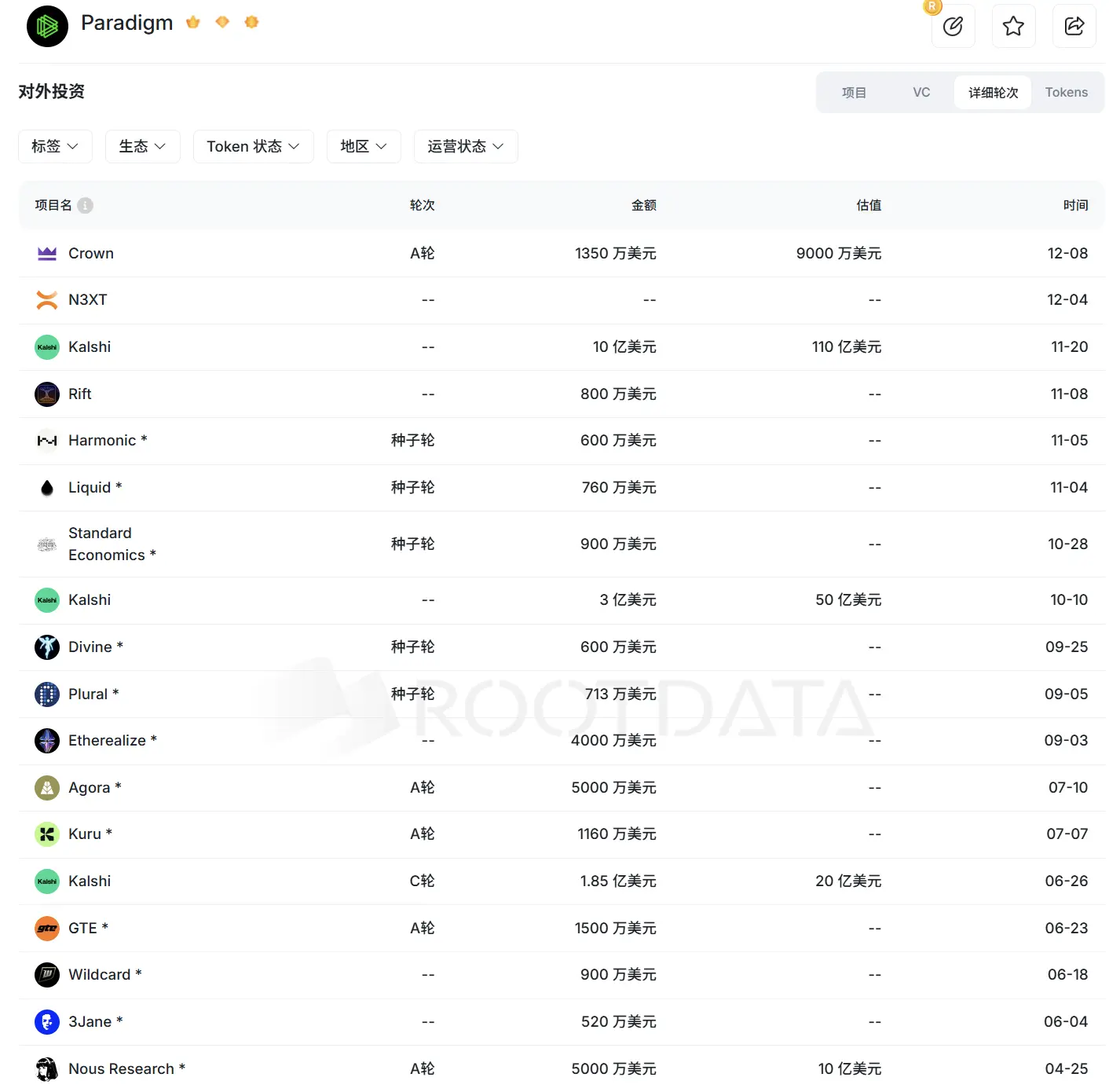
The prediction market model is not theoretically novel, and the technical difficulty is not top-tier; the failed investment experience led Paradigm to miss participation in the first five rounds of financing for Polymarket. Perhaps it was not until January of this year, when Polymarket announced the completion of a $150 million financing at a $1.2 billion valuation, that Paradigm realized the value of this track and began to heavily invest in Polymarket's competitor Kalshi, first leading its $185 million financing at a $2 billion valuation in June this year, and then participating in two rounds of financing at valuations of $5 billion and $11 billion within six months. This also marks Paradigm's highest-valued investment in history.
From this, it can be seen that Paradigm has made a firm decision not to miss core investment targets in the hottest tracks, even exhibiting a "FOMO" mentality.
Incubation Stalled
Deep involvement in project incubation has long been one of Paradigm's signature styles, with Uniswap and Flashbots being representative cases from previous cycles.
In a previous article published by Paradigm, the institution stated that Paradigm is a community of developers aimed at providing support to other developers. The most effective collaborations often involve deep cooperation with entrepreneurial teams to jointly solve significant business and research challenges.
For VCs, joining a project at the conceptual stage allows for better influence over product design and strategic direction, thereby unlocking greater value potential and achieving higher bargaining power and returns at the investment level.
With multiple successful cases, Paradigm has continued to explore incubation models in recent years and launched a formalized EIR (Entrepreneurs-in-Residence) model, where both parties work together in the same office space, with the VC providing substantial support in strategy, technology, recruitment, etc. However, recent cases indicate that Paradigm's model has also hit obstacles.
In December 2023, Paradigm collaborated through the EIR mechanism to develop the on-chain developer platform Shadow and invested $9 million, but the project has already ceased development this year, with the founding team pivoting to launch an unlisted company equity derivatives platform called Ventuals.
The decentralized fixed-rate protocol Yield Protocol, in which Paradigm previously participated in writing the white paper, development, and investment, also announced its shutdown in October 2023.
Subsequently, Paradigm shifted its focus solely to the infrastructure track. In October 2024, crypto VC firm Paradigm announced a $20 million investment in its spin-off company Ithaca, which is developing a new Layer 2 blockchain called Odyssey. Paradigm's CTO and general partner Georgios Konstantopoulos has taken on the role of CEO at Ithaca while retaining his position at Paradigm. Paradigm co-founder Matt Huang serves as chairman of Ithaca.
This team structure indicates that Ithaca is entirely developed by Paradigm's core team, with a deeper level of involvement than previous projects like Uniswap. Choosing the Layer 2 track at this point does not seem like a wise choice in hindsight. In the following year, Ithaca has had almost no significant developments in the market.
At the beginning of this year, as the crypto industry's focus completely shifted to stablecoins and payment tracks, Paradigm once again "followed the trend," partnering with internet payment giant Stripe to launch the high-performance Layer 1 public chain Tempo for payment scenarios in August this year, with Paradigm co-founder Matt Huang serving as CEO of the project. In October, Tempo acquired Ithaca, with all members joining Tempo.
At this point, the payment track already had strong projects like Arc, RedotPay, Plasma, Stable, 1Money, and BVNK making strides. Tempo was leading in terms of financing amounts and had the support of Stripe's resources, achieving a relatively advantageous position in the fierce competition.
The payment battle of Tempo will become a decisive campaign for Paradigm to once again prove its product and research capabilities.
Conclusion
Whether Paradigm will find its rhythm again remains to be seen. However, it is certain that it has reached a position where change is necessary.
Since January of this year, Paradigm's investment frequency has significantly increased, from an average of 1 deal per month in 2023-2024 to an average of 2 deals per month, with a noticeable increase in the proportion of early-stage investments. In June last year, Paradigm also announced the completion of an $850 million fundraise, still making it one of the VCs with the largest cash reserves today.
The turnover of the team and the setbacks in investment strategies are not unique challenges for any single VC but are rather a necessary path that almost all long-term institutions will experience in cross-cycle development. If the past Paradigm represented the "engineer era" of the crypto industry, what it faces next may be a more pragmatic, market results-oriented phase. The success or failure of this adjustment will determine whether it can continue to play the role of a definer rather than a bystander in the next cycle.
 Risk warning
 Risk warning



Popular articles





