








DTCC is not on-chain stocks: What has really changed?
 Core Viewpoint

 DTCC is tokenizing "entitlements" rather than "shares." A true on-chain ownership model is emerging elsewhere.
Author: Chuk @Stablecoin Blueprint
Compiled by: Payment 201
Introduction: Not the Kind of "Tokenization" You Think
The Depository Trust & Clearing Corporation (DTCC) has received a "no-action letter" from the U.S. Securities and Exchange Commission (SEC), allowing it to begin tokenizing securities infrastructure. This is a significant upgrade for the "pipeline system" of the U.S. capital markets: DTCC holds $99 trillion in securities and supports a trading volume measured in "trillions" annually.
However, the market's reaction to this announcement reveals a "gap between expectation and reality": what is being tokenized are security entitlements, not the shares themselves, and this distinction determines everything that follows.
Today's narrative of "securities tokenization" is not a unified future arriving simultaneously. In fact, two different levels of models are emerging concurrently: one is a modernization upgrade within the current "indirect holding system"; the other is redefining the concept of "ownership" itself. (Note: For simplicity, this article will not distinguish between DTCC's subsidiary DTC and its parent company.)
The Actual Operation of Securities Ownership Today
In the U.S. public markets, investors do not directly hold shares of a company. They exist within a chain of multiple layers of intermediaries. At the bottom layer is the issuer's shareholder register, typically maintained by a transfer agent. For almost all publicly traded companies, this register will show only one name: Cede & Co. ------ the nominee holder of DTCC. This means that issuers do not have to maintain records for millions of individual shareholders.
Above this layer is DTCC, which holds shares in bulk in an "immobilized" manner.
DTCC's direct participants are called clearing brokers, who are responsible for custodial and settlement services on behalf of retail brokers, who are the entities directly facing customers and receiving trade orders. DTCC records the number of shares each participant "is entitled to."
At the top layer are the investors. They do not truly own specific shares; instead, they hold "security entitlements" ------ a "legally protected claim" to the underlying shares, which is against their brokers, who hold down to DTCC through clearing brokers.
What DTCC is tokenizing are these security entitlements, not the underlying shares. This upgrade improves system operations but does not address the limitations caused by the multi-layered intermediary structure itself.
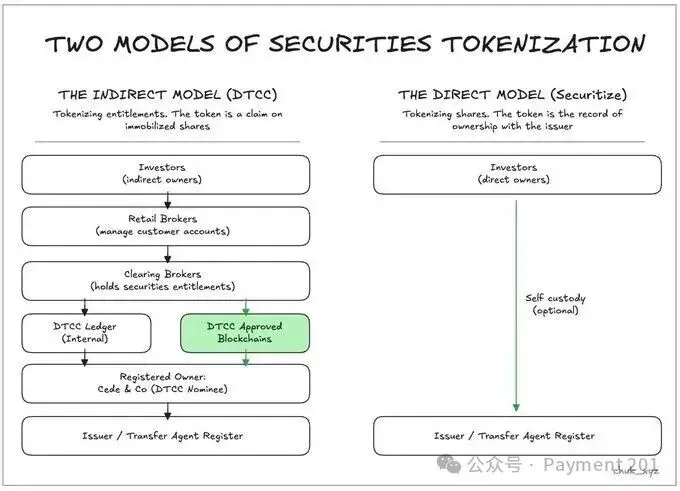
In other words, DTCC tokenizes the "claim"; the direct model tokenizes the "shares themselves." Both are referred to as "tokenization," but they address entirely different issues.
Why Upgrade?
The U.S. securities system is very robust, but its architecture still has some limitations.
Settlement relies on delayed, business-hour processing workflows;
Corporate actions and reconciliations still operate on batch messaging systems rather than a shared state;
Because ownership is a complex network of multiple layers of intermediaries, each with its own technology upgrade cycle, it cannot support real-time processes unless every layer enables the relevant capabilities, with DTCC being the key "gatekeeper."
This design also locks up capital: longer settlement cycles lead to the need for billions of dollars in margin to manage risk between trade execution and final settlement. These optimization designs stem from an era when "capital moved slowly and was costly." If settlement cycles could be shortened, or if certain participants were allowed to choose "instant settlement," then the scale of capital occupation could significantly decrease, costs would lower, and competition would intensify.
Some of the benefits can be realized by upgrading existing infrastructure; however, others ------ especially those involving direct ownership and faster innovation cycles ------ require entirely new models.
Tokenizing the Existing System (DTCC Model)
In the DTCC path, the underlying securities remain "frozen" and continue to be registered under Cede & Co.
What changes is the form of the "rights record": it no longer exists solely in proprietary ledger systems but has a digital twin that exists on an "approved blockchain."
This is crucial because it modernizes without disrupting the existing market structure: DTCC can introduce 24/7 capital flow between participants, reduce reconciliation burdens, and ultimately drive faster use of rights certificates in collateral liquidity and automated workflows, while still retaining the efficiency brought by a centralized system, such as net settlement.
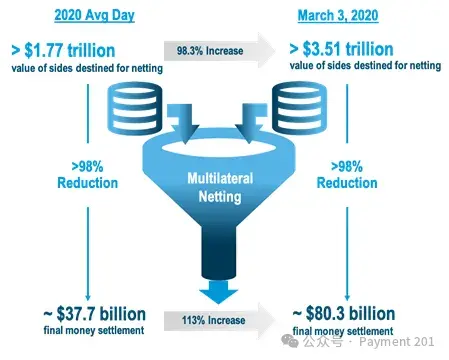
Multilateral netting can compress trillions of dollars of total trading activity into tens of billions of final settlements, and this efficiency is a core advantage of today's market structure.
But these boundaries are "deliberately set": these tokens do not make holders direct shareholders. They remain licensed, revocable rights within the same legal framework. They cannot become freely composable collateral in DeFi, cannot bypass DTC participants, and will not change the issuer's shareholder records.
In short: it improves our existing system but retains the original intermediary structure and its advantages.
Tokenizing "Ownership Itself" (Direct Holding Model)
The second model starts "outside the boundaries" of the DTCC model: it aims to tokenize not rights, but the shares themselves. Ownership is directly registered on the issuer's shareholder register, maintained by the transfer agent. When the token is transferred, the shareholder record changes accordingly. At this point, Cede & Co. no longer appears in the ownership chain.
This unlocks functionalities that are structurally impossible under the DTCC model: self-custody, direct relationships between investors and issuers, peer-to-peer transfers, and the programmability and composability with on-chain financial infrastructures (such as collateral, lending, and yet-to-be-invented innovative structures).
This model is not a theoretical concept. Shareholders of Galaxy Digital can already tokenize and hold shares on-chain through Superstate, appearing in the issuer's equity table. By early 2026, Securitize will enable the same mechanism and achieve 24/7 trading through a regulated broker-dealer system.
However, the trade-offs are very real: without the indirect holding system, liquidity will be fragmented, and net settlement efficiency will disappear. Broker services (such as margin trading and securities lending) must be redesigned. Operational risk will also shift from intermediaries to the holders themselves.
But the autonomy brought by direct ownership allows investors to choose these trade-offs themselves, rather than passively accepting them. Under the DTCC framework, such "choices" are nearly impossible to realize, as any innovation regarding rights must go through multiple approval processes of governance, operations, and regulation.
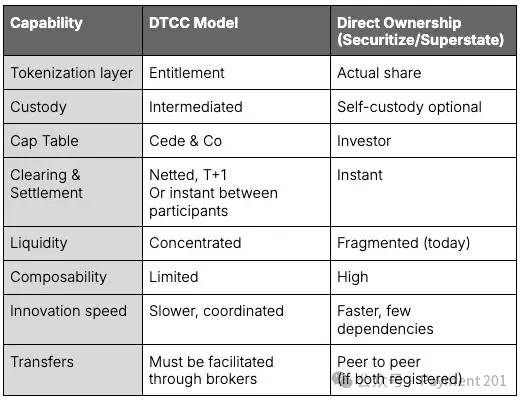
Overall, the DTCC model is more compatible and scalable; the direct holding model allows for more innovation around self-custody.
Why These Two Models Are Not Currently Competing
The DTCC model and the direct holding model do not compete; they address different problems. The DTCC path is an upgrade on the existing indirect holding system, retaining net settlement, liquidity concentration, and system stability. It caters to institutions that require scalability, settlement guarantees, and regulatory continuity.
The direct ownership model meets another type of demand: self-custody, programmable assets, and on-chain composability. It targets investors and issuers looking for new functionalities rather than just higher efficiency. Although the direct holding model may one day reshape the entire market, achieving this will require years of technological, regulatory, and liquidity migration transitions, and cannot happen overnight. The evolution of clearing rules, issuer behavior, participant readiness, and global interoperability will all progress much slower than technological advancements.
The realistic future will be one of parallel coexistence: one side modernizing infrastructure, the other side innovating ownership. Currently, neither can replace the other.
What This Means for Market Participants
The impact of these two tokenization models on the market ecosystem is vastly different:
Retail Investors:
For retail investors, the DTCC upgrade is almost "invisible." Retail brokers have already abstracted away most of the friction for customers (such as fractional shares, instant purchasing power, weekend trading), and these advantages will continue to be provided through brokers.
The direct holding model, however, will bring real change: self-custody, peer-to-peer transfers, instant settlement, and the potential to use shares as on-chain collateral. Currently, stock trading has begun to appear on platforms like Coinbase and Kraken, as well as wallets like Phantom, but most still rely on "wrapped representations." In the future, these tokens may become true registered equity, rather than synthetic layers.
Institutional Investors:
Institutions are the biggest beneficiaries of DTCC tokenization. Their operations rely on collateral liquidity, securities lending, ETF processes, and multi-party reconciliations, and tokenized rights can significantly reduce burdens and enhance speed in these areas.
The direct holding model is more attractive to some institutions, especially those seeking programmable collateral and settlement advantages. However, due to liquidity fragmentation, broader institutional adoption will start from marginal scenarios.
Brokers and Clearing Houses:
Brokers are at the center of this transformation. Under the DTCC model, their roles are strengthened, but innovation also converges towards them: clearing houses that adopt tokenized rights early can gain differentiated advantages, while vertically integrated companies can develop new products based on this.
In the direct holding model, brokers will not disappear ------ but will be reshaped. Licenses and compliance will still exist, but new "on-chain native intermediaries" will emerge to serve users who value direct ownership functionalities.
Conclusion: The Investor's Choice is the Real Winner
The future of tokenized securities does not hinge on which model "wins," but on how both evolve and interact. The "rights tokenization" model will modernize the core of public markets; the "direct ownership" model will expand from the margins, providing self-custody and programmable functionalities.
As the migration between the two models becomes increasingly seamless, we will see a broader market landscape: existing tracks becoming faster and cheaper; new tracks supporting behaviors that the existing systems cannot accommodate. Both paths will produce winners and losers, but the existence of the direct ownership channel means that investors are the ultimate winners ------ they will benefit from better infrastructure due to competition and have the right to choose freely between the two models.
 Risk warning Risk warning



Popular articles





