








Tron Industry Weekly Report: BTC Returns to $70,000 After a Sharp Drop, Detailed Explanation of AI-Guarded Full-Chain Interoperable L1 Zenchain
 Core Viewpoint

 TRON Industry Weekly Report
# I. Outlook
## 1. Macroeconomic Summary and Future Predictions
Last week, the U.S. stock market began to digest the reality of a still relatively strong job market and the repeated postponement of interest rate cut expectations after several weeks of high performance. High valuations and high positions quickly turned into sources of pressure in the absence of new positive news. Market sentiment shifted from "hesitant" to "defensive," with technology and high-growth sectors being the first to face sell-offs. The indices experienced a significant drop, indicating that this was not a normal correction, but rather an emotional sell-off triggered by collapsing expectations and loosening positions.
Looking ahead, this decline seems more like a forced correction of overly optimistic expectations. With no obvious macroeconomic downturn but delayed policy easing, it is difficult for U.S. stocks to quickly return to the previous trend of unilateral rises, and high volatility may become the norm.
## 2. Market Movements and Warnings in the Crypto Industry
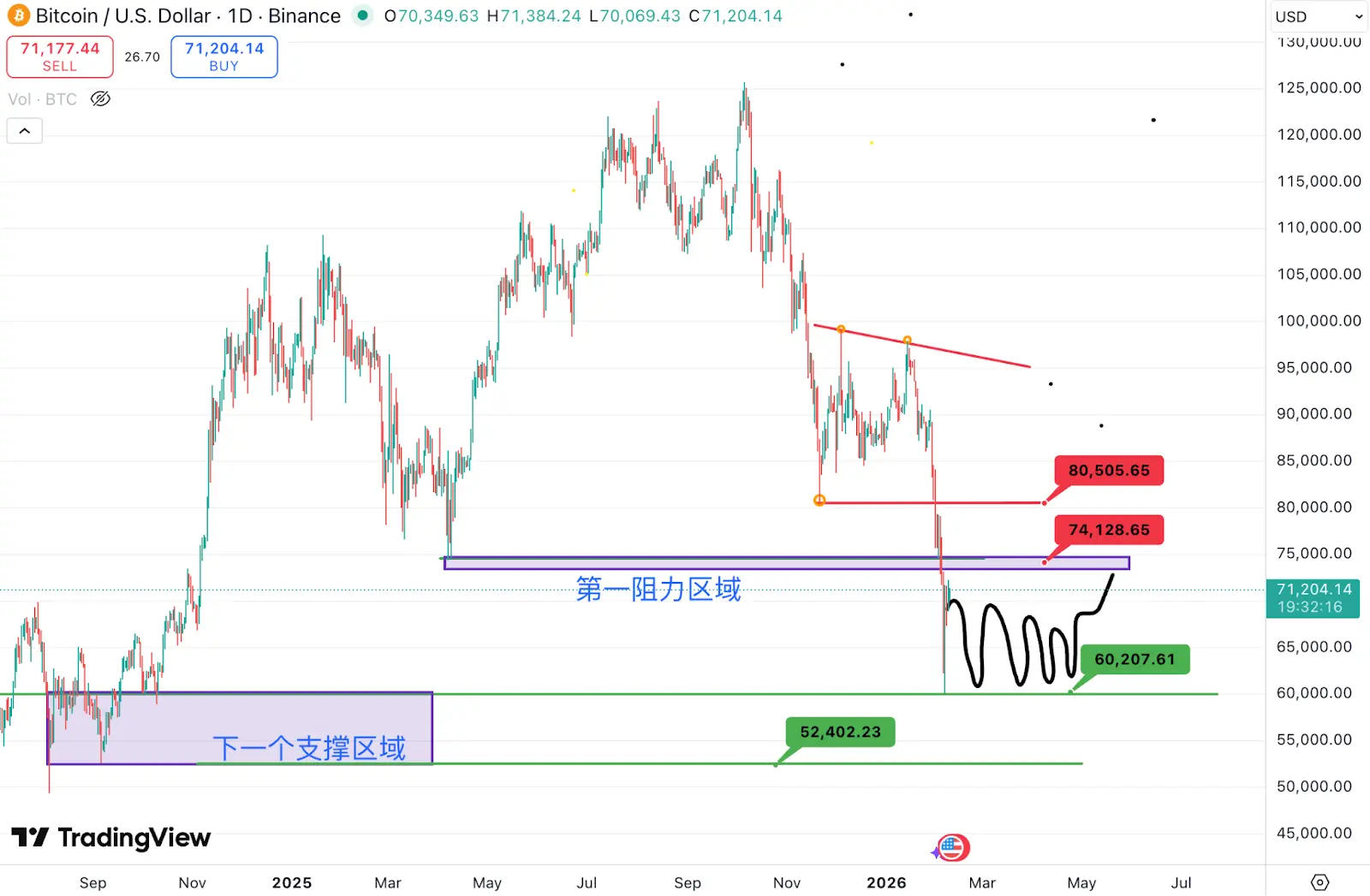
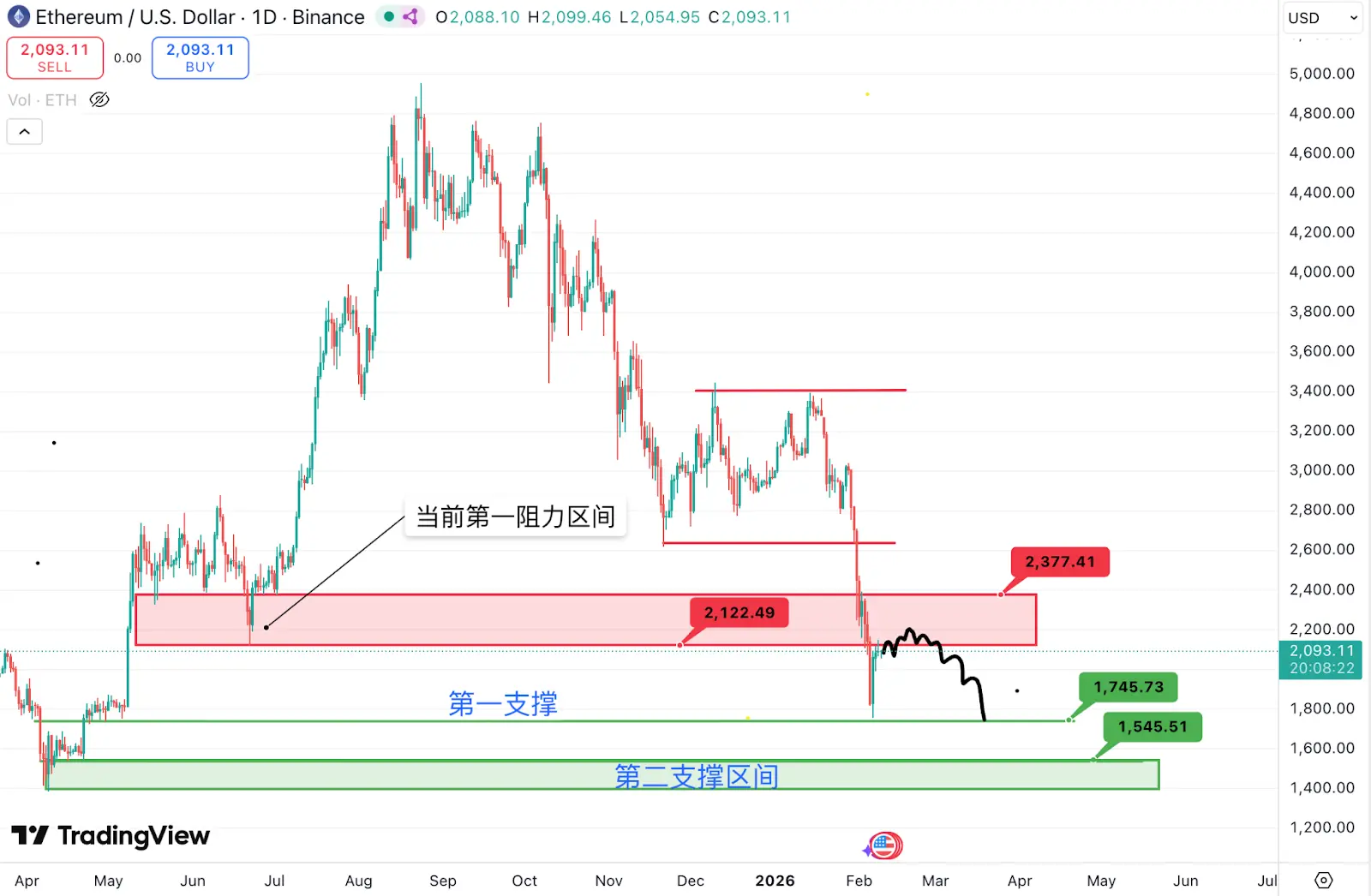
Last week, the cryptocurrency market entered a phase of high volatility and extremely fragile sentiment. Bitcoin experienced a technical rebound at $60,000 but remains in a clearly weak range. Trading volume remains high, indicating that deleveraging and long-short battles are still ongoing and have not yet fully cleared.
From a risk perspective, the current market is closer to a consolidation phase following a sharp decline rather than a trend stabilization. As long as Bitcoin cannot quickly return to and stabilize within the key pressure range, any rebound may be seen as a window for reducing positions, and altcoins and high-volatility sectors will continue to face selling pressure. Additionally, the repeated adjustments in macroeconomic interest rate expectations may continue to impact the crypto market through sentiment and liquidity channels. Overall, in the short term, there is a need to be wary of the risks of a second dip or prolonged low-level consumption, and true stability signals are still to be observed.
## 3. Industry and Sector Hotspots
Total financing of $2 million, led by CMS and Shimu Capital ------ River, a liquidity layer for bridge-less cross-chain stablecoins, is building a stablecoin system that abstracts chains to connect liquidity between different ecosystems; total financing of $5 million, led by Mint with participation from 90S, DeepNode is a decentralized smart infrastructure platform that supports the deployment, execution, and verification of AI models in a permissionless, low-trust, modular, and incentivized environment.
# II. Market Hotspot Sectors and Potential Projects of the Week
## 1. Overview of Potential Projects
1.1. Analysis of Total Financing of $2 Million, Led by CMS and Shimu Capital ------ River, a Bridge-less Cross-chain Stablecoin Liquidity Layer
Introduction
River is building a chain-abstract stablecoin system to connect liquidity between different ecosystems. Its core product is the omni-CDP-based satUSD: users can deposit collateral assets on one chain while minting satUSD on another chain ------ without cross-chain bridges or asset wrapping.
This design achieves true cross-chain capital efficiency, allowing liquidity to flow seamlessly between multi-chain ecosystems.
Core Mechanism Overview
1. Omni-CDP
River has built the first Omni-CDP (cross-chain collateral debt position) protocol by integrating LayerZero's cross-chain communication technology. Users can deposit BTC on one chain and directly mint satUSD on another chain, seamlessly connecting liquidity across multiple blockchains without traditional cross-chain bridges or asset wrapping.
2. satUSD+
satUSD+ is the core yield-bearing token in River's yield layer. After users stake satUSD, it automatically converts to satUSD+, allowing them to continuously earn a share of the protocol's real income while maintaining liquidity and composability.
satUSD staking mechanism:
Users stake satUSD, which is supported by over-collateralized assets like BTC, ETH, BNB, and LST, to participate in River's yield layer and proportionally earn fees generated by the protocol.Nature of satUSD+:
ERC-20 form of liquidity yield token
Automatically accumulates protocol income without manual claiming or reinvestment
Can be redeemed for satUSD at any time
Usable in other DeFi protocols (lending, LP, etc.)
Sources of income (non-inflationary):
Omni-CDP: minting, redeeming, and liquidation fees
System-level usage: satUSD's use across multiple chains and applications
Future modules: lending markets, cooperative protocol incentives, on-chain income sharing
3. River4FUN
River4FUN is River's contribution incentive layer, aimed at rewarding influence and participation, not just capital investment.
Core concept:
Most protocols only reward capital; River4FUN incorporates attention, content, and dissemination into the incentive system, converting them into real protocol ownership.Operation method:
Connect wallet with X (Twitter) account
Publish content related to River or partner projects (tweets, replies, quotes)
Earn River Points based on exposure, interaction quality, and continuity
Points are updated regularly
All River Points can be exchanged for $RIVER at TGE
System significance:
River4FUN completes the full flywheel of River:
Mint → Stake → Post
4. Smart Vault
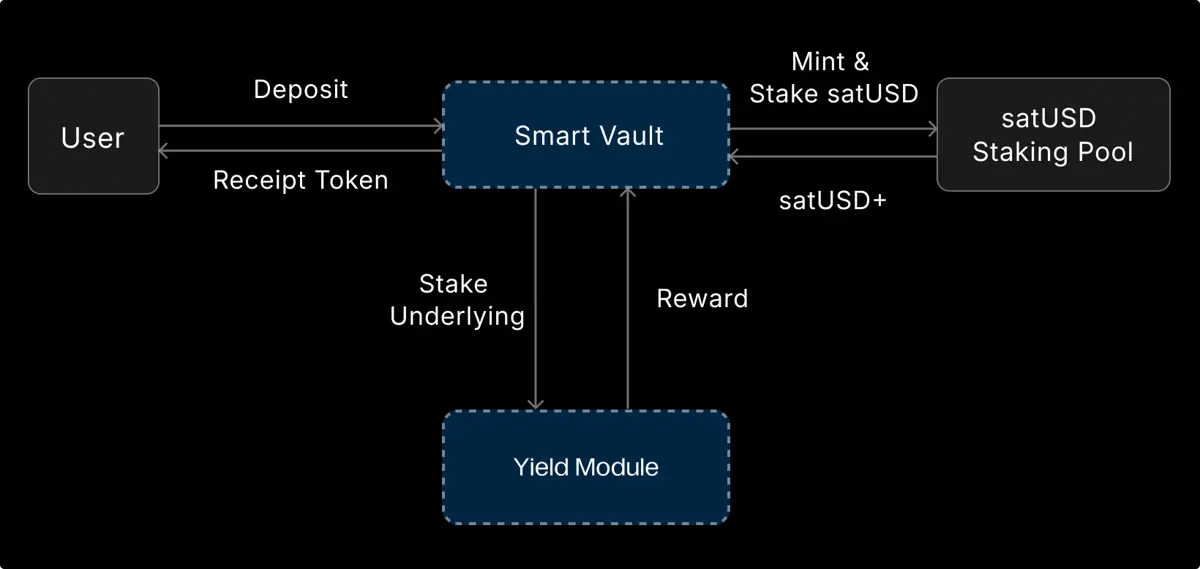
Smart Vault is a one-click yield module launched by River, focusing on zero liquidation risk + sustainable yield. Users only need to deposit assets to continuously earn yields without managing positions or worrying about market volatility and liquidation.
Problem solved:
In traditional DeFi, users often have to choose between "earning yield" and "ensuring safety," frequently managing collateral ratios and monitoring liquidation lines. Smart Vault eliminates these complexities through automated strategies.Core advantages:
Zero liquidation risk: assets will not be forcibly liquidated
No position management required: no need to monitor collateral ratios or health
Sustainable yield: derived from real strategy income rather than inflation
Asset security: 1:1 deposit and withdrawal, can be retrieved at any time
Operation mechanism:
Users deposit BTC, ETH, USDT/USDC → the protocol automatically mints satUSD based on value → satUSD goes directly into the staking pool → underlying assets are deployed to DeFi / CeDeFi / RWA yield scenarios by strategy modules → users continuously earn yields.
Throughout this process, satUSD circulates within the protocol and does not enter users' wallets, thus avoiding liquidation risk.
5. Prime Vault
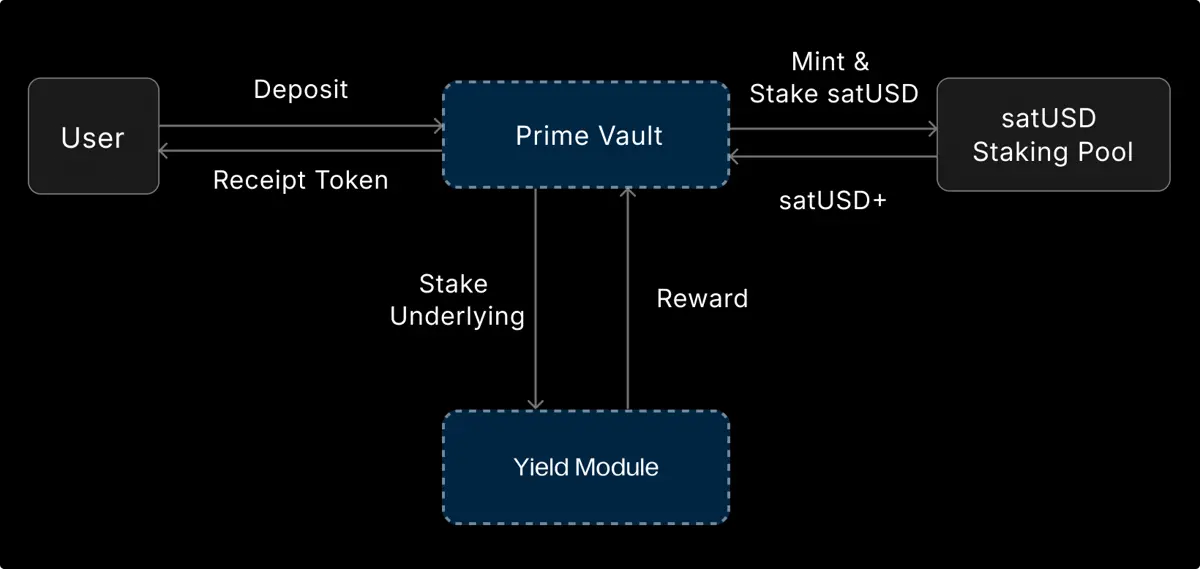
Prime Vault is an institutional-grade yield vault created by River for institutional users, providing predictable, sustainable stable yields while ensuring the highest level of asset security and compliant custody, while minimizing operational complexity and risk exposure.
Problem solved:
Eliminate forced liquidation risks due to market volatility
Meet high standards for compliance custody and asset security required by institutions
Reduce technical and operational burdens for institutions participating in DeFi
Core advantages:
Institutional-grade security: collaborating with leading custodians and publicly traded companies, assets are always held in regulated custodial wallets
Zero liquidation risk: internal automated position management avoids any form of liquidation
No smart contract risk: underlying assets are not exposed to complex DeFi contracts, avoiding code and hacker risks
Predictable returns: based on River's stablecoin yield system
Operation mechanism:
Institutions deposit assets like BTC → custodians lock assets in secure wallets → the protocol internally mints satUSD based on asset value → satUSD enters the staking pool to earn yields → principal + accumulated yields are withdrawn upon maturity.
Throughout this process, users do not incur liabilities, and satUSD does not enter users' wallets.Architecture and Risk Control Parameters:
Custodial integration: assets are always held by compliant custodians
Internal satUSD system: used only for staking and yield distribution
Smart position management: automatically adapts to deposits, withdrawals, and market fluctuations
Governance parameters: set by $RIVER holders for asset-level staking ratios (0--100%)
Regular rebalancing: based on oracle adjustments, ensuring yield operation without affecting principal safety
Tron Comments
River's core advantage lies in its highly differentiated chain-abstract stablecoin system: through Omni-CDP and LayerZero, it achieves "bridge-less, no wrapping" cross-chain minting of satUSD, significantly enhancing multi-chain capital efficiency; satUSD+, Smart Vault, and Prime Vault form a complete yield product matrix from retail to institutional, balancing zero liquidation risk, real protocol income, liquidity, and compliant custody; River4FUN incorporates influence and content contributions into the incentive loop, forming a complete flywheel of Mint → Stake → Yield → Contribute.
Potential disadvantages include a relatively complex system structure, high reliance on cross-chain communication and custodial partners, and the scale and long-term stability of yields still heavily depend on the cross-chain adoption rate of satUSD and the real usage of the protocol, posing certain execution and expansion risks before the ecosystem is fully mature.
1.2. Interpretation of Total Financing of $5 Million, Led by Mint with Participation from 90S ------ DeepNode, a Global Smart and Computing Market for Decentralized AI
Introduction
DeepNode is a decentralized AI network where intelligence no longer belongs to a few giants but to everyone who participates in building it. It is an open AI market: developers worldwide can contribute AI models, computing power, and data, receiving fair compensation based on the real value they create.
DeepNode aims to transform AI from a monopolized resource into a democratized public infrastructure ------ co-owned and co-operated by those who truly drive AI development.
Architecture Overview
DeepNode is a decentralized smart infrastructure platform that supports the deployment, execution, and verification of AI models in a permissionless, low-trust, modular, and incentivized environment. The platform connects model developers, computing power providers, validators, and users into a unified AI value network through the $DN token, replacing centralized intermediaries with on-chain coordination.
- Core Design Principles
Open Participation: Anyone can participate as a model creator, executor, validator, staker, or user
On-chain Transparency: Model registration, task execution, reputation scoring, and reward distribution are all on-chain
Modular Roles: Participants can choose or combine different roles based on their capabilities
Built-in Redundancy: The same AI task is executed in parallel by multiple nodes, ensuring verifiable and fault-tolerant results
Performance-Oriented Incentives: Rewards are based on quantifiable metrics such as accuracy, execution efficiency, and online rate
Gradual Decentralization: Starting from an initial whitelist, gradually transitioning to a fully open network governed by DAO
- Core Modules of the System Architecture
Model Marketplace
A decentralized model registration and monetization layer that ensures transparent ownership and fair income distribution for modelsExecution Layer
A distributed computing network where nodes run AI models and earn $DN rewards for validating tasksValidation Layer
Validates and scores model outputs, maintaining network credibilityReputation Layer
On-chain records of participant performance, influencing task allocation, weight, and earningsGovernance Layer
Community-driven protocol upgrades and key decision-making mechanismsDomain Layer
Supports specialized sub-networks (subdomains) to operate independently while anchoring to the DeepNode main network
Incentive Mechanism
DeepNode's incentive mechanism operates around the $DN token, covering staking, bonding, access rights, payments, governance, and incentive distribution. This mechanism is tightly coupled with platform roles and value flows, forming the economic foundation for efficient network operation.
- Domain-Level Incentive Design
DeepNode adopts a Domain-level incentive model
Each Domain has independent incentive configurations
Domain Owner is responsible for deciding within that domain:
Revenue Distribution
Emission Distribution
2. Incentive Targets (Key Participants)
Domain Owners set incentive rules for the following core roles:
Miners: Execute AI tasks and provide computing power
Validators: Validate model outputs and maintain network credibility
Creators & Backers: Provide AI models, data, or early support
3. Summary of Mechanism Highlights
Incentives are highly modular and configurable
Different Domains can customize economic models based on application scenarios
Earnings and token releases are directly tied to real contributions and performance
Tron Comments
DeepNode's advantage lies in its unification of AI models, computing power, and data into a decentralized market, achieving fine-grained pricing and fair distribution of real AI contributions through on-chain verifiable execution, multi-node redundancy, reputation systems, and domain-level configurable incentives; the $DN token runs through execution, validation, governance, and payments, avoiding idle incentives, and the modular architecture facilitates rapid expansion into vertical AI scenarios.
Its disadvantages include a higher system complexity, imposing greater demands on execution efficiency, validation costs, and network coordination, relying on Domain Owners' parameter design and governance capabilities in the early stages; if incentive configurations are inappropriate, it may affect the quality of computing power supply and the speed of ecosystem activation.
## 2. Detailed Explanation of Key Projects of the Week
2.1. Detailed Explanation of Total Financing of $8.5 Million, Led by DWF and Genesis --- Zenchain, a Fully Interoperable Layer 1 Connecting Bitcoin, Ethereum, and the Future Multi-chain World, Guarded by AI
Introduction
Zenchain is a Layer 1 blockchain designed to achieve trustless, low-trust-cost cross-chain interoperability with ecosystems like Bitcoin and Ethereum. Based on the BARK (Blockchain Architect Resource Kit) architecture, Zenchain employs a cross-liquidity consensus mechanism (CLCM) protected by validators, providing cryptoeconomic security for transactions.
On the execution layer, Zenchain natively supports EVM for smart contract deployment and integrates WebAssembly (Wasm) dApps through precompiles, bridging EVM and native Wasm runtimes. Its cross-chain interoperability module (CCIM) supports secure cross-chain asset transfers and interactions; the innovative ZIP-20 token standard provides a more flexible asset management framework.
Additionally, Zenchain integrates Niō (AI-driven on-chain guardian) for real-time threat detection and mitigation, enhancing network resilience and security; it also supports non-fork upgrades, promoting innovation in cross-chain communication and decentralized computing while maintaining stable operations.
Architecture Overview
Zenchain's architecture aims to build a highly secure, scalable, and strongly interoperable Layer 1 blockchain. Based on the BARK framework, Zenchain integrates advanced consensus mechanisms, flexible runtime environments, and comprehensive client support to facilitate smooth cross-chain interactions and decentralized application development.
The cross-liquidity consensus mechanism (CLCM) is Zenchain's core consensus design, aiming to balance security, decentralization, and efficiency. CLCM maintains network integrity through a collaborative mechanism involving validators and nominators, encouraging broad participation and enhancing overall security through staking and incentive mechanisms.
Validators: Responsible for validating transactions, producing blocks, and confirming block finality, elected based on their own or their nominators' delegated ZTC stake. Validators are incentivized through staking rewards, and any malicious behavior or poor performance will face penalties (Slashing), making their stable performance crucial for network security.
Nominators: Support one or more validators through staking tokens, sharing their validation rewards and bearing corresponding risks ------ if the supported validator is penalized, nominators will also face a reduction in their stakes, incentivizing them to carefully choose reliable validators.
Overall, CLCM strengthens Zenchain's decentralization and network security through economic incentives and risk-sharing mechanisms, providing a solid consensus foundation for cross-chain and application ecosystems.
- Block Production and Finality Mechanism
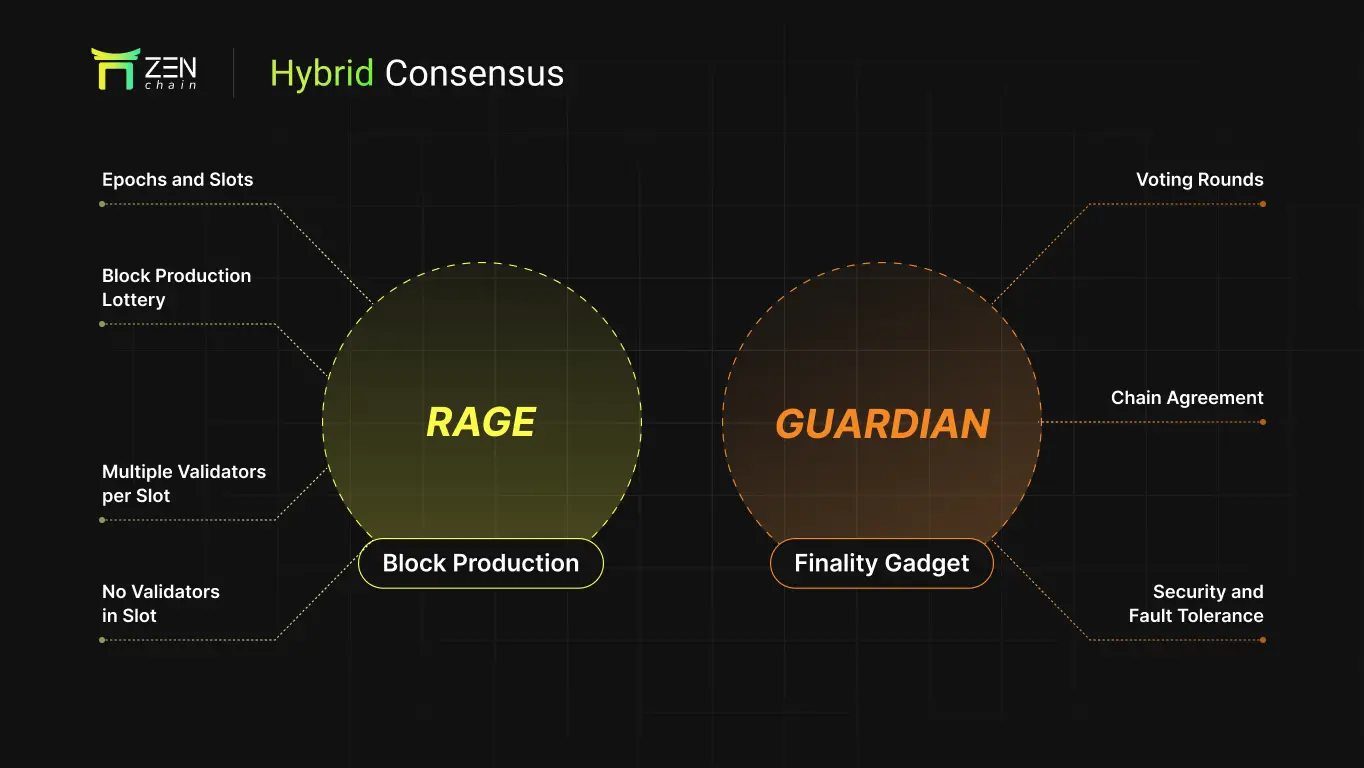
Zenchain adopts a hybrid consensus model, using RAGE for block production and GUARDIAN for finality confirmation, combining the advantages of probabilistic finality and provable finality to achieve irreversible secure consensus while ensuring high performance.
Hybrid Consensus Design
Probabilistic Finality (RAGE): Ensures blocks can be continuously and quickly produced, preventing the network from stalling due to consensus.
Provable Finality (GUARDIAN): Finalizes the blockchain state through validator voting, making blocks irreversible once finalized.
This division allows Zenchain to balance high throughput and strong security.
Block Production: RAGE
Epoch and Slot: The network operates in Epochs, each containing multiple slots of about 6 seconds.
Random Block Production: Each slot determines which validators are eligible to produce blocks through a random lottery.
Multi-validator Block Production: If multiple validators are selected in the same slot, they produce blocks simultaneously, with the fastest propagating block being accepted.
No Validator Backup Mechanism: If no one is selected in a slot, a polling mechanism is activated to ensure uninterrupted block production.
Finality Component: GUARDIAN
Voting Finalization: Validators vote in multiple rounds, and when more than 2/3 of validators confirm a chain, that chain and its previous blocks are finalized at once.
Chain-level Finality: Unlike block-by-block confirmation, GUARDIAN reaches consensus on the entire chain, allowing for quick recovery even during network fluctuations.
Security: In partially synchronized networks, finality can be achieved as long as 2/3 of validators are honest, tolerating a certain proportion of Byzantine nodes.
Fork Selection and Coordination Mechanism
RAGE continues to produce blocks on top of the chain head that GUARDIAN has finalized, forming clear fork selection rules to avoid the network following erroneous forks while overcoming potential stalling issues in purely finality systems.
2. Staking Mechanism
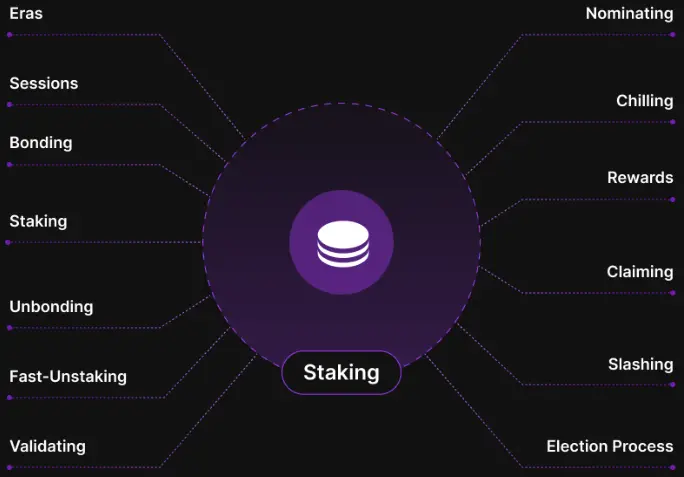
Positioning: Staking is the core of Zenchain's cross-liquidity consensus mechanism (CLCM), securing the network by locking ZTC tokens and incentivizing participants.
Cycle Structure:
Era: Approximately 6 hours, settling rewards and penalties for validators and nominators.
Session: Sub-cycles within an Era (approximately 1 hour) for rotating validators and assessing performance.
Participation Methods:
Bonding: Locking ZTC to participate in consensus.
Staking: Participating in the network as a validator or nominator.
Unbonding: Exiting staking, requiring a lock-up period.
Fast-Unstaking: Can exit quickly under specific conditions, requiring a deposit.
Role Distribution:
Validators: Produce blocks, validate transactions, and participate in finality voting, earning rewards based on performance, with violations leading to Slashing.
Nominators: Delegate stakes to support validators, sharing earnings and bearing joint risks.
Auxiliary Mechanisms:
Chilling: Temporarily stop participating in staking without unlocking assets.
Rewards: Distributed based on actual performance within the Era, unrelated to staking scale.
Claiming: Rewards must be actively claimed.
Slashing: Penalties for malicious or low-performance behavior.
Election Mechanism:
Uses the Phragmen algorithm to select and balance the validator set at the start of each Era.
3. Runtime Mechanism
Overall Positioning: Zenchain's runtime is compatible with both the Ethereum ecosystem and native BARK modules, supporting the development of various types of dApps.
EVM Compatibility:
Integrates SputnikVM to execute Ethereum-compatible smart contracts
Supports Ethereum JSON-RPC
Existing Ethereum dApps can be deployed directly without modification
Native BARK Modules (Wasm Modules):
BARK modules based on Wasm
Natively run on-chain, high performance, and strong flexibility
Supports direct integration of complex functions into the runtime
Precompiles:
Connect EVM with native BARK modules
Provide native functionality access for EVM
Achieve efficient cross-VM interaction
JSON-RPC Interface:
Unified client interaction entry
Supports both Ethereum and BARK-specific methods
Covers contract deployment, querying, transactions, state management, and other operations
- Cross-Chain Interoperability
Overall Design
Core Module: Cross-Chain Interoperability Module (CCIM)
Features: Chain-agnostic, unified management of cross-chain inbound and outbound transactions
Goal: Achieve secure and efficient interoperability between Zenchain and multi-chains like Ethereum and Bitcoin
Advantages:
Abstracts the complexity of different chains
Provides standardized interfaces
Highly scalable and adaptable
Incoming Cross-Chain Transactions
Process Overview:
- Transaction Detection and Monitoring
- Continuously monitor transactions on external chains pointing to Zenchain
- Transaction Verification
- Use chain-specific verification methods (light clients, proof mechanisms, etc.)
- Data Abstraction and Standardization
- Convert to a format that Zenchain can uniformly process
- Transaction Storage and State Recording
- Secure on-chain storage, ensuring traceability
- Execution and State Transition
- Execute corresponding operations on Zenchain (minting, state updates, etc.)
- User Transparency
- Provide query interfaces to track transaction status
Outgoing Cross-Chain Transactions
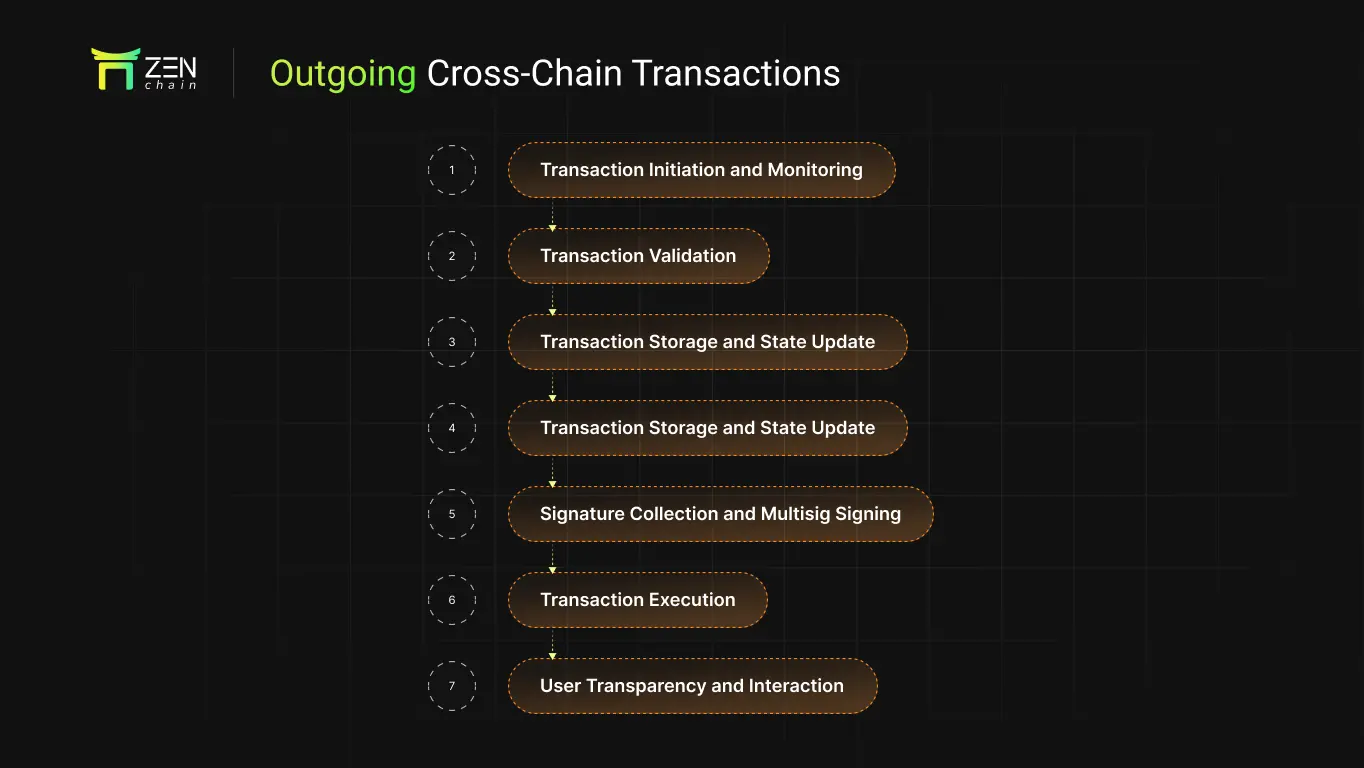
Process Overview:
- Transaction Initiation and Monitoring
- Listen for events on Zenchain that trigger cross-chain actions
- Transaction Verification
- Verify compliance with cross-chain rules and authorization conditions
- Data Abstraction and Transformation
- Convert to a data format recognizable by the target chain
- Transaction Storage and State Recording
- Record cross-chain transaction information on Zenchain
- Multi-signature Collection
- Zenchain validators complete signatures through multi-signature accounts
- Transaction Execution
- Complete asset transfers or contract calls on the target chain
- User Transparency
- Support queries for cross-chain execution progress and results
- Niō AI
Overall Positioning
Niō is Zenchain's built-in AI-driven security guardian system
Through decentralized AI + real-time monitoring, it identifies and defends against threats before they escalate
The goal is to provide continuous, adaptive chain-level security protection for Zenchain
Core Capabilities
Real-time security monitoring: Continuously scans on-chain activities and ecosystem behaviors
Decentralized security intelligence: Avoids single points of failure
Machine learning + heuristic analysis: Responds to evolving attack methods
Proactive defense: Intervenes before or early in an attack
Niō Guardians (Modular Security Guardians)
Niō adopts a modular design, allowing for flexible expansion of new Guardians based on attack types.
Deployed core Guardians include:
Scam Guardian: Identifies and warns against new types of scams
Attack Guardian: Real-time detection and mitigation of protocol-level attacks
Spam Guardian: Filters out spam tokens and NFTs, maintaining ecosystem quality
Rug Pull Guardian: Identifies malicious code patterns to prevent rug pulls
Sybil Guardian: Defends against Sybil attacks, ensuring the integrity of the identity system
Tron Comments
Zenchain's advantage lies in its integrated Layer 1 design centered on cross-chain interoperability: through CLCM consensus and the hybrid mechanism of RAGE + GUARDIAN, it achieves provable finality while ensuring fast block production; simultaneously, it natively supports EVM and integrates Wasm/BARK runtimes, allowing Ethereum applications and native modules to coexist efficiently; CCIM provides standardized, bidirectional cross-chain capabilities covering multiple ecosystems like Bitcoin and Ethereum; combined with Niō AI's real-time security guardianship, the network possesses differentiated advantages in security and maintainability.
Its potential disadvantages include high architectural complexity (multiple consensus components, multiple runtimes, multiple cross-chain modules), imposing greater demands on validators, developers, and early governance of the ecosystem, and the long-term stability and cost efficiency of cross-chain and AI security capabilities still require time to validate under large-scale real loads.
# III. Industry Data Analysis
1. Overall Market Performance
1.1. Spot BTC vs ETH Price Trends
BTC
ETH
2. Summary of Hot Sectors
# IV. Macroeconomic Data Review and Key Data Release Nodes for Next Week
Important macroeconomic data to be released this week:
February 10: U.S. December Retail Sales Month-on-Month
February 11: U.S. January Unemployment Rate; U.S. January Seasonally Adjusted Non-Farm Payrolls
February 13: U.S. January Unadjusted CPI Year-on-Year
# V. Regulatory Policies
China: Comprehensive Risk Prevention Notice Issued
On February 5, 2026, eight Chinese ministries jointly issued a notice on further preventing and addressing risks related to virtual currencies, upgrading regulatory measures comprehensively.
Core of the Policy: The notice explicitly prohibits all business activities related to virtual currencies and the tokenization of real-world assets, classifying them as illegal financial activities, and requires financial institutions, payment institutions, and internet companies to refrain from providing any related services.
New Regulatory Targets: In addition to virtual currencies, it is the first time that the tokenization of real-world assets has been explicitly included in the comprehensive prohibition scope, and strict regulation is imposed on domestic entities conducting related businesses abroad.
Law Enforcement Coordination: Emphasizes the establishment of a collaborative working mechanism between central and local authorities to crack down on related illegal financial and criminal activities.
United States: Legislative and Regulatory Coordination Progress
This week, the U.S. made clear progress in crypto legislation and regulatory coordination.
Legislative Process: On January 29, the Senate Agriculture Committee passed its version of the Digital Asset Market Structure Act by a vote of 12 to 11. This bill aims to expand the U.S. Commodity Futures Trading Commission's regulatory authority over the spot cryptocurrency market and still needs to be coordinated with the Senate Banking Committee's version of the bill.
Administrative Coordination: On February 2, the White House Crypto Policy Committee convened representatives from the cryptocurrency and traditional financial sectors to discuss pending issues such as market structure legislation and stablecoin yields.
Regulatory Cooperation: The U.S. Securities and Exchange Commission and the Commodity Futures Trading Commission announced they would jointly advance the "crypto project" to coordinate regulatory approaches to the digital asset market and reduce uncertainties arising from jurisdictional ambiguities.
European Union: Promoting the Implementation of Tax Transparency Directive
At the EU level, efforts are underway to push member states to implement existing crypto tax transparency rules.
Violation Handling: On January 30, the European Commission confirmed that 12 member states (including Belgium, Spain, the Netherlands, etc.) failed to timely transpose the DAC8 Directive into domestic law. This directive requires crypto asset service providers to report customer transaction information to tax authorities. The EU has initiated infringement procedures, requiring these countries to complete the transposition within two months.
Goal: This move aims to ensure the automatic exchange of crypto asset tax information across the EU to combat tax evasion.
Global Level: G20 Calls for Multilateral Regulatory Cooperation
- In the joint communiqué issued after the G20 finance ministers and central bank governors meeting held in early February, leaders from various countries called for international standard-setting bodies like the Financial Stability Board to monitor risks associated with crypto assets and consider taking multilateral responses. They also emphasized their expectation for the Financial Action Task Force to pass its new guidelines on crypto assets by the end of the month.
 Risk warning



Popular articles





