








The generation of the payment empire PayPal may be bought
 Core Viewpoint

 This giant, which once rewrote global payments and created a generation of entrepreneurial moguls, is no longer glorious. Just as it hits rock bottom, the hunters have already caught the scent of blood.
Author: Zhi Wubuyan
Around 2006, a group of small foreign trade bosses in Guangdong and Fujian began exploring opening stores on eBay. They sat in small offices next to factories, doing business with strangers on the other side of the globe using broken English.
The hardest part was not the language, nor the logistics, but the money—how to ensure that an American buyer could safely send money to a Chinese seller?
What made this possible was a blue button. That button was called PayPal.
At that time, PayPal represented the forefront of financial democratization and the most advanced productivity. According to the "Website Payments Standard Integration Guide," small and medium-sized businesses worldwide only needed to input a piece of HTML code on their webpage to receive payments globally.
This technological equality, combined with the foundation laid by eBay's only officially recommended payment method, made PayPal the undisputed global payment leader. Even today, when you open any overseas checkout page, there is sure to be a place for PayPal.
 Twenty years have passed. Many of those small foreign trade bosses have grown from eBay store owners into cross-border merchants flourishing on independent sites, Amazon stores, TikTok, and Temu. China's cross-border e-commerce export scale has exceeded 2 trillion RMB, and payment tools have blossomed from a blue button into a variety of options like Stripe, Wise, Lianlian, and Wanlihui.
The industry has grown, but PayPal has somewhat fallen behind.
Three weeks ago, on February 3, PayPal announced its financial report, with its stock price plummeting 20% in a single day, and the CEO resigned in disappointment. The main source of profit, branded checkout, saw its active user growth rate drop from a previously high trajectory to just 1%, and the transaction volume of active accounts decreased by 5% over the past 12 months.
Whether it's Stripe's one-click link payment, Apple's biometric verification with Apple Pay, or even just using Google to autofill credit card information, it seems much more convenient than that slightly outdated blue icon interface, which one might struggle to remember the login password for.
It was once a legend created by people like Musk, Peter Thiel, and Hoffman. Pelosi once held a significant stake, and Cathie Wood was one of its most loyal supporters, but they all chose to liquidate their positions.
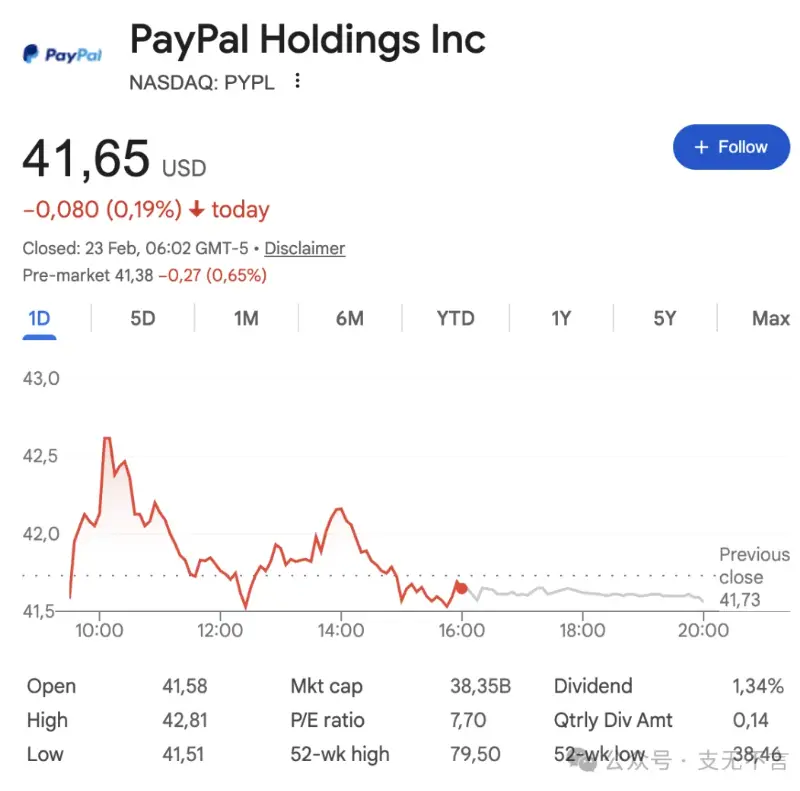
PayPal's market value has dropped from a peak of $363 billion during the pandemic to a recent low of $38 billion—over five years, evaporating by 90%, with a P/E ratio dipping to as low as 7.4. It wasn't until Bloomberg reported today that at least one large competitor is evaluating an overall acquisition, and several parties have expressed interest in some of its assets, that the stock price rose nearly 10%.
This news itself is the most accurate commentary on PayPal's situation. When a company starts to be viewed as prey rather than a predator, and its market value rises as a result, it indicates that the market's confidence in its independent operation is lower than the expectation of being acquired.
 The once-great payment empire is like the aging British Empire; its flags are still planted around the world, the sun has not yet set, but those who see it no longer gaze upon it with the same awe as before. Everyone knows deep down that the times have changed. But how exactly did it fall from grace?
"Watching a company I love so much come to this point is truly painful."
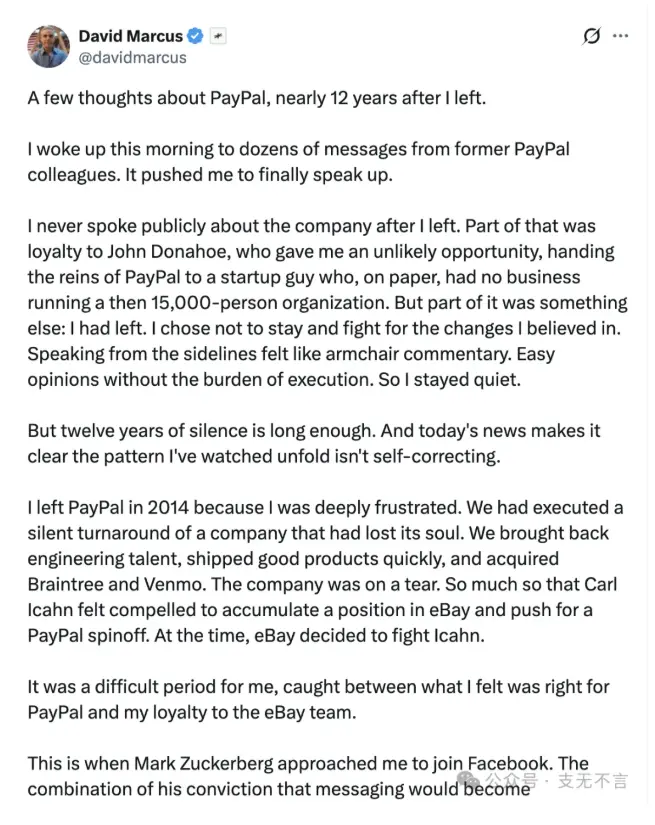
On February 3, former PayPal President David Marcus published a lengthy post on X, rarely and fiercely criticizing the company he had devoted himself to.
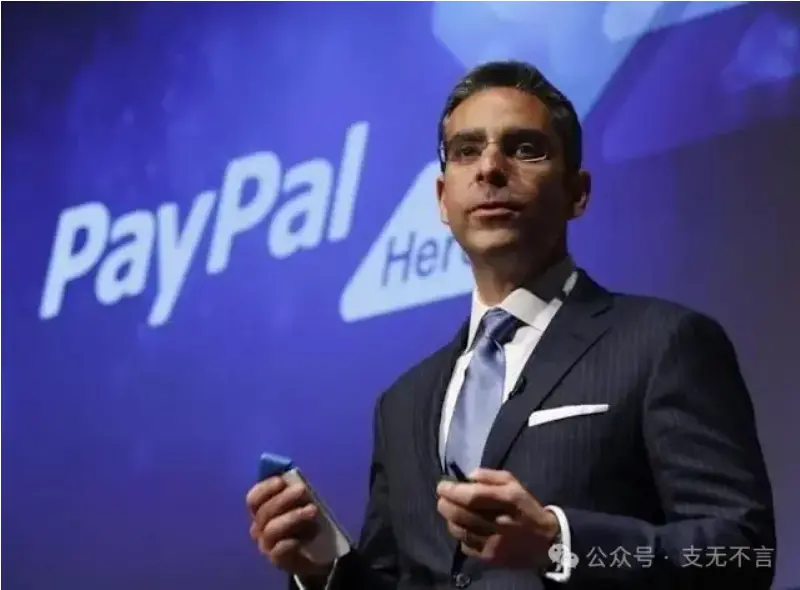 David Marcus's career has always been accompanied by radical financial innovation. He is currently the CEO of LightSpark, a Bitcoin Lightning Network payment company. During his time at PayPal, he recruited top engineering talent and led the acquisitions of Braintree and Venmo; at Facebook, he was one of the leaders of the sensational stablecoin project Libra. Although Libra failed due to regulatory issues, today's stablecoin craze is enough to prove David's foresight and boldness.
In addition to the stock price crash, another reason that prompted David to issue this long post was the resignation of former CEO Alex Chriss, who left after less than three years in office, with former HP CEO Enrique Lores taking over.
Enrique Lores served as CEO of HP for seven years, introducing a profitable printing-as-a-service model and launching a large-scale layoff plan. He is undoubtedly a master of cost reduction and business restructuring. If the PayPal board had already considered the overall or partial sale of PayPal, this choice of candidate would seem even more reasonable.
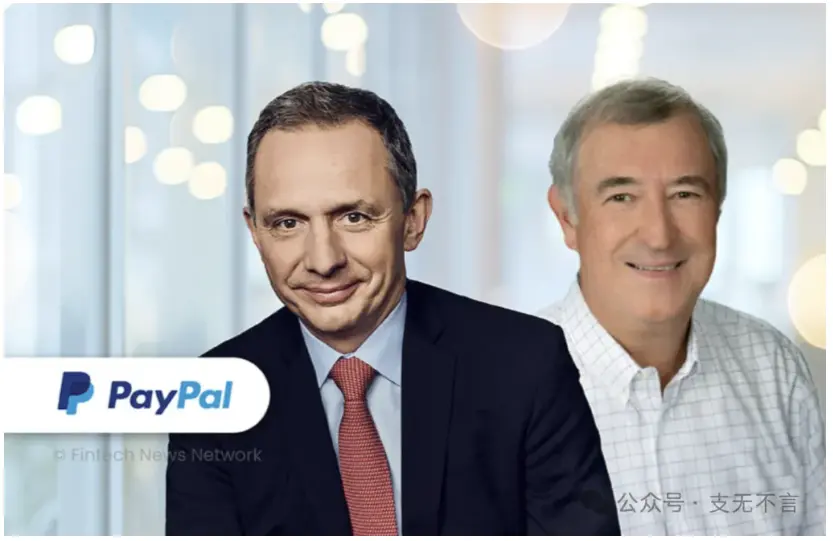 David subtly expressed his dissatisfaction: "I don't know Enrique. He might be a great leader, but at least from the information on paper, he is an executive from the hardware industry, now parachuted into a payment company."
This echoes David's core criticism. Unlike the market voting with its feet due to poor financial performance, David believes that PayPal's Achilles' heel lies in—"the company's leadership style has completely shifted from 'product-driven' to 'finance-driven.' Over time, the belief in products has given way to financial optimization."
Paraphrasing a famous quote from Benjamin Franklin: any company that sacrifices products for short-term stock performance will ultimately fail to keep up with the trends of the product era and will also lose its stock price.
David believes PayPal has lost its "mojo." This was a spirit from the PayPal mafia era, a wild force willing to turn the office roof upside down to solve an impossible problem. But today, this force has been replaced by compliance reviews and financial optimization.
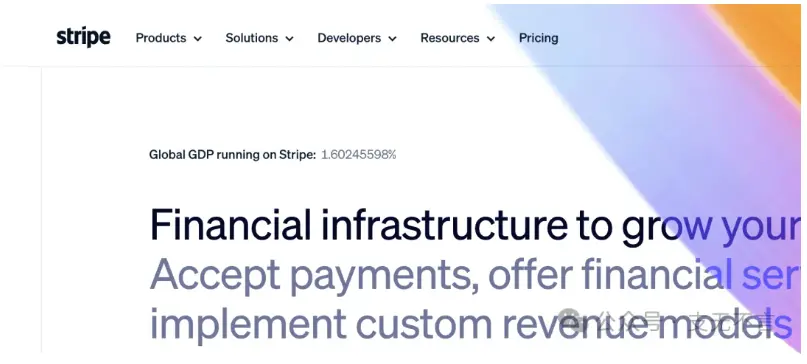
Stripe, which conquers developers with its simple API, has that mojo. Opening Stripe, the constantly pulsating "Global GDP running on Stripe" in the upper left corner embodies a conqueror's spirit.
In recent years, Apple's Pay has vigorously promoted Passkey, embodying that mojo. Relying on underlying security chips and Face ID, it has made the payment experience extremely comfortable—just raise your wrist, scan your face, and complete the transaction without even opening the app. This is something PayPal, which still lingers in the three-step experience of page redirection, reauthorization, and waiting for confirmation, cannot achieve.
Revolut, a representative of neobanks, has that mojo. With strong execution, this emerging company has quickly built a full-stack financial platform covering stocks, currency exchange, and cryptocurrencies across dozens of countries, and it continues to expand aggressively. These three companies share a commonality: their mojo does not come from scale, user numbers, or even money. It comes from a belief in their products: believing that what they are doing will make a difference in some corner of the world.
And this is just the tip of the iceberg. Shop Pay, Klarna, Affirm, Afterpay, Wise, Cash App, Adyen—every niche in the payment track is crowded with competitors.
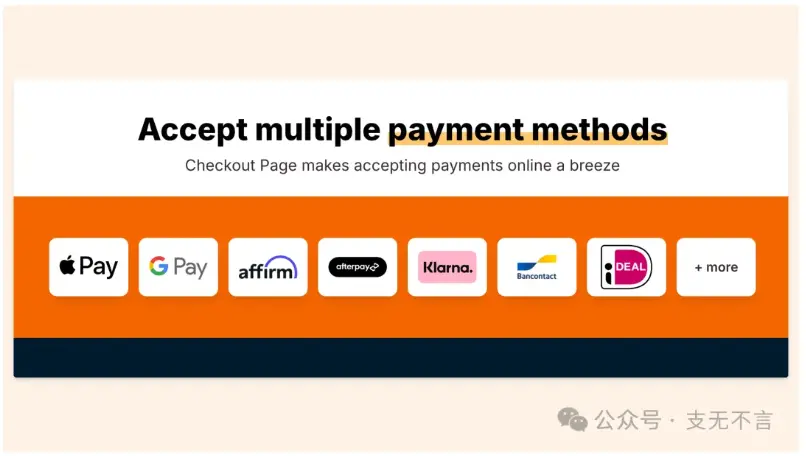
PayPal once had this kind of thing. That HTML code, that blue button enabling an American uncle selling second-hand goods in his garage and a small factory owner in Guangzhou to complete cross-border settlements, was itself a declaration of changing the world. But the process of losing it was quiet, almost silent.
When discussing PayPal's development over the years, one cannot overlook Venmo.
Venmo did one thing right: it turned transfers into a social activity—splitting the bill, sharing rent, sending an emoji to friends is much more fun than a bank transfer. Its spread among young people in the U.S. resembles a social app rather than a payment tool. "Venmo me" has even become a verb, synonymous with transferring money among young Americans.
 PayPal's acquisition of Venmo was actually a byproduct of acquiring the payment service provider Braintree. This product, which was not very prominent at the time, is now a bright spot in PayPal's lackluster financial report: projected revenue of $1.7 billion in 2025, over 100 million monthly active accounts, a 50% year-on-year increase in Pay with Venmo transaction volume, and a 40% growth in debit card users.
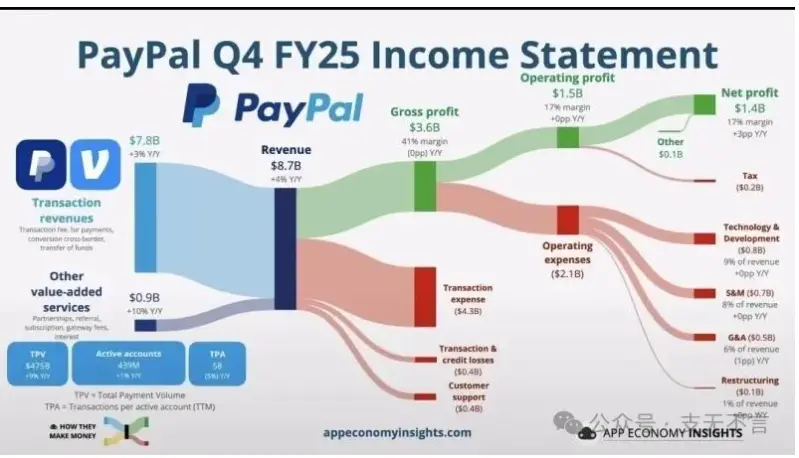
However, behind these numbers, several deep-seated issues are fermenting: those who are optimistic about it are obsessed with the doubling debit card transaction volume, believing that this cash cow is entering a monetization harvest period; while those who are worried will question if this prosperity is merely draining the remaining social circles, how long can this afterglow last?
This rift essentially reflects Venmo's entrapment in an ecological niche: upward, it cannot breach the hard wall built by Apple Pay and Google Pay; downward, it cannot penetrate the underlying networks deeply embedded by Stripe and Adyen. Venmo's growth is strong, but the ceiling is also very apparent.
First is the internal friction of the growth model. Behind the 20% revenue growth rate is only a 7% increase in active users—Venmo is no longer expanding its territory but taxing its own people, squeezing the same batch of users more fully without attracting a new generation.
Secondly, there is a dual dilemma of geography and product soul. Venmo has always been locked in the U.S. market, capturing the American dining table but has yet to step into the world's cash registers.
Finally, there is a temporary failure of the all-scenario financial imagination. In the business closed loop designed by PayPal for Venmo, there is also a shopping plugin called Honey, which was supposed to connect the "discovery-checkout" chain. However, in 2024, Honey nearly collapsed due to a scandal involving tampering with affiliate links, severing this flow pipeline and discounting Venmo's transformation journey.
How can an independent consumer payment app prove itself worthy of users actively opening it? This is a question Venmo is striving to answer, but the answer has yet to be revealed.
Venmo reflects PayPal's anxiety on the consumer side. On a further frontier, PayPal has also bet on two other cards—one called PYUSD and the other called Agent payment. The commonality of these two cards is that the market is large enough, but the odds of success have yet to be determined.
Objectively speaking, PYUSD has not performed poorly. Since its launch in 2023, it has reached a market size of $4 billion, firmly ranking among the top ten stablecoins globally. However, compared to Tether's approximately $180 billion USDT and Circle's approximately $70 billion USDC, PYUSD's size can only be considered a fraction.
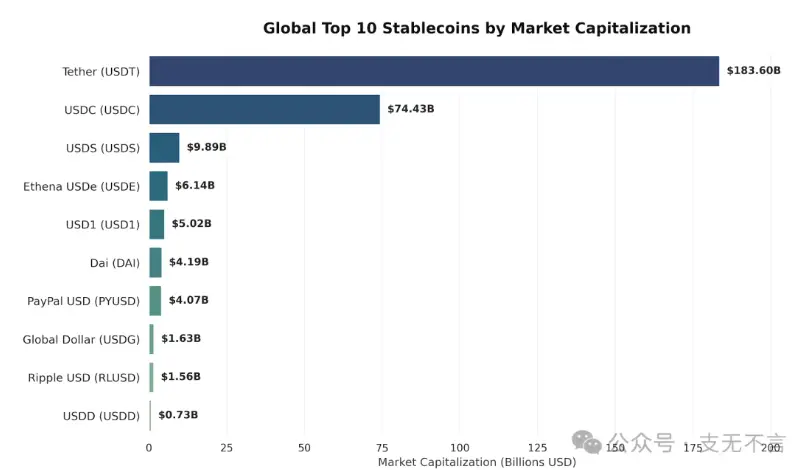
It instead proves one thing: even if everyone can issue stablecoins, the barriers to channel distribution and user mindset remain high, and even a giant like PayPal cannot expect to achieve a dimensionality reduction attack.
In April 2025, when PayPal announced a 4% annual interest for PYUSD holders, the industry was once shocked that the giant was about to kill the competition. However, the development of things is gradual. The current trillion-level usage of stablecoins mainly comes from crypto trading hedging, cross-border arbitrage, and gray market fund transfers, DeFi lending, LP, and yield farming's underlying assets, which are not PYUSD's strengths.
In the future, the use scenarios for stablecoins will certainly become more mainstream and everyday, such as cross-border B2B payments, on-chain settlements, and daily retail. However, competition is also extremely fierce, not to mention the two giants USDT and USDC, innovative-oriented USDe and USD1 backed by the Trump family are also formidable competitors, and PYUSD does not have a solid winning chance.
Beyond stablecoins, PayPal is also focusing on agentic payment. They have abandoned error-prone web crawlers and instead integrated with merchants' order management systems via API. Merchants only need to sign an agreement, and PayPal can distribute their real-time data on inventory, colors, prices, etc., to mainstream AI platforms like Google Gemini and PayPal's own app.
The idea is clear, but this is a market yet to be validated. Recently, Qianwen offered red envelopes to treat everyone to milk tea, serving as a market education for domestic consumers on AI shopping. However, changing consumer habits is not an overnight task, and whether chatting with AI to shop will become mainstream or whether the primary shopping experience lies in slowly comparing products remains an unknown.
Even if in the future people really get used to saying to ChatGPT, "Help me buy a cup of iced three-sweet oolong tea," the ones controlling the transaction retention data will still be the AI platforms with massive user bases, which are likely to have their own proprietary payment methods or share the benefits. In this new chain, PayPal's position remains questionable.
After discussing so much loss and uncertainty, you might think that PayPal's story has reached a conclusion.
But the reality is never one-sided. Braintree remains the underlying payment engine for many global platforms. Pay Later processed over $40 billion in transactions in 2025, leading the BNPL market in the U.S. The Fastlane one-click checkout launched in August 2024 is one of its rare proactive moves, directly challenging Apple Pay and Shop Pay. Coupled with 400 million active accounts and over $6 billion in free cash flow annually—these assets are strategic tickets that any company looking to position itself in the AI agency economy would find hard to replicate from scratch.
Nearly thirty years of accumulation has not been in vain and will not disappear into thin air. It’s just a pity that the great river flows eastward, washing away the past.
The ones who best understand how to use this ticket may no longer be PayPal itself.

 Risk warning


Popular articles





