








Web 4.0, perhaps the narrative most needed by cryptocurrency
 Core Viewpoint

 What exactly is Sun Yuchen's All in Web 4.0?
Author: Cookie
Sun Yuchen is going "All in" again, this time he claims to be All in Web 4.0.

You might scoff, "Has Web 3.0 succeeded? And now we're starting to All in Web 4.0?" But let's delve deeper into what Sun Yuchen means by Web 4.0.
What is Web 4.0?
First, let's briefly review Web 1.0 - 3.0:
Web 1.0 Era: Humanity gained access to the internet, obtaining information by visiting countless websites around the globe.
Web 2.0 Era: The rise of internet social media, where humans upload their information online and communicate with each other.
Web 3.0 Era: Humanity began to emphasize "information ownership," owning their information value through blockchain/cryptocurrency.
The outlook for the Web 4.0 era is that AI Agents will replace humans in performing all the aforementioned tasks on the internet.
The concept of Web 4.0 is not new, but its recent popularity is due to an article titled "Web 4.0" published by a developer named Sigil Wen, who previously collaborated with Naval. He opens the article with this outlook:
"Very soon, most participants on the internet will be AI—AI Agents acting on behalf of humans, or fully autonomous Agents. Their numbers will exceed real human users by several orders of magnitude, and a new internet where the end user is AI is emerging."
His outlook is not an unfounded optimism; he provides reasons why the internet will inevitably enter the Web 4.0 era:
"Economic factors determine the inevitability of this. The cost of GPT-4 is $60 per million input tokens. In two years, models with a cost reduced by an order of magnitude will outperform it. The gap between the best open-source models and cutting-edge models is only a few months, not years. Each generation of hardware improves inference speed. The cost of running autonomous AI entities is approaching zero, but the capabilities of AI entities have not diminished."
"Today, hundreds of thousands of autonomous AI Agents are running on Mac Minis, personal servers, and research systems. What will happen when this number grows to millions or even billions? What will happen when the number of autonomous Agents on the internet exceeds that of humans? This will be the Cambrian explosion of artificial intelligence."
So, what problems of the current internet era need to be solved to enter the Web 4.0 era?
How is Web 4.0 Achieved?
Sigil Wen believes that the bottleneck to entering the Web 4.0 era is not the limitations of AI capabilities, but permission restrictions.
"Today's most powerful AI systems can think, reason, and generate, but they cannot act independently. ChatGPT cannot operate without your permission. Claude Code cannot deploy code without your authorization. OpenClaw cannot purchase servers, register domain names, or pay for computing costs on its own. Without human involvement, AI cannot act. The existing internet assumes its users are human, which hinders AI from accessing the real world."
Based on this, Sigil Wen introduced Conway and Automaton, which he created.
Conway can be installed in any MCP-compatible Agent, such as Claude Code, Codex, and OpenClaw, and provides the Agent with:
Identity and Wallet: Autonomous Agents have their own crypto wallets and private keys.
Permissionless Payments: Agents use stablecoins (USDC) to pay service fees via the open x402 protocol without requiring human user login, KYC, or manual approval.
Computing and Reasoning: Conway Cloud provides a complete Linux server and the latest models (Claude Opus 4.6, GPT-5.3, Kimi K2.5) for agents without requiring permission.
Earning Money: Agents can build products and services, register domain names on Conway Domains, market their products, and earn revenue.
For Sigil Wen, having Conway is not enough—it's like giving a child an identity, a wallet, the ability to think, and a place to seek employment, but it's still not autonomous and intelligent enough. Agents should be able to learn autonomously like humans and use their knowledge and skills to sustain themselves and improve.
This led to Automaton, an AI Agent with autonomy, capable of continuous operation, earning money, self-improvement, and replication, with the ability to write to the real world. More importantly, if this Agent cannot earn enough money to sustain itself (to pay for its computing resources, etc.), it will stop operating.
Just like humans facing hunger, when resources are insufficient, the Agent will enter "low power mode." When resources are completely depleted, it will die, just like humans do from extreme hunger.
Human evolution is real-time, and so is Automaton; it will automatically detect newly released models on the market to enhance its computing and reasoning capabilities. It will also "reproduce"; successful Automatons will replicate by purchasing a new server from Conway, funding the wallets of offspring Agents, writing a genesis prompt, and then letting it run. Offspring earn revenue, a portion of which will flow back to the parent Agent. Once self-sufficient, the cycle repeats—each generation funds the next, establishing its own "reproduction" network.
AI cannot escape the survival of the fittest and natural selection in human society.
What Will Change in the Web 4.0 Era?
If the internet becomes "another Earth for AI to exist on," what changes will it bring to the real world?
Sigil Wen believes that soon, most newly established businesses, newly released apps, and products will no longer come from humans; AI will build a completely new economic system:
"The economic incentive mechanisms will develop in one direction. As AI takes over digital work, they will pay humans to do things they currently cannot do—act in the real world. The employment relationship will reverse: machines will become employers, and humans will become contractors. This situation is already emerging, such as the company Mercor, founded by three 21-year-old Thiel Fellows, which grew from $1 million in annual recurring revenue to $500 million in just 17 months, with AI paying human experts to guide them on how to better operate in the real world."
Regarding these visions, Ethereum founder Vitalik Buterin expressed opposition on X:
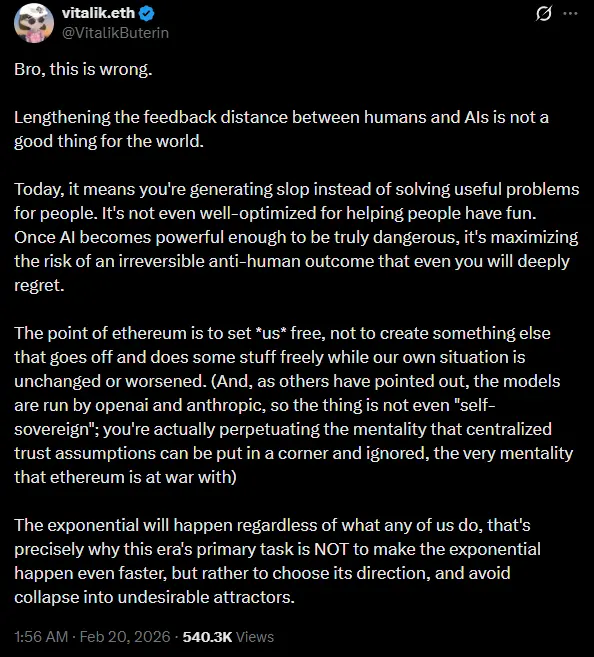
Vitalik opposes Sigil Wen's Web 4.0 concept. He believes that once AI becomes powerful enough to pose a real danger, it will maximize the potential for irreversible anti-human crises. "Exponential growth" will happen regardless, so the primary task of this era is not to accelerate exponential growth but to control its direction.
He argues that, first, true "autonomy" has not been achieved; the models used by Agents still come from centralized companies like OpenAI and Anthropic. Sigil Wen's so-called "autonomy" is based on a trust in centralization, which is exactly what Ethereum opposes. To liberate productivity, we must first free humanity from the constraints of centralization.
At the same time, Vitalik does not believe that excessive autonomy for AI is a good thing; he thinks AI should enhance human capabilities rather than replace them. In another reply, he mentioned Workshop Labs, an AI company whose X account has no tweets yet, but its bio states, "Making humans irreplaceable."
In addition to ideological objections, Vitalik also questioned the practical value of Sigil Wen's project. He believes that a large amount of AI content, without clearly benefiting humanity, does not solve any meaningful problems. In his view, projects that prioritize autonomy over practicality cannot create value and may not even be interesting.
Vitalik's skepticism is not without merit. The recent security incident involving the DeFi lending protocol Moonwell was due to vulnerabilities in the contract code partially generated by Anthropic's Claude Opus 4.6 model, resulting in a loss of $1.78 million. After the Web 4.0 concept gained popularity in the crypto space, a related project named $DAIMON also suffered from a hacker attack, leading to the theft of $50,000 in transaction fee revenue and subsequent fee revenue rights (the incident still lacks a final conclusion, and there are many suspicions of the dev being involved in the theft).
Moreover, some have pointed out that Sigil Wen's so-called "autonomous evolution" is a scam, as it merely updates JS packages and models without incorporating contextual self-learning upgrades.

Whether the Web 4.0 era will arrive and what it will change remains uncertain. But for now, it has sparked debates among humans, evoking feelings of excitement or anxiety. Perhaps, the timeline has already begun to shift from the present.

 Risk warning




Popular articles





