








It's 2026, how should we reasonably assess the market value of L1?
 Core Viewpoint

 Due to the structural characteristics of open permissionless networks, the transaction fees and MEV income of L1 public chains such as Bitcoin, Ethereum, and Solana are being systematically arbitraged and continuously diverted by new model systems within the ecosystem.
Author: Pine Analytics
Compiled by: Ken, Chaincatcher
Core Argument
Layer 1 public chains (L1) cannot sustainably and massively acquire stable fee revenue in the long term. From transaction fees to maximum extractable value (MEV), every major source of revenue they have generated has been systematically arbitraged and depleted by participants within the ecosystem. This is not an execution issue of any specific public chain, but rather a structural characteristic of open permissionless networks: once the revenue scale of L1 becomes significant enough, competitive forces in the market will squeeze or even eliminate this portion of revenue through new models.
Bitcoin, Ethereum, and Solana are the three most successful networks in the crypto industry. Despite handling asset flows worth tens of billions, they all follow the same trajectory: fee revenue initially experiences explosive growth, attracting market attention, only to be continuously siphoned off by layer 2 networks, private order flows, MEV-aware routing, or application layer innovations. This pattern has repeatedly appeared in every evolution of mainstream fee mechanisms, MEV structures, and scaling paradigms in the history of the crypto industry, with no signs of slowing down.
This article argues that the compression of L1 fees is permanent and accelerating. It will break down the specific new models that compress L1 profit margins at various stages and analyze the impact of this trend on L1 tokens that still incorporate long-term fee-generating capabilities into their valuations.
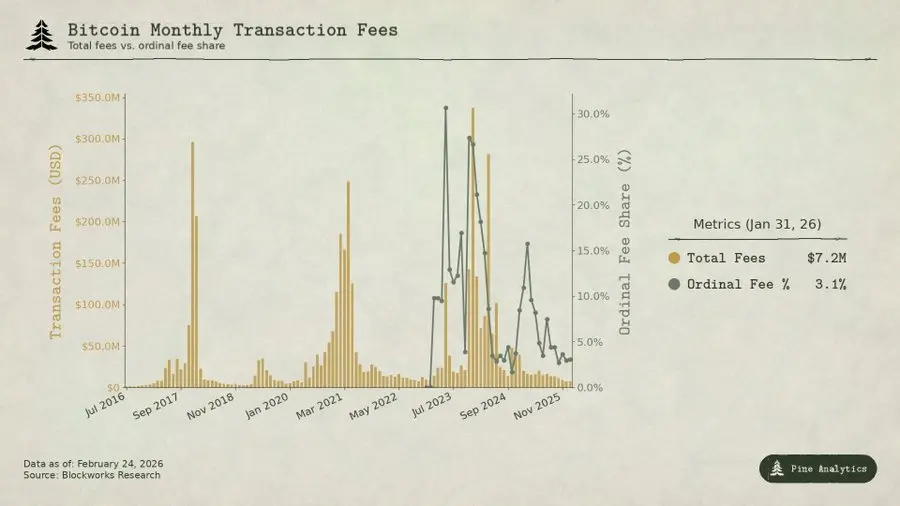
Bitcoin
Bitcoin's fee revenue is almost entirely derived from congestion caused by on-chain demand. With no smart contracts, MEV essentially does not exist. The problem is that whenever the price of Bitcoin rises, driving its fees to soar, the increase in fees tends to diminish sequentially despite the increase in economic activity.
In 2017, Bitcoin's price skyrocketed from $4,000 to $20,000, a fivefold increase. Average fees rose from below $0.40 to over $50. At the peak on December 22, fees accounted for 78% of miners' total block rewards: about 7,268 Bitcoins, nearly four times the block subsidy. However, the good times did not last long, as fees plummeted by 97% within three months.
The market reacted swiftly. By early 2018, the adoption rate of Segregated Witness (SegWit) was only 9%, rising to 36% by mid-year; despite such transactions accounting for over a third, they contributed only 16% of the total fees across the network. Exchanges adopted batching techniques, merging hundreds of withdrawals into a single transaction. These measures collectively reduced fees by 98% within six months. The Lightning Network was launched in early 2018. Other chains wrapped BTC in a way that allowed users to gain exposure to Bitcoin assets without interacting with the base layer.
By the peak in 2021, despite Bitcoin's price reaching $64,000, monthly fees were lower than in 2017. The number of transactions was even lower. However, the transaction volume in dollar terms was 2.6 times higher than before. The value transferred on the network was greater, but the fees collected remained flat or even lower.
The current cycle makes this trend undeniable. Bitcoin's price surged from $25,000 to over $100,000, a fourfold increase. However, standard transfer fees never soared as they did in previous cycles. By the end of 2025, transaction fees had dropped to about $300,000 per day, less than 1% of miner revenue. Bitcoin's total fee revenue in 2024 was $922 million, but primarily derived from Ordinals and Runes activities, rather than traditional transfer business.
By mid-2025, spot Bitcoin ETFs had accumulated over 1.29 million Bitcoins (about 6% of the total supply), meeting the market's huge demand for 'zero on-chain fee' Bitcoin exposure. The demand for users to interact with the main chain to acquire Bitcoin assets has essentially been eliminated.
In April 2024, the fees from Ordinals and Runes surged, temporarily pushing miner revenue to 50%, but as trading tools matured, this proportion had fallen back to below 1% by mid-2025. Such revenue is essentially closer to MEV rather than congestion premium: it stems from early inefficiencies and friction in new asset infrastructure, rather than genuine demand for Bitcoin's settlement functionality.
This pattern repeats itself: whenever Bitcoin's fee revenue reaches a significant scale, the ecosystem builds low-cost alternatives. L1 can only capture a one-time fee spike from each wave of new demand, and then faces profit compression brought about by innovation.
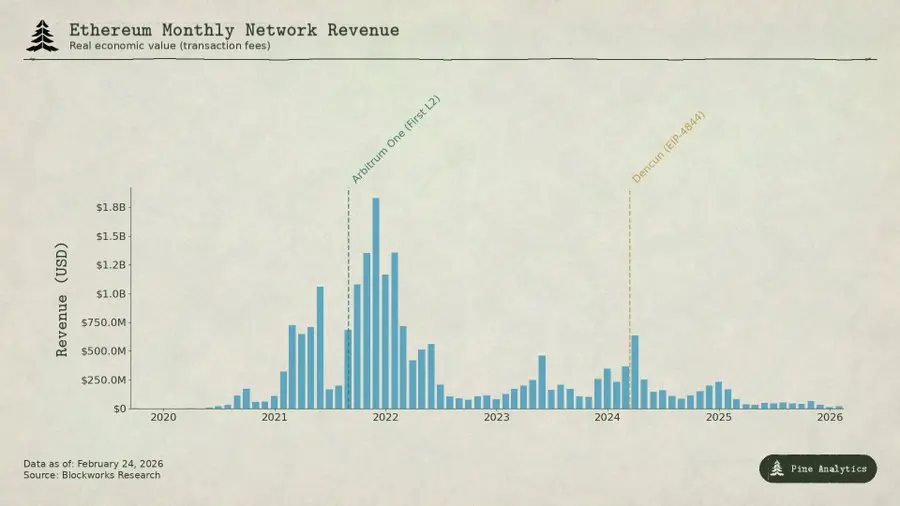
Ethereum
The evolution of Ethereum's fees is even more dramatic: it successfully captured massive value, only to witness its value moat systematically dismantled.
The DeFi Summer of mid-2020 established Ethereum as the core of the new financial system. Uniswap's monthly trading volume surged from $169 million in April to $15 billion in September; during the same period, total value locked (TVL) skyrocketed from less than $1 billion at the beginning of the year to $15 billion by year-end.
In September 2020, Ethereum miners achieved a record $166 million in fee revenue, six times that of Bitcoin miners during the same period. This marked the first time that a smart contract platform generated scalable and sustainable cash flow based on real economic activity.
In 2021, the NFT craze combined with the DeFi boom, pushing average transaction fees to as high as $53. Quarterly fee revenue skyrocketed from $231 million in Q4 2020 to $4.3 billion in Q4 2021, a year-on-year increase of 1,777%. The EIP-1559 implemented in August of the same year introduced a base fee burning mechanism, permanently removing this portion of revenue from circulating supply. At this point, it seemed that Ethereum had perfectly solved the value capture problem of public chains.
However, fees are calculated based on congestion. Users pay high fees not because they are reasonable execution costs, but because demand exceeds the chain's capacity of about 15 transactions per second. This creates a huge incentive for cheaper alternatives.
Alternative L1s like Solana, Avalanche, and Binance Smart Chain offer extremely low-cost execution. Layer 2 solutions like Arbitrum and Optimism absorb activity, executing on their own chains and sending compressed batch data back to Ethereum.
Subsequently, Ethereum initiated a self-revolution. The Cancun upgrade on March 13, 2024, introduced Blob transactions (EIP-4844), providing L2 with a cheaper data publishing solution. Before Blob, L2 used call data, costing about $1,000 per megabyte.
After the upgrade: Arbitrum's transaction fees dropped from $0.37 to $0.012. Optimism's fees fell from $0.32 to $0.009. The median Blob fee is almost zero. Ethereum established a dedicated low-cost channel to retain users, thereby losing a significant source of fee revenue.
The data is as follows: In 2024, L2 generated $277 million in revenue but paid only $113 million to Ethereum. By 2025, L2 revenue fell to $129 million, but the amount paid to Ethereum plummeted to about $10 million, less than 10% of L2 revenue, a year-on-year decline of over 90%. Once averaging over $100 million per month, L1 fee revenue fell below $15 million in Q4 2025. This blockchain, which once generated $4.3 billion in a single quarter, saw its revenue shrink by 95% just four years later.
The compression of Bitcoin stems from users turning to off-chain methods to hold and use assets. Ethereum's compression occurs in two waves: first, alternative layer networks siphoned off users unwilling to bear high congestion costs, and then Ethereum's own scaling roadmap further pushed L2 data availability costs close to zero, fundamentally weakening the ability of a layer 1 public chain to profit from settlement business. The commonality in both situations is that the infrastructure built or supported by L1 ultimately erodes its own revenue sources.
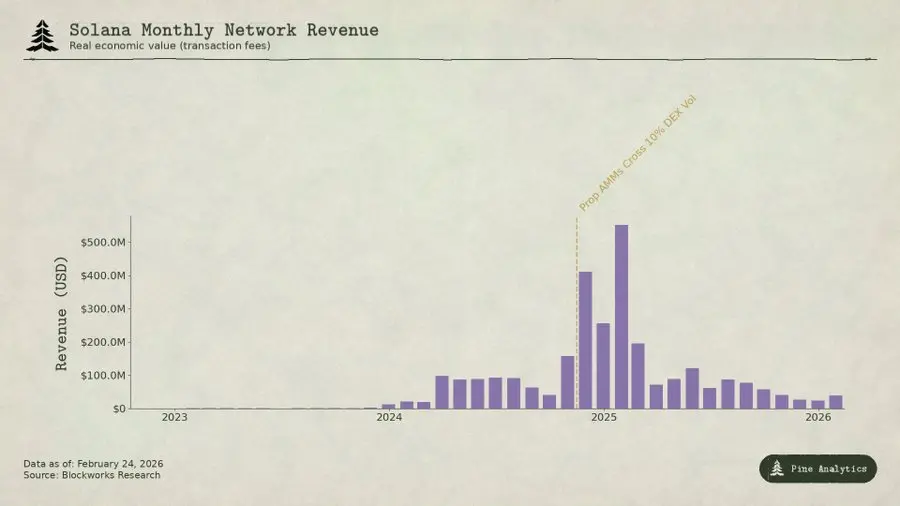
Solana
Solana's fee structure is entirely different, charging almost no congestion fees. The base fee is a fixed 0.000005 SOL per signature, essentially zero. Instead, about 95% of fee revenue comes from priority fees and MEV tips paid through the Jito block engine. In Q1 2025, Solana's actual economic value reached $816 million, with 55% coming from MEV tips. Validation nodes are expected to achieve $1.2 billion in revenue in 2024, with costs of only $70 million.
The driving force behind this is meme coin trading. Pump.fun launched in January 2024, generating over $600 million in protocol revenue in less than 18 months, capturing as much as 99% of meme coin issuance at its peak. Its decentralized exchange reached a daily trading volume peak of $38 billion.
In January 2025, the issuance of the TRUMP token pushed priority fees to 122,000 SOL in a single day, and MEV tips to 98,120 SOL. In 2024, the top 1% of meme coin traders contributed $1.358 billion in fees, accounting for nearly 80% of total meme coin fees, with this revenue almost entirely driven by MEV.
Now, two innovations are compressing this revenue.
First: the rise of private market maker models.
Protocols like HumidiFi, SolFi, Tessera, ZeroFi, and GoonFi use privately managed liquidity pools by professional market makers, who quote internally and update prices multiple times per second. Since liquidity is not visible to public pools, MEV bots cannot execute "sandwich attacks" on trades.
The key is that private market makers can actively filter counterparties (for example, by receiving routed quotes through aggregators like Jupiter), rather than passively remaining in public liquidity pools, allowing others to arbitrage by paying MEV tips or exploiting lagging quotes.
By keeping quotes private and continuously refreshing them, these solutions fundamentally eliminate the order lag problem that generates the vast majority of Solana's MEV revenue. Just HumidiFi alone saw cumulative trading volume close to $100 billion in the first five months after launch. Currently, private market makers account for over 50% of Solana's decentralized exchange trading volume, with even higher proportions in high liquidity trading pairs like SOL/USDC.
Second: Hyperliquid is directly extracting high-value spot trading from Solana.
Using HyperCore technology, Hyperliquid has built a native cross-chain infrastructure that supports tokens originating from Solana to deposit, withdraw, and trade on its spot order book. When Pump.fun issued the PUMP token in July 2025, the core spot price discovery process occurred on Hyperliquid, rather than on decentralized exchanges within the Solana ecosystem, with funds completing cross-chain transactions via HyperCore.
Prior to this, Hyperliquid had already validated this model with tokens like SOL and FARTCOIN. Now, the initial pricing phase, characterized by the highest spreads, most volatility, and greatest MEV arbitrage opportunities, is gradually migrating away from the Solana main chain.
These two forces compress MEV revenue from different directions: private market makers reduce the MEV generated by exchanges remaining on Solana; Hyperliquid directly withdraws high MEV value spot trading altogether. By Q2 2025, Solana's actual economic value had significantly declined by 54%, down to $272 million; daily MEV tips plummeted over 90% from the January peak, falling to less than 10,000 SOL per day.
The model is similar, but the mechanisms differ. Solana's fee revenue is essentially MEV value captured during the chaotic early stages of emerging trading models. As private market makers optimize trade execution and Hyperliquid siphons off high-value order flows, this profit margin continues to be compressed. Although the layer 1 public chain captured massive value during market frenzy, the market itself is continuously building new tools that make such value extraction difficult to sustain in the long term.
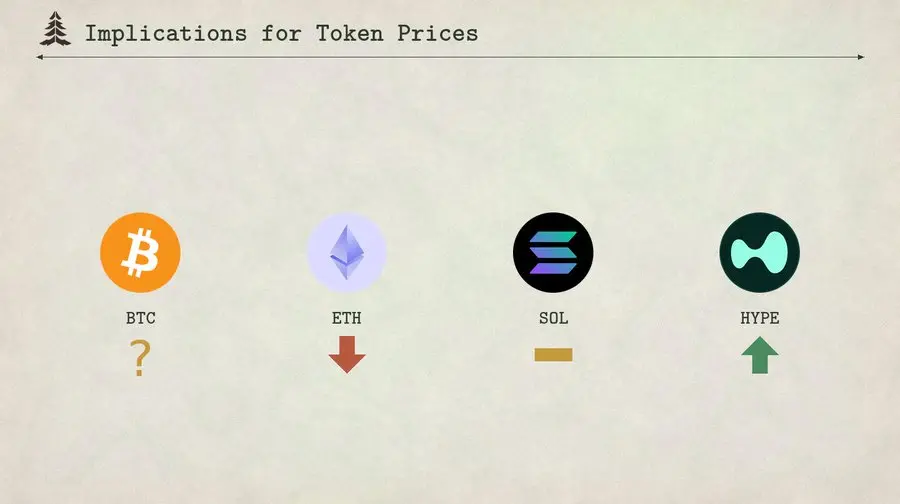
Impact on Token Prices
The patterns presented by the three public chains are not only a review of history but also a prediction of the future. L1 fee mechanisms follow the same trajectory: new demand triggers fee surges, fee surges induce innovation, and innovation compresses fees, with this compression being an irreversible structural change. Based on this framework, we can make specific predictions about the future prospects of four tokens.
Ethereum: Continuous Internal Competition of Fees
Ethereum's fee trajectory shows no obvious lower limit. Fees paid to Ethereum from L2 plummeted from $113 million in 2024 to about $10 million in 2025, a decline of over 90%. Each new L2 further siphons off block space demand, while the protocol's own roadmap continues to push down data availability costs.
EIP-4844 is not a one-time repricing but the beginning of a structural transformation—namely, Ethereum intentionally subsidizing the infrastructure that diverts its fee revenue. Currently, monthly L1 fee revenue has fallen below $15 million, and the downward trend is accelerating. Unless Ethereum can discover entirely new sources of L1 native demand, the token price will reflect this ongoing value compression.
The market trend for ETH has shown characteristics of a "low-yield infrastructure asset" rather than a "high-growth smart contract platform."
Solana: High Activity or Innovation, but Token Price Hard to Reach New Highs
Solana is almost certain to set new highs in activity in the next cycle. Its ecosystem is thriving, developer momentum is strong, and the robustness of its infrastructure is unprecedented. However, fee growth is unlikely to keep pace. The meme coin frenzy from late 2024 to early 2025 is Solana's "SegWit moment": after a significant surge in fees from new demand, rapidly emerging innovations directly compress profit margins.
Private market makers accounted for over 50% of DEX trading volume, eliminating most MEV arbitrage opportunities; Hyperliquid's HyperCore is shifting high-profit price discovery off-chain. Even if activity reaches 2-3 times that of January 2025, the mature fee infrastructure prevents it from translating into equivalent validator revenue. Despite a healthy ecosystem, daily MEV tips have dropped by over 90% from their peak.
Without fee revenue to support higher valuations, even with increased usage, SOL is unlikely to break its historical high in the next cycle.
Hyperliquid: Under Prosperity, Fee Rates Under Pressure
Hyperliquid is the most noteworthy case in this cycle, representing the next phase of the cycle, but the market has yet to price in its potential risks.
Hyperliquid has established its dominance in the perpetual contract space for traditional financial (TradFi) assets. During the recent volatility in silver prices, markets deployed through HIP-3 captured about 2% of global silver trading volume, with retail median spreads outperforming the Chicago Mercantile Exchange (CME). At specific times, TradFi assets contributed about 30% of platform trading volume, with a daily nominal value exceeding $5 billion. The platform's revenue in 2025 is expected to be around $600 million, with 97% allocated for the buyback and destruction of HYPE tokens.
We expect Hyperliquid to continue dominating on-chain trading of TradFi assets. Its product-market fit is clearly visible: around-the-clock trading, permissionless market deployment, and leverage up to 20 times (CME requires 18% initial margin). Entering a bull market, the dual growth of activity and fees may drive HYPE to achieve a repricing similar to Solana's rebound from the bottom. If TradFi trading volume continues to grow, HYPE may replicate this trajectory, as investors easily extrapolate future valuations based on substantial quarterly revenues.
However, its fee model harbors hidden dangers of self-compressing rates. The platform charges a base fee of 4.5 basis points on nominal value and offers discounts of up to 40% for high-volume and staked users. This is in stark contrast to the pricing logic of traditional financial derivatives. For example, for a $10 million nominal value position: CME fees are about $2.50; Hyperliquid fees are about $4,500. The difference is approximately 1,800 times.
This price disparity exists because current users are mostly retail and crypto-native groups. However, as institutions enter the market, the pressure to align with CME rates will increase significantly. Hyperliquid's own fee schedule has already shown signs: the HIP-3 model has reduced Taker fees for new markets by over 90% (down to 0.0045%), with top trader rates even below 0.0015%. The protocol is caught in a race against its own fee compression.
Whether losing to cheaper competitors or being forced to switch to a fixed fee model, it means that investors' linear extrapolations of revenue expectations will not be realized, and the token faces rapid value reassessment.
Bitcoin: Price Dominates Fees
Among the four, Bitcoin stands out with a completely opposite logical relationship between fees and token price. For ETH, SOL, and HYPE, the logic is: fees generate revenue → revenue supports valuation → fee compression leads to price pressure. In contrast, Bitcoin's logic is inverted: miners rely on a significant appreciation in price to maintain profitability after halving, as it has proven that fee revenue cannot fill the gap left by halved block subsidies.
The 2024 halving will cut block rewards in half, reducing daily issuance to 450 BTC. By the end of 2025, average daily transaction fees will drop to about $300,000, less than 1% of total miner revenue. Although total fee revenue in 2024 reached $922 million, it was primarily driven by speculative activities in Ordinals and Runes, rather than sustainable native transfer demand.
Due to the negligible contribution of fees, miners almost entirely rely on the block subsidies that halve every four years (measured in BTC). To maintain profitability through each halving, Bitcoin's price must roughly double within the same cycle to offset the halving of BTC-denominated revenue.
Historically, this has been the case, but the foundation is not solid. The chain's security budget does not stem from network usage fees but relies on the continuous appreciation of the asset itself. If the price stagnates during the halving cycle, mining will become unprofitable, leading to a decrease in hash power and security, potentially triggering a negative feedback spiral.
This makes Bitcoin's sustainability more fragile than it appears. Bitcoin operates primarily as a monetary asset rather than a smart contract platform, allowing its price to dominate the fee logic. This gives Bitcoin a unique mechanism: price increases driven by monetary demand can fund network security, even if fees are negligible. However, this also means that its long-term security relies entirely on the uncertain assumption of "continuous price appreciation."
As a secure settlement layer, Bitcoin's viability does not depend on building applications that generate fees but on maintaining a narrative that can continuously drive asset demand. So far, it has been effective. But as block subsidies decrease exponentially, whether this model can persist through the next three or four halvings remains the biggest unsolved mystery in the crypto space.
 Risk warning



Popular articles





