








Stripe Annual Letter: New cognitive density is extremely high, especially the 5-level model of "AI + Payment"
 Core Viewpoint

 Every trend here is affecting everyone's future survival.
Original Title: Stripe's Annual Letter, What Did It Say? A High-Density New Understanding, Especially the 5-Level Model of "AI + Payments"!
Original Author: Chen Tianyu Universe
Hello everyone, I am Chen Tianyu Universe.
Today we will break down a letter------Stripe's 2025 annual letter. Why break it down? Because this letter reveals many futures we haven't seen through Stripe's $1.9 trillion transaction volume!
If you are not a practitioner, you might not be very familiar with Stripe. In simple terms, Stripe is a global payment aggregation service provider, similar to Adyen, Pingpong, and Airwallex.
This letter, which is less than 3,000 words, is packed with information. It is not only an annual summary of the company but also a deep analysis and prediction of the global economic activities based on payments.
In 2025, Stripe's total transaction volume reached $1.9 trillion. What does this mean? A year-on-year growth of 34%, accounting for about 1.6% of global GDP.
In other words, for every 100 dollars of wealth produced on Earth, 1.6 dollars passed through Stripe's channel. In 2024, this number was $1.4 trillion. In just one year, it surged by $500 billion.
After reading this letter, I have only one feeling: the old world we are familiar with is collapsing and reconstructing at an astonishing speed. In this article, I will try to break down the key points of Stripe's annual letter in my own words, although there are also parts that are directly translated to maintain authenticity. The amount of information is indeed large, but every point is worth pondering. If you are an entrepreneur or in the payment business, I suggest you read it multiple times. Because every trend here is affecting everyone's future survival.
A sorting machine
At the beginning of the letter, a very hardcore concept is proposed------"sorting machine."
They say that the market economy is essentially a huge algorithm machine. Its function is not to make everyone prosperous together, but to brutally filter out profits, capital, and talent, redistributing them to the most productive enterprises.
In the past, this machine operated slowly, and everyone had enough to eat. But now, AI has added an overclocking engine to this machine.
From the data perspective:
The top one-third of publicly traded companies in the U.S. take home two-thirds of the entire stock market's value. This is the highest proportion since data has been available in 1963.
The top 10% of companies in the S&P 500 contribute 59% of the profits. And this is not a valuation bubble; it is a concentration of real profits.
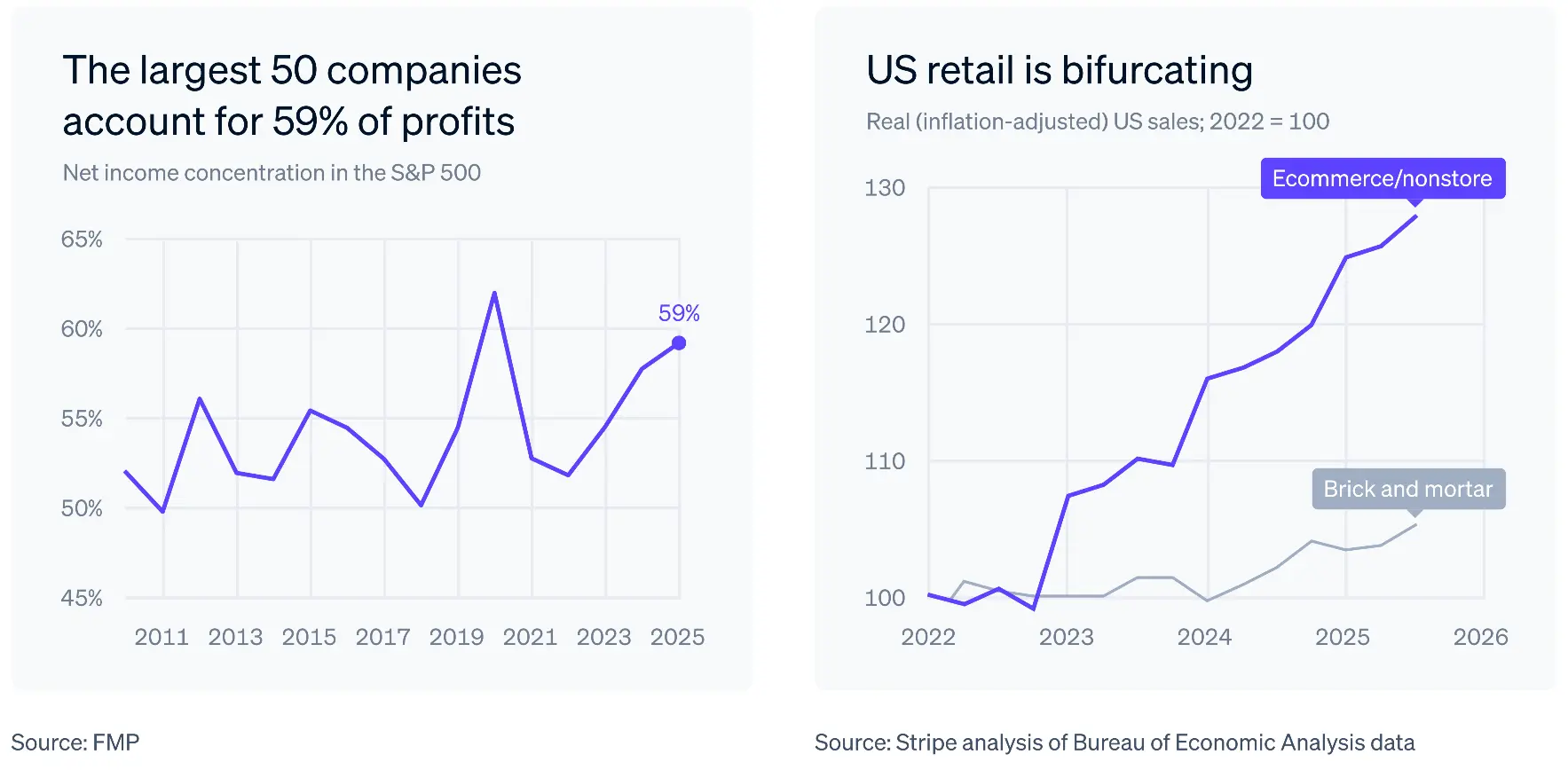
This differentiation is not only between large and small companies but also a life-and-death struggle within industries. The letter gives several examples:
Retail: Offline physical sales grew only 5% over the past three years after adjusting for inflation, while e-commerce grew 30% during the same period.
Aviation: The three major U.S. airlines—American Airlines, Delta, and United—have seen both market share and profits increase over the past decade. But by 2025, Delta and United will have taken almost all the profits from the U.S. airline industry. Other airlines are basically just along for the ride.
Healthcare: The profit share of hospitals and insurance companies has significantly shrunk since 2019, but the medical technology sector is expected to exceed $110 billion in EBITDA by 2029. Money is flowing from traditional players to new players.
This is the terrifying aspect of the "sorting machine": it used to be big fish eating small fish, but now it is fast fish eating slow fish, and AI fast fish eating slow-witted fish.
More macro data shows: the demand for software, computing, and data centers is driving nearly half of the GDP growth in the U.S. by 2025. And this proportion will soon become the majority.
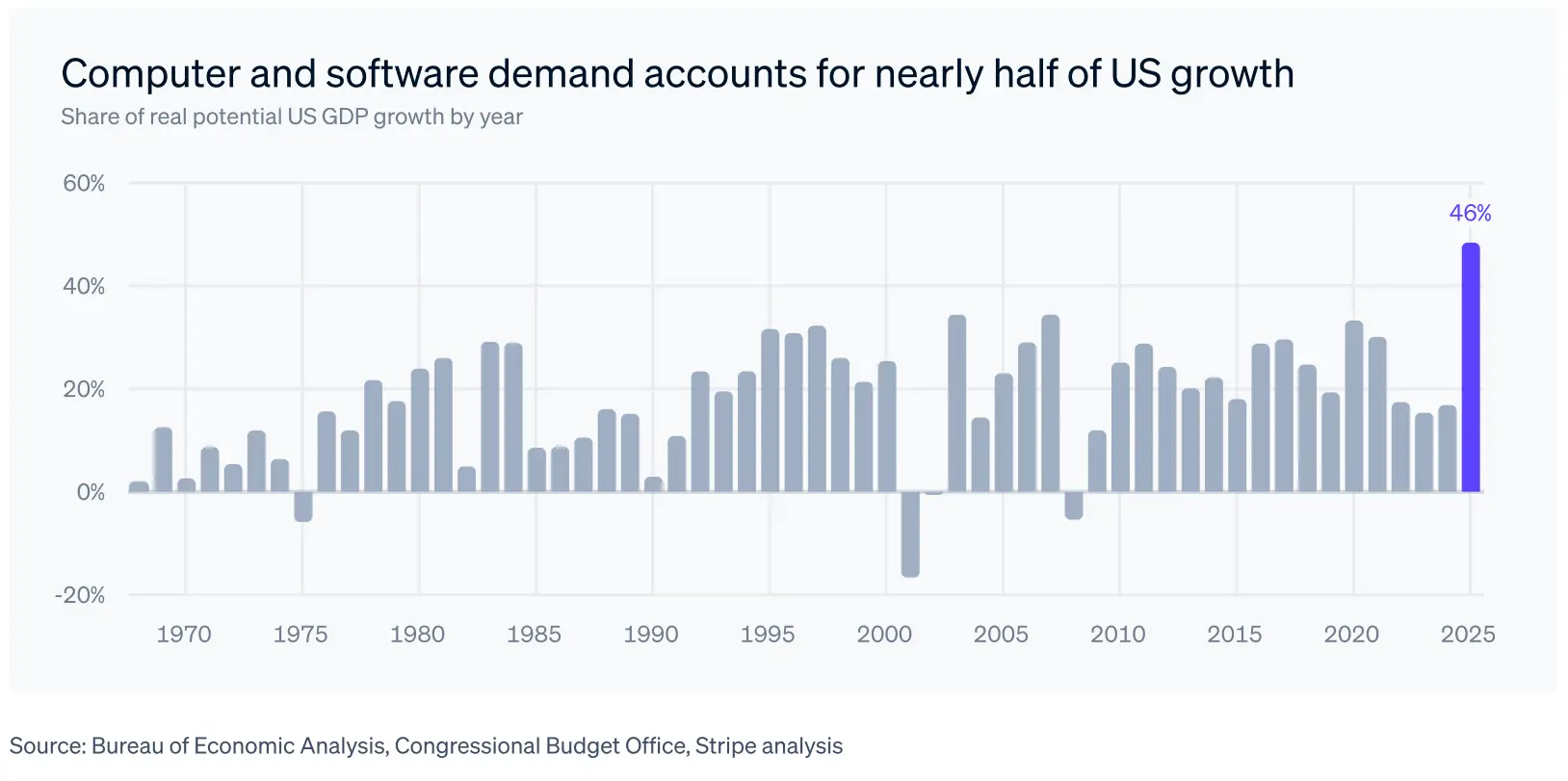
What does this mean?
In the past, we said software was eating the world; now it is computing power driving growth. Industries that are not on the computing power and software train are being ruthlessly left behind by this machine.
AI-Driven Entrepreneurial Explosion
What has Stripe observed?
In 2025, the number of new companies joining Stripe reached a historic high, with 57% coming from outside the U.S.
Moreover, these new companies are growing at an absurd speed, 50% faster than the batch from 2024.
Even more exaggerated, the number of companies that achieved an annual revenue of $10 million within three months has doubled.
However, AI companies feel this is just routine.
Why?
Because the volume of code submissions on GitHub increased by 41%. In previous years, it only increased by 10%-12%, but in 2025, it skyrocketed to 41%.
The number of iOS apps released in December 2025 increased by 60% year-on-year.
In the past, creating an app required assembling a team of over ten people and spending half a year refining it. Now, one programmer plus a few AI agents can code over the weekend, and by the following Monday, the product can be launched and start generating revenue.
Stripe itself has also pushed this wave. They created something called "claimable sandboxes," allowing you to directly start a Stripe account from AI programming tools like Manus, Replit, and Vercel.
Want to go live after testing? Just click a button, and the sandbox instantly becomes a formal account without needing to change any configurations. Currently, over 100,000 sandboxes have been created this way.
There’s also Stripe Atlas—the simplest company registration tool globally—which saw a 41% increase in company registrations last year. Moreover, these new companies are monetizing faster: in 2025, 20% of Atlas startups received their first customer payment within 30 days, compared to only 8% in 2020.
In light of this data, we must ask a question: Is 2025 an anomaly, or the beginning of a new normal?
Stripe's judgment is that the acceleration in 2025 marks the beginning of a turning point in entrepreneurship and creativity driven by large language models.
This "sorting machine" is accelerating, and if you can't make it into that top 10%, what awaits you may not be a slow decline, but an instant folding.
Globalization is Dead, Global Localization is Born
There is a particularly interesting viewpoint in the letter, called "globalization becoming the default state."
In the past, when our bosses went overseas, the path was relatively fixed: first, establish a presence in the domestic market, then send people to Southeast Asia or the U.S. to test the waters, and finally consider whether to expand into Europe.
Coca-Cola took 20 years to bottle its first soda in Cuba. McDonald's and Starbucks took 27 and 16 years, respectively, to open their first stores in Canada.
After the internet arrived, free services began to be released globally in sync, but the tools for monetization still had delays.
When Facebook opened to the public in 2006, anyone could register an account, but advertising? That was tricky. It wasn't until 2009 that it supported international currencies, five years after the company was founded. Google launched global search in 1998, but it wasn't until 2002 that it received its first pound of advertising revenue in the UK.
This approach is dead.
What are today's AI products like? OpenAI's ChatGPT, Anthropic's Claude, Replit, Cursor, Midjourney, all released globally in sync, covering all markets in seconds. Every AI product we have heard of is wildly popular in every country we know.
Stripe's data shows a very unusual phenomenon:
For companies whose main income comes from overseas, 30% of their revenue does not come from their home country or from major economies like the U.S., China, Japan, or Germany, but from those transparent countries that rarely make the news.
What does this indicate? It indicates that demand is decentralized, but the tools are unified.
In the past, if you wanted to collect money from the people of Kenya, you had to open a branch in Kenya and negotiate with local banks to integrate M-Pesa. Now? Stripe does it all at once, helping you connect over 120 payment methods; you just need to click a button in the backend to get it done.
For example: Gamma is an AI platform in California with 70 million users using it for presentations. When Gamma integrated Stripe to enable UPI payments in India, its revenue from India surged by 22% that month.
This is the benefit of the new generation of infrastructure: your product can be in San Francisco, but your money can be instantly collected from a breakfast vendor in Mumbai.
However, ironically, the most geographically constrained are not traditional industries but fintech companies themselves:
Chime has been around for 12 years and is still stuck in the U.S. If you want to open a Chime account? Forget it if you are outside the U.S.
Nubank was founded in 2013, and for the first six years only served Brazil, and in the next six years, it only added two more countries.
Even Stripe itself, after launching its Issuing product for seven years, only covers 22 countries—this is already faster than most, but still not fast enough.
But this is changing.
The new generation of fintech players—Sling Money, DolarApp, Felix, KAST—are building global financial applications from day one. Last year, Stripe also launched its first inherently global product, Financial Accounts, which businesses can use to hold, send, and receive funds. On its first day, it covered over 100 countries.
How can this be achieved? Because of stablecoins. Their borderless nature allows fintech to build a globally applicable infrastructure.
Inherently global has truly become possible for the first time.
Crypto Winter, Stablecoin Summer
2025 may be a crypto winter, but it is definitely a stablecoin summer.
Over the past decade, the trading volume of stablecoins has fluctuated with the prices of cryptocurrency assets. But in 2025, this correlation broke.
That year, Bitcoin's price plummeted, dropping 50% from its peak.
Logically, the crypto world should be at the "winter is coming" stage, right? But strangely, stablecoin payment volumes doubled, reaching $400 billion. It is estimated that 60% of this is B2B payments.
This is the golden phrase from the letter: Crypto Winter, but Stablecoin Summer.
In the past, people traded coins to get rich, but now, people use stablecoins to save money and for quick transactions.
The stablecoin orchestration platform Bridge, acquired by Stripe, saw its trading volume increase more than fourfold.
Now, the path for entrepreneurs has also changed:
A Y Combinator founder can raise funds using stablecoins.
Store them in Stripe's financial accounts to earn interest.
When needed, directly pay global engineers' salaries—these engineers could be anywhere in the world.
SaaS platforms can use smart contracts to collect stablecoin subscription fees, and wallet owners do not need to manually sign each transaction.
Companies relying on stablecoins for international expansion now have better payment tools, allowing them to embed digital wallets directly into their core products.
With companies like Privy, Ramp, and Deel, businesses only need to use one API to manage both custodial and non-custodial wallets.
The interoperability between stablecoins and fiat currencies is also rapidly improving.
In April 2025, Bridge partnered with Visa to launch a card that allows businesses and consumers to spend their stablecoins just like any credit card. When swiping the card, funds are deducted from the stablecoin balance and automatically converted to local currency; merchants receive payments just like with other payment methods, and they might not even know the user paid with stablecoins.
Phantom, one of the hottest crypto wallets with 20 million monthly active users, is using Bridge to offer users stablecoin cards.
Even Visa has started issuing cards for stablecoins. This means that the U**C in your wallet can now be used to buy a Coke at the corner convenience store.
To Facilitate Payments, Stripe Built a Chain
Since we are preparing to welcome the era of large-scale stablecoin payments, Stripe has spent considerable time researching blockchain.
Current blockchains are designed for transactions and DeFi, but the throughput, reliability, cost predictability, and privacy required for payments have not been the primary focus.
Bitcoin can handle less than 10 transactions per second.
In 2025, a wave of meme coin trading on a major blockchain delayed a payment for a Bridge user by over 12 hours, and the transaction fees skyrocketed by 35 times.
These issues are critical, but the future will be even more critical.
Because Stripe predicts that most internet transactions in the future will be completed by agent AI, we need a blockchain that can support over a million, or even a billion transactions per second.
In September 2025, Stripe and Paradigm incubated Tempo, a blockchain specifically designed for payments.
The logic of Tempo is simple: I won't play those flashy DeFi games; I will focus solely on payments.
Dedicated payment channels: not competing with meme coins.
Sub-second final confirmation: as fast as swiping a credit card.
Optional privacy: protecting business secrets while remaining compliant.
Interoperability with compliance and accounting systems: don’t talk to me about money laundering; I know anti-money laundering better than you do.
These features may not sound significant, but they are crucial for the payment infrastructure that supports real economic activities.
Visa, Nubank, and Shopify are already testing various scenarios with Tempo, including global payments, embedded finance, remittances, and more.
Klarna, whose CEO once claimed to be a cryptocurrency skeptic, has now become the first bank to issue stablecoins: it launched KlarnaUSD on Tempo's testnet, using Bridge's Open Issuance to accelerate and reduce the settlement costs of cross-border payments.
Tempo's architecture is particularly suited for agent payments and microtransactions.
The mainnet is about to go live, and we look forward to seeing what ambitious companies will create with it.
The Financing Dilemma for Small Businesses
Since 2008, the per capita GDP growth rate in OECD countries has been a pitiful 1.0%. In contrast, the average growth rate over the previous 46 years was 2.8%.
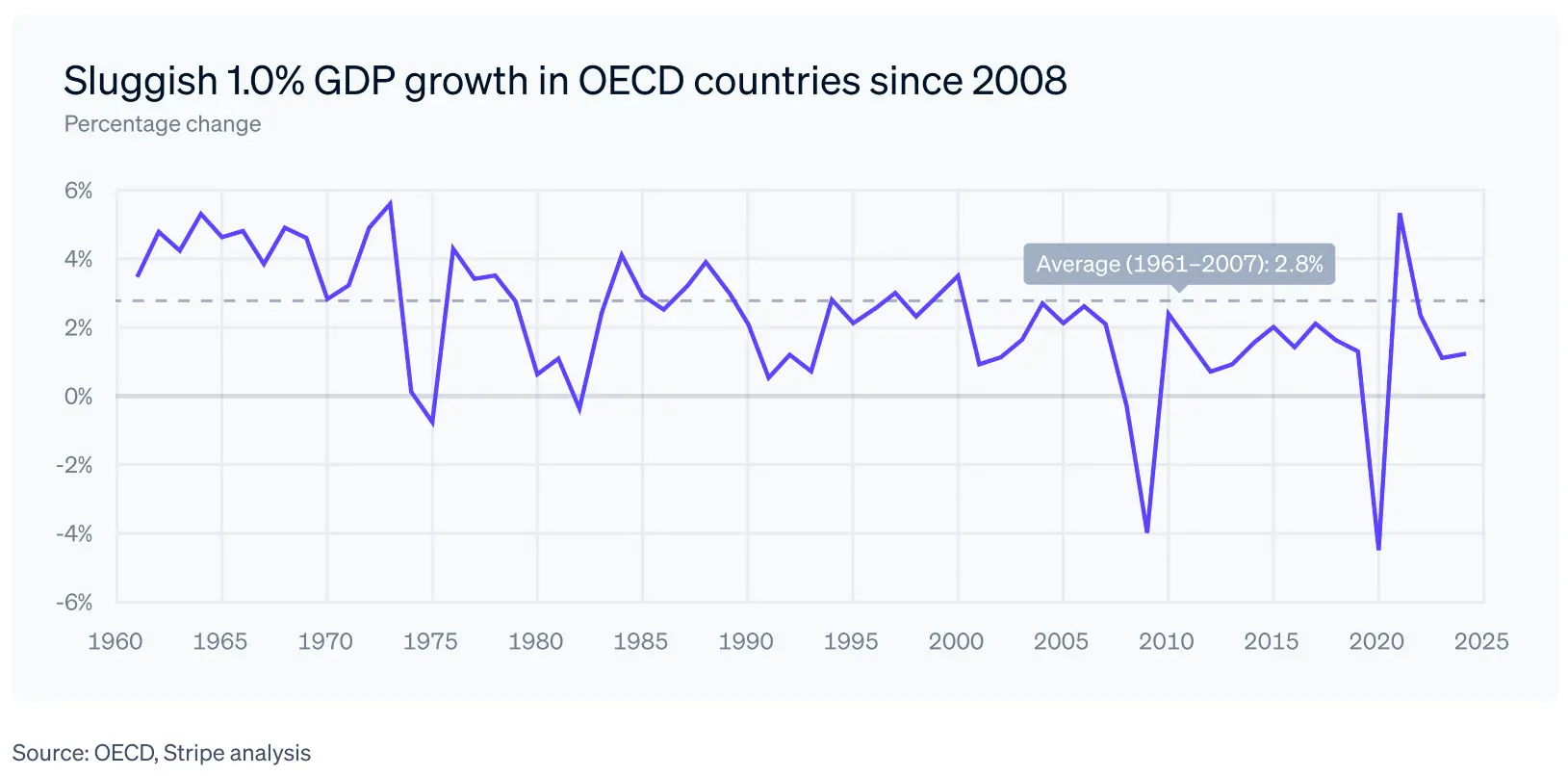
Japan's aging population, Brexit in the UK, Europe's energy structure…
But there is ample evidence that a significant culprit is the sharp decline in the availability of capital globally.
In most OECD countries, banks have raised capital requirements since the financial crisis, leading to a decrease in capital availability for small businesses.
Basel III reforms have raised capital standards for large global banks.
In Ireland, from 2011 to 2019, bank loans to small businesses fell by more than 66%.
In the UK, small business loans have been weak since they contracted in 2012.
The U.S. is slightly better, with non-bank lenders providing some channels, resulting in a 1.7% per capita GDP growth over the past 15 years. But the overall trend since the Dodd-Frank era is the same: bank rules have tightened, and capital availability for small businesses has decreased.
Since 2010, loans over $1 million have increased by 68%, while loans under $1 million have decreased by 5%. Last year, the approval rate for small business loan applications in the U.S. was only 41%, down from 50% in 2015.
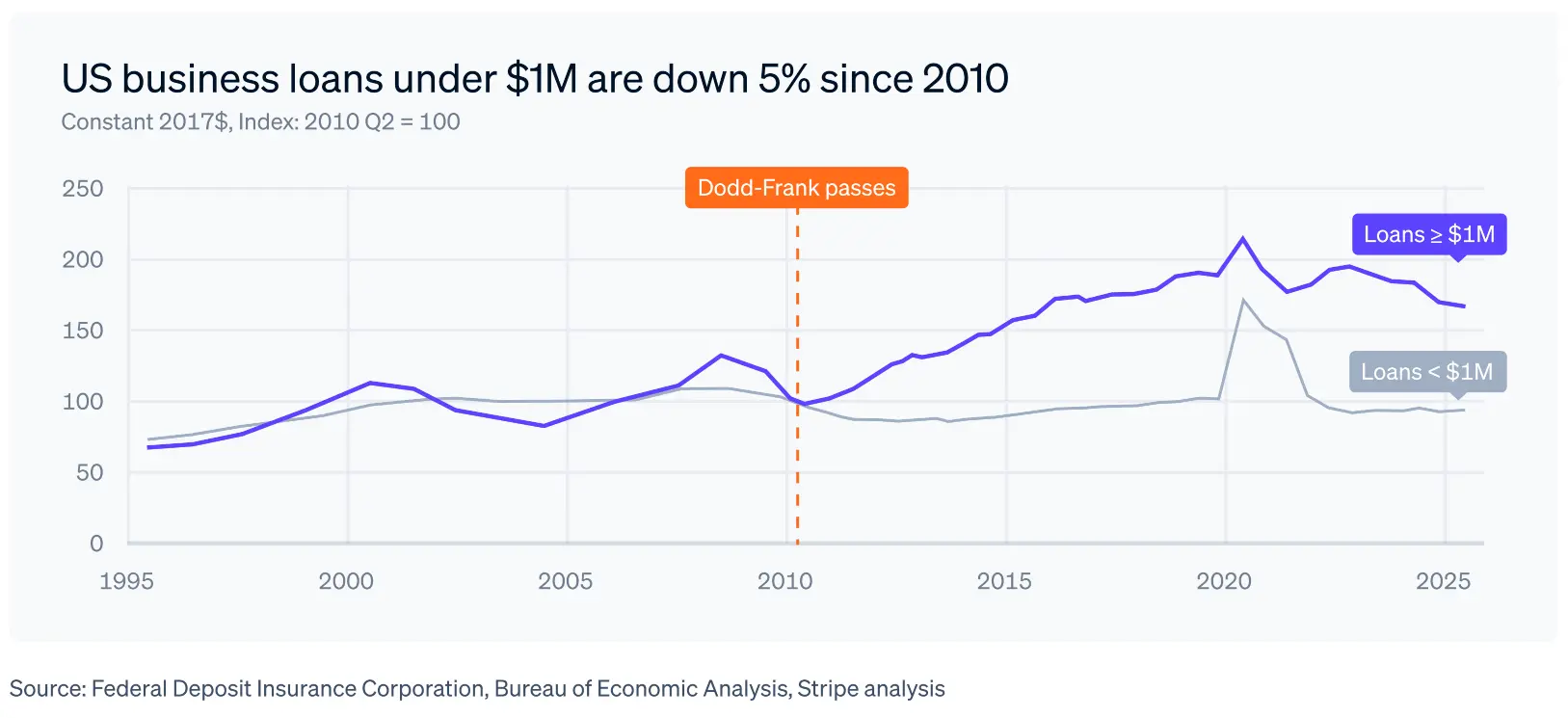
Stripe Capital was created to address the global capital availability issue, particularly for small businesses.
For businesses that use Stripe for payments, their real-time revenue data simplifies loan decisions. Companies can repay a small portion of future sales, effectively prepaying operational funds from their own growth.
From 2024 to 2025, financing amounts grew by 45%, with Stripe Capital serving over 80,000 businesses. Many of these businesses obtained funding through the vertical SaaS platforms they use—GlossGenius for beauty salons, Tekmetric for auto repair shops, Pixieset for photographers, and so on.
In the past two years, Stripe conducted a randomized study to understand the impact of capital: when we help businesses "grease the wheels," how fast can they run?
The result is much faster.
Businesses that received Capital financing grew 27 percentage points faster in the following year than similar businesses that did not.
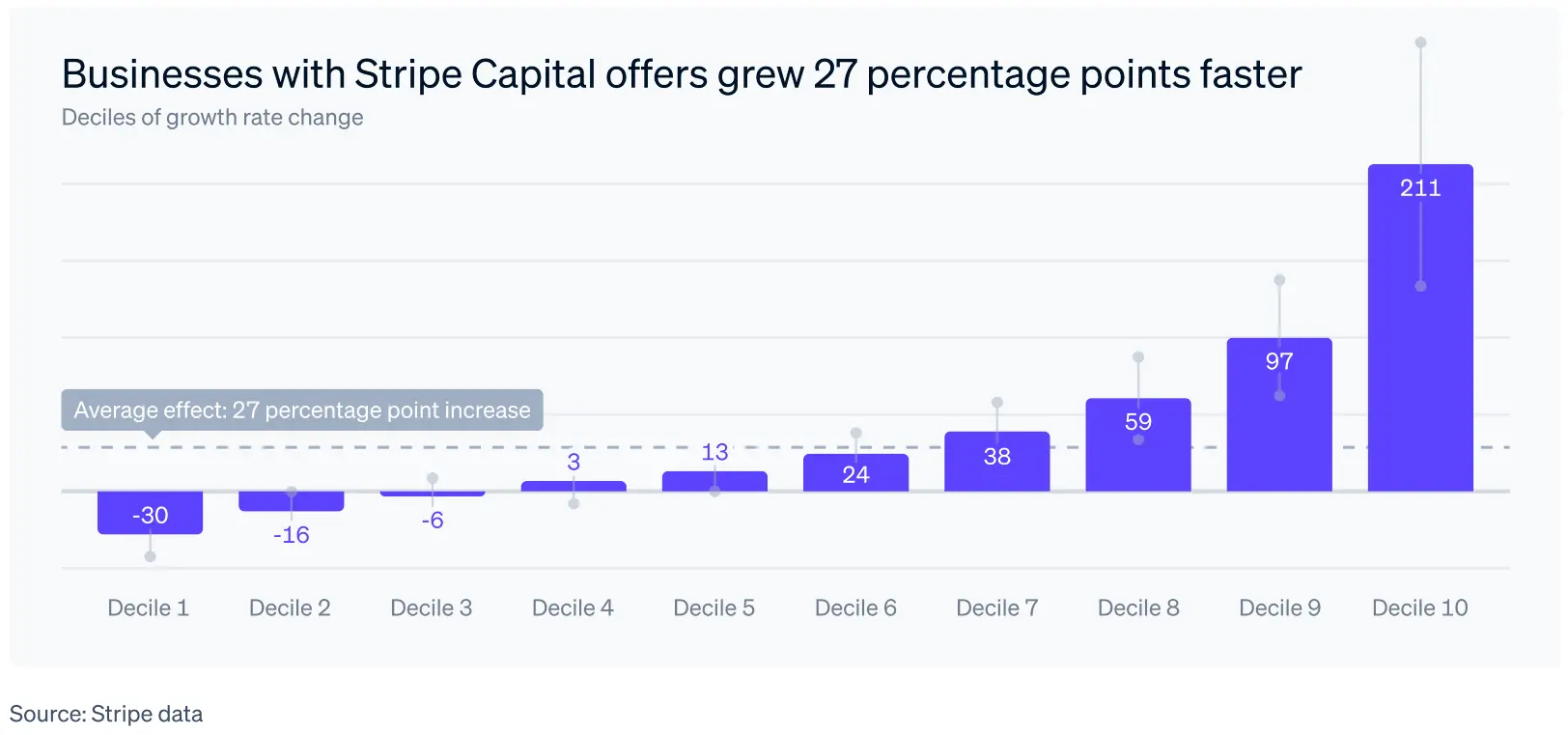
The fastest-growing 10% of businesses grew three times faster than their peers. The next tier also grew nearly 100 percentage points faster.
For example: Xirsys, a California-based server hosting company, used Stripe Capital financing to add servers in China, India, and Japan, subsequently doubling its revenue.
Notably, even businesses with low credit scores experienced growth rates that were 11 to 18 percentage points faster after obtaining financing.
Stripe posits a hypothesis in the letter: as AI improves investment returns, capital availability may become a more important variable in future economic outcomes.
"Low-Income Model" OR "High-Income Model"
For mature businesses, the clearly defined growth levers are pitifully few, and the most enticing ones may not necessarily work.
Take advertising, for example.
In 2019, Gillette's ad "The Best Men Can Be" won a Silver Lion at Cannes. Later that year, Procter & Gamble wrote down $8 billion in this business because that award-winning ad failed to drive explosive growth.
Recently, an advertisement by Indian Railways won the Grand Prix and six Gold Lions at Cannes in 2025—doing a golden ticket-style daily lottery, where every day a train ticket had a chance to win 10,000 rupees—but it was stopped after eight weeks because it did not see an increase in ticket sales.
This is why Stripe has maintained a missionary-like enthusiasm for payments after 15 years.
Compared to those more uncertain growth paths, optimizing payment setups is almost a surefire way to increase revenue and one of the highest ROI growth activities.
Microsoft evaluates the performance of various payment service providers every month. From June to October 2025, Stripe significantly improved authorization rates for Microsoft using adaptive acceptance, card account updaters, network tokens, and other means. The result was that Microsoft redirected more payment traffic to Stripe.
The previous payment provider at Gatwick Airport had persistent issues with payment failures, disputes, and customer complaints. After switching to Stripe, the payment success rate increased by 2.5 percentage points.
FICO conducted an A/B test comparing the previous payment provider with Stripe, then switched entirely, resulting in a 1 percentage point increase in authorization rates.
The telehealth company Ro used Stripe for the past 12 months, achieving a 2% increase in authorization rates and a 3% decrease in dispute rates, resulting in tens of millions of dollars more each year.
Most businesses are currently living in what Stripe calls the "low-income model": payment infrastructure is not optimized, leading to losses in conversion rates, authorization rates, and fraud prevention rates.
What does the "high-income model" look like?
The checkout page should dynamically adjust for each customer. Pricing should be in local currency, offering the most relevant options among hundreds of local payment methods.
Showing BLIK payment to Polish customers increased checkout conversion rates by an average of 46%; providing Pix to Brazilian customers increased conversion rates by an average of 31%.
Behind these improvements is Stripe's decade-long investment in AI, including their "Payment Infrastructure Model" and a host of AI-driven services—Stripe Radar, Optimized Checkout Suite, Authorization Boost—quietly optimizing billions of dollars in transactions every day.
But there is still plenty of room for improvement!
Last year, Stripe began testing a new authentication method: allowing customers to tap their cards on their phones. This touch verifies the card's NFC chip, effectively proving that the cardholder has the card in hand. DoorDash participated in the test and found that compared to previous fraud prevention methods, conversion rates improved significantly, and chargeback rates decreased.
Stripe also built a new model for Radar to address new fraud methods arising from the AI wave—especially those that misuse free trials to steal AI inference computing power, which is now quite common.
To quote a segment from the original text:
CEOs: Flashy ads are fun, but don’t overlook the growth opportunities right under your nose. Your payment head definitely deserves more recognition. How about throwing them an awards ceremony? Somewhere in the south of France, to honor payment optimization. Or if you think the weather there is too nice, San Francisco will do; April is just right.
Agentic Commerce
A recent hot topic in the AI circle is that models can not only think using training data but can also go online, use browsers, write code, and do things on the internet.
For Stripe's world, the most relevant concept is agentic commerce: your AI will soon be buying things for you.
Like other AI concepts, agentic commerce has also been prematurely overhyped. Some have painted a grand picture, claiming that autonomous agents will know all your preferences and plan and execute all your shopping.
Stripe's approach is to break this grand picture down into five levels:
Level 1: Eliminate web forms
You research and decide what to buy yourself. But no one likes filling out web forms. If you could just send a link to the agent, let it fill in the payment and shipping information, and come back to confirm, that would save a lot of trouble.
The system makes no decisions; it just types "buy" for you.
Level 2: Descriptive search
You no longer need to search for products or specific attributes; you describe the scenario.
"I need to prepare school supplies for a third grader in Chicago, including clothes that aren't too tight or scratchy, pencils, notebooks, and a lunchbox. My son likes KPOP Demon Hunters and tennis. School starts at the end of August."
The system needs to consider weather, material, size, durability, taste, reviews, and delivery time. Niche and long-tail products become easier to find. Annoying keyword searches will become history.
Level 3: Persistent memory
You no longer need to introduce yourself repeatedly.
"Find me options for Bobby's school clothes."
The system already knows your preferences and remembers the requirements inferred from previous conversations and purchases. You still decide what to buy, but the options have already been filtered based on your taste and budget.
Level 4: Delegated authority
You no longer need to make choices.
"Handle the school shopping, keeping it under $400."
The system takes care of searching, evaluating, and purchasing for you. You trust it to weigh options just like you would, choosing things your son would like. You only set the budget.
This is essentially what most people think of when discussing agentic commerce.
Level 5: Proactive prediction
No prompts needed.
The system already knows the school calendar, your son's preferences, and your usual budget. You just receive a notification: here’s the list of school supplies that have been purchased.
This is the most sci-fi version: the things you need appear just before you need them, without you having to say a word.
The industry is currently on the edge of Levels 1 and 2.
Stripe reflects on the mid-1990s, when the internet structure we use today was established. Netscape created the graphical browser. HTTP and HTML became the shared application layer. URLs and DNS became popular. At that time, no one knew which protocol or player would win. Every Google had an AltaVista standing in front of it.
Now, agentic commerce is also at such a critical moment—it has the potential to become a transformative change for a generation.
Like the early internet, the future of agentic commerce depends on universal interoperability.
To this end, Stripe has done a lot over the past year:
Collaborated with OpenAI to create the Agentic Commerce Protocol (ACP), establishing a shared technical language between AI platforms and businesses. Open design, usable across payment providers and AI platforms.
Launched Shared Payment Tokens, a new payment primitive that allows agents to initiate payments without exposing credentials. Even businesses that do not use Stripe for payments can forward these tokens to their treasury or other processors as secure credentials.
Released the Agentic Commerce Suite, providing businesses with a set of tools that can sell across multiple AI interfaces and protocols (including ACP and the Universal Commerce Protocol released by Google last month) with a single integration. Checkout, payments, and fraud prevention all operate as usual in the background. Brands already integrated include Anthropologie, Urban Outfitters, Etsy, Coach, and Kate Spade.
Launched machine payments, allowing developers to receive payments directly from agents using stablecoins—API calls, MCP usage, HTTP requests are all acceptable. Autonomous agents themselves are becoming a new type of customer for internet businesses.
Collaborated with OpenAI to create the first batch of shopping experiences in ChatGPT. Also working with Microsoft to bring similar capabilities to Copilot.
No one can accurately predict where agentic commerce will be by the end of 2026, but it is clear that it has moved past the pure hype phase and entered the stage of construction and real experimentation. The pace of change will only accelerate.
If all goes well, those small agents will not be trapped in walled gardens but will be racing down the open protocol highway.
The Republic of Licenses and the Cost of Innovation
Today's entrepreneurs and innovators have tools and reach that previous generations of industrialists could not have imagined. If the combinatorial effect of human ingenuity ultimately translates into increased productivity and improved living standards, how wonderful that would be.
Last year, Joel Mokyr won the Nobel Prize in Economics. Mokyr is known for emphasizing the importance of culture relative to traditional economic factors like capital, labor, and technology. The industrialists of the 18th century relied not just on coal or geographical location. They had a new culture—a "mindset of improvement" that viewed the status quo as imperfect and correctable.
In "The Political Economy of Technological Change," Mokyr also observed that new technologies often fail not because they are not advanced enough, but because technological decisions involve not only suppliers and customers but also a host of non-market aggregators—regulators, committees, courts—that influence what gets adopted.
As AI and the internet expand the boundaries of possibility, the synthetic barriers that hinder adoption and adaptation will become increasingly costly. The economic differentiation we are experiencing indicates that growth depends on the application of useful knowledge, rather than the mere existence of abstract knowledge.
AI has the potential to greatly improve drug discovery… but this potential will only be realized if the regulatory processes (including clinical trials) become faster and cheaper.
European entrepreneurs can use new tools to boost a sluggish economy… but only if they reduce the burdens of well-meaning but counterproductive regulations, such as the EU AI Act.
Next-generation nuclear technology could bring energy abundance… but only if outdated regulatory frameworks are thoroughly reformed.
Autonomous logistics—from long-haul trucks to drones—could significantly reduce the cost of physical goods… provided that a slew of local regulations do not harden into barriers.
Mokyr has written about the importance of the "Republic of Letters" in catalyzing the industrial revolution. Today, we live in a "Republic of Licenses": a filtering sieve composed of non-market aggregators.
While many regulations are well-intentioned, it is now more important than ever to ensure that they seriously weigh the benefits gained against the possibilities blocked.
We are fortunate to support resilient companies that demonstrate the boundaries of possibility:
Mistral AI and Bending Spoons are proving that top talent in Europe can pierce through the regulatory freeze.
Zipline and Varda are gradually securing licenses for complex new hardware.
Spring Health and Maven Clinic are weaving a new software layer for modern healthcare.
We still believe that ideas are crucial for driving economic progress, and many of the best ideas are undervalued. Stripe Press's reading list includes many people, stories, and models that we believe can contribute to the next wave of improvement. The team recently celebrated the sale of one million books. Works in Progress, our magazine discussing undervalued ideas that can improve the world, has also recently started a print edition.
The Event Horizon of a Black Hole
This letter dedicates a large portion to the progress of AI, sometimes feeling like it's hard to keep up. The gap between newly released products and last year's cutting-edge offerings is stark.
We are reminded of the phenomenon of falling into a black hole. If you are unfortunate enough to experience this, the moment you cross the event horizon will not feel particularly special: the path is locally smooth, even though the future space of possibilities has irreversibly changed after crossing that boundary.
As we write this letter, we may be standing on the eve of a different, hopefully better singularity.
While many things in 2026 may feel similar to previous years, it is also clear: the next decade will be completely different from the one just passed.
We continue to believe that a vibrant entrepreneurial spirit and wise culture can help build a more successful future society. We hope Stripe can play a small role in that.
If you are also driving economic growth—whether as an entrepreneur, business leader, or builder of financial infrastructure—we hope to see you at Stripe Sessions in April. As always, there is much to discuss.
That "sorting machine" will not stop; it will only spin faster. Whether you become one of the selected winners or the redundant data that gets left behind depends on how you respond now.
That's it for now, see you next time.
 Risk warning



Popular articles





