Lending Evolution: Aave V4 vs. Morpho V2, who is the future of DeFi lending?

 DeFi lending in the V4/V2 era is moving towards a professional, modular, and institution-friendly financial operating system.
TL;DR
Background: Aave launched V4, Morpho advanced to V2, and DeFi lending is entering a new round of architectural upgrade cycle.
Evolution History: Shared liquidity pool model born → Aave V2/V3 promotes multi-chain expansion and risk layering → Morpho "curation revolution"
Three Paradigms: Multi-asset liquidity pool | Isolated markets + curation mechanism | RWA lending
Aave V4 VS Morpho V2: Aave is more like a "big bank" on-chain, while Morpho is more like an "asset management platform" on-chain
Risks: Oracle and parameter configuration risks | Governance and organizational risks | Vault/Curator risks | Smart contract and runtime risks
Opportunities: Lending market becomes "modular financial building blocks" | Institutionalization becomes a product path | RWA and credit layering broaden asset boundaries
Conclusion: DeFi lending in the V4/V2 era is moving towards a professional, modular, and institution-friendly financial operating system.
DeFi lending is entering a new round of architectural upgrade cycle. Recently, both Aave and Morpho, two major DeFi lending protocols, announced significant version upgrades: Aave V4 went live at the end of March, while Morpho V2 officially launched in February. Aave V4's hub-and-spoke architecture aims to unify liquidity and deepen the RWA field; however, Chaos Labs suddenly announced its exit today, core contributors like ACI have previously left, and issues such as governance disputes and liquidation anomalies have raised widespread concerns. Morpho V2's non-custodial Vaults V2 significantly improves asset efficiency by 20-30% through the Curator curation mechanism, but discussions on Curator management risks and security are equally intense. The simultaneous upgrades of the two protocols mark a transition from "on-chain lending tools" to more complex capital allocation and credit layering infrastructure. On the other hand, it also serves as a warning to ordinary crypto investors: opportunities and risks coexist, and the upgrades are profound tests of capital efficiency, security, and governance dynamics.
I. Understanding DeFi Lending Protocols
1. The Underlying Logic of DeFi Lending
The underlying logic of DeFi lending can actually be summarized in one sentence: move the traditional banking deposit and loan business on-chain and rewrite it with code.
In this system, lenders deposit assets into the protocol to earn interest, while borrowers obtain funds by providing over-collateral. The biggest difference from traditional finance is that this process does not rely on manual review, credit assessment, or centralized institutional endorsement, but is fully executed by smart contracts. The flow of funds, interest rate calculations, and liquidation mechanisms are all driven by preset rules, providing high transparency and verifiability.
Because of this, the threshold for DeFi lending has been significantly lowered—any wallet address holding crypto assets can participate without permission.
2. Use Cases of Lending Protocols
From an investor's perspective, the use cases of lending protocols mainly focus on two typical needs.
- Borrowing without selling coins: Users can use assets like BTC, ETH as collateral to borrow stablecoins, obtaining liquidity without giving up potential upside, thus avoiding missing out on market opportunities due to premature selling.
- Earning interest on-chain: Users deposit idle assets into lending protocols to earn stable interest rates, treating it as "on-chain savings" or "money market fund alternatives." In the crypto market, which lacks low-risk yield tools, this function has long played the role of a basic yield anchor.
- Capital market infrastructure: Almost all complex strategies rely on the liquidity support provided by lending protocols. For example, liquidators need immediate funds to participate in liquidations to earn liquidation rewards; arbitrageurs need short-term liquidity to complete cross-market arbitrage trades; other protocols (like derivatives, stablecoins, yield aggregators) need composable collateral and borrowing interfaces to build their product structures.
It is evident that lending protocols do not only serve end users but also provide "blood circulation" for the entire on-chain financial system.
3. Two Core Capabilities: Pricing and Risk Isolation
From a mechanism design perspective, the complexity of lending protocols can ultimately be summarized into two core capabilities.
- Pricing capability: This includes interest rate models, collateral ratio settings, liquidation thresholds, and incentive mechanisms. These parameters collectively determine the supply and demand relationship of funds and capital efficiency, and are a direct reflection of the protocol's competitiveness.
- Risk isolation capability: In an environment with multiple assets and markets, how to prevent the volatility or risk events of a single asset from spreading to the overall system is a key proposition for the long-term evolution of lending protocols. Isolation pool design, risk layering, and independent market structures are all developed around this goal.
II. Evolution History of Lending Protocols
The evolution of lending protocols is not simply about adding new features, but about finding new balances among several core contradictions: between efficiency and security, between decentralization and specialization, and between open access and controllable risk management. In a sense, the history of DeFi lending is a process of continuously reconstructing mechanisms around this triangular relationship, as well as the history of the rise and growth of Aave and Morpho.
1. Origin Stage (2018-2020): Birth of the Shared Liquidity Pool Model In June 2018, Compound officially launched the cToken mechanism, which is regarded as the true starting point of DeFi lending. Users deposit assets like USDC, ETH into a shared large liquidity pool, and the system automatically adjusts interest rates based on supply and demand; borrowers can borrow funds by depositing 150%-200% over-collateral. This is the classic "peer-to-pool" model: everyone's funds are mixed together, providing high liquidity, and anyone can deposit or withdraw at any time, proving for the first time to the world the feasibility of "permissionless lending" on the blockchain.
Aave's predecessor, ETHLend, attempted pure P2P matching in 2017, but due to low matching efficiency and severe liquidity fragmentation, it was almost ignored in 2019. Aave V1 went live in January 2020, introducing the liquidity pool architecture and bringing Flash Loans as a key innovation into DeFi, laying the foundation for its later dominance.
2. Explosion and Iteration Stage (2020-2023): Aave V2/V3 Promotes Multi-Chain Expansion and Risk Layering After the "DeFi Summer" of 2020, liquidity fragmentation and multiple hacking incidents exposed the shortcomings of the single pool model. Aave V2 (launched in December 2020) expanded batch flash loans, debt tokenization, collateral swapping, and direct repayment with collateral, reducing gas consumption by 15-20%. These upgrades significantly improved V2's capital efficiency, user experience, and developer friendliness.
Aave V3 (launched in March 2022) introduced three killer innovations: isolated markets (e-mode, allowing similar assets like ETH and stETH to be used as collateral for each other), cross-chain Portal (supporting multi-chain liquidity transfer), and smarter liquidation parameters (LTV, Liquidation Threshold, Liquidation Bonus can be adjusted according to market dynamics). Aave's cumulative lending volume surpassed $1 trillion by the end of 2023.
3. Optimization and Modularization Stage (2023 to Present): Morpho's "Curation Revolution" In 2023, Morpho emerged as the "interest rate optimization layer" for Aave and Compound, prioritizing matching P2P lending parties, with remaining funds reverting to the original pool, often yielding 0.5-2% higher returns. Morpho V1 created isolated markets as "one collateral asset + one borrowed asset": market parameters are unchangeable, risks are isolated within a single market, and creation is permissionless. The upcoming V2, set to launch in 2026, will completely "externalize" risk management and pricing: Curators (professional curators like Gauntlet, Steakhouse, Bitwise) will be responsible for setting interest rates, terms, LTV, etc., while the protocol only provides timelock delay changes, flash loan-style redemptions, and Sentinel guardian mechanisms to ensure complete non-custodial management. The goal of V2 is to let "the market, not the protocol," determine interest rates, supporting fixed rates/fixed terms, smoother cross-chain operations, and structured contracts closer to traditional credit.
III. Three Mainstream Paradigms of DeFi Lending
The mechanisms of lending protocols can be divided into three dimensions: how assets are aggregated, how risks are isolated, and how interest rates are formed. Along these three dimensions, current DeFi lending can be roughly summarized into three mainstream paradigms.
1. Multi-Asset Liquidity Pool: Liquidity-First "Standard Model"
The first type is the most classic and familiar model to users—multi-asset liquidity pool (Pooled Money Market), represented by Aave and Compound.
The core of this model is: funds are aggregated uniformly by asset, and interest rates are automatically adjusted by algorithms based on supply and demand. All users' deposits are pooled together, and borrowers borrow funds from the pool, with interest rates dynamically changing with utilization. This design brings extremely high liquidity and availability: instant deposits and withdrawals, mature liquidation mechanisms, and support for advanced features like flash loans.
However, the flip side of high efficiency is "partial risk sharing." Although Aave V3 has implemented risk layering for different assets through isolation mode and E-Mode, significant volatility of a single asset in extreme market conditions may still impact overall liquidity.
2. Isolated Markets + Curation Mechanism: Rebalancing Between Efficiency and Security
The second type is a rapidly emerging paradigm in recent years—Isolated Markets + Vault Curation, represented by Morpho.
The core idea is: first achieve risk isolation, then supplement efficiency through structural design. In Morpho Markets, each market is typically "single collateral + single borrowing," with fixed and independent parameters, naturally avoiding risk transmission between different assets. This design is superior in safety compared to traditional liquidity pools.
However, the issue is that complete isolation can lead to liquidity fragmentation and a decline in user experience. To address this, Morpho introduced the Vault and Curator mechanism: Curators are responsible for selecting underlying markets and configuring parameters; Vaults repackage multiple isolated markets to present users with a near "liquidity pool" one-click experience; while dynamically reallocating between different markets to enhance yield and utilization.
As a result, this model achieves a compromise: yields are typically 0.5%-2% higher than Aave; risks are more finely isolated; but it also introduces new variables—the management ability and moral hazard of the Curator.
In other words, Morpho externalizes part of the risk management responsibilities originally borne by the protocol to "professional roles," which is essentially a step from "complete decentralization" to "professional governance."
3. RWA Lending: Connecting On-Chain and Real-World "New Boundaries"
The third type is the fastest-growing and most structurally significant direction—RWA (Real World Assets) lending. The key change in this model is that collateral or cash flow sources are no longer limited to on-chain assets, but come from the real world, such as accounts receivable, bonds, real estate, or corporate financing needs. Typical projects include Maple, Goldfinch, Centrifuge, etc.
Structurally, RWA lending can be roughly divided into two categories:
- Over-collateralized: Tokenizing real-world assets as collateral (e.g., invoice financing);
- Credit-based/Low-collateral: Relying on off-chain due diligence, on-chain reputation, or partial KYC (e.g., Goldfinch's tiered fund pool structure).
These protocols are closer to traditional finance in terms of risk control logic:
- Yields mainly come from fixed-rate loans, typically ranging from 4%-8% or even higher;
- Lower correlation with crypto market volatility, possessing certain "anti-cyclical" characteristics;
- However, they also rely more on oracle, legal structures, and compliance frameworks.
From an industry trend perspective, RWA is becoming an important incremental source for the lending track: its TVL has accounted for over 10% of lending protocols, and Aave V4 has clearly included RWA as a key expansion direction; Morpho is also collaborating with institutions like Ondo and Apollo to introduce off-chain assets. It is foreseeable that the development of RWA will drive DeFi lending from "internal crypto circulation" to a new stage of "on-chain and off-chain integration."
IV. Aave V4 and Morpho V2: Two Upgrade Paths, Two Futures for Lending
If the main line of DeFi lending in recent years has been about repeatedly seeking balance among "efficiency, security, and scalability," then Aave V4 and Morpho V2 represent two completely different answers. The former chooses "unified liquidity + modular expansion," attempting to position itself as the central hub for on-chain lending; the latter moves towards "non-custodial curation + customized markets," returning more pricing power and risk management authority to the market and professional managers.
1. On-Chain Data Performance
If we take "lending track TVL" as the denominator, Aave accounts for about half, while Morpho is at the 10%+ level; if we take "total lending across the network" as the denominator, Aave's lending proportion is even higher, exceeding 50%, indicating that it remains the core layer for on-chain leverage and credit demand.
According to DefiLlama data, as of April 9, 2026, the TVL of the DeFi lending track is approximately $51B, with total lending across the network around $34.4B. Aave's TVL is about $24.8B, with lending around $17.6B, of which Ethereum accounts for about $20B, with the rest distributed across Plasma, Arbitrum, Base, Mantle, Avalanche, and other multi-chains.
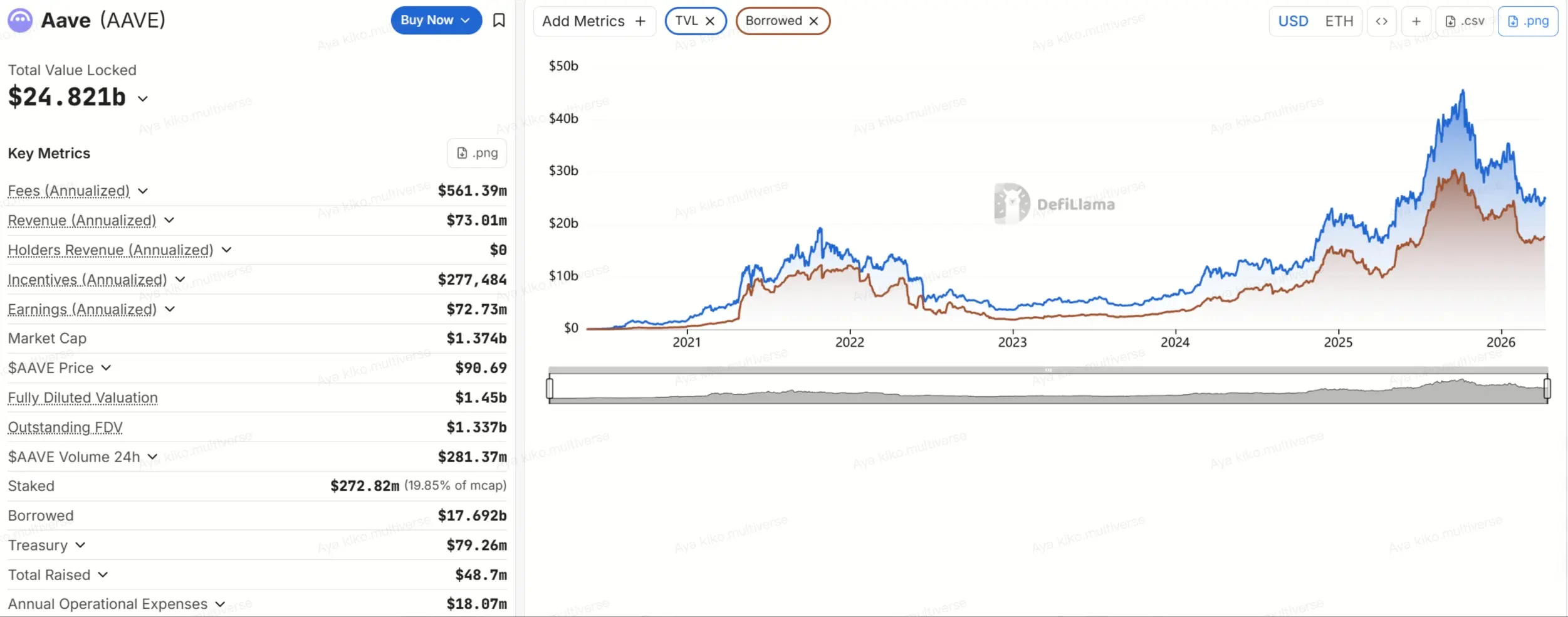
Source: https://defillama.com/protocol/aave Morpho's TVL is approximately $7.4B, with lending around $4.3B, primarily distributed across Ethereum (about $3.9B) and Base (about $2.3B), with additional distribution in Hyperliquid L1, Arbitrum, and others.
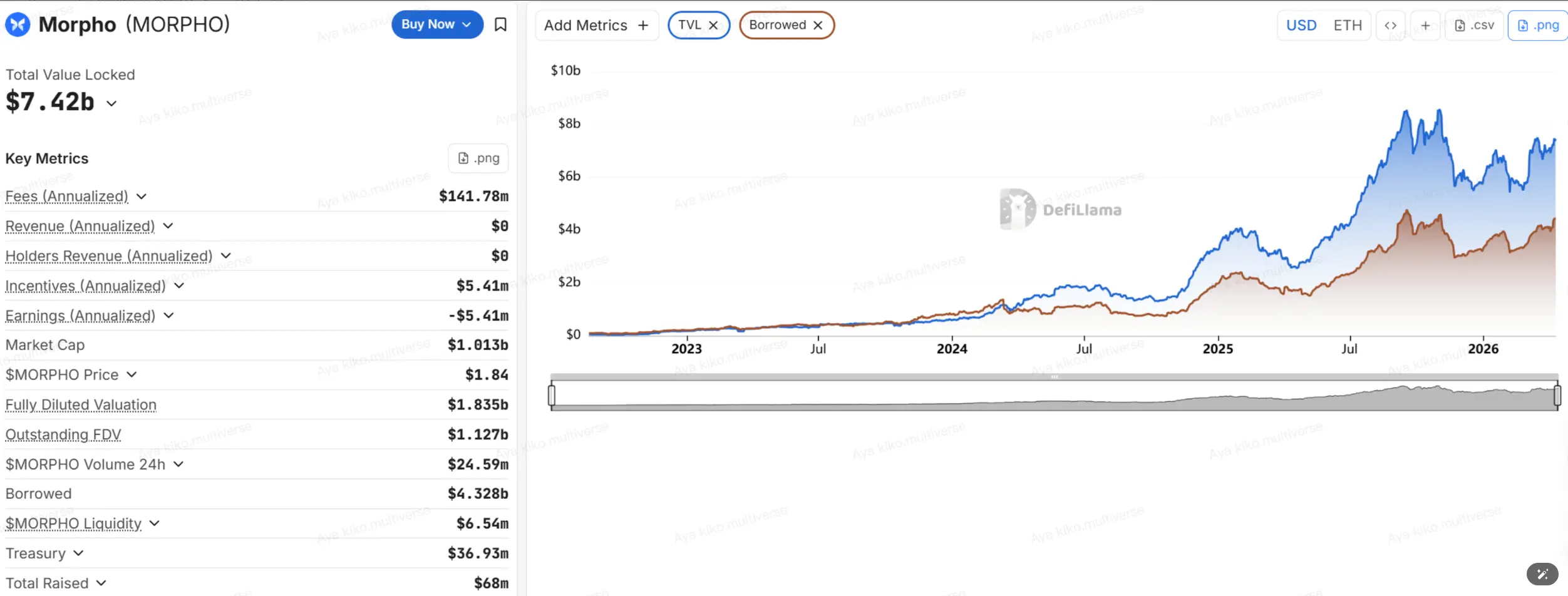
Source: https://defillama.com/protocol/morpho
2. Aave V4: Restructuring Liquidity with Hub-and-Spoke
The core change of Aave V4 is an attempt to solve a long-standing problem from the V3 era: liquidity fragmentation caused by multi-market and multi-chain expansion. In the V3 model, users deposit assets into a market on a specific chain, and liquidity primarily serves that market; starting a new market often requires redirecting funds, which is inefficient. Aave V4's solution is "Liquidity Hub + Spokes": each network sets up a unified liquidity center, and users enter the protocol through different Spokes, with the Hub responsible for unified accounting, quota control, and core risk management constraints, thereby sharing liquidity while placing different strategies and asset types into different risk partitions.
The key points of Aave V4 can be summarized in three aspects:
- Unified liquidity: Reduces capital fragmentation between different markets on the same chain, improving overall utilization.
- Modular risk isolation: Different Spokes can be configured with different parameters, avoiding "all assets sharing one risk pot."
- Reserving space for institutions and RWA: RWA Spokes can introduce stricter access, custody, and redemption rules, preparing infrastructure for bringing real assets on-chain.
The challenges of Aave V4 stem precisely from its ambition. A more powerful architecture means that governance, risk management, and operational complexity will also increase. The initial configuration of V4 will include 3 Hubs and 10 Spokes, and V4 and V3 are expected to run in parallel for 24 to 36 months.
It is also at this stage that governance disputes within Aave have erupted. Core contributors like BGD, ACI, and Chaos Labs have announced their departure or ended cooperation, with Chaos Labs publicly stating that the fundamental disagreement lies in "how risks should be managed."
3. Morpho V2: Making "Asset Management" a Protocol Capability
In contrast, the upgrade logic of Morpho V2 is more restrained and "modular." It is not a complete overhaul but a step-by-step rollout of Vaults V2 and subsequent Markets V2. The official statement clearly indicates that Vaults V2 will launch first, initially continuing to allocate funds to the old Morpho market, and once Markets V2 is fully implemented, it will provide initial deep liquidity for fixed-rate, fixed-term markets.
The focus of Morpho V2 is not to create a larger total pool but to turn "asset management" itself into a protocol-level capability. Key changes include:
- More granular role separation: Owner, Curator, Allocator, Sentinel each have their own responsibilities, facilitating role separation and institutional compliance.
- Curator becomes a core role: Responsible for configuring risk parameters, setting liquidity allocation boundaries, and appointing Allocators for execution.
- Strengthened non-custodial guarantees: Through timelock, flash loan-driven in-kind redemption, and Sentinel's emergency intervention, the worst-case scenarios are minimized.
One of the most important points is that the Morpho protocol no longer makes "unified risk assessments" for all users, but allows users to choose their Curator. Essentially, users are not selecting a unified market but choosing an "on-chain fund manager." This is also the biggest difference between Morpho and Aave.
The appeal of Morpho V2 is very clear:
- Users can one-click follow professional strategies through Vaults;
- Strategy parameters are transparent and auditable;
- Yields are often higher than traditional shared pool models;
- The non-custodial exit mechanism is stronger, theoretically allowing for "exit at any time."
However, the cost is also clear: protocol risk is partially replaced by manager risk. This means that if the Curator has a high-risk preference, insufficient capability, or weak governance safeguards, localized risk events may still occur.
It is worth noting that lending protocols are being redefined by "institutional entry." Since 2026, Morpho has seen multiple collaborations and access points aimed at institutions: a cooperation agreement with Apollo Global Management allows it to access the MORPHO on-chain lending market within certain limits; at the same time, custodians/service providers like Anchorage Digital and Taurus provide pathways for "accessing Morpho Vaults within compliance workflows." Bitwise has also entered the Morpho ecosystem as a Curator, further reinforcing the narrative that "Vault = on-chain product shell available for institutions."
4. Two Paths, Essentially a Trade-off
Ultimately, Aave V4 and Morpho V2 do not replace each other but represent two different futures for DeFi lending:
- Aave V4 chooses "unification + expansion": aiming to become the largest liquidity network and accommodate institutions and RWA;
- Morpho V2 chooses "modular + customization": aiming to hand over more pricing power and asset management authority to the market.
For ordinary investors, a more realistic understanding is not "who is more advanced," but "who is more suitable for your capital use": funds that prioritize base assets, low volatility, and protocol scale are more suited for Aave; while funds willing to research Curators and pursue higher yields and more refined strategies are better suited for Morpho.
V. Risks, Opportunities, and the Future
If the past market understanding of lending protocols was still at the level of "depositing coins to earn interest" or "borrowing money with collateral," then entering the era of Aave V4 and Morpho V2 requires a re-examination of the risk structure itself. Meanwhile, lending protocols are also welcoming clear new opportunities: product modularization, institutional access, and credit expansion driven by RWA.
1. Risks and Issues
1) Oracle and Parameter Configuration Risks: The wstETH incident in March 2026 has shown that even if the protocol itself does not have bad debts, any slight deviation in oracle or exchange rate parameters may trigger large-scale liquidations. More importantly, liquidation profits are often taken by external liquidators first, and whether and how to compensate later ultimately depends on the DAO's governance willingness and execution efficiency. For users, this means that "the protocol has no bad debts" does not equate to "users have no losses."
2) Governance and Organizational Risks: Many investors previously assumed that leading protocols had mature governance and stable teams, but the recent departures of several core service providers from Aave have exposed another side: as protocols grow larger, risk management is no longer just a technical issue, but also becomes a matter of budget, voting rights, accountability mechanisms, and organizational structure. For ordinary users, this risk will ultimately manifest in three aspects: whether parameters are still being maintained at a high quality, whether rapid collaboration can occur during crises, and whether budget resources are being used to buy safety or to buy growth.
3) Vault/Curator Risks: This is particularly important in the Morpho system. Vaults V2 uses mechanisms like Owner, Curator, Allocator, Sentinel, timelock, and veto to bring traditional asset management industry's "permission isolation, delayed operations, investor protection" onto the blockchain. However, the existence of mechanisms does not mean that risks automatically disappear. What it truly requires is that users are willing and able to scrutinize the management structure behind the Vault—who the Owner is, who the multi-signers are, how long the timelock is, whether there is a Guardian veto power, and whether there have been any instances of aggressive parameter settings in history. If this cannot be achieved, then "non-custodial" does not mean "risk-free," but merely shifts the risk from the protocol layer to the manager layer.
4) Smart Contract and Runtime Risks: This includes code vulnerabilities, logical flaws, boundary condition triggers, abnormal cross-contract interactions, and congestion and delays in on-chain execution during extreme market conditions. Protocols like Morpho have indeed adopted multi-layer security practices such as formal verification, fuzzing, code audits, and bug bounties, but no team can prove that "risks have been completely eliminated." In on-chain finance, the more realistic situation is that risks can only be dispersed, mitigated, or delayed, but are difficult to be completely eradicated.
2. Opportunities and Space
Alongside the growing risks, new spaces are being opened up by lending protocols.
1) The lending market is moving from "unified products" to "modular financial building blocks." Aave V4's Hub-and-Spoke architecture essentially creates a public base layer for liquidity, allowing markets with different assets, risk levels, and business objectives to share the same liquidity framework; while Morpho V2 further hands over pricing power to the market and Curators, introducing fixed terms, fixed rates, and other structures, making on-chain lending closer to the product forms of traditional credit markets. Future lending protocols may no longer be a single product but a set of underlying financial engines.
2) Institutionalization is no longer just a narrative but is becoming a clear product path. Whether through collaborations with institutions like Apollo or the entry of Bitwise, Steakhouse, and Gauntlet as Curators, it indicates that on-chain lending is gradually embedding itself into more familiar institutional workflows and compliance frameworks. In the past, DeFi resembled a market among crypto-native users; now it is beginning to accommodate larger-scale, more professional funds with higher requirements for processes and permissions.
3) RWA and credit layering are broadening the asset boundaries of lending protocols. Although the current TVL of RWA Lending is still significantly less than traditional crypto-collateralized lending, its significance goes far beyond the scale itself. What is truly important is that on-chain products closer to real credit structures are beginning to emerge: tiered fund pools, delegated management, off-chain cash flows, and off-chain recovery mechanisms. The objects served by lending protocols will gradually expand from "pure crypto-collateralized assets" to a broader range of revenue rights and cash flow assets.
Conclusion
DeFi lending in the V4/V2 era is no longer a simple "on-chain deposit and loan machine," but is becoming the core engine for the migration of traditional financial infrastructure onto the blockchain. It signifies the transition of the crypto world from "wild growth high-yield experiments" to "professional, modular, institution-friendly financial operating systems."
The two upgrade paths of Aave and Morpho jointly answer the same macro question: should on-chain lending resemble a super bank or an open asset management platform? The answer may lie in integration—RWA will inject real-world credit, cross-chain unification will break liquidity islands, and institutional-level non-custodial mechanisms will lower entry barriers. This evolution ultimately points to a broader future: DeFi is no longer an exclusive playground for crypto natives but a structural reconstruction of global capital achieving "borderless, permissionless, high-efficiency" financial services.
 Risk warning
Popular articles