Yushu's stock surgeUnitree Rallies on Debut, With Price Discovery Starting 19 Days Earlierd on the first day, with price discovery starting 19 days before its listing

 From 50 USDT to RMB 1,100: A Review of Pre-IPO Futures Price Discovery
Unitree shares closed their first trading day up approximately 460%. While humanoid robotics commercialization remains at an early stage, the capital market has already begun assigning a relatively high valuation to Unitree's future growth, which has further increased market attention to the commercialization of embodied intelligence and robotics-related assets.
However, participating in the rally was far from easy. A total of 9.78 million accounts participated in Unitree's online IPO subscription, while the final allocation rate was only 0.01809759%. Even successful applicants were required to pay RMB 75,400 for one lot.
In the Futures market, however, price discovery for Unitree had already begun 19 days before its listing.
On July 31, MEXC became the first platform to launch UNITREEUSDT Pre-IPO Futures, with an initial price of approximately 50 USDT. At that time, Unitree's official offering price had not been announced, IPO subscriptions had not started, and there was no publicly traded market price.
Bybit, Gate, and trade[XYZ] subsequently launched their own Unitree-related products on August 3, August 4, and August 5 respectively.
By August 19, UNITREEUSDT Pre-IPO Futures on MEXC reached an intraday high of 120.54 USDT (07:20, UTC+0), representing an increase of approximately 141% from the initial price.
Without an actual stock price as an anchor, how did the market price an unlisted humanoid robotics company starting from 50 USDT, and how was that price continuously revised as the offering price, IPO allocation results, and official opening price became available?
1. Where Did the 50 USDT Starting Price Come From?
When Unitree released its IPO prospectus on July 31, the official offering price had not yet been disclosed. However, two important figures were available:
-
Planned issuance size: 40,446,434 shares;
-
Planned fundraising amount: approximately RMB 4.202 billion.
Dividing the planned fundraising amount by the number of shares implied a reference price of approximately RMB 103.88 per share. This figure was not Unitree's official IPO price. It was only an implied reference derived from publicly available information.
The initial MEXC price of approximately 50 USDT was equivalent to around RMB 339 based on the exchange rate at the time, or approximately 3.27 times the implied reference price.
MEXC has not publicly disclosed its complete initial pricing methodology. Therefore, it cannot be concluded that the 50 USDT starting price was directly derived by multiplying the RMB 103.88 reference price by 3.27. However, this comparison provides a possible explanation for how the initial level may have been established. The platform may have used publicly available IPO information, including the planned fundraising amount and issuance size, as an initial reference, while incorporating factors such as expected listing premiums, comparable market valuations, and market-making considerations.
Currently, there is no standardized pricing model for Pre-IPO Futures.
For comparison, when trade[XYZ] launched the CXMT Pre-IPO market on Hyperliquid, the initial reference price was set at USD 5. Public information does not indicate that this price was directly linked to the IPO price, market capitalization, or total share count. The approach is to first establish an initial reference point through the deploying platform, then allow the market to gradually adjust the price through the order book, oracle mechanisms, and ongoing price discovery.
The underlying approach is similar: establish an initial reference point, then allow market participants to continuously adjust the price through trading activity.
2. Why Does Pre-IPO Trading Need an Initial Reference Price?
Listed stocks already have observable market prices, allowing derivatives markets to reference existing spot prices. However, Pre-IPO assets do not have this advantage.
Without an initial reference price, market makers cannot determine reasonable bid and ask levels, while trading platforms cannot establish parameters such as price ranges, margin requirements, or risk controls.
The purpose of an initial price is not to guarantee accuracy from the first trade. Instead, it provides a starting point where different market expectations can be converted into orders, executed trades, and a continuous price curve.
The earlier a Pre-IPO Futures market is introduced, the less information is available and the more challenging the initial pricing process becomes.
On July 31, when MEXC launched UNITREEUSDT Pre-IPO Futures, Unitree's offering price had not yet been announced, and other major Pre-IPO Futures markets had not entered the market.
MEXC therefore established the earliest available market reference while taking on the risk that the price could later be significantly adjusted as more information became available.
When Bybit, Gate, and trade[XYZ] entered the market several days later, MEXC's price history had already become one of the observable references available to market participants.
3. How Did the Market Reprice the Initial Level?
The first trading sessions across different platforms provide insight into how the market accepted or adjusted the initial reference price.
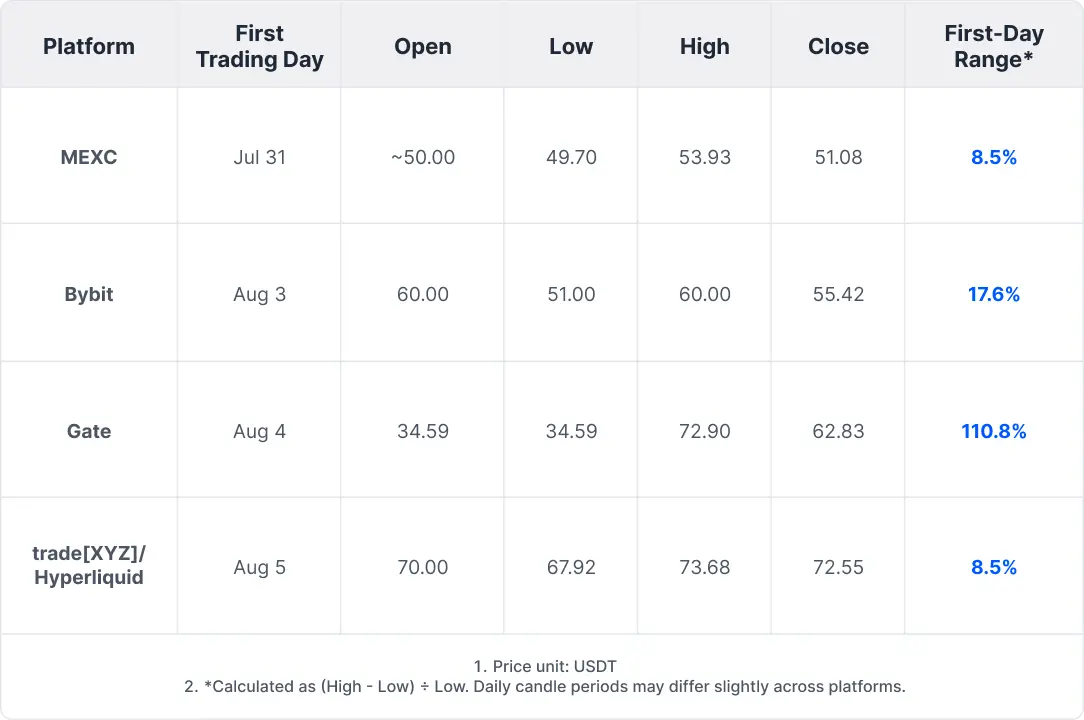
The difference in volatility was significant.
The first-day trading ranges varied significantly across the four markets. MEXC and trade[XYZ] both recorded approximately 8.5% volatility, while Bybit recorded around 17.6% and Gate reached 110.8%.
After multiple platforms launched their UNITREEUSDT Pre-IPO Futures, pricing continued to evolve as traders incorporated new information and adjusted their expectations.
4. How Did New Information Reshape the Price Over 19 Days?
The initial price only allowed the market to begin trading. Subsequent information determined whether that valuation would be accepted or revised.
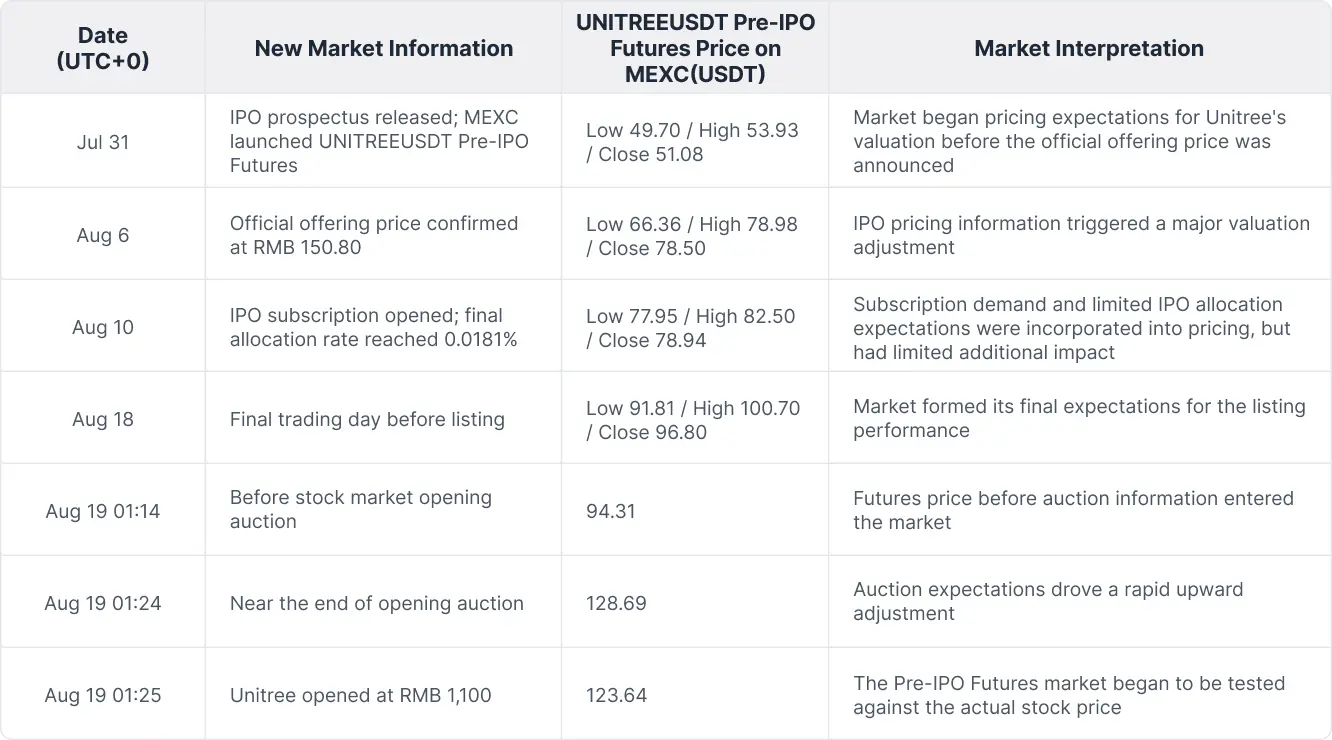
The closing prices from July 31 to August 18 refer to the final candle of each trading day. The three prices on August 19 refer to the corresponding one-minute candle closes.
For traders, the Pre-IPO Futures price provided an early benchmark for how the market valued Unitree. On August 6, Unitree's official offering price was confirmed at RMB 150.80, approximately 45% above the implied reference price of RMB 103.88. On the same day, UNITREEUSDT Pre-IPO Futures closed at 78.50 USDT, up approximately 54% from the July 31 close, marking the most significant repricing event before listing. This showed that the market significantly raised its expectations for Unitree's valuation following the announcement of the official offering price.
But strong demand did not translate into another sharp rally. On August 10, the final allocation rate came in at just 0.01809759%, confirming intense demand for the IPO. Yet UNITREEUSDT Pre-IPO Futures barely moved, closing at 78.94 USDT compared with 78.50 USDT on August 6. The muted reaction suggested that part of the expected demand had already been priced in.
Trading activity also increased noticeably as the listing approached. From August 16 to August 18, the average daily trading volume of UNITREEUSDT Pre-IPO Futures on MEXC increased by approximately 136.6% compared with the period from August 9 to August 15.
Some traders stayed positioned for further gains after the listing, while others took profits or adjusted their exposure ahead of the open. With Pre-IPO Futures, they could react to the offering price, allocation results, and market moves as they happened, rather than waiting for the stock to start trading.
5. How Did Pre-IPO Futures Perform After the Real Stock Price Appeared?
On August 18, the closing prices of four UNITREEUSDT Pre-IPO Futures markets converged within a range of 96.80 to 100.09 USDT.
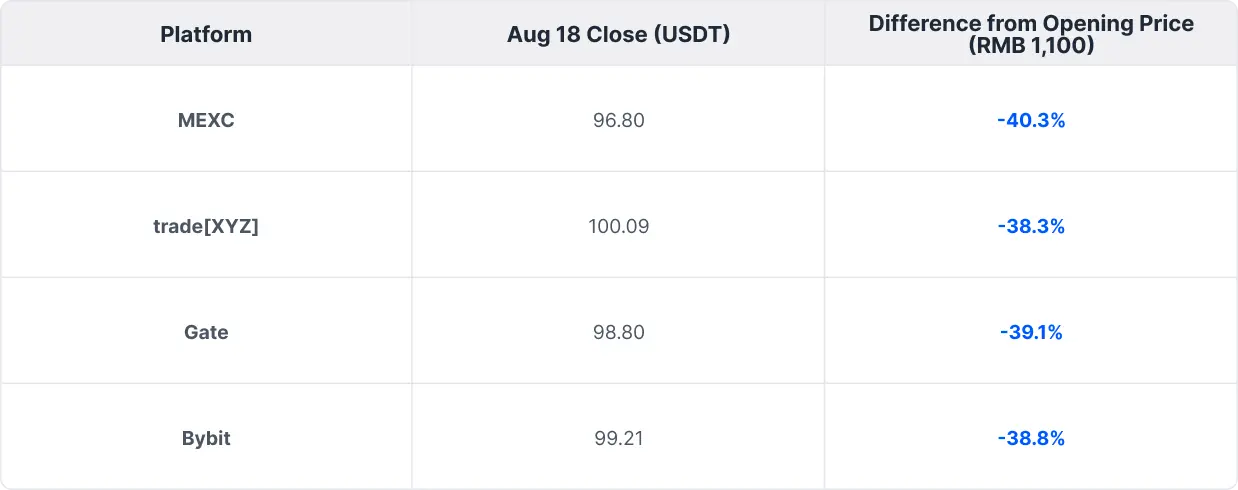
The four markets formed a relatively consistent expectation before listing. However, all prices remained approximately 38% to 40% below Unitree's RMB 1,100 opening price. The entire Pre-IPO Futures market had not fully priced in the strong demand and limited availability reflected in the opening auction.
This indicates that Pre-IPO Futures reflected the information available at the time and the collective expectations of market participants, rather than accurately predicting the final opening price.
The real test began at 01:25 on August 19.
Unitree opened at RMB 1,100, equivalent to approximately USD 162.11 based on the exchange rate at the time. Meanwhile, UNITREEUSDT Pre-IPO Futures on MEXC closed its one-minute candle at 123.64 USDT, creating a nominal price gap of approximately 23.7%.
Following the opening auction, Unitree's stock price quickly pulled back from its auction high, while the MEXC price adjusted in parallel, narrowing the gap between the two markets.
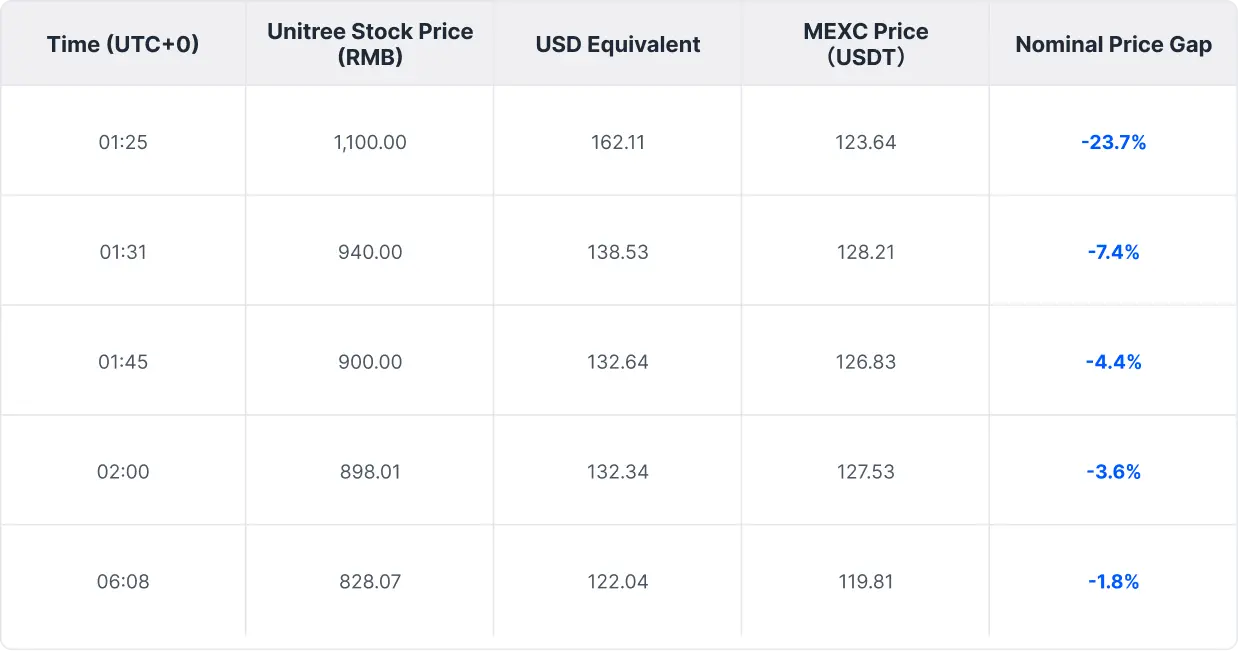
Within six minutes, the nominal price gap narrowed from 23.7% to 7.4%. By 01:45, it had further decreased to 4.4%, and later narrowed to approximately 1.8% at one point in the afternoon.
This process demonstrates how Pre-IPO Futures transition from expectation-based pricing before listing to market-driven price discovery after real trading information becomes available.
Before listing, traders were pricing expectations around future valuation and opening performance. After the stock began trading, UNITREEUSDT Pre-IPO Futures started adjusting around the newly available market reference.
For traders who established positions before listing, trading did not end on the listing day. Existing positions could continue to be managed as UNITREEUSDT Pre-IPO Futures transitioned from Pre-IPO expectation trading into post-listing price tracking.
After transitioning into a standard perpetual futures product, UNITREEUSDT Futures on MEXC supports up to 25x leverage and launched a 0-fee trading event. Specific fee structures, event periods, and eligible regions are subject to official announcements.
Leverage can improve capital efficiency, but it also amplifies potential losses caused by price fluctuations.
Conclusion
Over those 19 days, Unitree was already being priced in the futures market before its offering price had been set or subscriptions had opened. Traders were putting real capital behind their views on what the company could be worth at listing.
As more high-profile AI and robotics companies head toward public markets, the point at which investors can take part in price formation keeps moving earlier. Pre-IPO trading is giving investors a new way to gain exposure and position around listing expectations before shares begin trading publicly.
Risk Disclosure
-
UNITREEUSDT Pre-IPO Futures are USDT-settled derivative products. They do not represent ownership of Unitree shares, provide shareholder rights, or involve IPO subscription, delivery, or one-to-one conversion with the underlying stock.
-
Price differences between Pre-IPO Futures and listed shares may be affected by liquidity, funding rates, mark price mechanisms, leverage, and trading hours. Such markets do not represent risk-free arbitrage opportunities.
-
Historical price movements of UNITREEUSDT Pre-IPO Futures reflect a specific market event and should not be interpreted as a prediction for future Pre-IPO Futures products or investment advice.
 Risk warning


Popular articles