








Non-farm payrolls disappointed, yet U.S. Treasury yields remain stagnant: what Wall Street is truly worried about has arrived
 Core Viewpoint

 A surprising employment report lowered expectations for short-term interest rate hikes, but failed to shake long-term yields—Wall Street's real anxiety has shifted from the next rate hike to a more challenging question: how long can the economy hold up if borrowing costs refuse to decline?
Author: Gao Zhimou, Wall Street Journal
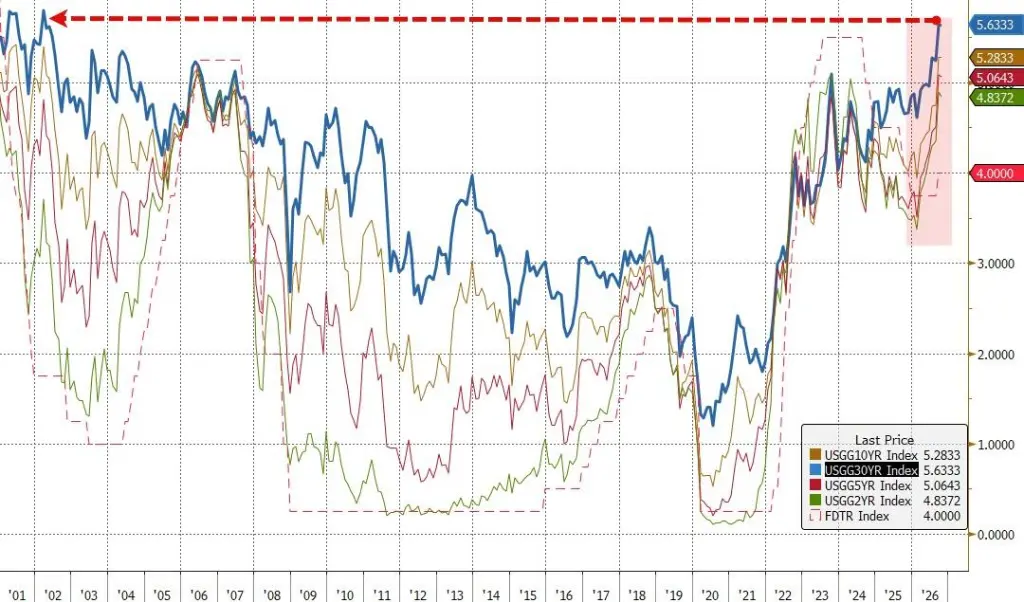
In September, the U.S. non-farm payrolls increased by only 29,000, far below the expected 90,000, but the 10-year U.S. Treasury yield quickly rebounded by more than 10 basis points to 5.30% after a brief dip, showcasing a V-shaped reversal.
A surprisingly weak employment report lowered short-term rate hike expectations but failed to shake long-term yields—Wall Street's real anxiety has shifted from the next rate hike to a more challenging question: How long can the economy hold up if borrowing costs refuse to decline?
The real estate market is frozen, consumer credit is increasingly punitive, and financing costs for weak borrowers are high—cracks in the 5% interest rate environment have already appeared, only masked by the shine of leading stock indices.
Non-farm Payrolls Surprise, Bond Market Only Gives Half a Day's Respect
Data from the U.S. Department of Labor on Friday showed that non-farm payrolls increased by only 29,000 in September, below the lower limit of all forecasts; August data was revised down from 162,000 to 133,000, and the unemployment rate slightly rose to 4.2%, with average hourly wage growth slowing to 3.0% year-on-year.
Subsequently, the two-year U.S. Treasury yield fell by 10 basis points to 4.69% in one day, the S&P 500 futures rose by 0.8%, and the Nasdaq 100 futures rose by 1.1%. CME FedWatch showed the probability of a rate hike in October dropped from 22% to 17%. Jefferies Chief U.S. Economist Thomas Simons stated that this data "should be the final nail in the coffin for an October rate hike."
But the turnaround came quickly. The 10-year yield rebounded rapidly from a daily low of 5.16%, testing 5.30% at midday, approaching the high of 5.34% set on Thursday, the highest since 2002. For the week, the 10-year yield rose by about 12 basis points, climbing for the fifth consecutive week; while the two-year yield fell by about 3 basis points for the week, ending a six-week streak of increases.
The divergence in long and short-term trends points to the same conclusion: weak non-farm payrolls lowered short-term rate expectations, but inflation, fiscal supply, and term premiums still firmly support long-term yields.
Economists generally believe that data distortion stems from seasonal factors. According to Reuters, this year's Labor Day holiday fell at the end of the month, which historically tends to lead to lower statistical reporting. The number of initial jobless claims still hovers at a 57-year low, with healthcare, construction, and manufacturing maintaining net job growth, showing no signs of large-scale layoffs. Charles Tan, Chief Investment Officer of Century Investment Global Fixed Income, stated:
"This marginally provides more reasons for the Federal Reserve to stay put. But conversely, just one or two hot inflation data points could push the market back to a hawkish stance."
K-Shaped Divergence Under 5% Interest Rates
Stock investors are most concerned about the speed of rising yields, but the economy ultimately must bear the absolute height at which yields remain.
"There is a huge divide between the real economy and AI/capital expenditures," said Brad Conger, Chief Investment Officer of Hirtle & Co. Strong earnings and the wave of AI spending have kept major stock indices near record levels—NVIDIA hit an all-time high during trading on Friday, with a market cap approaching $6 trillion, and the Nasdaq 100 index closed at a new record. However, beneath the indices, market breadth has narrowed. The banking, industrial, and utility sectors have softened, with the KBW Bank Index falling 2.78% for the week. Among the three major indices, only the Nasdaq rose by 0.45% for the week, while the S&P 500 fell slightly by 0.27%, and the Dow Jones dropped by 1.26%.
"I don't think there is a critical point where everything suddenly collapses, but we are already in a range where some industries are feeling pain," Conger pointed to real estate, automotive, consumer loans, and credit cards.
Nancy Tengler of Laffer Tengler Investments is relatively optimistic: "Sometimes rising yields are a good thing." She believes that if companies can borrow at a 5% cost and generate returns of 15%-20%, "they should do it all day long." Michael Alfaro, a fund manager at Gallo Partners, pointed out that there is no sign of a slowdown in the private sector's massive spending in data centers, and companies related to AI and aerospace have a much higher tolerance for high interest rates than traditional industries.
The Real Risk: How Long Will High Rates Last
The current economy still has a buffer against high interest rates.
Max Gokhman of Franklin Templeton noted that most U.S. homeowners hold fixed-rate mortgages with an average interest rate of about 4%, isolating them from new rate shocks in the short term; only about 13% (approximately $570 billion) of non-financial corporate debt is due by 2027. It is estimated that about $300 billion of AI-related financing is primarily from investment-grade companies, which are capital-rich and not sensitive to funding prices.
But the buffer has an expiration date.
"5% is not the last straw that breaks the camel's back, but it is another heavy sack on the weary hump; if some weight is not unloaded, a collapse is just a matter of time," Gokhman said. "We have already seen economic pressure from the latest employment data and sentiment indicators."
A more dangerous scenario is that inflation continues to push yields higher while growth simultaneously weakens. The conflict between the U.S., Israel, and Iran has driven up energy prices, with diesel prices reaching historic highs; declining refining capacity in the Middle East and Russia has made refined oil supply a new pressure point—G7 announced on Friday the coordination of releasing 100 million barrels of reserves through the IEA, focusing on diesel, with WTI crude oil briefly dropping over 5%. Ongoing tariff frictions are also suppressing companies' willingness to expand production, with ISM surveys showing manufacturers' concerns about the Canada trade dispute continuing to heat up.
"Then stocks and fixed income could fall simultaneously, replaying a scene similar to 2022, with commodities becoming the only safe haven," Gokhman said. He and his team have increased commodity allocations in their portfolios to hedge against this possibility.
The pressure in the global bond market is also spreading. The spread between 10-year French and German government bonds widened to 150 basis points on Friday, reaching the widest level since the European debt crisis in 2012.
A non-farm payroll report can temporarily lower short-term rate expectations, but long-term yields remain unchanged—the true test of the 5% era lies in how long it will last.
 Risk warning


Popular articles





