








Is it war or negotiation? The US and Iran enter a "critical week," with oil prices still maintaining above the 100 yuan mark
 Core Viewpoint

 Recently, Trump has intensively stated that Iran "either signs the agreement or ceases to exist," while three U.S. aircraft carrier strike groups are simultaneously gathering in the Middle East. Reports indicate that Saudi Arabia is preparing for a large-scale counteroffensive against the Houthis, and the Mandeb Strait is in a state of emergency. Bank of America pointed out that the pricing of Brent at around $103 falls precisely between "sporadic conflicts" and "intense battles." This week, Trump's decisions, Iran's responses via Qatar, and the developments in Yemen will determine the direction of oil prices, and the boundaries between war and negotiations between the U.S. and Iran may become clearer.
Author: Bao Yilong, Wall Street Journal
The confrontation between the U.S. and Iran has entered a new critical phase. Against the backdrop of stalled negotiations and ongoing military deployments, Trump has continuously sent out hardline signals, while Iran has warned of a "more devastating" retaliation while also stating that it has not closed the door on diplomacy.
According to Xinhua News Agency, on October 4, Iranian Foreign Minister Amir-Abdollahian stated, "Although Iran is still willing to seek a 'just and dignified' solution through diplomatic means, if the enemy resorts to military action again, Iran will respond with a 'more devastating' counterattack than before."
Trump stated to reporters outside the White House last weekend, "I will make a decision regarding Iran. It will either be the easy way or the hard way." He did not disclose a specific timeline, only leaving the remark, "You will see." Meanwhile, Axios reported that last Friday, U.S. Vice President Pence, Secretary of State Rubio, Defense Secretary Pete Hegseth, Special Envoy Steve Witkoff, CIA Director John Ratcliffe, and Chairman of the Joint Chiefs of Staff General Dan Caine gathered at Camp David for a secret meeting, with the Iranian situation and the Yemen Houthi issue on the agenda.
Bank of America pointed out that the current pricing of Brent at around $103 is right between the scenarios of "sporadic conflict" and "intense combat." This week, Trump's decision, Iran's response via Qatar, the situation in Yemen, tanker attack dynamics, domestic pressures in Iran, and macro cross risks will collectively determine which scenario range oil prices will fall into. The boundary between war and negotiation may become clearer this week.
Trump's continuous diplomatic pressure and military chips gathering in the Middle East
Wall Street Journal mentioned that according to CCTV news, Trump explicitly stated in an interview with Time magazine that if the U.S. and Iran cannot reach a satisfactory agreement for the U.S., military action may resume after the midterm elections; later that evening, while traveling to Oklahoma, he again told reporters:
They will either sign a very fair agreement or they will not exist.
Xinhua reported that Iranian Foreign Minister Amir-Abdollahian stated on October 4 that during a recent trip to New York for the United Nations General Assembly, the Iranian delegation proposed a plan aimed at resolving differences and ending the current hostile state with the U.S. If this plan is adopted by the U.S., the Strait of Hormuz will reopen within seven days. Amir-Abdollahian said that the U.S. has already faced failures in both military and diplomatic fields, and the new sanctions imposed on Iran are also destined to be futile, hoping the U.S. will choose a wise and rational path. He stated, "The only way out is to seek solutions through diplomacy and negotiation based on justice and fairness."
Meanwhile, U.S. military deployments are still advancing. According to The Wall Street Journal, the "Theodore Roosevelt" carrier strike group has departed from San Diego, and the "Makin Island" amphibious readiness group has also set sail, with the two groups carrying over 7,000 sailors and about 2,000 Marines, expected to arrive in the Middle East around the end of October.
At that time, the U.S. will form a deployment of three carrier strike groups near Iran. According to Bloomberg, this level of troop concentration has not been seen since the early stages of the Iraq War in 2003.
Previously, Bloomberg reported that Iranian officials themselves believe that the likelihood of reaching an agreement before the November 3 midterm elections is extremely low, while "the possibility of escalation after the elections is very high." This means that the diplomatic window from this week to next week may be the last relatively controllable negotiation time before the midterm elections.
The war in Yemen continues, and the second energy corridor is in crisis
The complexity of the situation further escalated over the weekend.
Wall Street Journal mentioned that according to CCTV news, the Houthi armed group in Yemen issued a statement on the evening of October 3, local time, saying that in response to Saudi airstrikes on Sana'a and other areas in Yemen, the Houthis used multiple ballistic missiles and drones to strike targets of Saudi Aramco in the capital Riyadh, claiming the operation "successfully achieved its goals," "hitting the targets and causing fires."
Meanwhile, according to Axios, citing two U.S. officials, Saudi Arabia is planning to launch a large-scale military operation against the Houthi armed group in the coming days, targeting the coastal areas that allow the Houthis to control the critical maritime passage of the Bab-el-Mandeb Strait. The report states that the operation will be led by ground forces of the Yemeni government, supported by Saudi air power, focusing on striking the strategic footholds of the Houthis along the coast.
The core interests of this conflict also point to energy. Last month, the Houthis seized the Bab-el-Mandeb Strait and about 150 kilometers of the Red Sea coastline, which is a key alternative route for Saudi Arabia to export crude oil to the West, bypassing the Strait of Hormuz.
Negotiations stalled, seven conditions blocking the Strait of Hormuz
On the negotiation front, significant differences remain. Iranian Speaker and Chief Negotiator Mohammad Baqer Qalibaf stated according to Reuters:
The Strait of Hormuz will not reopen unless our seven conditions are met; the era of the U.S. delaying the negotiation process and making unilateral demands is over.
Iran's seven conditions include: lifting the maritime blockade, returning frozen assets, canceling sanctions on Iranian oil exports, stopping actions justified by military threats, ending the war against Iran and its regional allies, withdrawing U.S. forces from around Iran's borders, and compensating for war losses while promising not to interfere with Iran's nuclear and missile capabilities.
Trump has previously made it clear that he rejects the proposal to reopen the strait within seven days based on these conditions, believing that Iran's proposal is "far from sufficient."
Baqer stated that Iran will provide "additional detailed opinions" on the proposal conveyed by the U.S. through Qatar before responding. According to a knowledgeable official cited by Reuters, the differences between the two sides are not about the content of the steps but about the order in which each step is advanced. The diplomatic window has not completely closed, but the passage is narrowing.
Why are oil prices still above $100? Goldman Sachs provides the answer
In response to the market confusion of "Why are oil prices still above $100 when Gulf exports have returned to pre-war levels," Goldman Sachs commodity trading strategist Thomas Evans explained in a weekend report:
Supply tightness has eased, but risk premiums have not dissipated. Futures and spreads remain at recent highs as the market is still pricing in a significant risk premium.
Thomas Evans estimates the spot-futures price spread to be around $20 to $25 per barrel. He further emphasized:
The real risk is that if strikes cause Gulf shipments to drop below 50% within days, the current buffer has significantly thinned, and at that point, inventories and prices will see a substantial spike.
According to Bloomberg, Energy Aspects data shows that global oil inventories have decreased by over 400 million barrels since March, with a total of about 4.3 billion barrels at a five-year low. Tanker rental rates from the Persian Gulf to China have surpassed $1.2 million per day. Since last Thursday, there have been at least four tanker attacks in the southern waters of Oman, and if the UK Maritime Trade Operations (UKMTO) continues to issue warnings at this frequency, the current supply recovery reliant on "dark line exports" will face severe challenges.
Goldman Sachs' co-head of global oil and product trading Jerome Dortmans bluntly stated:
Iran has significant capabilities to disrupt shipments through the Strait of Hormuz… The U.S. announcing the deployment of a third carrier strike group and 10,000 Marines to the region is definitely a signal that Iran cannot ignore.
Is "Decision Week" approaching? The easy path or the hard path, the market is already pricing it in
Bank of America's commodity team raised its Brent benchmark forecast for the second half of 2026 from $83 to $95, citing that "sporadic conflicts may continue until the end of the year." The current pricing of Brent at around $103 is right between the scenarios of "sporadic conflict" and "intense combat." Bank of America provided the complete scenario paths as follows:
- Reaching an agreement and restoring the memorandum of understanding (low probability): Shipments through the Strait of Hormuz return to over 10 million barrels per day, with an average Brent price of $83 in the second half of 2026;
- Maintaining sporadic conflict (baseline scenario): Intermittent shipments of about 5 million barrels per day, with an average Brent price of $95 in the second half of 2026;
- Resuming intense combat (low probability): Brent rises to $120;
- War affecting energy infrastructure (tail risk): Brent averages $150 or even higher.
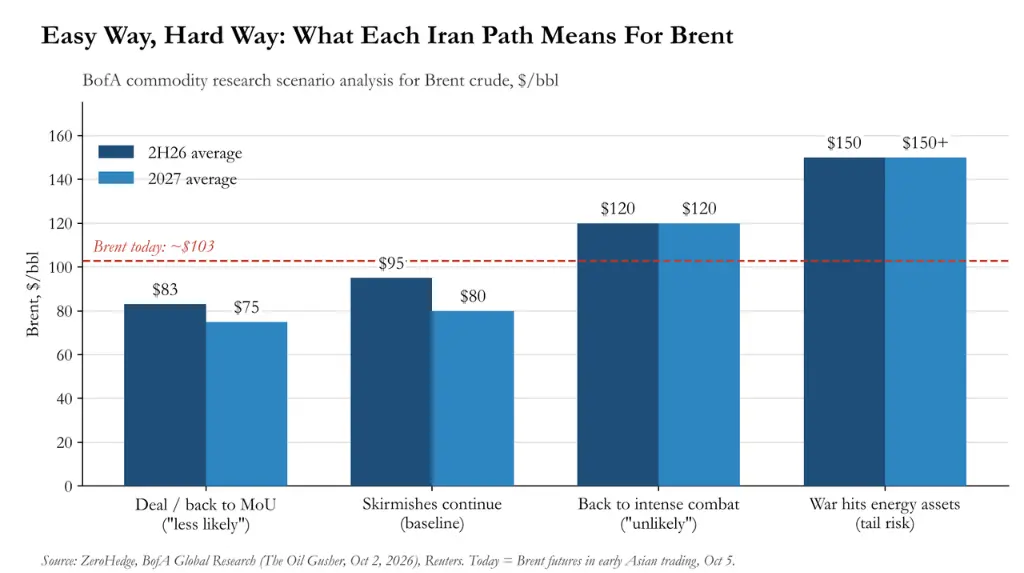
According to Bank of America analysis, the following clues this week will collectively determine which scenario range oil prices will fall into:
First, Trump's "decision." He has made the remark "You will see" three times in the past five days. Whether the Camp David meeting leads to a substantive decision and whether there is an official announcement released externally is the most critical observation point this week.
Second, Iran's response via Qatar. Baqer stated that additional opinions still need to be conveyed to Washington through Qatar. The real differences between the two sides lie in the order of advancing each step, rather than the content of the terms themselves—whether this crux can show any signs of loosening this week will determine whether negotiations truly enter a substantive phase.
Third, the situation on the Yemen battlefield. The Houthis are advancing toward the last road between Taiz and Aden. Whether Saudi Arabia can make progress in its military actions along the Bab-el-Mandeb Strait and whether Riyadh or Hodeidah suffers confirmed strikes will directly affect the security expectations of the second energy corridor.
Fourth, the dynamics of tanker attacks in southern Oman. Since last Thursday, at least four tankers have been attacked. If UKMTO continues to issue warnings at this frequency, the supply recovery reliant on dark line exports will face substantial impacts.
Fifth, domestic pressures in Iran. The position of Iran's oil minister is vacant, the rial exchange rate has dropped to 2.7 million to 1 U.S. dollar, and inflation is approaching 90%. The level of internal pressure in Tehran is also an important variable in judging whether its negotiation bottom line can loosen.
Sixth, macro cross risks. The Federal Reserve will release the FOMC meeting minutes on Wednesday, along with 10-year and 30-year U.S. Treasury auctions; China will return to the market on Thursday after the Golden Week holiday, combined with the policy background of halting fuel exports in October. Goldman Sachs pointed out that oil prices are currently "more correlated with interest rates than usual," and the aforementioned macro factors cannot be ignored in their transmission to crude oil trends.
Bloomberg cited the judgment of Chatham House researcher Aniseh Bassiri Tabrizi to conclude:
Both sides generally hope to reach an agreement, but they are moving further apart.
Above the $103 oil price, the market has already given its judgment—sporadic conflicts will continue, but the boundary between war and negotiation will become clearer this week. As Trump himself said, "You will see."

 Risk warning




Popular articles





