Bank of America: After Thanksgiving, the market is highly likely to welcome a short-term rebound, but a major market trend needs to meet three key conditions
 Core Viewpoint


 Bank of America chief strategist Hartnett expects that the breadth of global stock markets has deteriorated to extreme levels. After Thanksgiving, U.S. stocks are likely to see a technical rebound, but a real market rally still requires three conditions: the yield on the 10-year U.S. Treasury bond must fall below 4.5%, WTI crude oil must drop below $70, and the U.S. dollar must confirm a peak. Meanwhile, stock funds continue to flow in, and positions have not yet been fully cleared. Bank of America warns that the market underestimates the risk of a hard landing, with a slowdown in AI capital expenditure and wealth effects, and investors should wait for a clearer risk release.
Author: Bu Shuqing, Wall Street Watch
Michael Hartnett, Chief Investment Strategist at Bank of America, provided his assessment in the latest edition of The Flow Show: After Thanksgiving, U.S. stocks are likely to experience a technical rebound, but this is just a short-term respite. For it to evolve into a major market trend, the market must see three conditions met simultaneously: the 10-year U.S. Treasury yield must fall below 4.5%, WTI crude oil must drop below $70 per barrel, and the dollar must confirm a peak following weak employment and inflation data.
The direct reason triggering this rebound expectation is that market breadth has deteriorated to extreme levels. Bank of America's Global Breadth Rule shows that as of November 18, 68% of global stock indices are in an "oversold" state, having simultaneously fallen below the 50-day and 200-day moving averages. According to this rule, when 88% of the market is in an oversold condition, it constitutes a significant contrarian buy signal for risk assets. Hartnett stated that this threshold "is likely to be triggered in the coming days," providing short-term relief for oversold stocks after Thanksgiving.
The market has indeed been oversold. According to Bank of America statistics, crude oil has risen 44.9% this year, the dollar index has increased by 5.7%, while U.S. stocks have only risen 4.8%, global stocks have increased by 4.4%, and cash has grown by 3.3%. High-yield bonds have fallen by 1.2%, investment-grade bonds by 3.0%, government bonds by 3.9%, gold by 15.1%, and Bitcoin by 29.5%. During the same period, the Nasdaq has retreated 15% from its peak, bank stocks have dropped 16%, and crude oil has fallen 22% from its high. The 30-year U.S. Treasury bond is heading towards its sixth consecutive year of negative price returns, marking the longest record since the Vietnam War from 1963 to 1969.
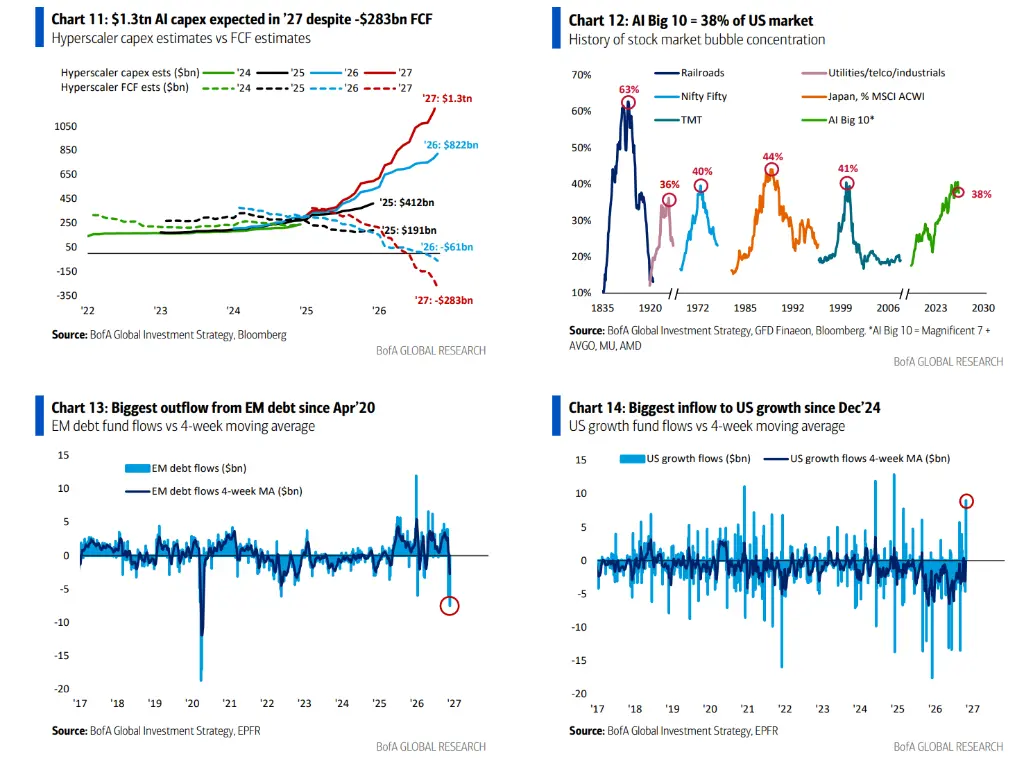
However, Bank of America warns that a sell-off in prices does not equate to a sell-off in positions. Over the past week, global equity funds still saw an inflow of $66.6 billion, with U.S. growth funds attracting $9.1 billion, marking the largest single-week inflow since December 2024; in the November fund manager survey, cash levels were only at 3.6%, within the "sell" range, and asset allocators generally favored long positions in stocks and short positions in bonds. In Bank of America's view, this indicates that more position clearing is needed before a comprehensive buy signal for risk assets can be given.
Breadth Rule Approaching Threshold, But Only "Short-Term Relief"
Bank of America's Bull-Bear Indicator dropped from 7.4 to 7.1, signaling neutrality.
In terms of components, hedge fund positions are at a neutral percentile of 56%, stock fund flows are at an extreme bullish percentile of 99%, fund manager survey positions are at an extreme bullish percentile of 100%, while global stock index breadth is only at 18%, in an extreme bearish percentile. Significant outflows from emerging market bonds and high-yield bonds, weakening credit technicals (widening spreads between high-yield bonds and subordinated bank bonds), deteriorating stock market breadth, and a shift to short positions in futures have collectively depressed this reading. The old Bull-Bear Indicator is currently at 6.2.

The current reading of Bank of America's Global Fund Flow Trading Rule is 1.1%, also neutral. This rule issues a buy signal when global stocks and high-yield bonds flow out more than 1% over four weeks, and a sell signal when inflows exceed 1%.
The report clearly states that the triggering of the breadth rule brings "short-term relief for oversold stocks after Thanksgiving," rather than a trend reversal. A true major market trend requires the simultaneous realization of the three macro conditions listed in the following sections.
Three Conditions: Yield, Oil Price, and Dollar
The first condition is that the 10-year U.S. Treasury yield must fall below 4.5%. Bank of America believes that the biggest threat to risk assets right now is not the downward movement of yields during a recession, but rather the upward movement of yields due to excessively high debt levels. The price of the 30-year U.S. Treasury bond has fallen 62% from peak to trough, and the current 30-year yield is only 25 basis points away from its recent high.
The second condition is that WTI crude oil must drop below $70 per barrel. High oil prices have been the core of this year's best trade of "going long on oil and short on cryptocurrencies," and are a key variable suppressing consumption and inflation expectations.
The third condition is that the dollar must peak, and this must be predicated on weak employment and inflation data. Bank of America refers to the dollar as a "wrecking ball," believing that a peak in the dollar, along with bottoms in Bitcoin, gold, and the Korea Composite Stock Price Index (KOSPI), are the best indicators for measuring the peak of interest rate hike concerns, as these four asset classes are the first "casualties" to sense the interest rate hike cycle.
"Market of Two Questions": When Will Rate Hikes Stop, and Will They Stop Before a Recession?
Hartnett summarizes the market entering 2027 as a "market of two questions": When will the rate hike cycle end, and will it end before a recession?
The background he provides is that there will be a total of 71 rate hikes globally between June 2026 and May 2027, combined with excessive bullish sentiment, putting continued pressure on risk assets. If the Federal Reserve remains Wall Street's "best friend," viewing the stock market as too big to fail, then the declines in credit and the stock market itself could short-circuit the rate hike cycle. The specific threshold is an IG CDX spread exceeding 80 basis points, or the S&P 500 falling below 6,845 points, erasing the annual gains.
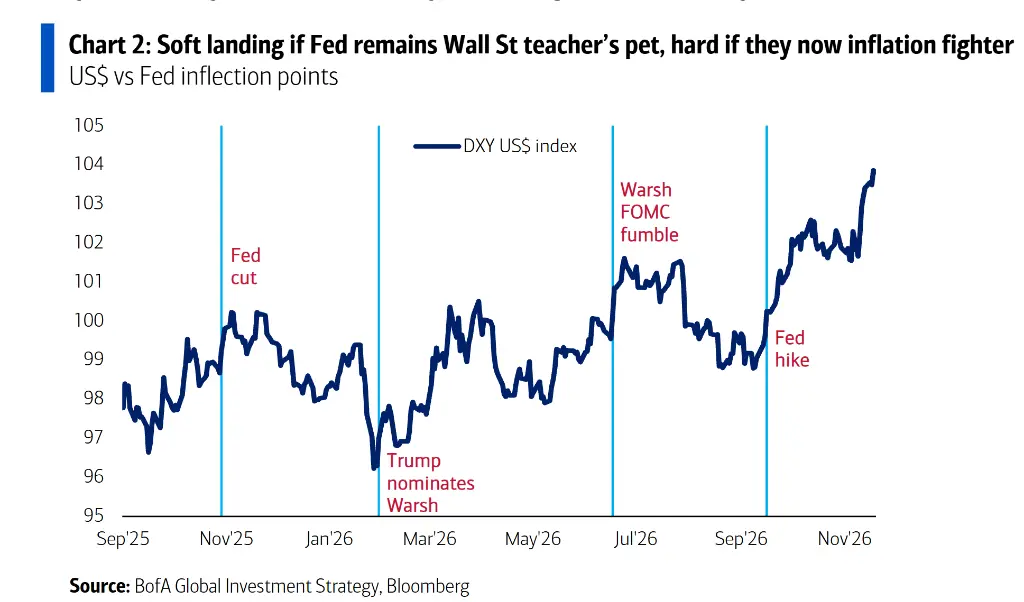
However, after the midterm elections, voters clearly demand "affordability." If the Federal Reserve turns into an inflation "hardliner," investors may have to wait until the FOMC meetings on March 18 or April 28 to start pricing in the end of the tightening cycle, with hard landing risks subsequently rising. Bank of America's timeline outlines: On October 29 last year, the Fed's dovish rate cut corresponded with Bitcoin's peak; on January 30, Trump's nomination of Warsh corresponded with gold's peak; on June 17, Warsh's dovish FOMC "misstep" corresponded with the Philadelphia Semiconductor Index and KOSPI peaks; on September 16, the Fed's hawkish rate hike corresponded with copper price peaks, IG spread lows, and a surge in the dollar.
Hard Landing Probability Underestimated: Wealth Effect and AI Capital Expenditure Both Slowing
Bank of America's disagreement with market consensus centers on this: the probability of a hard landing is underestimated, while "prosperity" expectations are too high. The current consensus predicts nominal GDP growth of 5% to 6% in 2027 and earnings per share growth of over 15%, which Bank of America believes are both overly optimistic.
The two engines supporting U.S. nominal GDP and earnings per share are weakening. One is household stock wealth, which has shrunk by about $5 trillion this quarter, although it is still expected to increase by about $8 trillion for the full year of 2026; the second is AI capital expenditure, with estimates for ultra-large cloud providers' capital expenditure in 2027 reaching $1.3 trillion, while free cash flow is negative $283 billion. Bank of America states that voters, the bond market, and asset allocators are all saying "slow down AI data center construction."
In terms of leading indicators for a recession, Bank of America places the most importance on initial jobless claims and credit spreads: once initial claims exceed 250,000 and IG spreads exceed 100 basis points, it signifies a shift from a "prosperity cycle" to a "doom cycle," forcing asset allocators to reduce stock holdings and increase allocations to bonds, dollars, and assets negatively correlated with AI, such as REITs and real estate, i.e., "going long on apartments and short on chips," reversing the long-term themes since the 2020s.
This shift means reversing the four major themes of the past few years: including ABB (Anything but Bonds, buying everything except bonds, catalyzed by debt and deficits, with a 62% price return from peak to trough for the 30-year U.S. Treasury bond), ABD (Anything but the Dollar, holding everything except the dollar, catalyzed by depreciation concerns, with Bitcoin and gold peaking in October and January with annualized gains of 44% and 23%, respectively), and AI (fully betting on artificial intelligence, catalyzed by disruption, with the Nasdaq's market value increasing by $26 trillion since March 2023, and the top ten AI-weighted stocks accounting for 38% of the S&P 500).
Funds Still Flowing into Stocks, Bonds and Gold Losing Ground
Over the past week, global equity funds saw an inflow of $66.6 billion (with ETFs seeing an inflow of $73.5 billion and mutual funds experiencing an outflow of $6.8 billion), cash inflows were $400 million, gold inflows were $200 million, cryptocurrency outflows were $1.1 billion, and bonds saw an outflow of $7.4 billion, marking the first outflow since April 2025.
In terms of specifics, emerging market bonds saw an outflow of $7.5 billion, the largest since April 2020; investment-grade bonds had an outflow of $700 million, the first in two months; TIPS had an outflow of $22 million, the first since January 2026; European stocks saw an inflow of $1.5 billion, the largest since February 2026; Japanese stocks had an outflow of $4.2 billion, the largest since May 2026; U.S. growth funds saw an inflow of $9.1 billion, the largest since December 2024; technology funds had an inflow of $5.4 billion, marking the eighth consecutive week of inflows.
Bank of America manages $4.6 trillion in assets for private clients, with stock allocation at 65.7%, bonds at 17.7%, and cash at 9.4%, still increasing stock positions: stock ETF shares increased by 1.1% over the past four weeks, and by 9.5% year-to-date. Over the past four weeks, private clients bought bank loans, TIPS, and high-yield bond ETFs, while selling utilities, consumer discretionary, and energy ETFs.
For the full year of 2026, global equity funds set a record with an annualized inflow of $1.5 trillion, global bonds saw inflows of $909 billion, U.S. stocks $751 billion, U.S. large-cap stock funds $669 billion, investment-grade bonds $443 billion, U.S. Treasury bonds $243 billion, technology funds $229 billion, and Korean stocks $79 billion; consumer funds recorded a record outflow of $20 billion.
In the November fund manager survey, investors' expectations for 2027 are: a soft landing for the global economy, declining inflation, and slowing growth in AI capital expenditure; positioning is bullish on stocks, commodities, emerging markets, healthcare, and industrials, while bearish on cash, bonds, REITs, consumer goods, and energy. They believe the best-performing asset classes will be international stocks (36%) and U.S. stocks (24%), with the best stock markets being the Nasdaq (21%) and MSCI Emerging Markets (21%), and the best currency being the yen (42%). For the target levels at the end of 2027, the median given in the survey is a 10-year U.S. Treasury yield of 4.9%, an exchange rate of 1.12 for the euro to the dollar, an S&P 500 index of 7,926 points, and gold at $4,341 per ounce.
Bank of America's stance on this is to wait. If a soft landing materializes, meaning lower inflation, stable employment, and visible productivity improvements by next spring, then a valuation of 16 times for the equal-weighted S&P 500 index, 15 times for mid-cap stocks, and 12 times for MSCI ACWI excluding the U.S. is not alarming. At that point, one only needs to wait for the narrative to shift from "rate hikes" to "rate cuts" before buying cyclical "C" assets: cryptocurrencies, chips, copper, consumer goods, and apartments. Until then, preserve capital and wait for "fear" to become more evident.
 Risk warning

ChainCatcher reminds readers to view blockchain rationally, enhance risk awareness, and be cautious of various virtual token issuances and speculations. All content on this site is solely market information or related party opinions, and does not constitute any form of investment advice. If you find sensitive information in the content, please click , and we will handle it promptly.




Popular articles