Single-month outflows hit a record, what happened to the Bitcoin ETF?
 Core Viewpoint


 BTC fell along with the U.S. stock market. When the U.S. stock market rebounded, it did not follow suit. Original buyers such as ETFs, treasury funds, and mining companies are all withdrawing.
Author: Zhou, ChainCatcher
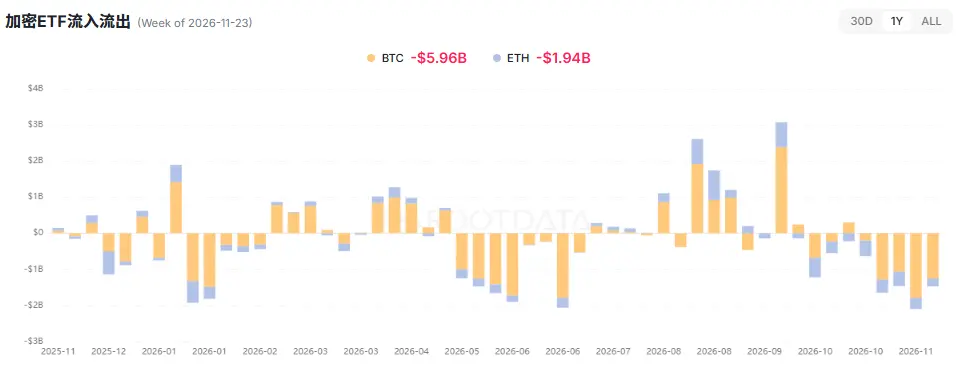
The single-month outflow record for Bitcoin spot ETFs in the United States was refreshed in November. According to RootData, as of November 25, the net outflow this month reached $5.7 billion, surpassing June's $4.51 billion.
Looking at the longer term, the cumulative net outflow this year is approximately $5.96 billion. Meanwhile, Bitcoin fell below $60,000 again in November, hitting a new low since September 2024.
U.S. Stocks Withstood the Impact, Bitcoin Did Not
In September this year, the Federal Reserve raised interest rates for the first time in three years, coinciding with the nearly three-year anniversary of the spot ETF listing, marking the first encounter with a rate hike cycle. Although the interest rate was maintained in the range of 3.75% to 4% during the meeting on October 28, no signals of a shift were released. According to 10x Research, in the following 17 trading days, Bitcoin ETFs experienced net outflows on 14 days.
On the first trading day after the theft of approximately $6.3 billion from Binance, the Bitcoin spot ETF saw a net outflow of about $640 million, the largest single-day outflow since late June. Jeff Ko, Chief Analyst at ViaBTC, believes that the Bitcoin held by the ETF is custodied by regulated institutions and has no direct connection to Binance; this outflow is more of an emotional shock.
However, some have raised questions about the custodial safety of the ETF itself. Yishi from OneKey pointed out that approximately 760,000 Bitcoins in IBIT are mainly custodied at Coinbase, whose insurance coverage of $320 million does not even cover 1% of IBIT's holdings.
Entering November, negative factors within the crypto industry continued to accumulate. On November 3, during the midterm elections, the Democratic Party secured both the House and Senate. Stefan Muehlbauer from CertiK believes that the CLARITY Act is unlikely to pass in both the current and next Congress. On November 11, MSCI announced the removal of Strategy from its index, and the largest Bitcoin treasury company was rejected by index funds.
On a macro level, on November 5, AI stocks plummeted, with the Nasdaq 100 index falling 6.36% in a single day, while Bitcoin dropped about 5.5% on the same day; on November 10, the CPI exceeded expectations, and after the release of the Federal Reserve's meeting minutes on November 18, CME FedWatch indicated that the probability of a rate hike in December had approached 95%.
The key point is that while macro shocks also affected U.S. stocks, the triple negative factors of exchange security, regulatory outlook, and treasury buying pressure only impacted the crypto industry.
The difference in trends is quite evident; since October 28, Bitcoin has fallen about 25%, while the Nasdaq 100 index has only dropped about 10%. Bitcoin fell when U.S. stocks fell, but it did not follow the rebound in U.S. stocks. Glassnode also noted that U.S. stocks have returned above the election day closing price, while Bitcoin fell again after the CPI announcement.
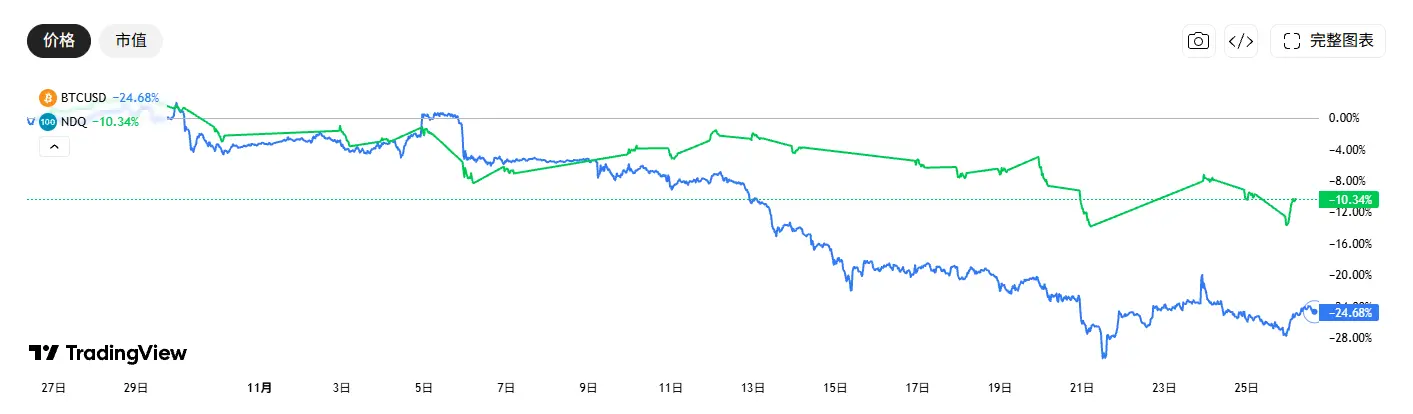
In other words, the interest rate hike and the correction in AI stocks were the triggers, but the real reason Bitcoin cannot recover is the issues within the crypto industry itself.
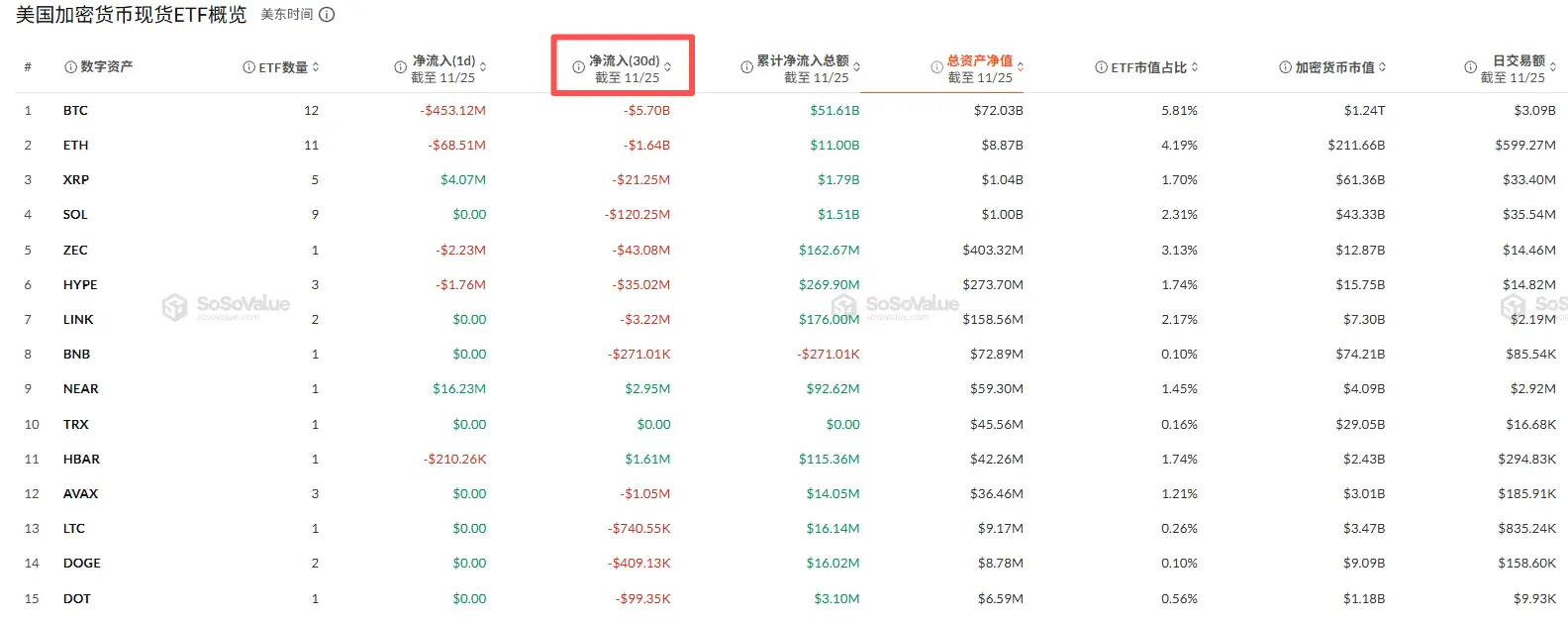
Last November, when BTC and ETH ETFs were bleeding, funds were still flowing into newly listed SOL and XRP ETFs. This year, even the SOL ETF ended its 14-week streak of net inflows in October, turning to outflows. According to SoSoValue, among 15 types of U.S. spot crypto ETFs, 12 types have seen net outflows in the past 30 days; the Ethereum ETF had a net outflow of $1.64 billion during the same period.
Trapped Holders, Absent Buyers
According to the CFTC position report, as of November 17, leveraged funds had only about 1,211 net short positions in CME Bitcoin futures, equivalent to about 6,000 Bitcoins, a reduction of over 90% from the peak in December 2024.
This also means that basis trading had basically withdrawn by early November, yet the ETF continued to experience significant outflows, with more selling coming from actual holders reducing their positions. 10x Research believes this pattern is more indicative of risk control by allocation-type funds.
From the Q3 13F filings, advisory and wealth platforms have become the largest reporting holding group, accounting for about 40.5%. However, the 13F only covers 27.6% of Bitcoin held by funds, and it will not be until February next year that we can partially see who is selling.
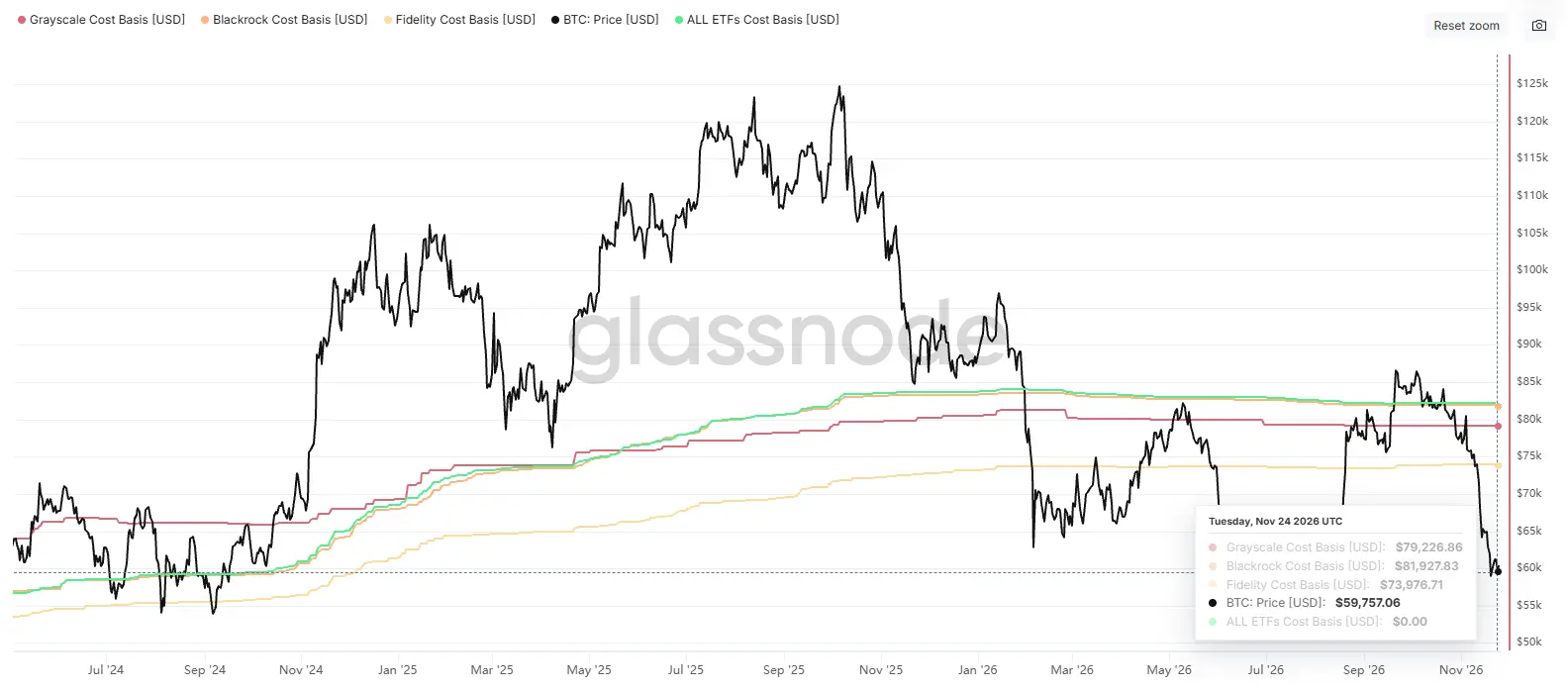
What is certain is that this group of holders is overall trapped. According to Glassnode data, as of November 24, the average cost for BlackRock IBIT holders was about $81,928, while Grayscale and Fidelity were approximately $79,227 and $73,977, respectively, while Bitcoin's price that day was about $59,757. Calculating with IBIT, the unrealized loss is about 27%. The BTC price being consistently below the ETF cost price historically tends to suppress capital inflows.
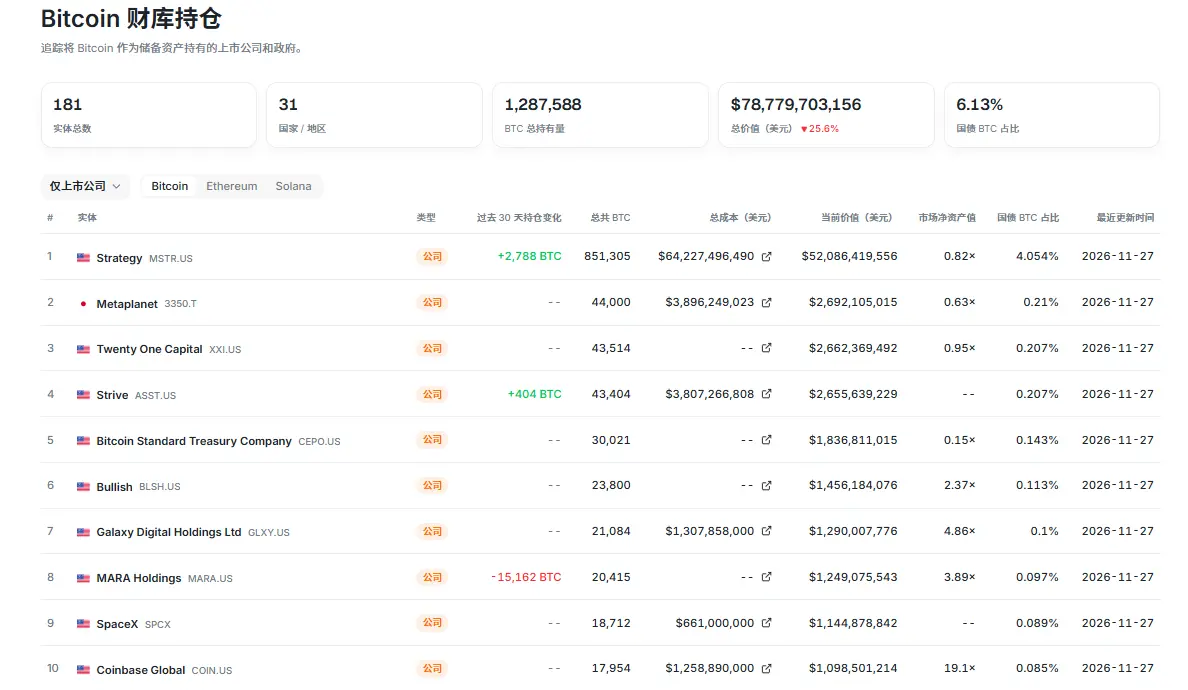
Potential buyers who could take over are also retreating. According to RootData, Strategy holds 851,305 Bitcoins, with an average cost of about $75,000, resulting in an unrealized loss of about 20%, and its mNAV is only 0.83 times, having only increased its holdings by 2,788 Bitcoins in the past 30 days. At the end of May this year, it even sold 32 Bitcoins to pay dividends on preferred shares, the first sale since December 2022.
After the market close on November 30, MSCI will officially remove Strategy, Metaplanet, and Upexi from the index. JPMorgan previously estimated that this could lead to about $2.8 billion in passive selling; however, Strategy stated that the related funds only hold about 3.1% of its shares, so the impact is limited.
MARA was once one of the most steadfast Bitcoin-holding mining companies, but it has now become a seller. According to its Q3 shareholder letter, the company sold 13,597 Bitcoins after the quarter ended, cashing out about $1.1 billion, and stated it would continue to sell to raise funds for AI infrastructure and other projects. RootData shows that MARA's holdings have decreased by 15,162 Bitcoins in the past 30 days.
In the past 30 days, the total market value of stablecoins has shrunk by about $16 billion. According to rwa.xyz, the current total market value of stablecoins is $273.09 billion, down 5.58% from 30 days ago.
Benson Sun, founder of Coinkarma, stated that although long-term indicators have reached a good buying point, the 30-day net flow of stablecoins and ETFs is still outflowing, and he will not buy until the ETF's net inflow turns positive. Everyone is waiting for the ETF to move first, but the ETF has been slow to act.
When Will Funds Return?
According to 10x Research, this is the fourth time since early 2025 that Bitcoin ETFs have seen outflows of $4 billion to $6 billion within 30 days, with the previous three times accompanied by declines of about $20,000. From its rolling 30-day flow chart, the previous outflow lows roughly correspond to the price's periodic lows, and this time the reading is about $4.6 billion, which has fallen within the historical range.
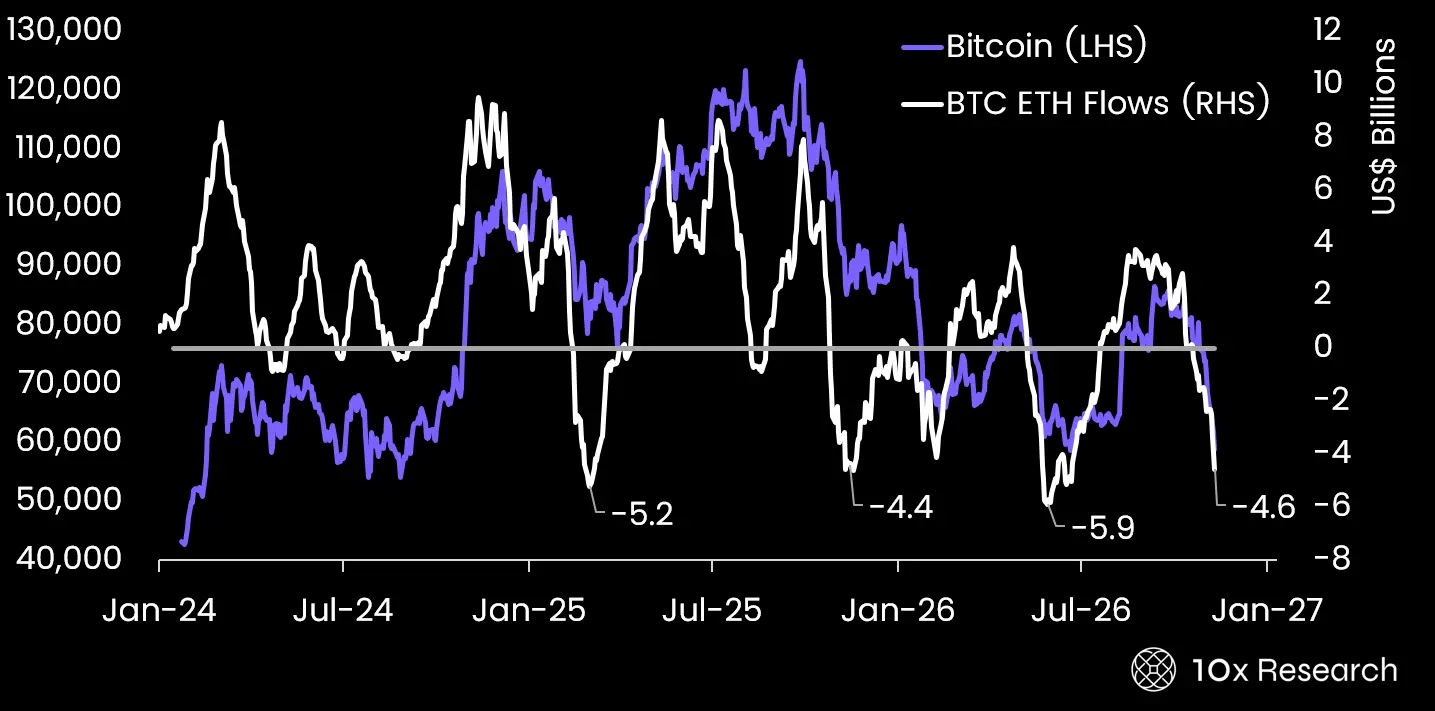
However, there have only been three precedents, making it difficult to determine the bottom based on this.
With only one month left this year, on November 30, MSCI's removal will take effect; the December interest rate meeting is almost certain to raise by 25 basis points, with the key being the Federal Reserve's stance on next year's interest rate path.
Finally, it is worth noting the tax deadline on December 31. Last Christmas week, Bitcoin ETFs experienced six consecutive days of outflows totaling about $1.1 billion. 10x Research estimates that this year there are about $14 billion in unrealized losses in ETF positions that need to be decided whether to sell before the end of the year to realize tax losses.
However, ETF shares are subject to wash sale rules, while directly held Bitcoins are not, so some of the funds sold may not leave Bitcoin. If there is indeed a wave of tax-related selling in December, January might instead see a return of funds.
Overall, this time interest rates are on the rise, treasury companies and mining enterprises are preoccupied with their own issues, and policy dividends are also receding. In the short term, it is likely very difficult to find sufficient strength within the crypto circle to turn ETFs back into net inflows.
ChainCatcher reminds readers to view blockchain rationally, enhance risk awareness, and be cautious of various virtual token issuances and speculations. All content on this site is solely market information or related party opinions, and does not constitute any form of investment advice. If you find sensitive information in the content, please click , and we will handle it promptly.





Popular articles