Scan to download
BTC $70,740.69 -2.62%
ETH $2,076.78 -2.43%
BNB $645.12 -1.41%
XRP $1.42 -4.56%
SOL $81.67 -4.53%
TRX $0.2795 -0.47%
DOGE $0.0974 -3.83%
ADA $0.2735 -4.22%
BCH $457.98 -0.19%
LINK $8.64 -2.97%
HYPE $28.98 -1.81%
AAVE $122.61 -3.42%
SUI $0.9138 -6.63%
XLM $0.1605 -4.62%
ZEC $260.31 -8.86%
BTC $70,740.69 -2.62%
ETH $2,076.78 -2.43%
BNB $645.12 -1.41%
XRP $1.42 -4.56%
SOL $81.67 -4.53%
TRX $0.2795 -0.47%
DOGE $0.0974 -3.83%
ADA $0.2735 -4.22%
BCH $457.98 -0.19%
LINK $8.64 -2.97%
HYPE $28.98 -1.81%
AAVE $122.61 -3.42%
SUI $0.9138 -6.63%
XLM $0.1605 -4.62%
ZEC $260.31 -8.86%

-leverage

Gate launches TradFi API and multi-leverage mechanism to build an integrated smart trading infrastructure

Gate officially launches the TradFi trading API and simultaneously upgrades the leverage mechanism for TradFi products, further enhancing the maturity of the multi-asset trading ecosystem. The newly introduced TradFi trading API supports automated trading for metals, foreign exchange (FX), indices, commodities, and other mainstream global asset classes. Users can directly access the Gate TradFi trading system through the API.In terms of functionality, this API supports programmatic order submission and management, meeting the needs of algorithmic trading and systematic strategy execution; it also provides real-time market data and order book depth information, offering data support for quantitative analysis and strategy optimization. Additionally, account and position information can be called in real-time through the interface, including balance inquiries, position details, and historical order records, enhancing overall operational and risk control efficiency.In terms of product mechanisms, the Gate TradFi zone innovatively launches an adjustable leverage mechanism, adding multiple leverage options on top of the maximum 500x leverage to meet different strategy needs and enhance the flexibility of position and capital management. The multi-leverage structure continues to maintain the advantages of high-efficiency trading while providing a more flexible parameter space for diversified strategy execution.At the same time, the platform continues to adopt a unified account system, allowing users to trade digital assets and traditional financial products such as metals, foreign exchange, and indices under the same account, using USDT as the unified margin asset to achieve cross-market capital sharing and flexible allocation.The launch of the TradFi trading API creates a closer synergy between programmatic trading capabilities and the multi-leverage mechanism. The automated interface significantly enhances strategy execution efficiency and systematic management levels, while the multi-leverage structure provides more refined options for strategies with different risk preferences and trading cycles.Currently, Gate has established a multi-asset trading system covering digital asset spot, derivatives, and traditional financial products. With the launch of the TradFi API and the implementation of the multi-leverage mechanism, the platform's synergy capabilities in terms of unified accounts, unified margin, and trading tools have been further strengthened, providing more efficient cross-market solutions for institutions and professional users. Looking ahead, Gate will continue to improve interface capabilities and product structures, deepen multi-asset integration and technological upgrades, and accelerate the construction of an integrated intelligent trading infrastructure, expanding broader development space in the competitive landscape of global comprehensive trading platforms.

Arthur Hayes: The Japanese market is disrupting the global scene, and positions in high-leverage Bitcoin-related assets such as Strategy and Metaplanet have been closed

Arthur Hayes published an article titled "Woomph" analyzing that the recent continuous depreciation of the yen and the decline in Japanese government bond prices are triggering "anomalies" in the global financial markets. He believes that the Federal Reserve and the U.S. Treasury may be forced to work together to directly intervene in the yen exchange rate and the Japanese government bond market by expanding their balance sheets, thereby injecting new liquidity into the global fiat currency system.He stated, "The yen is strengthening against the dollar, and Bitcoin prices are falling. I will not increase risk until it is confirmed that the Federal Reserve is printing money to intervene in the yen and Japanese government bond market. If there is a significant increase in foreign currency-denominated assets on the Federal Reserve's balance sheet, it will be a good time to increase Bitcoin holdings." Before the yen's trend shows volatility, he has closed positions in high-leverage Bitcoin-related assets such as Strategy and Metaplanet; if his judgment is validated, he will re-enter the market.While waiting for policy clarity, his fund Maelstrom continues to increase its holdings in Zcash, while maintaining positions in other quality DeFi tokens; once the Federal Reserve confirms balance sheet expansion intervention, he will consider increasing positions in DeFi assets such as ENA, ETHFI, PENDLE, and LDO.

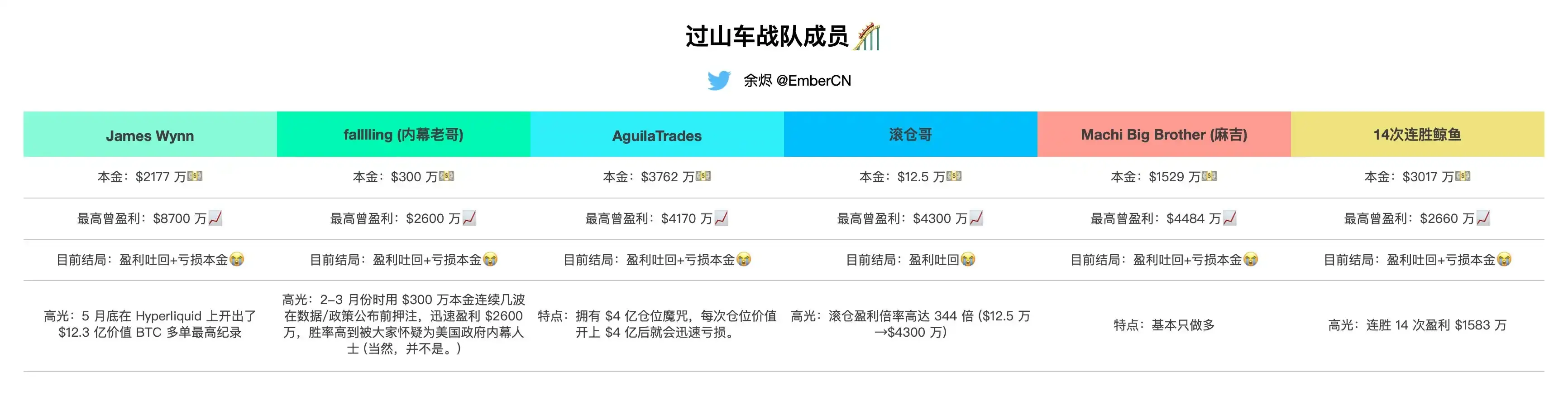
Data: HyperLiquid's six major high-leverage whales have all gone to zero, with an average loss exceeding 40 million dollars

According to statistics from Ember (@EmberCN), the six major high-leverage contract whales on HyperLiquid all faced liquidation after reaching massive profits of tens of millions of dollars, with an average loss exceeding 40 million dollars. Among them:"James Wynn" used a principal of 21.77 million dollars, with a maximum profit reaching 87 million dollars. He once opened a BTC long position with a notional value of 1.23 billion dollars on Hyperliquid, but ultimately not only returned all profits but also lost all principal, ending up at zero."Insider Whale falling" had a principal of 3 million dollars, with a maximum profit of 26 million dollars. Previously, he was skilled at betting before data/policy announcements, but ultimately made consecutive wrong bets, returning all profits and losing the principal."Whale AguilaTrades" had a principal of 37.62 million dollars, with a maximum profit of 41.7 million dollars. Each time he increased his position to 400 million dollars, he faced a pullback, ultimately resulting in an account balance of zero."Rolling Long Whale" had a principal of 125,000 dollars, with a maximum profit reaching 43 million dollars, achieving a return of 344 times. Ultimately, after a market reversal, he was bitten by the rolling strategy and lost all funds in a short period."Brother Maji" Huang Liben had a principal of 15.29 million dollars, with a maximum profit of 44.84 million dollars, primarily engaging in long positions. Ultimately, he insisted on going long during a market crash and faced liquidation."100% Win Rate Whale" had a principal of 30.17 million dollars, achieving a maximum of 14 consecutive wins, with a maximum profit of 26.6 million dollars. After the winning streak, he increased his position and encountered consecutive losses, resulting in an account balance of zero.
app_icon
ChainCatcher Building the Web3 world with innovations.