BTC $62,446.93 -2.01%
ETH $1,739.48 -2.13%
BNB $577.28 -1.23%
XRP $0.9647 +0.92%
SOL $72.36 +0.42%
TRX $0.3086 +0.42%
DOGE $0.0578 -0.69%
ADA $0.1500 -0.70%
BCH $204.80 -0.99%
LINK $8.90 -2.05%
HYPE $65.86 -2.51%
AAVE $106.65 -3.75%
SUI $0.7059 -1.56%
XLM $0.1374 +0.26%
ZEC $916.86 -1.37%
AAPL $352.27 +0.27%
AMZN $263.42 +3.42%
GOOGL $280.54 -0.03%
MSFT $503.14 +1.10%
META $614.72 +0.01%
NVDA $151.91 -1.25%
TSLA $381.18 +0.75%
SNDK $761.96 -1.56%
INTC $54.05 +0.56%
SPCX $144.63 +3.20%
MU $694.34 +0.85%
AMD $508.94 +4.35%

29

All
Article
Flash

first_img Ming-Chi Kuo: Google TPU shipment visibility extended to 2029

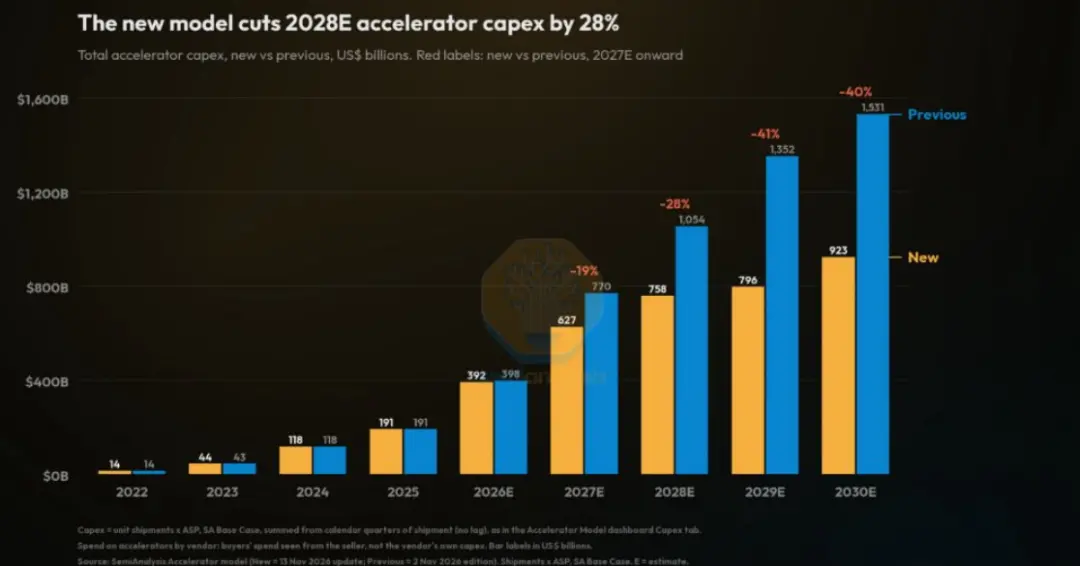
Tianfeng International Securities analyst Guo Mingqi stated that his latest industry survey shows that new orders from OpenAI and Anthropic will extend the visibility of Google TPU shipments to 2029, earlier than Nvidia GPU and other AI ASICs (most of which are from the fourth quarter of 2027 to the second quarter of 2028). He indicated that starting from 2028, v9 will become the main force of Google’s self-built computing power, thus orders for the v8 series (8t, 8i, or its design variants) can be seen as coming from OpenAI and Anthropic. The total demand from 2028 to 2029 is approximately 12 million units from OpenAI (8t designed by MediaTek) and 14 million units from Anthropic (8i designed by Broadcom), both of which will grow year by year; OpenAI will adopt a buyout model, while Anthropic will use both leasing and buyout.Guo Mingqi mentioned that the v10 product line has been adjusted from Icefish and Merope/Bladerunner to Quillfish, with mass production expected in 2029, and the design service order obtained from MediaTek. Icefish has been changed to v11, with mass production expected in 2030, and the design service order also obtained from MediaTek; Merope has lower visibility, with the supplier undecided, and it may also be canceled. MediaTek will be the sole design supplier for v9 (Humufish and Triggerfish) and v10 (Quillfish), accounting for approximately 45% to 50%, 50% to 55%, and 55% to 60% of total TPU supply from 2027 to 2029, respectively. Starting from v9, the new TPU models will adopt Intel EMIB-T advanced packaging; due to initial capacity constraints, the main shipments until 2029 will still be from the v8 series.Guo Mingqi stated that under supply chain constraints, the more reasonable TPU shipment estimates from 2027 to 2029 are 8 million to 9 million units, 14 million to 15 million units, and 16 million to 18 million units, respectively. He indicated that the market generally expects AI capital expenditures to peak in 2028, but the above plans show that TPU shipments will still grow in 2029, primarily driven by direct orders from OpenAI and Anthropic. He also mentioned that MediaTek has been the sole design supplier since v9, with high-margin 8t series shipment visibility extending to 2029; Broadcom leads the design of 8i, which has a higher profit margin than 8t, but its focus in the coming years will be on non-TPU XPU and AI network chips, with non-TPU revenue potentially exceeding TPU revenue as early as 2027.

Zhang Yiming: ByteDance will not be able to compete with OpenAI until 2029

ByteDance founder Zhang Yiming recently provided a timeline at the all-hands meeting of the Seed team, stating that ByteDance is not expected to compete with OpenAI and Anthropic in the cutting-edge AI field until 2029 to 2030 at the earliest. Zhang Yiming pointed out that the pre-training dataset used by the Seed large language model is several orders of magnitude smaller than that of top competitors. Doubao is the largest AI chat application in terms of user scale in the country, and the video generation model Seedance has also entered the ranks of the world's top models.When Seed 2.1 was released in June this year, the team admitted that the model still has significant shortcomings in high-difficulty open tasks and cutting-edge scientific research problems. In May this year, the company discussed raising its annual capital expenditure to a maximum of $70 billion, mainly for building AI data centers and other infrastructure. In August, it was reported that Seed is pre-training a large model with up to 100 trillion parameters, surpassing all publicly available large models in the country.Seed currently has about 1,000 R&D personnel, led by Wu Yonghui, who was recruited by Zhang Yiming from Google DeepMind last year. ByteDance has also launched a virtual stock "Doubao Stock" linked to the Doubao business. ByteDance plans to launch a personal AI assistant similar to Meta Muse in the coming weeks, allowing users to interact with AI through voice and virtual avatars and have it complete tasks on their behalf. The personal assistant project, internally codenamed Spell, began internal testing in April but was not officially launched due to the release of the Doubao phone and other reasons. It is now planned to be further integrated with Doubao.
app_icon
ChainCatcher Building the Web3 world with innovations.