BTC $82,617.12 +0.68%
ETH $2,433.06 +0.54%
BNB $725.19 +0.45%
XRP $1.31 +1.00%
SOL $105.38 +1.38%
TRX $0.3306 -0.77%
DOGE $0.0796 +0.28%
ADA $0.2197 -0.62%
BCH $279.27 +1.50%
LINK $12.15 +1.10%
HYPE $79.81 +0.98%
AAVE $152.29 -1.20%
SUI $1.00 +1.65%
XLM $0.1780 +0.09%
ZEC $1,163.39 +2.56%
AAPL $343.30 -0.05%
AMZN $253.44 +1.58%
GOOGL $343.27 +1.05%
MSFT $530.96 +0.44%
META $713.63 +0.96%
NVDA $217.41 +1.48%
TSLA $355.87 +1.03%
SNDK $1,354.22 +5.93%
INTC $93.70 +4.86%
SPCX $147.80 +1.97%
MU $907.08 +4.34%
AMD $545.09 +2.84%

kospi

All
Article
Flash

DeepSeek's new model adds to financing concerns, Asian chip stocks drop over 2%

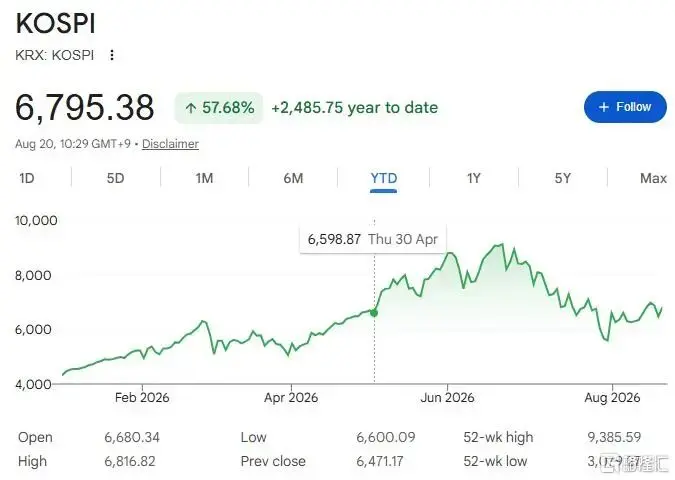
According to Bloomberg, Asian semiconductor stocks continued to weaken on Monday. The Bloomberg Asia Chip Index fell more than 2%, reaching its lowest level since July, with TSMC, SK Hynix, and Advantest being the main drags. The Korea Composite Stock Price Index recorded its largest weekly decline since October 2008 last week, dropping more than 3% at one point on Monday before recovering some ground; the Nikkei 225 index fell 2.3% at one point, and the Taiwan Weighted Index dropped 2%.Market concerns stem from two aspects. First, the pressure on financing for AI infrastructure in the United States continues to ferment, with CoreWeave's financing capabilities being questioned and the IPO expectations for Anthropic and Nscale cooling. Second, Chinese AI company DeepSeek released a new model update over the weekend, claiming faster operation speeds and lower resource consumption, raising concerns about the potential decrease in storage capacity required for AI models and the possible impact on chip demand.Kang DaeKwun, CEO of Life Asset Management, stated that the market uncertainty is too high, making it difficult to determine when the Korean stock market will bottom out. Financing for U.S. corporate AI projects is one of the main risks, and the profitability of Korean chip companies still heavily relies on continuous investment in AI infrastructure by U.S. companies. This week, the earnings reports from tech giants like Meta and Tesla will be an important window to observe the growth momentum of AI capital expenditures.

Goldman Sachs: Korean retail investors are flowing funds into cryptocurrency, and KOSPI's upward movement relies more on foreign investment

Goldman Sachs Global Investment Research Department's South Korea stock analyst Chris Cha stated in a report on September 23 that KOSPI has the conditions for a short-term tactical breakout, but the continuous flow of liquidity from South Korean retail investors into the cryptocurrency market will make the index's subsequent upward movement more reliant on foreign capital and local institutions reconfiguring. The report noted that concerns about the Federal Reserve's interest rates have been partially digested by the market, and risk appetite has shifted towards proxy AI themes.The report pointed out that South Korean memory chips provide fundamental support, with fourth-quarter DRAM contract prices expected to grow double digits quarter-on-quarter, and the ramp-up of HBM4 capacity will continue to limit the supply of standard server DRAM. Samsung Electronics' large shareholder returns, continuous buying by institutions, and foreign capital turning into net buying may drive KOSPI towards the resistance zone of 7000 to 7200 points.The report also indicated that the capacity of local South Korean retail investors to absorb has weakened. After Bitcoin returned to $85,000, cryptocurrency trading in South Korea has heated up. According to DefiLlama data cited in the report, Upbit's single-day spot trading volume on June 13 was approximately $770 million, which rose to $1.817 billion on September 22, an increase of about 136%. Based on the total trading volume of $3.27 billion on that day across South Korea's five major trading platforms, Upbit alone accounted for over half. Goldman Sachs believes this will make KOSPI more reliant on foreign and institutional buying in the future, and October is a critical window to test whether foreign capital will continue to increase its investment in South Korean semiconductor and AI assets.
app_icon
ChainCatcher Building the Web3 world with innovations.