BTC $63,592.68 -1.83%
ETH $1,784.82 -1.56%
BNB $586.62 -0.60%
XRP $0.9596 +0.59%
SOL $72.47 +2.08%
TRX $0.3074 +0.49%
DOGE $0.0587 -0.87%
ADA $0.1519 -0.74%
BCH $206.75 -0.47%
LINK $9.06 -1.14%
HYPE $67.79 +0.42%
AAVE $110.11 +2.68%
SUI $0.7164 -0.57%
XLM $0.1376 +0.25%
ZEC $919.40 +3.71%
AAPL $350.89 -0.29%
AMZN $256.99 -0.03%
GOOGL $280.32 -1.39%
MSFT $507.62 -2.10%
META $619.98 -0.68%
NVDA $153.81 -1.20%
TSLA $380.38 +1.11%
SNDK $791.80 -2.51%
INTC $53.74 -3.21%
SPCX $141.38 +1.94%
MU $697.00 -3.75%
AMD $491.02 -3.00%

sell-off

All
Article
Flash

Tom Lee: The continuous sell-off in the cryptocurrency market is caused by factors such as the sell-off of tech stocks, the liquidity squeeze from the Anthropic IPO, and some holders cashing out after Binance was hacked for 6.3 billion dollars

Tom Lee, Chairman of Bitmine, stated that despite several banks announcing the adoption of crypto assets and blockchain technology, the crypto market has still faced continuous sell-offs over the past few weeks.He believes that the sell-off in AI and semiconductor stocks may have triggered margin calls, particularly affecting retail investors in Asia; the upcoming IPO of Anthropic may also prompt some investors to sell stocks early to raise funds. If Robinhood users receive a large allocation, some retail investors may also sell crypto assets to participate in the subscription.Tom Lee also listed the recent theft of $6.3 billion in crypto assets as one of the potential factors. He believes that once the funds in the relevant accounts are restored, some holders may convert their assets into cash or stablecoins.In addition, discussions during the Anthropic roadshow about how AI may weaken existing cybersecurity defenses, as well as the U.S. Department of Justice's review of chips sold to Asia, including China, may also intensify market risk aversion.He believes that the aforementioned pressures will eventually dissipate. In the long term, crypto networks can serve as a transaction settlement layer, and digital assets will change capital markets, potentially driving a "super cycle" in crypto that exceeds previous scales. He remains optimistic about Ethereum's role in the financial system.

Bloomberg reviews the U.S. stock sell-off: retail investors sold first, followed by hedge funds and institutions, with mechanical reduction of positions intensifying the sell-off

According to Bloomberg, Wall Street's reaction to the U.S. midterm elections shifted from positive to negative in about 24 hours. The sell-off on Thursday spread from retail investors to hedge funds, long-only asset management firms, and quantitative strategies, causing a loss of approximately $3.7 trillion in market value for U.S. stocks in a single day, with the Nasdaq 100 index recording its largest drop since March 2020. Initially, the stock market rose after the elections due to the reduction of event risk and a decline in oil prices, but investors later reassessed the risks of Democratic scrutiny on data center expansion.In the first half hour after the market opened on Thursday, retail investors were the first to sell for profit, followed by hedge funds and long-only firms. Data from Vanda Research shows that the net selling scale of retail investors on that day was second only to two days during the pandemic shock in March 2020. Its strategist Viraj Patel pointed out that while retail and systematic investors were actively selling, institutional buyers chose to step back. The decline subsequently triggered mechanical selling, with Nomura strategist Charlie McElligott estimating that based on the negative gamma exposure during Thursday's trading, for every 1% drop in the market, options market makers would generate an additional selling pressure of about $7 billion.Volatility control funds estimated that they needed to reduce their holdings by about $61 billion in stocks based on market changes at the time, with about $25 billion in sales still being executed on Wednesday. The rebalancing of leveraged ETFs is expected to bring about an additional $47 billion in stock sales. Vanda estimated that commodity trading advisors sold about $13 billion in S&P 500 and Nasdaq futures. Goldman Sachs' prime brokerage trading desk estimated that fundamental long-short funds lost about 1.3% on Thursday, while technology-themed funds fell over 4%. The basket of stocks in storage, optical networks, data centers, and AI semiconductors dropped by 12% to 15% that day, and the VIX index rose from 16.6 points at the opening to nearly 28 points at the close.

The Democratic Party's sweeping victory in Congress raises concerns about AI regulation, leading to a sell-off in U.S. tech stocks
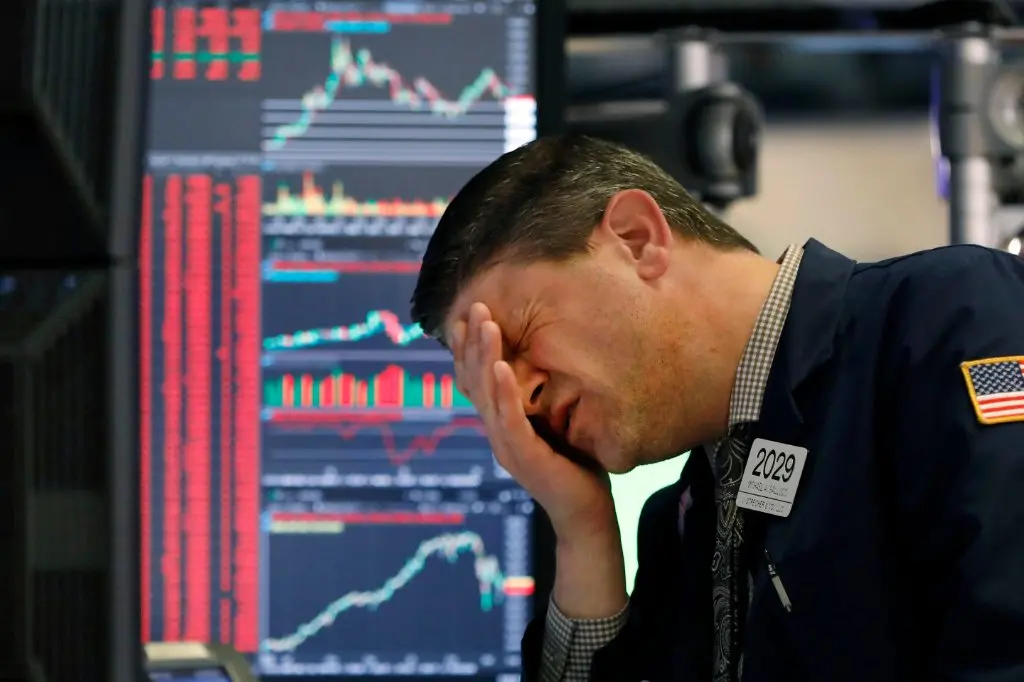
After the Democratic Party won the midterm elections, U.S. stocks surged significantly on Wednesday, but as investors continued to pull out of tech stocks for the second consecutive trading day, the Nasdaq Composite Index plummeted on Thursday. The tech-heavy Nasdaq fell by 3.3%, and the S&P 500 Index dropped by 1.9%. The Dow Jones Industrial Average decreased by 489 points, a decline of 0.9%. Although stocks like Chevron and Johnson & Johnson rose, it was not enough to offset the drag on the Dow from the tech stock sell-off. AI-related stocks, especially those in the chip industry and data centers, fell for the second day in a row.According to Gate market data, AMD (AMD.O) fell by 12%, Micron Technology (MU.O) dropped by 9%, SK Hynix (SKHY.O) decreased by 8.8%, and Nvidia (NVDA.O) fell by 5%. The Philadelphia Semiconductor Index plummeted by 8%, reaching a new low since April 20. The Nasdaq Composite Index has dropped more than 10% from its closing record high set on October 6.Investors are concerned that the Democratic Party controlling both houses of Congress and winning key gubernatorial elections may lead to more regulation of AI infrastructure development across the United States.Jordan Watson, portfolio manager at Tandem Investment Advisors, stated that the stock market surge and the trend of funds pulling out of AI stocks may only be a temporary phenomenon. However, as investors digest the election results and their potential policy impacts, the market may face more volatility.
app_icon
ChainCatcher Building the Web3 world with innovations.