Scan to download
BTC $68,918.57 +0.59%
ETH $2,012.19 -0.22%
BNB $626.88 +1.58%
XRP $1.42 +2.83%
SOL $84.22 +1.40%
TRX $0.2760 -0.44%
DOGE $0.0932 +0.63%
ADA $0.2635 +1.38%
BCH $522.08 +1.90%
LINK $8.52 +0.71%
HYPE $29.71 -6.01%
AAVE $109.10 +0.01%
SUI $0.9409 +1.34%
XLM $0.1564 -0.07%
ZEC $242.11 +5.87%
BTC $68,918.57 +0.59%
ETH $2,012.19 -0.22%
BNB $626.88 +1.58%
XRP $1.42 +2.83%
SOL $84.22 +1.40%
TRX $0.2760 -0.44%
DOGE $0.0932 +0.63%
ADA $0.2635 +1.38%
BCH $522.08 +1.90%
LINK $8.52 +0.71%
HYPE $29.71 -6.01%
AAVE $109.10 +0.01%
SUI $0.9409 +1.34%
XLM $0.1564 -0.07%
ZEC $242.11 +5.87%

senate

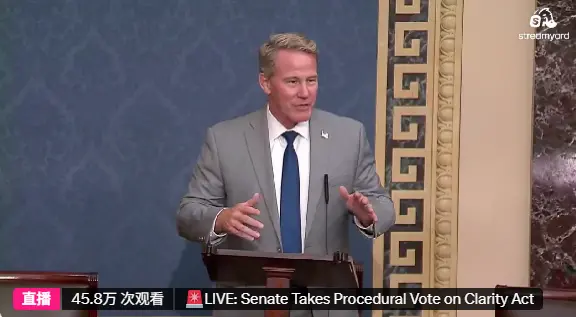
The U.S. cryptocurrency market structure bill passes a key Senate procedure despite opposition from Democrats

According to market news, the U.S. Senate Agriculture Committee has officially advanced the cryptocurrency market structure bill with a partisan vote of 12-11. This marks the first progress for the bill at the Senate committee level, indicating its entry into a new phase. However, due to the vote being entirely along party lines and lacking Democratic support, the bill still faces significant obstacles for future passage in the full Senate.Committee Chairman and Republican John Boozman stated that significant progress has been made after months of negotiations, and it is now time to move the process forward. However, Democratic chief negotiator Corey Booker criticized the Republicans for withdrawing from negotiations and accused President Trump and his family of profiting from the crypto industry while attempting to push a regulatory framework lacking ethical constraints. Democrats on the committee unanimously oppose the current version but have expressed a willingness to continue negotiations to reach a bipartisan consensus.The bill also needs to pass through the Senate Banking Committee, where its version has progressed slowly due to more controversial provisions involving stablecoin earnings. The White House plans to convene another meeting next week to coordinate positions among the cryptocurrency industry, banking sector, bipartisan lawmakers, and the government. If the bill ultimately passes in the Senate, it will be reconciled with the version that has already passed the House with a high vote and then submitted to the President for signing into law. Analysts point out that as the midterm elections approach, the legislative window is narrowing.

The Democratic Party is willing to return to the negotiating table, and there is a breakthrough in the Senate Agriculture Committee's discussions on cryptocurrency legislation

After setbacks in negotiations over cryptocurrency market legislation in the Senate Agriculture Committee, a Democratic senator's aide stated that the Democratic side is still willing to return to the negotiating table to push for a bipartisan compromise.The aide revealed that at the beginning of the new year, Democratic members were "caught off guard" during the negotiations, as the Republican side drafted a new version of the bill without sufficient consultation and originally planned to move directly into the markup process in mid-January. In response, the Democratic side hopes to re-engage with the committee chair, Republican Senator John Boozman's team, before a vote this week to strive for a bipartisan consensus.The Senate Agriculture Committee was originally scheduled to hold a markup and voting session on cryptocurrency legislation this Tuesday, but it has been postponed to Thursday due to severe weather in Washington. Meanwhile, some Democratic lawmakers are actively pushing to restart negotiations to reach a bipartisan-approved text before the hearing.The cryptocurrency market structure bill aims to establish a federal regulatory framework for digital assets, including clarifying the regulatory division between the SEC and CFTC, as well as related disclosure requirements. Analysts point out that, given that both the Senate Banking Committee and the Agriculture Committee need to advance their respective versions of the bill, bipartisan cooperation remains a key prerequisite for the smooth progress of the legislation.

Democratic aides express willingness to return to the negotiating table, Senate Agriculture Committee's cryptocurrency legislation discussions see a breakthrough

According to reports, after negotiations on cryptocurrency market legislation hit a snag in the Senate Agriculture Committee, a Democratic senator's aide stated that the Democratic side is still willing to return to the negotiating table to push for a bipartisan compromise.The aide revealed that at the beginning of the new year, Democratic members were "caught off guard" during the negotiations, as the Republican side drafted a new version of the bill without sufficient consultation and originally planned to move directly into the review process this week. In response, the Democratic side hopes to re-engage with the committee chair, Republican Senator John Boozman's team, before the vote this week to seek a bipartisan consensus.The Senate Agriculture Committee was originally scheduled to hold a markup and voting session on cryptocurrency legislation this Tuesday, but it has been postponed to Thursday due to severe weather in Washington. Meanwhile, some Democratic lawmakers are actively pushing to restart negotiations to reach a bipartisan-approved text before the hearing.The cryptocurrency market structure bill aims to establish a federal-level regulatory framework for digital assets, including clarifying the regulatory division of responsibilities between the SEC and CFTC, as well as related disclosure requirements. Analysts point out that, given that both the Senate Banking Committee and the Agriculture Committee need to advance their respective versions of the bill, bipartisan cooperation remains a key prerequisite for the smooth progress of the legislation.

The U.S. Senate Agriculture Committee has released a version of the cryptocurrency market structure bill, but there are still differences in the legislative process

The chairman of the U.S. Senate Agriculture Committee, John Boozman, officially unveiled the committee's version of the cryptocurrency market structure legislation on Thursday. Although the bill has made some progress on decentralized finance (DeFi) related issues, Boozman pointed out that there are still differences between the two parties on "fundamental policy issues," and formal legislation is still some distance away.Sources indicate that the Democratic opposition to the bill stems more from political differences, including concerns about potential conflicts of interest involving Trump and his family's involvement in cryptocurrency projects, as well as worries about insufficient consumer protection. According to legislative procedures, the bill requires bipartisan support to pass in the Senate, needing at least 60 votes, which means that in addition to full support from Republican senators, it must also secure at least 7 Democratic senators.Both the Senate Agriculture Committee and the Banking Committee need to hold markups and votes on their respective versions, with the Agriculture Committee's markup expected to take place next week. However, progress in the Senate Banking Committee has stalled. Previously, the markup was postponed due to Coinbase withdrawing its support, with contentious issues including tokenized stocks, the regulatory division of DeFi, the boundaries of SEC and CFTC responsibilities, and stablecoin incentive mechanisms. Bloomberg reported that the Banking Committee may delay the legislative process by several weeks to prioritize housing and affordability issues.

The Senate Agriculture Committee may announce the latest text of the cryptocurrency market structure bill

According to Crypto in America, the U.S. Senate Agriculture Committee is expected to release the latest text of its cryptocurrency market structure bill before the end of the workday, in preparation for the committee's review meeting next Tuesday.The release of this text will reveal key consensus points reached by both parties after two additional weeks of negotiations. The main points of contention in the bill include whether meme coins should be included in the definition of "digital commodities," overall listing standards, the classification of different tokens, the regulatory funding of the Commodity Futures Trading Commission, and ethical clauses. If the Agriculture Committee can reach a strong bipartisan agreement, it may pave the way for similar legislative processes in the Senate Banking Committee.On the other hand, the Banking Committee's review has not yet been rescheduled after being postponed last week. Currently, the pressure is mainly on Coinbase, whose sudden withdrawal of support for the bill led to the suspension of the review. Now, consensus must be reached with the banking sector on stablecoin revenue provisions to bring all parties back to the negotiating table.The Executive Director of the White House Crypto Council hinted on social media that delaying legislation could invite harsher regulations from a future government that may be less friendly to cryptocurrencies.

Opinion: The U.S. Senate's delay on the cryptocurrency market structure bill increases regulatory uncertainty, putting pressure on related assets

Galaxy Digital's research director Alex Thorn stated that the U.S. Senate Banking Committee's originally scheduled hearing on the cryptocurrency market structure bill has been postponed, highlighting the deep divisions between Congress and the industry on several key issues, particularly focusing on stablecoin yield mechanisms and DeFi-related provisions. This delay occurred just hours after Coinbase CEO Brian Armstrong withdrew his support for the bill. Armstrong publicly opposed the bill's references to tokenized securities, DeFi restrictions, and stablecoin yields. Senate Banking Committee Chairman Tim Scott subsequently announced the postponement of the hearing, but no new timeline has been provided. With the Senate set to recess next week, the earliest possible restart could be between January 26 and 30.Alex Thorn pointed out that within just 48 hours, the bill draft was released late at night, over 100 amendments were submitted, and stakeholders continued to discover new points of contention at the last minute, significantly increasing the difficulty of political coordination. On the market side, following the announcement of the delay, cryptocurrency assets generally declined, with Bitcoin and Ethereum dropping about 2% on the day; related U.S. stocks also faced pressure, with Coinbase down 6.5%, Robinhood down 7.8%, and Circle down 9.7%. In his analysis, Thorn believes that although there is a broad consensus on "market structure" itself, non-core but highly sensitive issues surrounding stablecoin yields, DeFi compliance, and granting the SEC regulatory tools in the area of tokenized securities have created an insurmountable political divide. "The apparent gap in disagreements is not large, but the substantive chasm is deep."

Coinbase stated that it does not support the Senate cryptocurrency bill, which may affect the legislative process

Coinbase CEO Brian Armstrong stated that Coinbase will not support the current version of the bill before the Senate Banking Committee revises and votes on comprehensive cryptocurrency legislation. Armstrong posted on the X platform that, while he appreciates the senators' efforts to promote bipartisan consensus, the draft is "worse than the current regulatory status" and that "it’s better to have no bill than a bad bill."The bill aims to clarify the jurisdictional boundaries of the Commodity Futures Trading Commission (CFTC) and the Securities and Exchange Commission (SEC) in the regulation of digital assets, define when digital assets are considered securities or commodities, and introduce new disclosure requirements. The Senate Banking Committee plans to hold a hearing and vote on the bill on Thursday morning.Armstrong pointed out that the bill has significant issues regarding DeFi, stablecoin yields, and other areas, with some provisions potentially granting the government "unlimited access to personal financial records," eroding user privacy, while related amendments could "stifle stablecoin reward mechanisms." He also criticized the bill for weakening the CFTC's authority, making it subordinate to the SEC in regulatory matters, which is detrimental to industry innovation.Insiders indicated that Coinbase's public opposition is "symbolic" and could affect the final fate of the bill. The issue of stablecoin yields has become a focal point of controversy, with banking groups concerned that the related mechanisms could siphon off deposits and impact community banks, while the crypto industry accuses banks of trying to limit competition.Despite this, some industry organizations continue to support advancing the legislation. Digital Chamber CEO Cody Carbone stated that they will continue to push for the bill to become law by 2026; Ripple CEO Brad Garlinghouse also expressed optimism about resolving differences through amendments.

The U.S. Senate Banking Committee clarifies 7 misconceptions about the CLARITY Act: it does not deviate from securities law and emphasizes investor protection and regulatory boundaries

The U.S. Senate Banking Committee published an article interpreting and clarifying seven major misconceptions about the CLARITY Act, which mainly include:It does not deviate from existing securities laws but is based on established securities law principles, clearly defining which digital assets are securities and which are commodities.The act is essentially an investor protection measure, aimed at combating fraud, manipulation, and abuse by establishing clear rules, with the goal of preventing a recurrence of risks similar to those seen with FTX.By clearly delineating the regulatory authority of the SEC and CFTC and establishing a joint advisory committee to coordinate rules, it addresses regulatory gaps while introducing targeted anti-avoidance provisions to reduce arbitrage opportunities.It requires key intermediaries to fulfill anti-money laundering and anti-terrorist financing obligations and strengthens compliance with sanctions and enforcement authority for the Treasury.It does not allow DeFi to become a conduit for illegal funds, emphasizing "precise strikes against illegal activities," requiring centralized intermediaries interacting with DeFi protocols to implement risk management standards, while also establishing specific rules for intermediaries that are not truly decentralized to protect the code and innovation itself.It clearly protects the self-custody rights of software developers and users, not considering developers who do not control user funds and only publish or maintain code as financial intermediaries, while retaining the ability for regulatory agencies to intervene in response to real risks.The core goal is to strengthen national security, protect investors, and promote compliant innovation under clear rules, rather than being "tailored" for specific industries.
app_icon
ChainCatcher Building the Web3 world with innovations.