BTC $64,904.45 +0.63%
ETH $1,826.25 +1.17%
BNB $590.32 +0.09%
XRP $0.9592 +1.18%
SOL $71.29 +0.17%
TRX $0.3065 +0.45%
DOGE $0.0593 +1.35%
ADA $0.1527 +0.27%
BCH $207.60 +0.12%
LINK $9.17 -0.55%
HYPE $66.80 +0.26%
AAVE $107.62 +1.01%
SUI $0.7213 +0.82%
XLM $0.1371 -0.57%
ZEC $889.04 -1.09%
AAPL $353.20 -0.93%
AMZN $258.31 -1.89%
GOOGL $286.82 -1.68%
MSFT $522.38 +0.41%
META $627.26 -0.92%
NVDA $156.71 -2.57%
TSLA $378.96 -2.12%
SNDK $821.64 -4.02%
INTC $55.62 -3.45%
SPCX $136.41 -1.55%
MU $729.39 -3.89%
AMD $507.74 -2.65%

thl

All
Article
Flash

Ethlabs proposes to achieve quantum resistance and AI resistance for Ethereum by 2027

Ethlabs published an article on the Ethereum developer community forum, proposing to set 2027 as the target year for Ethereum to achieve post-quantum and post-AI capabilities, referring to this plan as "pqai27." The proposal argues that with the rapid enhancement of AI capabilities, the accelerated development of quantum computing, and the increased ability of AI models to discover software vulnerabilities on a large scale, Ethereum should prioritize strengthening the security of its underlying protocol to prepare for potential future cryptographic risks and cyberattacks.Ethlabs pointed out that the U.S. government has advanced its target date for addressing quantum risks from 2035 to 2030, while Google plans to achieve post-quantum capabilities by 2029. At the same time, AI is solving a large number of long-standing mathematical problems and can also discover software vulnerabilities on a large scale. Ethlabs believes that although there is currently no evidence that existing cryptographic primitives will definitely be broken by AI, the associated risks are difficult to predict accurately, making it necessary to advance security upgrades proactively.In terms of the technical roadmap, Ethlabs divides the goals into two phases: the first is "pqai-ready," which means the Ethereum consensus layer will achieve a post-quantum upgrade, allowing all users to have a path to migrate to post-quantum accounts; if existing cryptography fails prematurely, the network can still operate with reduced processing capacity. The second is "pqai-scaled," which means supporting post-quantum transactions and data availability under full network capacity, aiming for post-quantum transactions to reach the processing scale of ordinary transactions, including post-quantum signature aggregation and post-quantum data availability solutions.To achieve this goal, Ethlabs suggests reassessing the scope of the upcoming hard fork Hegotá, reconsidering upgrades that do not belong to the critical path of pqai27. Among them, Frames and related post-quantum account proposals are still regarded as key components; FOCIL needs to be reassessed for its impact on upgrade progress and post-quantum compatibility. Additionally, Ethereum needs to choose between the post-quantum transformation of the existing Gasper consensus protocol and transitioning to a decoupled consensus. Ethlabs stated that to concentrate resources on advancing pqai27, it will withdraw the Quick Slots feature previously sought for Hegotá and plans to continue promoting this feature in 2028. The Glamsterdam upgrade and its scaling plan will proceed as originally scheduled. This roadmap remains a suggestion proposed by Ethlabs and will require further discussion and determination by Ethereum core developers.

The Ethereum development organization Ethlabs suggests postponing the determination of the Hoodi fork date

The non-profit research organization Ethlabs stated that the EIP-8037 and EIP-8038 in the Ethereum Glamsterdam upgrade involve adjustments to Gas costs and billing mechanisms, which may affect some already deployed smart contracts. Ethlabs recommends postponing modifications to the upgrade specifications or determining the fork date for the Hoodi testnet until the results of external audits are published and the relevant impacts are clarified. The final decision will be made by the Ethereum Core Developers Meeting (ACD).The two external audits commissioned by the Ethereum Foundation from ChainSecurity and Dedaub are expected to be published before November 16. On the same day, a public Q&A will be held during the ACD testing meeting. The ACD executive meeting on November 19 is expected to discuss the audit results and may decide whether to modify the upgrade specifications.Glamsterdam aims to increase the Ethereum Gas limit per block from 60 million to 200 million. Ethlabs pointed out that adjustments to Gas costs may affect contracts and tools with hardcoded operational costs, and changes in the billing mechanism may also cause some deployed contracts to exhibit unexpected behavior. For example, after an internal call rollback, the remaining Gas returned by gasleft() may actually increase, affecting the contract's judgment on whether the call failed due to Gas exhaustion.

DeepSeek is hiring for operations and maintenance with a monthly salary of 30,000, while regular duty staff only earn five to six thousand

According to an interview with "Daily People," a data center operations engineer who has worked in Ulanqab, Inner Mongolia for 5 years stated that local AI data centers are still under large-scale construction, but the hiring demand at his company has significantly decreased. The company hired thousands of people in 2025, but by the time of the interview in 2026, only 3 new hires had been made.The engineer, who goes by the pseudonym Zhang Liwei, originally worked on an assembly line at an automobile factory. When he first switched careers, his internship monthly salary was 2,000 yuan, which increased to 4,500 yuan after graduation. After 5 years of job hopping and promotions, he currently earns over 10,000 yuan per month. In April of this year, DeepSeek was hiring senior operations engineers and senior delivery managers for its data center in Ulanqab, offering a monthly salary of 15,000 to 30,000 yuan, with 14 months' salary. These positions require extensive experience in data center operations and project management. According to Zhang Liwei's observations, local ordinary duty staff still earn around 5,000 to 6,000 yuan per month, while assistant engineers can earn over 10,000 yuan.The entry barriers are also rising. In 2024, some data centers were still hiring newcomers without relevant professional backgrounds; however, this year, some companies have required candidates to have a relevant degree and work experience, and there is even a 35-year age limit for basic duty positions. Zhang Liwei mentioned that a former colleague has started a training class for operations, charging nearly 20,000 yuan per student, and classes only start when there are 60 students, with a single session fee approaching 1.2 million yuan. The so-called internal recommendations are mostly just to help students secure an interview opportunity.

USDD released the October monthly transparency report: reserve assets reached 2.21 billion USD, and Smart Allocator's cumulative earnings exceeded 33.59 million USD

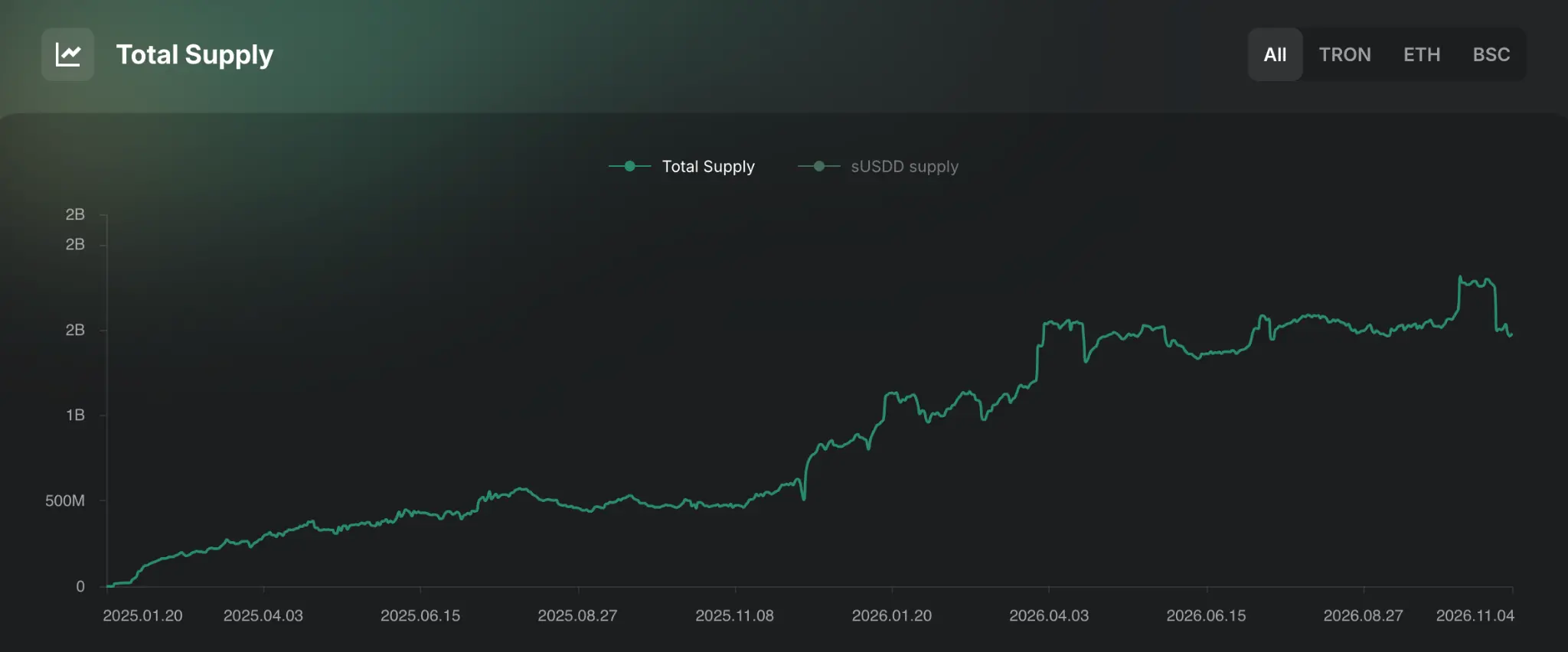
On November 6, the decentralized over-collateralized stablecoin USDD recently released its monthly transparency report for October 2026. The report shows that as of October 31, the circulation of USDD was approximately 1.5 billion, with reserve assets reaching 2.21 billion USD and a collateralization rate maintained at 146.99%.In October, the average daily minting volume of USDD increased by 10.5% month-on-month. During the period from October 12 to 19, the market capitalization of USDD grew by 180.3 million USD, leading the stablecoin market. On October 12, the circulation of USDD once exceeded 1.81 billion USD, and the Total Value Locked (TVL) surpassed 2.51 billion USD, both setting historical highs.In terms of revenue and ecological development, the investment return of USDD Smart Allocator in October increased by 8.5% month-on-month, with the average daily capital deployment scale growing by 15%. By the end of the month, the cumulative revenue reached 33.59 million USD. Meanwhile, the TVL of USDD Earn on the BNB Chain increased by 62.9% month-on-month. USDD continues to deepen cooperation with platforms such as Binance Wallet, Gate DEX, Morpho, and Pendle, further expanding DeFi revenue scenarios.In addition, the treasury data disclosed by USDD for the third quarter of 2026 shows that the treasury surplus increased by 27.1% month-on-month, and the treasury balance exceeded 30 million USD for the first time. USDD stated that it will continue to promote ecological construction around the two core scenarios of earning and transferring, and will continuously enhance asset transparency through public reserve addresses and on-chain data dashboards.

first_img Binance has not executed the monthly LUNC burn for the first time since 2023

According to Decrypt, Binance has been burning Luna Classic tokens almost at the beginning of each month since March 2023, but the burn for November has not yet occurred. StatsBin data shows that there have been no burn records this month. LUNC is the original native token of the Terra blockchain, which was forked by Terraform Labs founder Do Kwon after the project's collapse in 2022, and community members continue to maintain its operation through on-chain burns.Some investors have linked the delay in burning to the record $6.3 billion hack that Binance experienced last week. The FBI attributed the incident to the North Korean hacking group TraderTraitor, which is also said to be related to the Bybit theft; the loss is estimated to be four times that of the $1.5 billion stolen from Bybit, making it the largest hacking incident in crypto history. Binance is gradually restoring withdrawals, having resumed withdrawals for dozens of Ethereum and Solana tokens later on Monday.Terra Classic ecosystem contributor Dawid Skinder stated that monthly burns are an important signal of support for the community, and the delay may be an operational issue following the largest hack in history. Notable community member Pedro (Vegas) mentioned that Binance is conducting security maintenance and has transferred LUNC to a more secure wallet before resuming burns, but Binance has not confirmed this statement and has not responded to Decrypt's request for comment. Decrypt data shows that LUNC has fallen 7.9% to $0.0000417 in the past week, down 99.99% from its all-time high of $119.18.
first_img Hongguo Free Short Drama had 430 million monthly active users in September, surpassing Doubao

On November 3, QuestMobile released the "China Mobile Internet Autumn Report." As of September 2026, the scale of monthly active users in China's mobile internet reached 1.281 billion, a slight increase of 0.9% year-on-year; the average usage time per user in September was 189.8 hours, a year-on-year increase of 6.5%. Short drama videos and short videos have become the core sources of growth in usage time, contributing a growth rate of 111.5% as of September 2026. In that month, the total net increase in usage time for short drama video and short video apps was 13.329 billion hours and 5.717 billion hours, ranking first and second in the duration growth track, while the net increase for AIGC was 978 million hours, with the total usage time for online videos declining by 1.38 billion hours during the same period.In terms of user numbers, the top three applications within the Douyin Group in September 2026 were Douyin, Hongguo Free Short Drama, and Doubao, with deduplicated total user counts of 1.029 billion, 430 million, and 419 million respectively, with Hongguo surpassing Doubao. The top three applications in the same period last year were Douyin, Jinri Toutiao, and Douyin Lite. The user scale of the short drama video industry increased from 10 million to 400 million in less than three years, with a compound annual growth rate of 443.1%. Douyin, Kuaishou, and their lite versions occupy the top four positions in the short video industry and continue to show growth.Specifically, in September 2026, Hongguo Short Drama had 430 million monthly active users, while Hongguo Comic Drama had 7.883 million, with a year-on-year growth rate of 268.7 times. The newly launched Green Bubble Short Drama at the end of September reached 156 million monthly active users. The Hippo Theater app had 30.8 million active users in September, a year-on-year decline of 40.3%; the user volume of the top ten short drama mini-programs has exceeded that of the Hippo Theater app, with Lianqu Short Drama and Ceylon Theater having 75.17 million and 45.67 million respectively. According to iiMedia Consulting, the market size of China's micro short drama is projected to be 50.44 billion yuan in 2024, reaching 67.79 billion yuan in 2025, and expected to be 79.33 billion yuan in 2026.

Qianwen had 158 million monthly active users in September, a year-on-year increase of 5077%, a decrease of about 9 million compared to June

According to the latest rankings from QuestMobile, in September 2026, Alibaba's AI application Qianwen App reached 158 million monthly active users, a year-on-year increase of 5077%, ranking first in growth among apps with over 100 million monthly active users. In the domestic AI native app rankings, Qianwen ranks second, surpassing DeepSeek's 123 million, but still below the first place, Doubao, which has 419 million.This growth is related to Alibaba's large-scale promotion. In November last year, the Tongyi App was renamed to Qianwen. This Spring Festival, Alibaba announced an investment of 3 billion yuan to launch a free order campaign, allowing users to order milk tea and takeout through AI. The campaign link was widely shared in WeChat groups, and the system experienced delays due to increased traffic. QuestMobile data shows that on the first day of the campaign, Qianwen's daily active users rose from about 7.06 million to 58.48 million.The year-on-year growth of 5077% was also influenced by last year's low base. Based on year-on-year data, Qianwen's monthly active users were about 3.05 million in September last year. By March this year, Qianwen's monthly active users had reached 166 million, rising to 167 million in June, and then falling back to 158 million in September, a decrease of about 9 million compared to June, with a decline rate of approximately 5.4%.
app_icon
ChainCatcher Building the Web3 world with innovations.