BTC $84,784.37 -0.50%
ETH $2,679.08 -0.52%
BNB $777.55 +0.51%
XRP $1.49 -1.05%
SOL $119.58 -0.33%
TRX $0.3370 +0.30%
DOGE $0.0929 -2.20%
ADA $0.2445 -3.22%
BCH $313.45 +0.00%
LINK $13.81 -2.74%
HYPE $88.98 -0.39%
AAVE $178.96 -2.82%
SUI $1.15 -0.44%
XLM $0.2132 -3.68%
ZEC $1,294.91 -5.46%
AAPL $333.25 +0.03%
AMZN $251.71 +0.32%
GOOGL $343.05 -0.14%
MSFT $517.62 +0.59%
META $728.47 -0.29%
NVDA $234.59 -0.62%
TSLA $370.67 -0.12%
SNDK $1,716.39 -0.80%
INTC $118.26 -2.97%
SPCX $158.94 +1.30%
MU $1,070.91 -0.97%
AMD $632.07 +0.08%
BTC $84,784.37 -0.50%
ETH $2,679.08 -0.52%
BNB $777.55 +0.51%
XRP $1.49 -1.05%
SOL $119.58 -0.33%
TRX $0.3370 +0.30%
DOGE $0.0929 -2.20%
ADA $0.2445 -3.22%
BCH $313.45 +0.00%
LINK $13.81 -2.74%
HYPE $88.98 -0.39%
AAVE $178.96 -2.82%
SUI $1.15 -0.44%
XLM $0.2132 -3.68%
ZEC $1,294.91 -5.46%
AAPL $333.25 +0.03%
AMZN $251.71 +0.32%
GOOGL $343.05 -0.14%
MSFT $517.62 +0.59%
META $728.47 -0.29%
NVDA $234.59 -0.62%
TSLA $370.67 -0.12%
SNDK $1,716.39 -0.80%
INTC $118.26 -2.97%
SPCX $158.94 +1.30%
MU $1,070.91 -0.97%
AMD $632.07 +0.08%

deepfake

All
Article
Flash

first_img Tavus claims that the Griffin model causes 48% of video call participants to mistakenly believe they are interacting with a real person

AI startup Tavus released a new model called Griffin on October 1, referring to it as the first "human interaction model" that can understand and generate face-to-face conversations, paying attention not only to wording but also to expressions and pauses. Tavus stated that in tests, after a one-minute video call with Griffin-Lite, 26 out of 54 participants (48%) believed the other party was a real person; its previous generation system only convinced 1 out of 41 participants.Participants were told they would have a one-minute video call with another person to discuss things they were looking forward to this year, and only at the end of the call were they asked if they suspected the other party was not a real person. Tavus noted that those who became suspicious typically noticed within 20 seconds. This result comes from Tavus's own research page, where participants were recruited through a channel they call an independent research platform. Community comments on X pointed out that these results have not been independently verified and do not meet standard protocols.In the NVIDIA VideoFDB benchmark, Tavus claimed Griffin-Lite ranked first, with a generation dimension score of 3.83, the next best system scoring 2.8, and human reference scoring 3.92; the perception dimension score was 3.73, with the strongest baseline at 3.44 and human reference at 4.2. Tavus stated that NVIDIA independently conducted this evaluation. Griffin supports full duplex, allowing it to listen, see, and speak simultaneously, with an average audio-video delay of 0.43 seconds on the NVIDIA H100 chip. Tavus completed a $40 million Series B funding round led by CRV in November 2025.

North Korean hackers use AI deepfake video calls to attack cryptocurrency practitioners

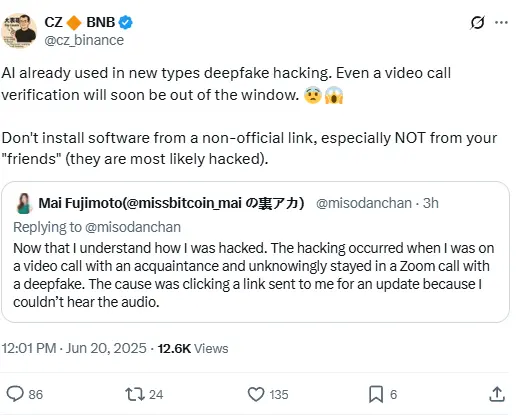
Hacker groups associated with North Korea are continuously upgrading their attack methods against individuals in the cryptocurrency industry. They are using AI-generated deepfake video calls to impersonate people familiar to or trusted by the victims, enticing them to install malware.Martin Kuchař, co-founder of BTC Prague, revealed that attackers initiate video calls using compromised Telegram accounts and lure victims into installing malicious software disguised as a plugin under the pretext of "fixing Zoom audio issues," thereby gaining complete control over the devices. Security research firm Huntress pointed out that this attack pattern is highly consistent with previous disclosures regarding actions against cryptocurrency developers. The malicious scripts can execute multi-stage infections on macOS devices, including implanting backdoors, logging keystrokes, stealing clipboard content, and accessing cryptocurrency wallet assets.Researchers have strongly attributed this series of attacks to the North Korean state-sponsored hacker group Lazarus Group (also known as BlueNoroff). The information security head of blockchain security company SlowMist stated that such attacks exhibit clear reuse characteristics across different operations, targeting specific wallets and cryptocurrency professionals. Analysts believe that as deepfake and voice cloning technologies become more widespread, images and videos are increasingly difficult to serve as reliable evidence of identity authenticity. The cryptocurrency industry needs to remain vigilant and strengthen multi-factor authentication and security measures.

first_img AI detection suggests that the meme coin video released by the President of the Central African Republic may be a deepfake, raising multiple doubts about the project's authenticity

ChainCatcher news, Central African Republic President Touadéra announced the issuance of the official meme coin CAR on the X platform this morning, calling it an "experiment" to promote national development. However, the announcement video has been flagged as suspicious by two AI deepfake detection tools. According to GMGN market data, CAR's market capitalization has now surpassed $700 million.The authenticity of the project is being questioned by multiple parties. Two detection models from the AI deepfake detection platform Deepware indicate that the president's video statement is highly suspicious, with one model suggesting an 82% likelihood that the video is a deepfake.Yokai Ryujin, founder of Unrevealed XYZ, pointed out that the project domain name was registered only three days ago through Namecheap, and the registration method does not comply with government operational norms. The domain service provider Namecheap has suspended related services, but the project website is still operational.Additionally, industry insiders question the timing of the announcement at local midnight and the use of English instead of the official language, French, for the announcement. Currently, the project's official X account @Carmeme_news has been banned by the platform.

Hong Kong police dismantled a scam group that used deepfake technology to lure others into investing in virtual currency, with an involved amount of approximately 34 million yuan

ChainCatcher news, according to Phoenix News, the Hong Kong police recently dismantled a scam group that used deepfake technology to lure others into investing in virtual currencies through social media platforms, involving approximately 34 million HKD.The Hong Kong Police Commercial Crime Bureau arrested 31 individuals, aged between 20 and 34, some of whom claimed to be students and unemployed, based on intelligence last week in two industrial buildings in Kowloon Bay, related to the same scam group, and seized their pre-written "scripts." The group would recruit young people looking to "make quick money," training them to create accounts on dating platforms with fake identities, pretending to have good looks and a luxurious lifestyle, and getting to know individuals from overseas, including Taiwan and East Asia, chatting according to the "script." After understanding the other party's background, they would cater to their interests and develop into online lovers, even using deepfake technology for video calls, subsequently luring the other party to invest in virtual currencies, claiming substantial returns, and asking them to deposit into fake platforms. Once the group received the virtual currency, they would immediately transfer it away and cut off contact with the victims.Hong Kong Police Commercial Crime Bureau Acting Chief Superintendent Kong Hing-fun stated: "They rented two scam centers located next to each other in Kowloon Bay to disperse risks and increase confidentiality. Most importantly, we noticed that these two scam centers operated in two shifts, aiming to continuously attract more victims day and night. Never think that participating in some tasks of a criminal group is just a minor issue; even if you are only assigned to meet victims online without direct contact with virtual currency investment work, it is still illegal."The police stated that this scam group has been operating for at least a year, with criminal profits exceeding 34 million HKD. The mastermind of the scam group, the center's head, and key members, a total of five individuals, have been charged with conspiracy to commit fraud and money laundering, and were brought to the Eastern Magistrates' Court on Monday.
app_icon
ChainCatcher Building the Web3 world with innovations.