Scan to download
BTC $77,393.84 +3.60%
ETH $2,422.71 +3.86%
BNB $645.29 +2.44%
XRP $1.48 +3.38%
SOL $89.02 +1.28%
TRX $0.3271 +0.14%
DOGE $0.0994 +1.64%
ADA $0.2587 +1.41%
BCH $455.69 +1.04%
LINK $9.61 +2.06%
HYPE $45.10 +3.93%
AAVE $115.92 +2.06%
SUI $0.9995 +1.16%
XLM $0.1743 +4.71%
ZEC $335.51 +0.40%
BTC $77,393.84 +3.60%
ETH $2,422.71 +3.86%
BNB $645.29 +2.44%
XRP $1.48 +3.38%
SOL $89.02 +1.28%
TRX $0.3271 +0.14%
DOGE $0.0994 +1.64%
ADA $0.2587 +1.41%
BCH $455.69 +1.04%
LINK $9.61 +2.06%
HYPE $45.10 +3.93%
AAVE $115.92 +2.06%
SUI $0.9995 +1.16%
XLM $0.1743 +4.71%
ZEC $335.51 +0.40%

zk-

Vitalik published an article explaining the Ethereum scaling plan, covering short-term gas optimization and the phased deployment of long-term ZK-EVM

Ethereum co-founder Vitalik Buterin posted on the X platform that Ethereum's scalability is divided into short-term and long-term parts.In the short term, the Glamsterdam upgrade will introduce block-level access lists for parallel validation, ePBS will allow a larger proportion of time slots for block validation, and gas repricing will ensure that operational costs align with actual execution time.The multi-dimensional gas mechanism will be implemented in phases, starting with Glamsterdam, where the "state creation" cost will be separated from the "execution and calldata" cost, with state creation gas not counted towards the approximately 16 million transaction gas limit. The EVM level will introduce a "reservoir" dimension mechanism, which will prioritize the consumption of dedicated dimension gas by default, and when insufficient, will draw from the reservoir. This will eventually transition to multi-dimensional pricing, where different dimensions may have different floating gas prices.Long-term scalability includes ZK-EVM and blob components. In terms of blobs, there are plans to continuously iterate PeerDAS, aiming to achieve approximately 8MB of data processing capacity per second, with future Ethereum block data directly entering blobs.The ZK-EVM aspect will be implemented in phases: by 2026, there will be a validator client supporting ZK-EVM, allowing about 5% of the network to rely on it; by 2027, this will expand to a larger proportion of a few nodes while advancing formal verification; once conditions are mature, it will transition to a five-out-of-three mandatory proof mechanism, ultimately continuously enhancing the security and formal verification level of ZK-EVM, and involving changes to VMs such as RISC-V.

Vitalik: The combination of ZK-EVM and PeerDAS will push Ethereum towards a new form of decentralized network

Vitalik Buterin stated that the current ZK-EVM has entered the alpha stage, demonstrating production-level performance, with the remaining major work focused on security; meanwhile, PeerDAS has officially launched on the Ethereum mainnet. Vitalik pointed out that this is not a gradual optimization, but rather a transformation of Ethereum into a new type of P2P network that simultaneously possesses decentralization, consensus mechanisms, and high bandwidth.He recalled that BitTorrent has high bandwidth but lacks consensus, while Bitcoin has consensus but is bandwidth-limited due to full replication; with the introduction of PeerDAS (data availability sampling) and ZK-EVM, Ethereum is expected to achieve decentralization, consensus, and high throughput simultaneously, solving the trilemma through "real code running on the mainnet." Among these, PeerDAS is already running on the mainnet, and ZK-EVM has reached production-level performance.Vitalik expects that starting in 2026, with the advancement of mechanisms like BAL and ePBS, the gas limit will gradually increase, and there will be practical opportunities to run ZK-EVM nodes; from 2026 to 2028, there will be gas repricing, state structure adjustments, and execution load entering blobs; by 2027 to 2030, ZK-EVM is expected to become the primary method for validating blocks on the network, further promoting an increase in the gas limit. Additionally, he mentioned the importance of distributed block construction, with the long-term goal of avoiding the complete construction of blocks in any single location and decentralizing block construction power through on-protocol or off-protocol means to reduce the risk of centralized intervention and enhance regional fairness.

Ethereum developers advance the deployment of a ZK-based "Secret Santa" system

According to CoinDesk, Ethereum developers are refining a zero-knowledge protocol aimed at providing stronger privacy guarantees for on-chain interactions, starting with a matching system similar to "Secret Santa," which is expected to evolve into a broader set of private collaboration tools.Solidity engineer Artem Chystiakov revisited this research in a post on the Ethereum community forum on Monday, mentioning his related work first published on arXiv in January this year. The concept aims to recreate an anonymous gift exchange game on Ethereum, where participants are randomly paired, and no one knows who is giving gifts to whom. However, achieving this on a transparent blockchain requires addressing several long-standing issues surrounding randomness, privacy, and resistance to Sybil attacks.Chystiakov stated that the core issue is simple: "Everything on Ethereum is visible to everyone," the blockchain cannot provide true randomness, and the system must prevent users from registering multiple times or assigning gifts to themselves. The proposed protocol uses zero-knowledge proofs to verify the relationship between the sender and receiver without disclosing identity information, and it also employs transaction relayers to submit operations, so that a single wallet cannot be linked to specific actions. This type of zero-knowledge layer can be applied to anonymous voting, DAO governance, reporting channels, and private airdrops or token distributions that avoid revealing recipient information.
Web3Caff Research releases a report on the L2 public chain Scroll: Can it become the most compatible zk-Rollup network with Ethereum?

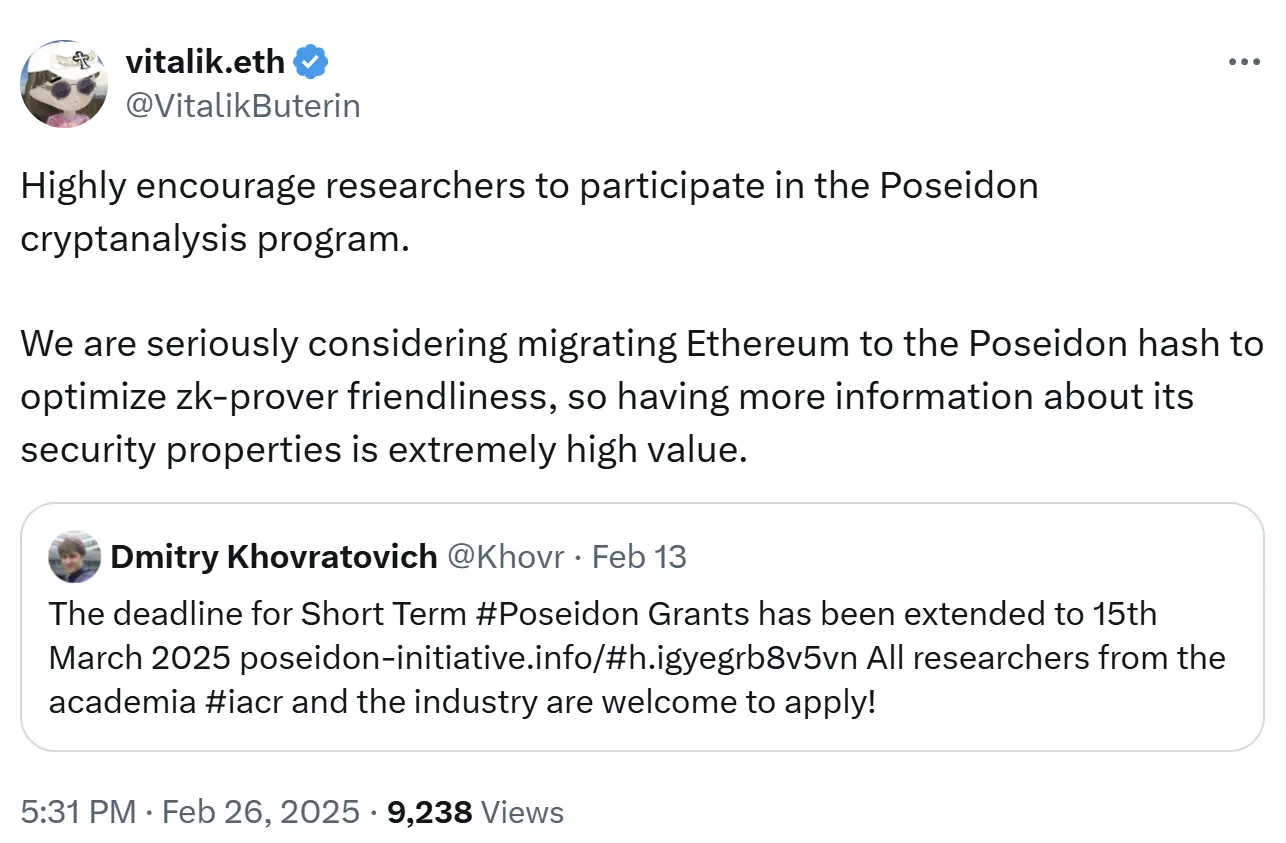
ChainCatcher news, the Web3 industry research and analysis platform Web3Caff Research recently released an in-depth report on the L2 public chain Scroll. Web3Caff Research researcher ssr.eth pointed out in the report that in January 2021, Ethereum co-founder Vitalik Buterin stated that with the advancement of zk-SNARK technology, zk-Rollup would prevail among all Layer2 solutions. As a member of the zk-Rollup sector, Scroll is collaborating with the PSE team, supported by the Ethereum Foundation, to develop zkEVM. Although the PSE team has recently shifted its focus to zkVM, Scroll maintains its unique orthodoxy and is exploring new technologies such as zero-knowledge proofs and hardware acceleration, aiming to launch a more secure, efficient, and highly scalable zk-Rollup network.In addition, Scroll introduced EIP-4844 data blobs on April 29, 2024, to achieve Layer1 data availability. The emergence of EIP-4844 significantly optimizes Layer2 solutions and effectively alleviates data availability issues. The report further indicates that with the launch of the Scroll mainnet, its ecosystem is continuously improving, and community incentive activities and hackathons are attracting more and more users and developers.Despite the steady increase in its TVL and active address count, whether Scroll can stand out among numerous competitors remains a key concern for the community. For example, the disadvantages and risks faced by Scroll include issues of technological maturity and user acceptance; zk-Rollup technology is still in the validation phase, has a long development time, and hardware acceleration technology is still under testing. In terms of developer support and ecosystem building, the number of Scroll users and transaction volume still needs to grow. Challenges in cross-chain interoperability and ecosystem integration also increase the resistance to its comprehensive application, while the choice between zkVM and zkEVM will determine the future development direction.
app_icon
ChainCatcher Building the Web3 world with innovations.