








Decrypting Sequoia Capital's Crypto Bureau, a Woman Chooses ALL IN
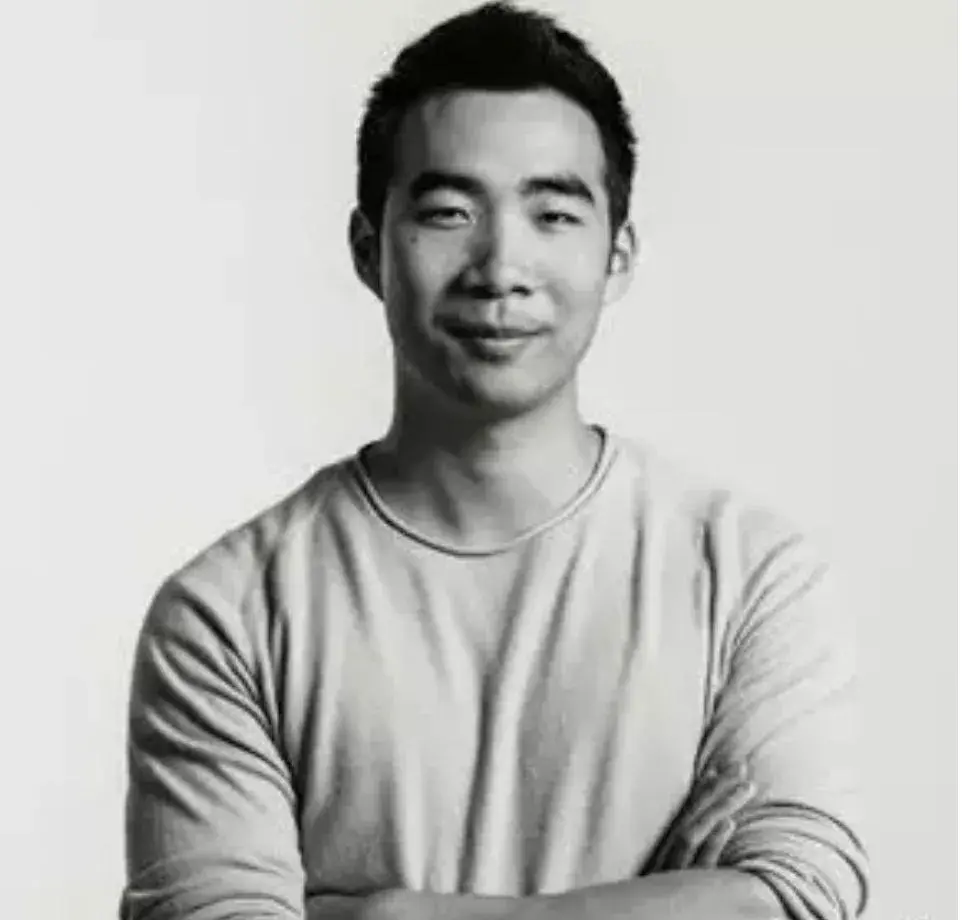
 Someone is driving and leading, her name is MICHELLE BAILHE.
Author: Deep Tide TechFlow

On February 18, Sequoia Capital announced the launch of a cryptocurrency investment fund with a scale of $500-600 million, marking Sequoia Capital's first industry-specific fund since its establishment in 1972.
But how did all this happen? Why did Sequoia Capital make a significant leap from a traditional dollar fund to lead Web3 investments?
The answer is simple: someone is driving and leading this effort, and her name is MICHELLE BAILHE.
To some extent, she has changed Sequoia Capital.
In September 2020, after transitioning from the private equity firm Hellman & Friedman to Sequoia Capital, MICHELLE began actively leading investments in the Crypto direction, and led investments in FIREBLOCKS and FTX.
In the words of someone within Sequoia Capital, Michelle Bailhe is truly ALL IN CRYPTO!
Another similar partner is Shaun Maguire, who has led investments in projects like DeSo, ParallelFi, and Faraway.
Currently, the investments in the crypto space at Sequoia Capital are primarily led by Michelle Bailhe and Shaun Maguire, followed by Alfred Lin, Ravi Gupta, and Konstantine Buhler, who also prioritize Crypto.
Here are some of their current portfolio and responsible individuals:
Michelle Bailhe (FTX, Fireblocks)
Shaun Maguire (DeSo, ParallelFi, Iron Fish, Faraway, Strips, and more seeds in stealth)
Alfred Lin (FTX)
Mike Vernal (Starkware)
Ravi Gupta (Fireblocks)
Roelof Botha (Square now Block)
Andrew Reed (Robinhood)
Stephanie Zhan (stealth seed, Brud acquired by Dapper Labs)
At least in the second half of last year, Sequoia Capital did not plan to establish a dedicated crypto fund. In Maguire's own words, "We don't want the lessons of crypto to be siloed just in a crypto team," but at that time, they did not rule out this possibility.
Perhaps inspired by a16z, dedicated crypto funds have become increasingly popular. Former a16z Crypto head Katie Haun believes that if there is no dedicated team, it is impossible to succeed in crypto investments.
We are not concerned about Maguire's background, but are curious about her views on Web3/Crypto investments, such as her particular interest in the storytelling ability of companies or founders, and her belief that the potential of WEB2 entrepreneurs transitioning to WEB3 is underestimated, with some content derived from past podcast interviews.
According to Sequoia's projected Crypto cycle model, we are currently in the second phase.
Storytelling Ability
"In most companies, especially in the tech field, storytelling is an underestimated art. The difference between great companies and legendary companies lies in how they tell the story of making people's lives better."
In Michelle's view, the ability to tell stories is a core competency that is severely underestimated.
In her words, humans are a storytelling species, and a story is more useful than other information.
Michelle's father is a filmmaker, so she understood from a young age that having technology and products alone is not enough; one must also make them understandable.
For example, Google's success was built on telling a story about how to make life better early on, rather than simply stating that they are a well-known large company.
Google's first Super Bowl ad roughly involved searching in the search box for "how to study abroad in France," "how to date a girl," "how to assemble a crib"…
The reader envisions a beautiful life story rather than a dull product.
Currently, there are mainly two narrative logics: one is to tell the story from the company's perspective to attract curiosity; the other is to start from the founder's perspective and then tell the company's story, like Steve Jobs, Bill Gates, and Elon Musk.
In the Crypto field, Michelle has high praise for FTX founder SBF.
At a Sequoia meeting, she stated that one reason she likes SBF is that he is an amazing storyteller, which is important for creating truly legendary companies.
Additionally, SBF's "clock speed" is astonishing, and for any question you pose, he may have already thought about it from a hundred angles. Michelle ranks SBF among the top three "excellent talents" she has encountered.
WEB3 Investment
Michelle stated that Sequoia Capital focuses on investing in the next technological era. Moving forward, they will focus on two things: first, continuing to invest in and support great entrepreneurs in the Web 3 and Crypto fields; second, there is one thing that is severely underestimated by the public, which is the transition of WEB2 entrepreneurs to WEB3, similar to the shift from PC desktop to mobile, where there will be very successful transformation cases.
Michelle shared a small story.
At a Sequoia home base event, all founders camped overnight together, and three founders from different fields—gaming, consumer, and live shopping—unanimously talked to her about NFTs. This made her think that these companies might all transition to Web3, just as they did to mobile, and those that do not will be left behind.
How to pitch a project?
Michelle admitted that most of her investments are found on Twitter, and she actively contacts people through Twitter DMs, such as reaching out to relevant personnel at FTX. She believes that the most important thing she can do for the companies she has helped is to introduce them to the right people at the right time.
For Sequoia Capital, one question is whether venture capital in the WEB3 era will impact traditional VCs like Sequoia. This seems to be a self-revolution, as various cases like ConstitutionDAO provide a new investment paradigm.
Michelle believes that VCs, like all biological systems, must either evolve or die, and Sequoia Capital will always be paranoid.
Sequoia Capital has been building a long-term model in which they do not have to sell stocks or tokens just because a company goes public, which is a challenge for traditional venture capital.
If LPs want liquidity, then the fund will sell stocks (tokens), which can harm founders to some extent, especially at critical moments; and once the stocks or tokens are sold, the relationship may end, but founders actually need long-term support. As a VC, Sequoia Capital is not "passive money," but a true business partner.
(Note: In October 2021, Sequoia Capital announced the establishment of a single, permanent fund called Sequoia Fund in the U.S. and European markets, changing the traditional fund structure and no longer setting a duration for it. Sequoia can hold public stocks for a long time after a company’s IPO and seek the best long-term returns for LPs, most of whom are non-profit organizations and endowment funds.)
What advice would you give to those wanting to enter this industry?
Michelle sincerely stated, "If you feel there is a space in life, even if many people may feel there isn't, but if you can sense a space to take risks, then go take that risk."
Additionally, Michelle emphasized the importance of quick execution rather than wasting too much time on consideration and entanglement, which is also what she admires most about the FTX team. For example, sometimes SBF would ask her some questions, and although she replied within 24 hours, SBF had already solved it early on, making her feel like she had said a lot of nonsense. This is a lesson she learned from some powerful founders.
Finally, I would like to highlight and strongly recommend an article written by Michelle herself at the end of 2021 titled "Ask Not Wen Moon--Ask Why Moon," which encapsulates her thoughts on WEB3 and Crypto investments:
Ask Not Wen Moon--Ask Why Moon
2021 was a bumper year for cryptocurrency: hundreds of projects launched; thousands of new developers and over 100 million new users entered the crypto space; the total market capitalization of cryptocurrencies increased by $1 trillion; the total locked value of DeFi reached $250 billion; NFT sales broke historical records and received a feature on SNL; Tom Brady (professional American football player) and his wife Gisele's support for FTX sparked interest in cryptocurrency; PleasrDAO rescued a Wu Tang Clan album; ConstitutionDAO almost bought the Constitution…
However, many newcomers to the crypto space still ask the same questions: What exactly is happening in the crypto space? Are crypto investments about investing in currency or investing in a new internet? What are the hot new tokens and NFTs? When will we TO DAO MOON?
I believe a better question is: Why MOON? Why are crypto and Web3 thriving? Why now? While the crypto space, as a trillion-dollar behemoth, is indeed worth attention, why is it important?
While answering these questions may be a Sisyphean task, we attempt to do so within a few pages. These questions may seem overly simplistic to anyone delving into the field, but we hope to engage more users, developers, operators, and founders by providing a historical context for cryptocurrency and a broad overview of the ecosystem's thinking patterns.
We also hope it helps people understand why Sequoia Capital firmly believes that cryptocurrency is one of the most significant transformations of our time.
What is Happening in the Crypto World and Why It Matters
Essentially, currency represents trust. Many people on this planet like to trust their currency and financial systems.
We believe our central banks will not devalue our currency overnight. We trust that governments can avoid hyperinflation so that our currency retains its purchasing power. We trust that banks will ensure our funds are safe and will not lend recklessly, while private companies help us safely use our funds for business and other financial services.
We pay for this privilege of trust through taxes and fees to financial service companies (a multi-trillion-dollar industry). For centuries, this foundation of trust has been a crucial cornerstone of our economic progress.
However, many financial systems do not deserve this level of trust. This is true even in some of the most prosperous and populous countries. For example, the financial crisis of 08-09 even eroded trust in the United States. In recent years, governments' global monetary stimulus measures in response to COVID have raised many questions, further diminishing trust.
The Bitcoin white paper that sparked the crypto industry was released on October 31, 2008, just six weeks after Lehman Brothers collapsed during the financial crisis, which seems like more than a coincidence. The white paper is titled "Bitcoin: A Peer to Peer Electronic Cash System," and it describes a solution to the holy grail problem in cryptography: using a distributed network to verify the authenticity of digital files.
This introduced a new problem to the internet: verifiable scarcity and how to transfer value directly online without intermediaries. To exchange Bitcoin, all we need is internet access and trust in Bitcoin's open-source code. Just as billions of people now believe the internet can facilitate the free exchange of information globally, 220 million people now believe blockchain can enable the free exchange of value worldwide.
Historically, "internet finance" can be seen as a natural evolution of our financial system. The history of financial currency is a story of gradual abstraction for convenience (from barter economies to metal currencies to paper money, etc.).
Today, most of the currencies issued around the world are already digital, just as we once replaced gold with paper money. However, we pay a huge price for the inefficiency of this simulated system, as it has decentralized jurisdictions, countless intermediaries, and long settlement delays.
Why not shift towards internet-native financial currency flows? Isn't this the next step in the journey that PayPal, Stripe, Square, and other companies should embark on?
While Bitcoin seems designed to solve payment issues, generally speaking, most inventions rarely go according to the inventor's plans. As demand for Bitcoin grows, its price and transaction fees also increase, making it gradually function as an investment tool (or store of value) rather than a payment mechanism (medium of exchange).
Interestingly, new inventors have built the concept of Bitcoin in new ways. For instance, Ethereum contributed a distributed ledger not just for currency but also for computation.
Blockchain, as a decentralized computing platform, has captured the imagination of developers, with a vast market potential that can be broadly described as an attempt to bring about better financial order and a better internet.
Better financial currency: currency that is not subject to arbitrary monetary policy, censorship, and oversight, and a financial system that is more trustworthy, accessible, efficient, and cheaper; A better internet: users own their data rather than renting access from given platforms; creators receive better compensation, and communities manage themselves; digital goods (NFTs) that are more liquid, portable across platforms, and better suited for managing digital rights.
These are just goals; we have a long way to go. Some believe the entire effort of cryptocurrency is a scam, but this misses the point. Historically, when technological innovations lead to financial innovations before regulation, we see world-changing innovations, followed by frenzy, fraud, collapse, regulatory frameworks, and then the slow establishment of lasting value (see: the early stock markets in Amsterdam in the 1600s).
Crypto seems no different, with its fake tokens and some excessive hype. But like all other technological revolutions, enduring companies will surely emerge during this period.
The Great Transformation
Cryptographic technology will change the value of the internet and the value of the internet itself. Blockchain will rewrite how we own, sell, buy, trade, exchange, and reward. As software permeates our world, cryptocurrency (software currency) will also permeate currency and everything we do with it.
The inherent properties of blockchain—instant value transfer, verifiable scarcity, and user ownership—can reorganize trillion-dollar market caps across payments, finance, gaming, content, social networks, and more.
Digital currency is fundamentally useful for 220 million people and an ever-increasing number of individuals, whether as a hedge against inflation with capped supply, a censorship-resistant store of value, a borderless medium of exchange, and/or an investment tool, creating a new asset class.
This new asset class is creating markets for centralized and decentralized (DeFi) financial services. Like any asset class, owners want to be able to buy, hold, sell, trade, lend, hedge, swap, subdivide, insure, and more. With cryptocurrency, they also want to freely cross borders and time zones 24/7. This could expand the current financial system and create more consumer choices.
The rise of crypto requires a new crypto stack. From core infrastructure to developer tools, some traditional stacks can be converted while others cannot. Custody, nodes, fiat on/off ramps, and on-chain and off-chain data are just a few areas of the emerging crypto stack. In this era, value may accumulate to new levels.
In traditional software, the application layer generates more value (Google ~ $2T market cap, TCP/IP/SMTP can be said to be worth $0), while in cryptocurrency, core protocols can be monetized through tokens (BTC+ETH ~ $2T market cap).
Blockchain supports not only digital assets but also digital goods (NFTs) and decentralized applications (Web3). Although transaction volumes, user interest, and developer energy in these areas are exploding, they are still in their early stages. Web3 has enormous potential to reshape internet services around principles of user ownership, creator rewards, and community governance (e.g., DAOs).
Regulatory frameworks are still being shaped, so founders need to thoughtfully explore the unknown.
The Psychological Model of Crypto
Understanding cryptocurrency along two dimensions may be helpful: space and time.
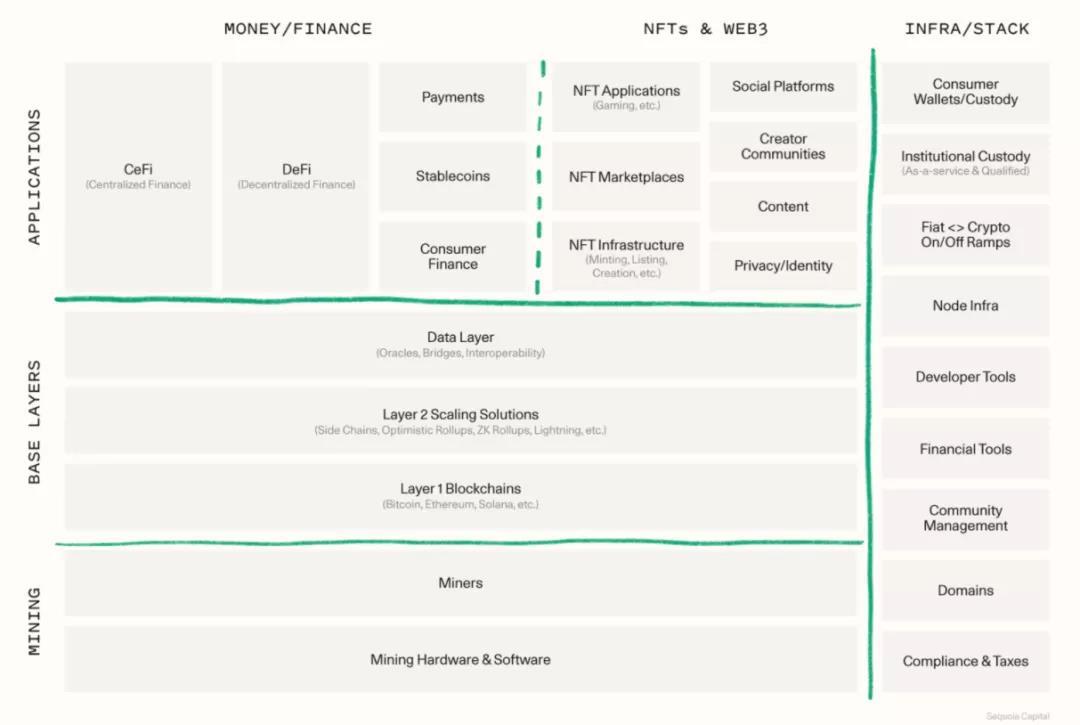
Space: Below is a map of the crypto ecosystem.
It is organized like a typical stack, from hardware at the bottom to applications at the top, with infrastructure for building and accessing it on the right side. For now, we certainly know this is not perfect. Many of these categories overlap.
Time: Inspired by the typical S-curve of new technology adoption, this is a framework for when opportunities in a specific field mature. This is also imperfect—building happens simultaneously, phases overlap, and interact in feedback loops.
However, this is not a rehash of every local maximum and minimum over the past decade; rather, it attempts to narrow the scope and imagine how we evolve from millions to billions of crypto users.
First Phase: Isolation. Crypto as an island, disconnected from the non-crypto world. Crypto builds its core protocols independently (think of TCP/IP for the internet, and first-layer blockchains like Bitcoin, Ethereum, and Solana for crypto).
Protocols are inseparable from their native tokens, and various tokens create demand for exchanges and additional financial services. Most legacy companies lack the technology and regulatory willingness to meet this demand, allowing crypto natives to fill the gap. The crypto-native analogs of each financial service have roughly emerged in historical order: currency, forex, lending, derivatives, insurance, options, ETFs, etc.
Second Phase: Connectivity. Connecting the crypto and non-crypto worlds. The non-crypto world sees the value of crypto and builds/buys infrastructure to access it. Custody/wallets, crypto fiat on/off ramps, data feeds, blockchain-specific infrastructure, and developer tools have grown exponentially during this time.
New use cases from the NFT art community to gaming to Web3 social networks attract new users. As the mass market begins to engage with the crypto market, competitive pressure greatly simplifies user experience and lowers access barriers. In the coming decade, the number of users and developers able to access crypto will increase by 10-100 times. We believe we are just at the beginning of the second phase.
Third Phase: Maturity. The integration of the crypto world and the non-crypto world, so they are no longer different. Just like mobile devices, once crypto access becomes sufficiently widespread, applications will have the foundation they need to fully realize their potential. They will bridge the gap from crypto to everyday life.
It is important to clarify that many people are already building in areas like consumer finance, DeFi, NFTs, and Web3, but only a few hundred million people and institutions can access them. As access expands, user engagement with applications will increase by an order of magnitude.
Looking Forward
Cryptocurrency is still in its early stages. While it is full of volatility, it is also full of innovation. Viewing cryptocurrency purely as a speculative endeavor overlooks the history of every financial innovation having its abusers and misses the tremendous potential for creating a better financial system. To see cryptocurrency as too slow, too expensive, or too confusing to use is akin to rejecting the internet during its dial-up phase.
While criticisms of the user experience, cost, speed, or environmental impact of crypto are valid, these are not death knells for the movement; rather, these criticisms present opportunities for us to enter and build.
Our fundamental appeal is: billions of people want a better financial system and a better internet; we believe the new generation of developers is motivated to build these solutions for the world.
 Risk warning
 Risk warning

Popular articles





