








Drops DAO: A Revolution in NFT Liquidity Efficiency
 Drops DAO is a platform that provides instant loans for NFT assets, supporting NFT assets as collateral to offer loans through a funding pool.
The issue of poor liquidity in NFTs has long plagued buyers and sellers in the NFT market. As a result, more and more developers are trying to tackle this problem using DeFi lending models. NFT lending refers to the ability of holders to borrow short-term funds by collateralizing their NFT assets without selling them, thus enjoying the benefits of holding NFTs while improving the efficiency of NFT asset utilization.
Currently, NFT lending is still in the early stages of exploration. There are mainly two models of lending: the Peer-to-Peer (P2P) model and the Peer-to-Pool model.
The process of the P2P model for NFT lending is quite similar to an auction, requiring both parties to agree on the loan amount, loan duration, and interest before completing the transaction. Upon maturity, the NFT collateralizer must repay the principal and interest to retrieve the NFT from the smart contract; otherwise, the NFT will be transferred to the liquidity provider.
For example, NFTFi and Arcade are such P2P lending markets. Although this P2P model theoretically applies to any type of NFT (such as gaming, avatars, land, etc.), as long as supply and demand are met, transactions will occur. However, its drawbacks are also evident. Since the matching process is manual, obtaining liquidity may take a long time, making it unsuitable for users who want to quickly access funds. Additionally, because there is no unified standard for NFT pricing, the pricing is based solely on the personal judgment of the liquidity providers, which places high demands on them. After all, providing the wrong quote carries the risk of losing money after liquidation. The result is that quotes in the P2P model tend to be lower, and interest rates are higher.
Due to these shortcomings, the NFT liquidity pool model has emerged. Drops DAO is a classic solution under this model, dedicated to providing a "new primitive" for NFT-Fi.
Drops DAO is a platform that provides instant loans for NFT assets, supporting NFT assets as collateral to offer loans through a liquidity pool.
In the liquidity pool model, holders can immediately borrow funds after collateralizing their NFT assets into a pool, and the entire process is similar to using platforms like Aave or Compound. The pricing of NFTs is determined by the time-weighted average price (TWAP) of the floor price collected from on-chain data over a period.
In Drops DAO, the borrowing limit for NFT holders is generally 30% of the floor price of the NFT asset, and the interest paid depends on the liquidity of the pool and the supply of NFTs. The crypto assets in the liquidity pool are injected by lenders, who can deposit mainstream crypto assets into the corresponding liquidity pool to earn interest. Currently supported crypto assets include USDC, ETH, WBTC, and ENJ (Enjin).
Specifically, how does Drops utilize liquidity pools to guide this "NFT liquidity efficiency revolution"? This article will detail Drops DAO from aspects such as operational logic, token economics, team, and operational status.
1. Operational Logic
Historically, the biggest issue with using NFTs as collateral has been pricing, as the price determines the amount that can be borrowed against the NFT. However, each NFT has a different price due to its uniqueness, so how to measure the price of NFTs as collateral becomes a problem that NFT lending applications need to solve. As mentioned earlier, in the P2P model, pricing can only rely on the personal judgment of liquidity providers, leading to significant subjectivity and uncertainty, resulting in higher financial risks.
The liquidity pool model mostly uses on-chain data to calculate TWAP, excluding outliers and averaging the floor price over a period. Therefore, regardless of how rare an NFT is in a series, the floor price is uniformly used as the valuation standard, preventing price manipulation.
Drops DAO obtains high-quality NFT floor price data through Chainlink. The Chainlink oracle will introduce the latest NFT market data on-chain, allowing users to access tamper-proof and reliable market data with multi-layer aggregation features, helping to eliminate single points of failure and enabling Drops DAO to provide accurate and timely floor price information for NFT collections.
So, how does Drops NFT lending specifically operate?
For NFT holders, it mainly involves four steps:
- Choose a lending pool: Select an existing lending pool that accepts your NFT as collateral, such as the BYAC lending pool;
- Provide NFT as collateral: The value of the collateral is determined by the TWAP of the NFT floor price;
- NFT lending: Users can use any compatible NFT as collateral, borrowing up to 80% of the asset's value, and can also obtain a permissionless quick loan from the Drops pool, where up to 30% of the NFT valuation can be borrowed immediately. The specific interest rate is determined by the liquidity and funding situation of the lending pool.
- Manage credit: Users will be informed of the collateral ratio and limits, which must be adhered to in order to prevent liquidation of the collateral. Additionally, defaulting users will incur a certain amount of liquidation penalties.
In summary, Drops' permissionless NFT lending pool allows users to use NFTs as collateral and immediately obtain trustless loans without dealing with lenders or waiting for approval.
As compensation for providing NFTs, Drops also offers users dNFTs as rewards. dNFTs are ERC721 tokens that can be exchanged for the underlying assets they represent at any time. Unlike dTokens, dNFTs do not accrue interest and can only be used as collateral.
NFTs with low borrowing interest can also earn income by placing borrowed stablecoins in Drops' yield strategies.
For liquidity providers, they can earn returns by depositing stablecoins and governance tokens into the lending pool to utilize idle assets. During the period the protocol is staked, depositors in Drops lending will automatically receive variable interest rate returns on their assets. The interest rates will fluctuate based on supply and demand.
Drops combines liquidity tokens, staking, and yield farming in diverse ways to generate returns for liquidity providers.
2. Token Economics
The governance token of DropsDAO is DOP (Drops Ownership Power), which has been listed on Uniswap, MEXC Global, and Gate.io.
It is worth mentioning that to encourage participation in governance, Drops DAO links the inflation rate of new DOP tokens to the amount of veDOP locked, thereby incentivizing DAO participants to remain active or pay the supply of new tokens when rewards decrease. Therefore, if someone wants to use it to participate in DAO governance, they must lock DOP to create another token called veDOP.
DOP Token
The governance token DOP of Drops DAO has the right to allocate liquidity incentives in the lending pool and make decisions about the future of the protocol. Currently, DOP is mainly used for two purposes: voting and staking. Users must lock DOP and obtain voting escrowed DOP (veDOP) to participate in the voting and staking process.
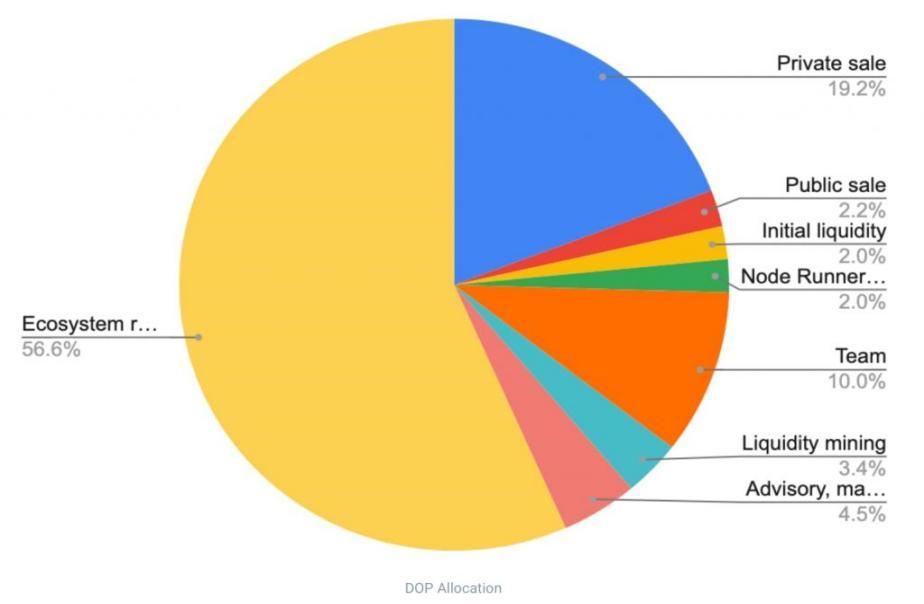
The maximum supply of DOP is 15,000,000 tokens, with the following allocation ratios:
- 25.39% allocated to investors and advisors
- 10% allocated to the team
- 50.63% allocated to the community, obtainable through liquidity mining
- 10.5% allocated to the foundation reserve for business development, bug bounties, and community incentives
- 1.11% allocated to decentralized exchanges to guide liquidity
- 2% allocated to Node Runners DAO (this organization is an early supporter of the community)
veDOP
Vote-escrowed DOP is a non-transferable token that can only be obtained by locking DOP. When the lock is activated, an NFT reflecting the veDOP position is created. veDOP is inspired by the veCRV model. Tokens are received by locking DOP for a duration ranging from 1 week to 4 years. These tokens are non-transferable, and the veDOP balance depends on the amount of DOP and the duration of the lock. 1 DOP locked for 4 years = 1 veDOP.
It is noteworthy that a total of 2,420,000 DOP tokens (16.1% of the supply) will be distributed as liquidity incentives over the next five years across the entire asset market.
veDOP holders can enjoy three powers, including: governance, influencing NFT liquidity, receiving protocol fees, and "additional benefits."
Governance: Community members will be able to use governance tokens to fund new initiatives; manage interest rates, fees, and collateral factors; decide which lending pools to add; and manage DOP inflation.
Influencing NFT Liquidity: Users can vote on NFT pools to receive DOP rewards; the more votes a liquidity pool receives, the more DOP is allocated, increasing the stable funding supply APY, thereby attracting liquidity, and higher liquidity will lower the custody interest rates.
Receiving Additional Rewards: NFT collections can offer tokens to veDOP holders as "bribes" to vote for their pools. This will achieve non-inflationary yield on top of existing protocol fees.
3. Team and Operational Status
The Drops team has extensive experience in product development and marketing, with most team members working in the cryptocurrency field since early 2017, possessing skills in blockchain and non-crypto software development.
Additionally, Drops received support from major market participants such as Polygon, Enjin, Attrace, and Bridge at its inception. This includes investments from large investors like Enjin CEO Maxim Blagov and SushiSwap CTO Joseph Delong.
Of course, like any decentralized protocol, the Drops Loans protocol has inherent risks, such as smart contract code errors. However, Drops has also taken corresponding preventive measures, such as conducting third-party audits to mitigate risks. The Drops protocol completed a smart contract audit report using PeckShield in February of this year, ensuring security.
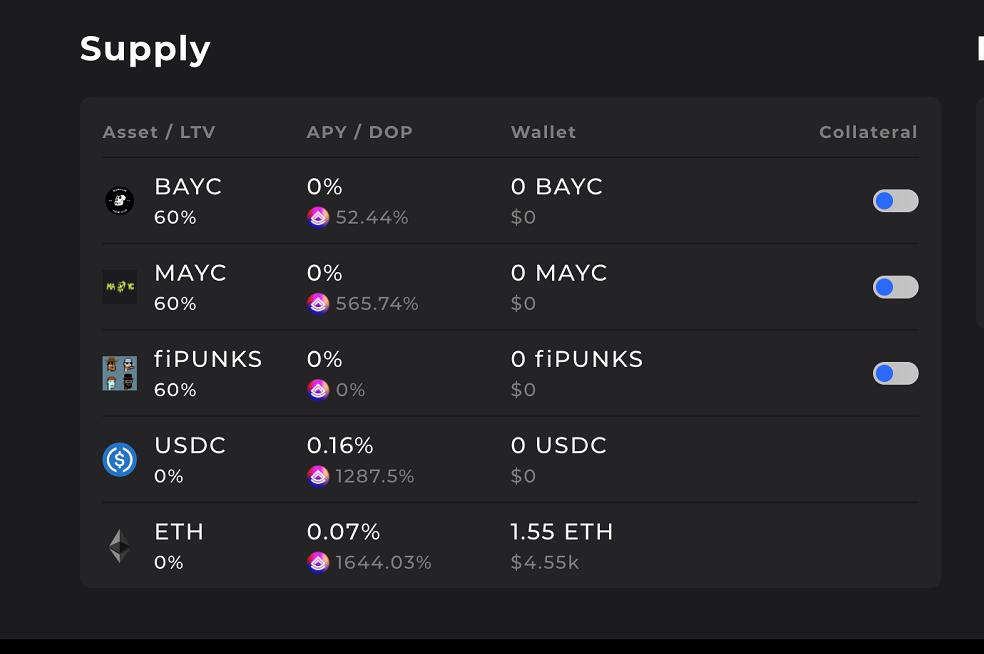
Since its launch, the Drops lending market has reached a scale of $7.197 million, but currently only has a token staking pool. According to the latest news from the project team, Drops Loans will soon launch the first lending pools for Punks and BAYC NFTs. In the future, the team will also work on improving liquidity, enhancing the accuracy of NFT oracles, and striving for decentralization.
It can be said that Drops is one of the few protocols in the NFT-Fi space that can truly enhance NFT liquidity. Its liquidity pool model, compared to the P2P model, can quickly help NFT holders obtain loans without requiring trust. At the same time, using Chainlink oracles as the NFT valuation model also lowers the threshold for liquidity providers in the lending pool, as it establishes a relatively objective pricing standard.
Moreover, according to the Drops white paper, the protocol will be deployed to networks like Polygon in the future, striving to provide users with a gas-free and transaction-free model. Drops is open to all NFTs, and for aspiring digital artists and designers, Drops may serve as a springboard for their careers. One day in the future, as innovative NFT-Fi models increase, the NFT market will no longer be a playground for a few whales, and more observers will participate and become players.
 Risk warning Risk warning



Popular articles





