








a16z partner to project founders: how to weather the storm during market downturns

 The wind rises at the end of the green rushes; powerful enterprises are always established in the most difficult times.
Source: “A Framework for Navigating Down Markets”
Authors: Justin Kahl, David George, a16z
Compiled by: Aididiao, ForesightNews
During market downturns, many blogs or Twitter posts offer the same advice: conserve cash, extend timelines, and shift focus from growth to efficiency. However, when the market declines, founders need more than clichéd advice; they require a practical framework to reassess risk and value, focusing on the next round of funding and future direction.
In this article, we will introduce a decision-making framework to share with founders: revaluation, controlling the "spending return ratio," and preparing for battle.
Revaluation
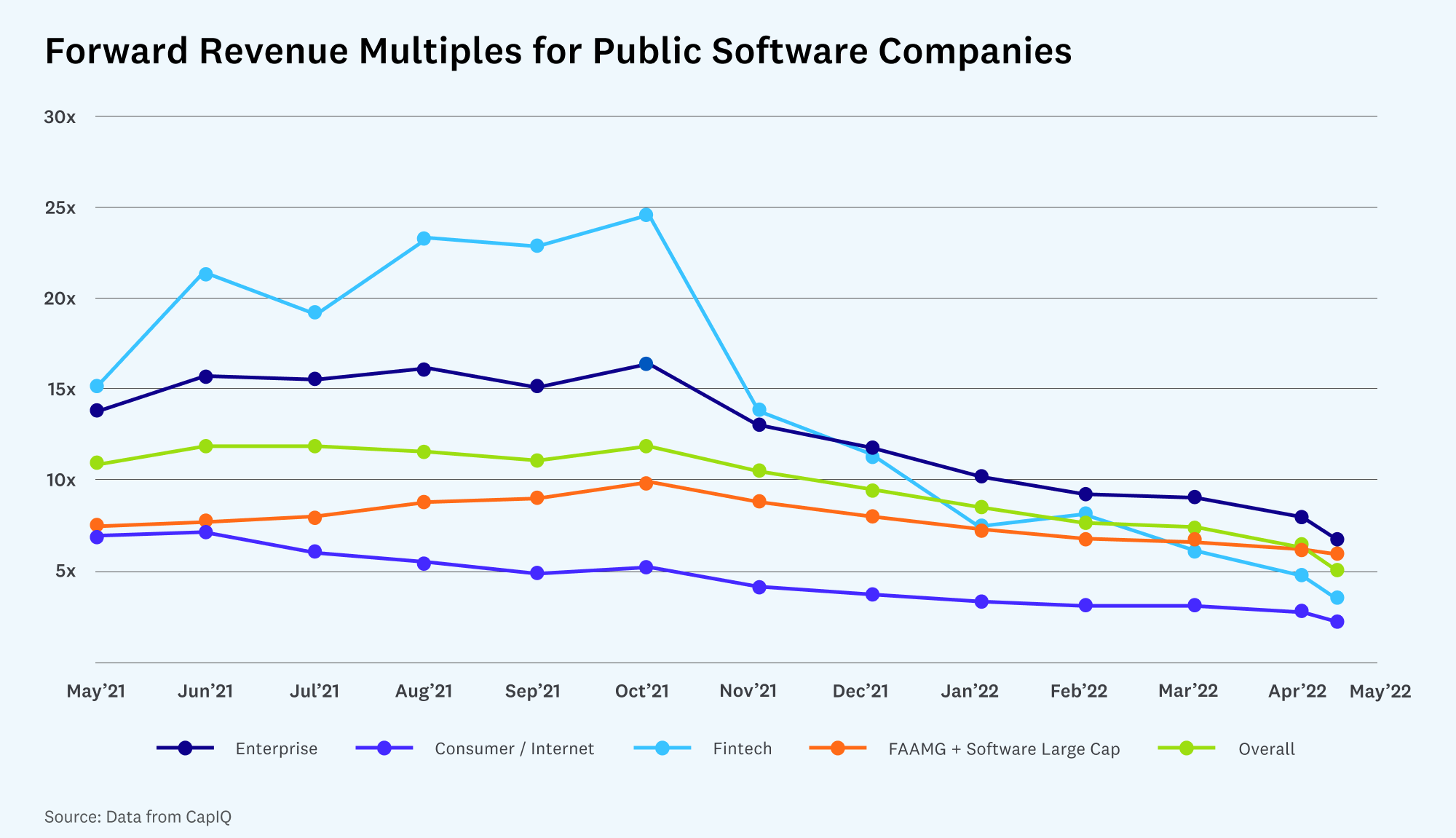
First, we need to quantify the changes in valuation multiples (i.e., the ratio of valuation to revenue). The public market provides the best way to readjust valuation changes, as the effects of declining valuations can be seen first in public markets. For example, in the current market (as shown in the figure below), the median expected revenue multiple for publicly traded software companies has dropped from a peak of 12 times in October 2021 to 5 times or even lower, a decline of nearly 60%. The same is true for fintech and consumer internet companies, whose stock prices have also fallen by over 70-80%.
However, the impact on the venture capital market will only become apparent after financial data reports are released in the coming months and quarters. In other words, it may take more than six months to see the effects of a downturn in the public market on venture capital.
The impact of a recession varies across industries, so it is essential to pay attention to relevant publicly listed companies to better assess your situation. For instance, a year ago, it was common for private companies to have financing valuations at 100 times ARR (Annual Recurring Revenue). If your last round of financing had an ARR of $20 million and grew by three times, you might have achieved a valuation of $2 billion in the new round.
But now the situation is very different; you can roughly estimate valuation changes by observing the leading publicly listed companies in your industry. If their stock prices have dropped by 60%, you are likely facing a similar situation. When observing high-growth publicly traded software companies, you can compare your ARR valuation multiple with their revenue valuation multiple, which can serve as a GAAP accounting metric.
Once you know how much the segment has declined, how do you readjust your targets for this new low-valuation environment?
It is necessary to figure out how much ARR you need to achieve to return to the previous round's valuation and make corresponding plans. To do this, you can use the estimated changes in valuation multiples of leading publicly listed companies in your industry, along with growth rates and efficiency-adjusted premiums to calculate the ARR you need to achieve. When you can reach your revenue target within 12 months, you will be in a position to raise the next round of funding; conversely, if you cannot meet the target within 12 months, financing will become more challenging.
For example, a business with $20 million ARR that ultimately raises funds at a $2 billion valuation, but observes that the valuation multiple of leading publicly listed companies is 10 times instead of 100 times. Considering that startups should have a faster growth rate compared to publicly listed companies, a 15 times ARR is a reasonable valuation for its next round of financing. (Note: 15 times ARR corresponds to a 50% premium over leading companies in the industry and a 200% premium over the industry average, but the specific multiple varies by company.) This means their target should be to reach $133 million ARR within 12 months.
Controlling Spending Return Ratio
After setting the target ARR, what is the next step to assess whether the business is effectively growing to meet this target?
At this point, we shift our focus to the spending return ratio, which we define as the cash consumed divided by net ARR. For example, if a company spends $40 million to increase its ARR by $10 million, its burn multiple will be $40 million / $10 million, which equals 4 times. The spending return ratio is a metric that can be evaluated each quarter, and closely tracking it can ensure the business is growing effectively.
When market conditions change, we prefer to recalibrate using the spending return ratio because it encompasses all business activities. Unlike other multiples that focus solely on sales and marketing (e.g., LTV/CAC), actions taken in each business unit will affect the final return ratio. A company with $5 million ARR will have a much lower operational proportion than a company with $100 million ARR. Over time, as the company's cash flow turns positive, the goal should at least be to maintain positive cash flow.
We studied the spending return ratios of private companies at different growth stages to derive some general guidelines for assessing the quality of spending return ratios.
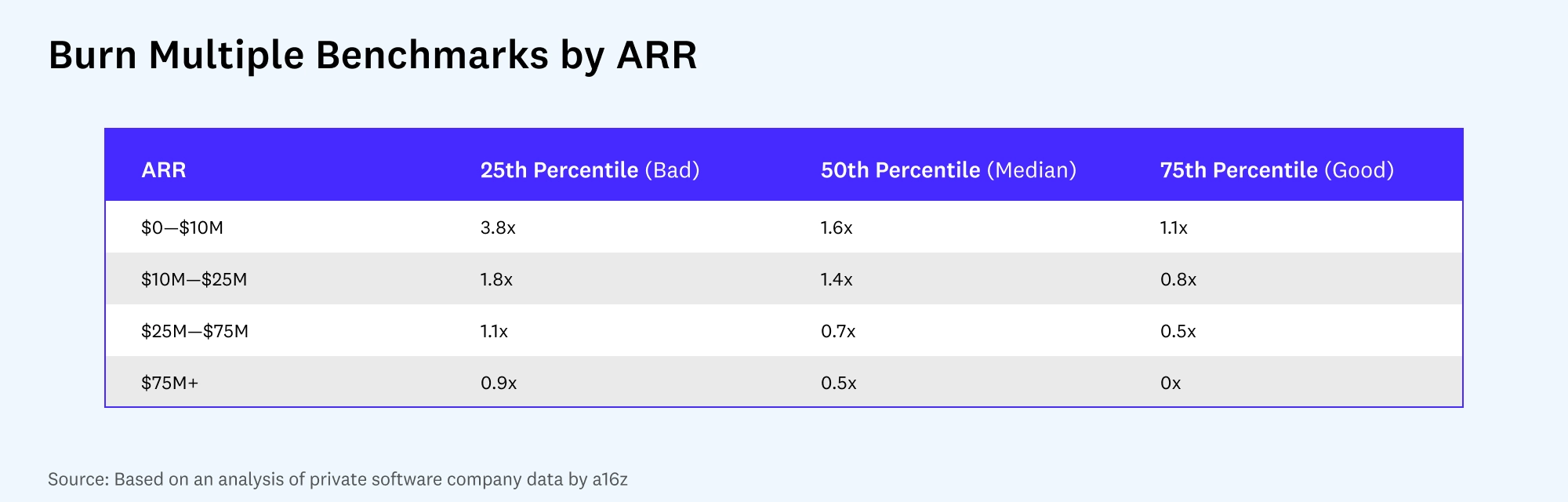
For companies at different stages, these metrics provide useful guidance while keeping in mind the constraints of the business itself. If you need to increase ARR by $100 million with $50 million in costs, you should develop a plan to ensure the spending return ratio is less than 0.5 times. If the spending return ratio does not meet the requirements, there are many ways to improve it to enhance efficiency, including appropriately adjusting the scale, increasing profit margins, or reducing CAC. In this article, we will continue to focus on our investment framework while previously discussing how to use financial data to navigate market turbulence.
Preparing for Battle
The spending return ratio and valuation multiples represent the efficiency of growth and the need for growth targets, respectively. However, when the financing environment changes and obtaining funds becomes more uncertain and expensive, it is crucial to carefully control the company's cash flow to ensure it can operate normally for an extended period. Being well-prepared in advance helps consider how macro events (war, supply chain issues, inflation) affect performance metrics such as growth and CAC. Closely monitoring cash expenditures and developing contingency plans can help quickly adjust spending and investments based on performance.
Plan for at least the following three scenarios:
Base Case: A feasible plan with an 80% probability that can operate with a good spending multiple. Customer acquisition investments and operational expenses (opex) slow down or stabilize. Revenue growth will be below the operational plan from six months ago, but you will improve efficiency and absolute cash consumption.
Best Case: ARR growth and burn rate may equal or exceed the operational plan from six months ago. Growth efficiency is high, with no concerns about timelines, and operational spending and customer acquisition investments can be increased.
Worst Case: A significant slowdown in burn rate is required, and the operational timeline needs to be extended. You plan to grow ARR to the limit, which may require substantial cuts in sales/marketing spending. At the same time, operational expenses, including headcount, may need to be reduced.
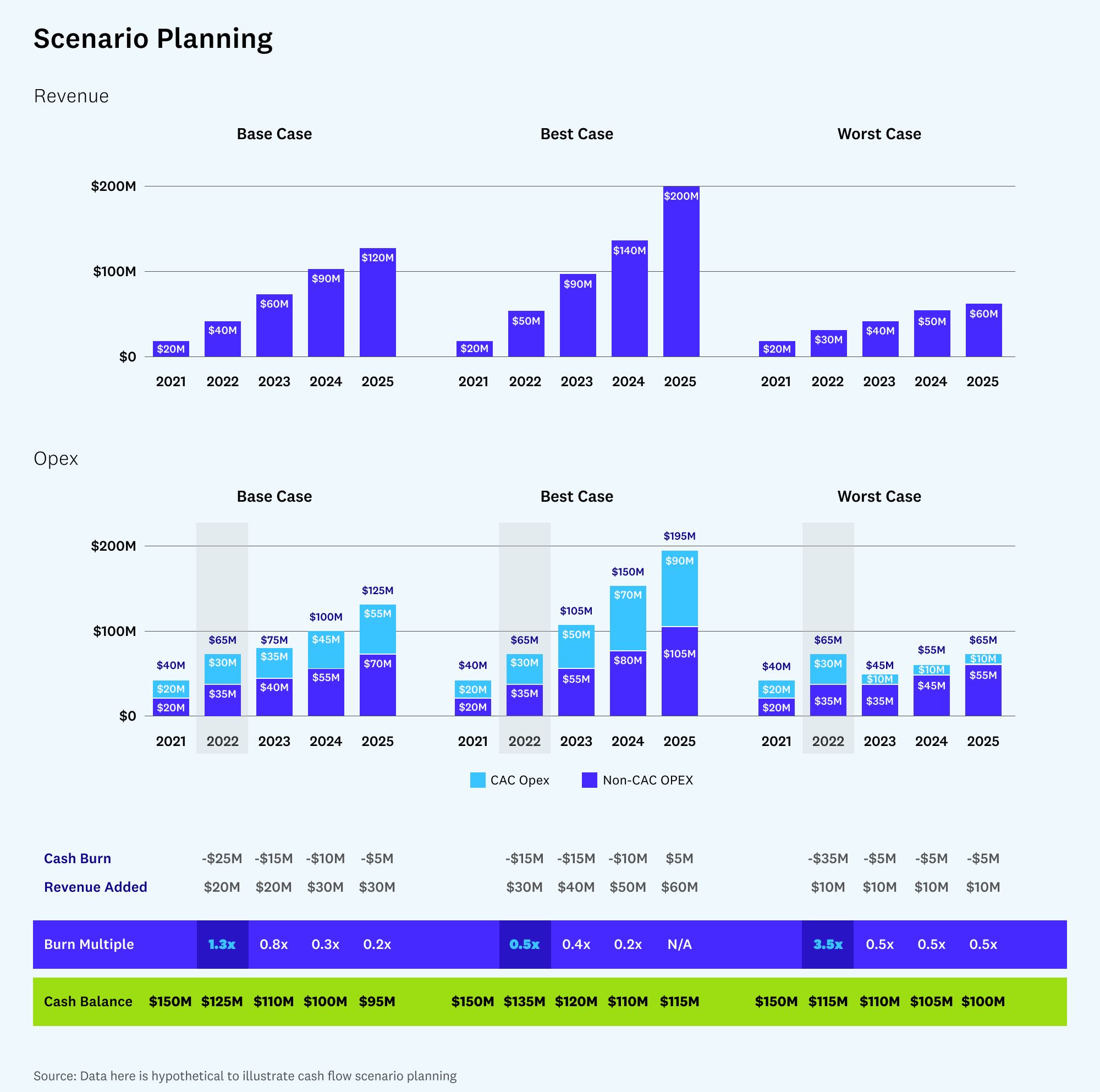
Once the plan is established, evaluate progress quarterly or monthly, and adjust spending and hiring accordingly. While hoping to move toward the best-case scenario, if the worst-case scenario arises, difficult decisions may need to be made—such as whether layoffs are necessary, whether to raise debt, or whether to go for another round of financing. There are no templates for these questions, and if you find yourself facing them, seek professional help.
Through the uncertainty and downturn of the market, it is important to remember that markets are cyclical, and there is always a glimmer of hope during downturns. Some of the strongest companies are built during the toughest times, and those that survive market transitions often gain more market share and operate more streamlined and efficiently.
 Risk warning
 Risk warning




Popular articles





