From crypto "Cheerleader" to crypto "Executioner," how did the SEC Chairman fall into regulatory embarrassment?

 From "Ambiguity" to a Falling Out: The Anxiety Behind the Imbalance of SEC's Cryptocurrency Regulation.
Written by: flowie, ChainCatcher
Recently, two Republican members of the U.S. House of Representatives submitted a bill aimed at restructuring the U.S. SEC and removing SEC Chairman Gary Gensler. Republican lawmakers stated that Gensler has been "allowed a series of abuses under the current SEC structure."
Following the collapse of FTX, there has been growing public discontent regarding the SEC and Gary Gensler's series of extreme actions in cryptocurrency regulation. As personal experiences of Gary Gensler and his various connections with FTX spread, the war between the SEC and cryptocurrency institutions has begun to shift towards a campaign against Gary Gensler himself.
From being the "cheerleader" of cryptocurrency to becoming the "executioner," Gary Gensler's frequent changes in stance have not only led to unprecedented criticism but have also raised concerns that the SEC, under his leadership, seems to be anxious and gradually losing control in the face of continuous blows to the cryptocurrency market.
Cryptocurrency Claims Change Frequently, Gary Gensler Called to Step Down
"This SEC chairman looks thin because he has been 'eating only his own words' since 2018," a former U.S. Chamber of Commerce writer sharply criticized Gary Gensler's inconsistent claims regarding cryptocurrency.
Indeed, Gary Gensler has presented almost two faces regarding cryptocurrency before and after taking office at the SEC. Before taking office, Gary Gensler was a professor advocating for the development of cryptocurrency and a guide for cryptocurrency users entering the field. In 2018, Gary Gensler served as a professor at the MIT Sloan School of Management and a senior advisor for the MIT Media Lab's cryptocurrency project, where he taught a course on the development of Bitcoin and the impact of blockchain on the financial industry. This course was the first lesson for many cryptocurrency users entering the field. Manta Network co-founder and COO Kenny also stated that as one of Gensler's former students, Gary Gensler sent him a report he wrote about BNB and encouraged him to participate more in cryptocurrency innovation.
During this period, Gensler was also a proponent of cryptocurrency. He was active in numerous blockchain forums, expressing optimism about the development of blockchain technology and acknowledging its tremendous potential to change the financial world. In response to accusations during a U.S. Congressional hearing that cryptocurrency projects are Ponzi schemes, Gensler countered that cryptocurrencies could be viewed as digital rare metals.
More importantly, Gensler once mentioned at an institutional investor event focused on cryptocurrency: "Over 70% of the cryptocurrency market share is held by Bitcoin (BTC), Ethereum (ETH), Litecoin (LTC), and Bitcoin Cash (BCH). Why do I mention these four currencies? They are not securities, and three-quarters of this market may not be securities." This is in stark contrast to the SEC's current claim that "most cryptocurrencies are securities."
Given his previous friendliness towards cryptocurrency, coupled with Gary Gensler's 18 years of traditional finance experience at Goldman Sachs, as well as his rich political experience as the Assistant Secretary of the Treasury and Chairman of the CFTC, his appointment was highly regarded both inside and outside the industry, with many believing he would promote the U.S. leadership in cryptocurrency regulation.
However, now Gary Gensler has transformed from a supporter of cryptocurrency to a suppressor of it, and the contradictions between "most cryptocurrencies are not securities" and "most cryptocurrencies are securities" have led to unprecedented scrutiny. A casual glance at a tweet from Gary Gensler reveals a comment section filled with calls for his resignation. Media, KOLs, and U.S. congressional officials are all condemning and even calling for the removal of Gary Gensler and the restructuring of the SEC.
The wave of criticism began almost immediately after the FTX collapse. After FTX's bankruptcy last year, a U.S. senator accused Gary Gensler of having flaws in his "cryptocurrency information gathering work" and insisted that Gensler should appear before Congress to explain the costs of his "regulatory failures."
Earlier this year, as the SEC launched successive attacks on Binance, Coinbase, and stablecoins, dissatisfaction within the cryptocurrency industry towards Gary Gensler gradually reached a peak. [Skybridge](https://www.rootdata.com/zh/Investors/detail/SkyBridge Capital?k=MTA4NDQ=) founder [Anthony Scaramucci](https://www.rootdata.com/zh/member/Anthony Scaramucci?k=ODkxMA==) stated in an interview in April that Gary Gensler is a "malicious regulator," and his stance towards the cryptocurrency industry could push more businesses overseas. Meanwhile, the founder of Messari criticized the SEC under Gary Gensler's leadership as an extremely unethical organization, lazy and corrupt, stating that this year they would spend half their time making leaders aware of their true nature. Recently, two Republican members of the U.S. House of Representatives submitted a stablecoin bill to restructure the SEC and remove SEC Chairman Gary Gensler.
Amid the calls for Gary Gensler's resignation, various forms of dissatisfaction are intertwined.
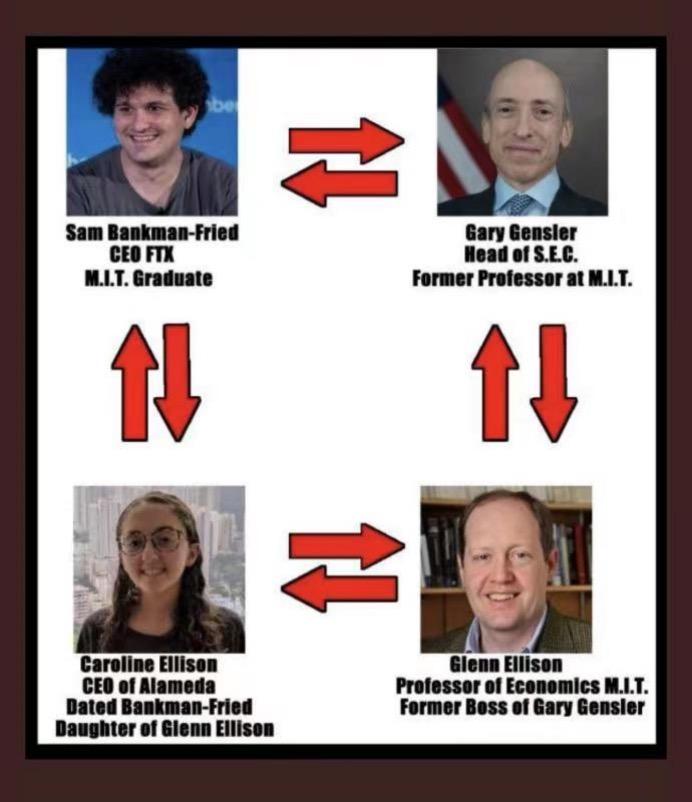
Firstly, there is dissatisfaction with Gary Gensler's alleged "personal vendetta." The fallout from FTX has not only led to discontent regarding Gary Gensler and the SEC's ineffective regulation but has also sparked public outrage over the intricate connections between Gary Gensler and FTX. Many of his former colleagues from the CFTC have joined FTX.US, and it is worth noting that Alameda CEO Caroline's father, who is the former girlfriend of SBF, is a professor and director of economics at MIT, which means he was Gensler's former boss while he was teaching there. Zhao Changpeng's role in the FTX collapse has been interpreted by many cryptocurrency users as Gensler seeking to "settle scores."
Secondly, there is dissatisfaction with the bureaucratic nature of Gary Gensler and the SEC. On one hand, many cryptocurrency projects, represented by Coinbase, have stated that despite spending significant human and financial resources trying to establish a relationship with the SEC to promote clarity in cryptocurrency regulation, they have not achieved their goals.
Realio's founder elaborated on this painful process in "Why Am I Leaving the U.S.?". Realio claimed that they spent most of the last three years on compliance, incurring huge costs to hire top lawyers to register their "tokenized" fund with the SEC under the 40 Act. Unfortunately, after the FTX collapse, the SEC shut down all registrations for "tokenized" funds seeking approval, and attempts to seek other regulatory bodies were fruitless. Realio criticized, "Most issuers of blockchain-based assets actually have no registration pathway, not due to a lack of attempts or compliance. Regulatory agencies are not unfamiliar with the various strategies we adopt; it is typical bureaucracy."
Additionally, the SEC's actions have been viewed as sacrificing cryptocurrency innovation in the competition for jurisdiction over cryptocurrency with the CFTC. The jurisdictional battle between the SEC and cryptocurrency has escalated, especially since Gary Gensler took office.
Thirdly, there is dissatisfaction with Gary Gensler's SEC stifling innovation and handing over the leadership of U.S. cryptocurrency to others. BlockWorks published a manifesto stating that the development of digital assets is inevitable, and in the technological revolution that financial markets must ultimately accept, the U.S. has two choices: to lead or to follow. Gensler's SEC has chosen to ignore progress and stifle innovation, leading to the U.S. relinquishing leadership in tomorrow's financial markets to Europe, the Middle East, and even countries deemed hostile by the U.S. In fact, under Gary Gensler's severe accusations against Coinbase and Binance, many regions in Hong Kong and Dubai are extending olive branches to them, and many cryptocurrency projects are migrating out of the U.S.
From "Ambiguity" to Open Conflict, The Anxiety Behind the Imbalance of SEC Cryptocurrency Regulation
The accusations are met with widespread disbelief and one-sided criticism, and the SEC's hasty and chaotic regulatory measures may reflect Gary Gensler's anxiety over losing control of cryptocurrency regulation.
Although Gary Gensler has initiated numerous investigations and accusations against cryptocurrency since taking office in 2021, perhaps out of concern for not stifling cryptocurrency innovation, his early actions were mainly warnings and small fines.
For example, in 2021, Circle and Uniswap Labs received SEC investigations, while Coinbase was warned not to launch lending products or face lawsuits. The calls for cryptocurrencies to register with the SEC were also primarily met with warnings rather than actual enforcement. Around 2022, although BlockFi and Nexo faced SEC accusations of selling illegally issued securities, they quickly ended with fines in the tens of millions of dollars, and the SEC targeted projects that were not absolute leaders in the industry at that time.
Crypto KOL @tmel0211 believes this is a phase of regulatory balance, describing it as an "ambiguous" period, "where it cannot excessively regulate and stifle innovation and development, nor can it allow the industry to run amok and breed financial risks. For many years, regulatory agencies and the crypto industry have not been considered oppositional but neither have they cooperated, existing in a delicate gray area, where when mistakes are made, fines are imposed, and the market naturally evolves to gradually drive regulatory penetration."
However, at the beginning of this year, "the long-standing balance in cryptocurrency regulation began to tilt." The SEC first accused Kraken of illegally issuing securities, initially thinking a $30 million fine was a routine regulatory move, but it turned out to be the beginning of the SEC's aggressive actions. Subsequently, the SEC targeted the stablecoin BUSD, then sued Binance US and its founder Zhao Changpeng and Coinbase, accusing the vast majority of cryptocurrencies of being securities, pushing the cryptocurrency industry into a dark moment.
A clear regulatory watershed may be the collapse of FTX. Coinbase CEO Brian Armstrong recently hinted in an interview with The Wall Street Journal that the SEC's change in regulatory attitude may have been triggered by the FTX incident.
The collapse of FTX may have awakened Gary Gensler's anxious nerves. As mentioned earlier, the fallout from FTX has led to accusations against Gary Gensler for ineffective regulation and questions about the unclear connections between the two. Congressman R-AR, chair of the House Digital Assets Subcommittee, accused Gary Gensler of his recent crackdown on cryptocurrencies, stating, "The purpose is to divert attention from his failure to prevent the collapse of the cryptocurrency exchange FTX."
More importantly, crypto KOL @tmel0211 provided a perspective that "FTX's decision to establish its headquarters in the Bahamas and set up a U.S. subsidiary for regulatory oversight has been proven unfeasible by the harsh reality," indicating that the collapse of FTX has taught regulatory agencies a lesson, breaking the ambiguous magnetic field of regulatory subsidiaries that ostensibly protect the parent company.
On the other hand, the collapse of FTX also means that Binance lacks a strong counterbalance in the U.S. Binance's original monopoly position, its strong stance towards regulation, and Zhao Changpeng's personal identity as a Chinese national have made Gary Gensler feel an anxiety of losing control. Crypto investor @26x14eth mentioned in a tweet, "I firmly believe the U.S. will not allow a monopolistic centralized cryptocurrency exchange to exist, especially one that is culturally not very ABC ."
After losing control over the regulation of centralized platforms, the original regulatory approach of issuing licenses to oversee centralized virtual asset service providers and then using technical means to further regulate centralized DeFi protocols has also vanished.
The SEC finds itself in a difficult regulatory predicament. On one hand, it needs to act under the banner of protecting investors, but its tough regulations have caused losses for crypto investors. Taking a step back, it faces the risk of more cryptocurrency collapses and regulatory failures, while losing its dominant position in cryptocurrency jurisdiction.
What Kind of Cryptocurrency Regulation Do We Need?
Despite the peak of criticism towards the SEC and Gary Gensler's regulation within the industry, for cryptocurrency investors, the call for cryptocurrency regulation to find a balance between innovation and investor protection remains unchanged.
However, the current regulation seems to focus solely on harsh accusations without striving to provide clear pathways to resolve issues.
On one hand, in the face of financial innovation, applying old legal provisions has led to too many discrepancies in regulation. For example, the "Howey Test" used to determine whether something is a security involves four questions—(1) investment of money; (2) common enterprise; (3) expectation of profits; (4) whether profits come solely from the efforts of others—often leaves too many gray areas when applied to cryptocurrencies.
Bloomberg financial commentator Matt Levine analyzed that, for example, regarding the Solana token SOL, most large crypto blockchains like Solana are decentralized to some extent; furthermore, its growth relies not only on the efforts of Solana Labs but also on the efforts of third-party users and developers who enjoy using it. For some crypto tokens, it can be reasonably argued that people purchase tokens not for the expectation of profit but to make payments on the blockchain; the SOL token is used as "fuel" when people run programs and transact on the Solana blockchain, and if SOL is purchased purely as a "utility token," it can be argued that it is not a security. "Most crypto tokens have both utility and speculative investment characteristics, complicating the analysis."
On the other hand, the attitude towards clearer cryptocurrency frameworks for collaborative exploration seems unfriendly. For instance, Coinbase has requested the SEC to respond to its rulemaking request made in 2022, but the SEC has yet to reply. Additionally, Realio has also complained that in seeking compliance registration or licenses, they have had multiple conversations with the SEC and FINRA to try to resolve all issues, but "the other party repeatedly repeats basic questions, aiming to make us retreat or trap us in some technical issues."
From the current market feedback, after experiencing a series of collapses, the U.S. as a leader in cryptocurrency regulation seems to have failed to deliver a satisfactory answer. However, the development of crypto finance is unstoppable, and rather than merely suppressing it, we need to see clearer, simpler, and legally defined regulatory rules.
Related Reading: “SEC Misregulation, Congressional Legislative Delays, How Many More Difficult Days Does the U.S. Cryptocurrency Industry Have?”
 Risk warning
 Risk warning

Popular articles